To increase your mic volume in Windows 11, open Start > Settings > System > Sound, click your microphone under Input, and drag the Input volume slider to the right. If it’s still too quiet at 100, open the classic Sound window’s Levels tab and raise Microphone Boost, if your microphone offers it.
These steps are for Windows 11 versions 24H2 and 25H2 as of October 2026, and they match Microsoft’s guide to setting up and testing microphones. The input volume controls how loud your voice is in calls and recordings. It’s separate from the speaker volume, which only changes what you hear.
Raise the Input Volume in Settings
- Click Start, then Settings, or press Windows key + I.
- Click System in the left pane, then click Sound.
- Scroll to the Input section. Under Choose a device for speaking or recording, make sure the microphone you actually use is selected. A headset, a webcam, and a laptop’s built-in mic each show up as separate devices.
- Click the arrow (>) to the right of that microphone. Its properties page opens.
- Under Input settings, drag Input volume to the right. Start by moving it 10 to 20 points at a time.
- Click Start test, say a sentence at your normal speaking volume, then click Stop test. Windows shows the detected level as a percentage, and on current builds you can click Play to hear the recording.
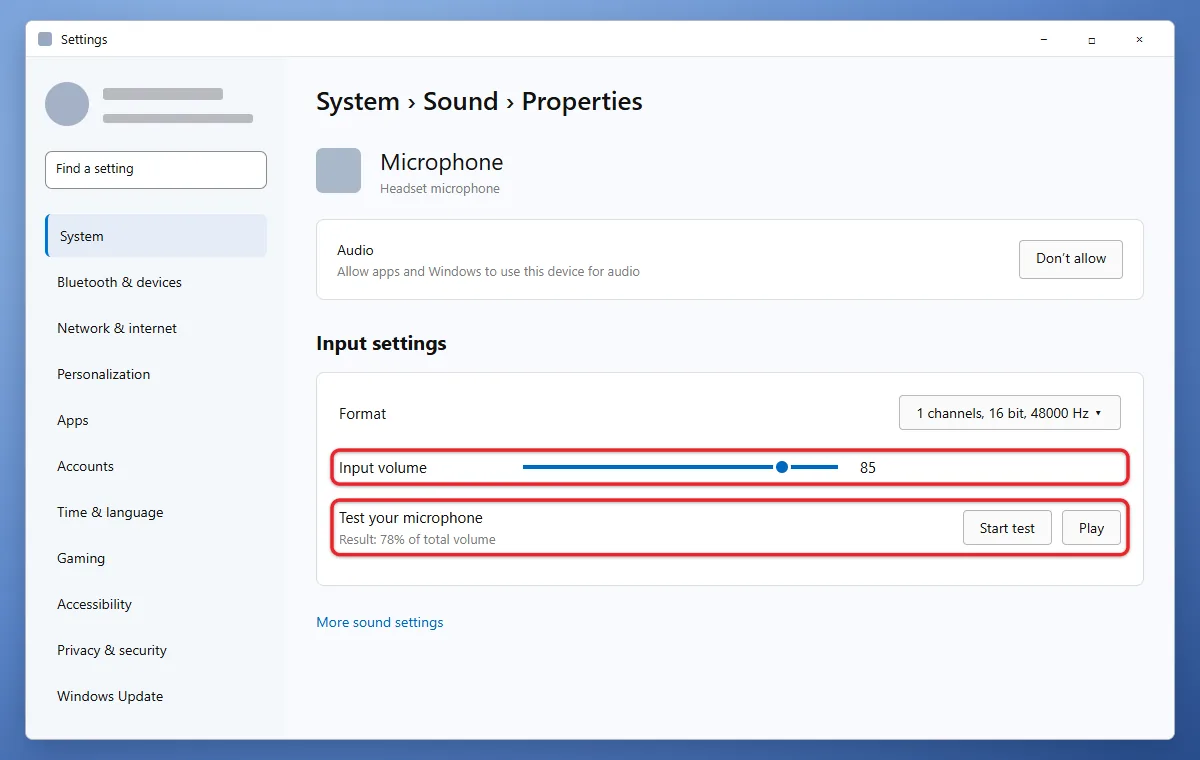
- Adjust and test again until your voice is clear without crackling or distortion.
The change applies right away. Most apps that use the default microphone pick it up without a restart.
You can also get to the same slider from the taskbar. Right-click the speaker icon next to the clock and click Sound settings, then follow steps 3 through 7.
Turn Up Microphone Boost for a Very Quiet Mic
Microphone Boost adds extra gain on top of the input volume. Not every microphone has it, because it depends on the audio driver. It’s common on built-in laptop mics and 3.5 mm headset jacks, and rare on USB microphones.
- Open Settings > System > Sound.
- Scroll down to Advanced and click More sound settings. The classic Sound window opens.
- Click the Recording tab, select your microphone (it has a green check mark if it’s the default), and click Properties.
- Click the Levels tab. Set the Microphone slider to 100 if it isn’t there already.
- If you see Microphone Boost, move its slider up one step, such as +10.0 dB.
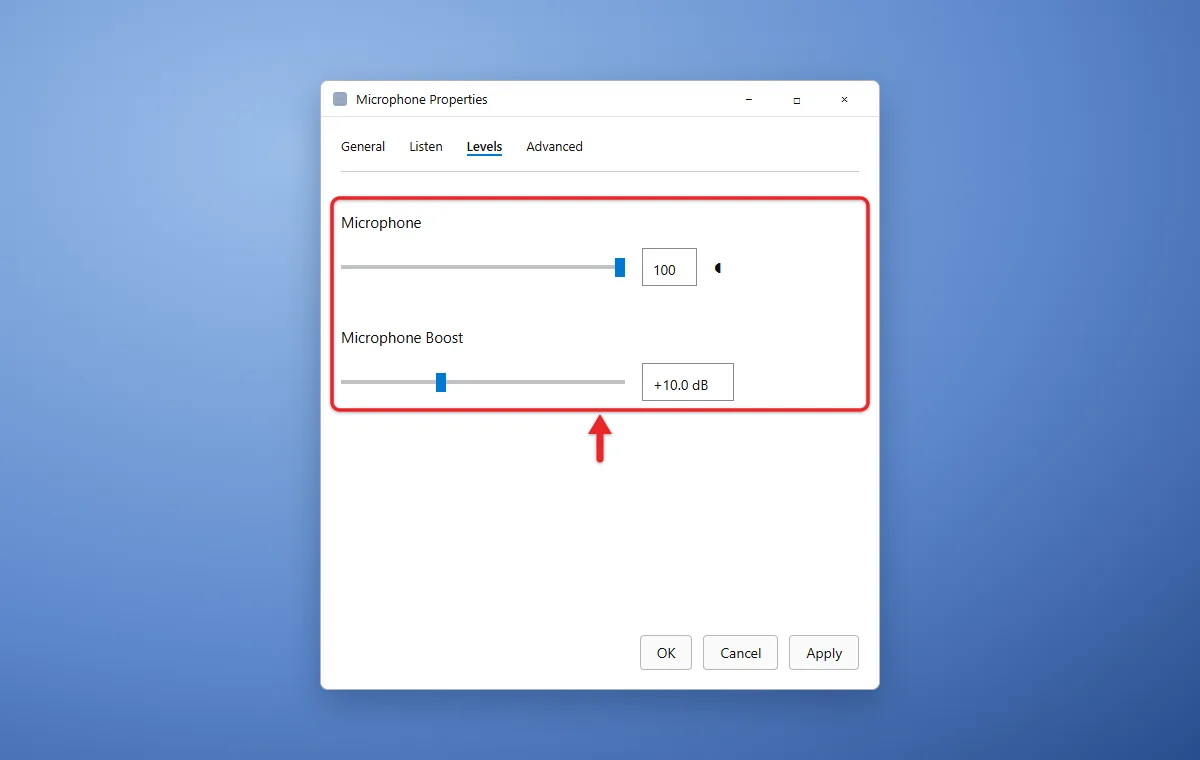
- Click Apply, then OK, and run the Start test check in Settings again.
Boost amplifies everything the mic hears, including fan noise, hiss, and keyboard clicks. Use the lowest step that makes your voice clear. If there’s no Microphone Boost slider, your driver doesn’t offer it; check the microphone or headset maker’s app, which may have its own gain control. Our guide to opening the Sound control panel in Windows 11 has other quick ways into this window.
Check the Volume in Your Calling App
Teams, Zoom, Discord, and other apps have their own microphone settings, and some adjust your level automatically.
- Pick the same microphone. If the app is set to a different input than Windows, your Windows changes won’t make a difference. Look for an Audio or Voice section in the app’s settings.
- Look for automatic adjustment. Options such as Zoom’s Automatically adjust microphone volume can lower the level you just set. Turn it off if your volume keeps drifting back down.
- Check voice activation. In Discord, the input sensitivity setting decides when your mic transmits. If quiet words get cut off, lower the threshold or turn on automatic sensitivity, as Discord explains in its voice input modes guide.
Get a Louder, Cleaner Signal Without More Boost
Software volume can only do so much. These changes often help more than pushing the sliders to the top:
- Move the mic closer. Halving the distance between your mouth and the mic makes a big difference. For a headset, bend the boom so it sits an inch or two from the corner of your mouth.
- Speak into the right side. Many USB mics pick up from the side, not the top. Check the maker’s diagram.
- Use a better input. Built-in laptop mics are often quiet and noisy. A USB headset or USB microphone usually sounds better at a lower volume setting.
- Check for a hardware gain knob. Many USB mics have a gain dial on the body that works on top of the Windows slider.
To hear yourself while you adjust, see our guide on how to hear yourself on a mic in Windows 11. Turn that monitoring off when you’re done, or you’ll hear an echo of your own voice.
If Raising the Volume Doesn’t Help
- The test shows no level at all. Check the mic’s mute switch or button, then reconnect it. In Settings > System > Sound, confirm it’s selected under Input.
- Apps can’t hear you, but the Windows test works. Open Settings > Privacy & security > Microphone and make sure Microphone access, Let apps access your microphone, and Let desktop apps access your microphone are on. Microsoft covers these in its microphone troubleshooting guide.
- The slider keeps resetting. In the classic Sound window, open your mic’s Properties > Advanced tab and clear Allow applications to take exclusive control of this device, then click Apply. Also turn off automatic volume adjustment in your calling app.
- Your voice sounds distorted. The level is too high. Lower Microphone Boost first, then Input volume.
- The microphone doesn’t appear in the list. Open Settings > System > Sound, scroll to Advanced, click Troubleshoot common sound problems, and choose Input devices. If that doesn’t find it, reinstall or update the audio driver under Sound, video and game controllers in Device Manager.
Frequently Asked Questions
What’s a good microphone input volume in Windows 11?
There’s no single right number, since every mic is different. Many people end up between 70 and 100. Set it so the Start test result is consistently high when you talk normally but your recording doesn’t crackle.
Is Microphone Boost the same as Input volume?
No. Input volume scales the signal up to its normal maximum. Microphone Boost adds extra amplification in the driver for mics that are too quiet even at 100.
Can I increase mic volume above 100 in Windows 11?
Not with the Input volume slider. Microphone Boost, a hardware gain knob on the mic, or the mic maker’s software are the ways to go past it.
How do I lower my mic volume if people say I’m too loud?
Use the same Input volume slider and move it to the left. If Microphone Boost is turned up, lower that first, since it’s the more common cause of distortion.

Matthew Burleigh is the founder, head writer, and editor of Solve Your Tech, which he launched in 2012. He has written technology tutorials since 2008 and worked in IT since 2003, including small-business support, IT management, and consulting. He holds Bachelor’s and Master’s degrees in Computer Science from Arizona State University.
Matthew writes practical guides for Windows, iPhone and iPad, Microsoft Office, Outlook, Google apps, and Android. Solve Your Tech’s guides are checked step by step against the device or app maker’s own documentation and tested on his own devices whenever he has the hardware or software, with clear steps, sources, and update dates.
Read more about Matthew and how Solve Your Tech writes and updates its guides, or report a correction.