To raise the maximum volume on an iPhone, open Settings > Sounds & Haptics > Volume Limit and turn off Limit Maximum Volume, or drag its slider to the right. That setting caps the built-in speaker. If the sound is quiet in headphones instead, open Settings > Sounds & Haptics > Headphone Safety and turn off Reduce Loud Audio or raise its slider.
If neither limit is on, the iPhone is already allowed to play at full volume, and the cause is usually something else: the buttons are changing a different kind of volume, the sound is going to another device, or the speaker opening is blocked. This guide covers each of those in order. The menu names come from Apple’s iPhone User Guide for iOS 26 and iOS 27; older versions of iOS do not have every setting described here.
Before you start: the limits below exist to protect hearing, and Apple’s guide carries a hearing-loss warning on its volume page. Raise the volume in small steps and stop at a level that is comfortable.
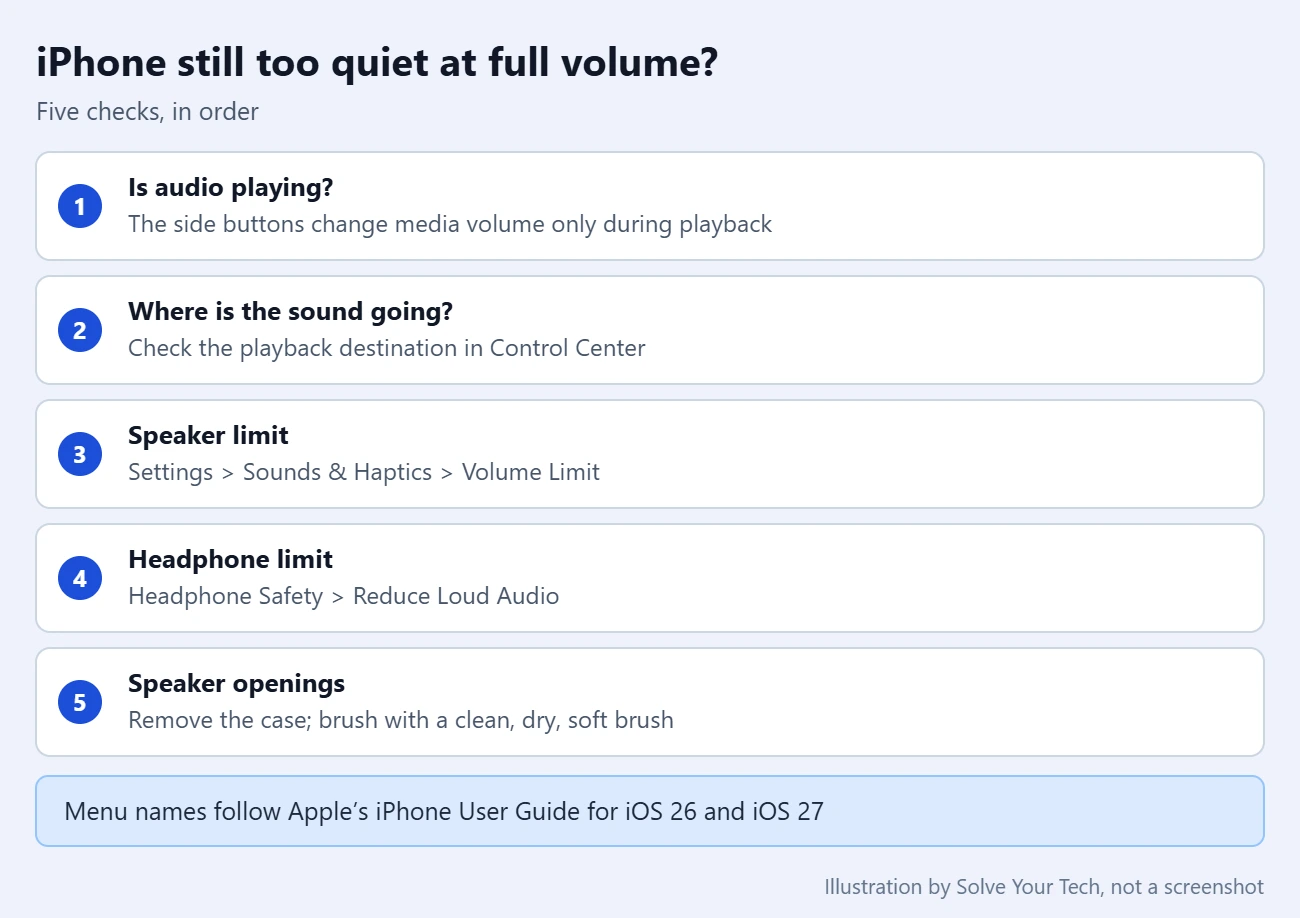
Turn the Right Volume All the Way Up First
An iPhone has more than one volume level. According to Apple, the side buttons control media volume while audio is playing, and ringer and alert volume at other times. Pressing volume up on a silent Home Screen may therefore do nothing for a video you play a minute later.
- Start the song, video, or podcast you want to hear.
- While it is playing, press the volume up button on the side of the iPhone until the on-screen volume indicator is full.
- Or open Control Center and drag the volume slider (the tall control with the speaker icon) to the top. On an iPhone with Face ID, swipe down from the top-right corner to open Control Center. On an iPhone with a Home button, swipe up from the bottom edge.
- You can also ask Siri to turn up the volume.
Control Center works from the Lock Screen and inside apps, so you do not have to leave what you are watching. If the level is already at the top and the sound is still weak, move on to the limits.
Remove the Built-In Speaker Volume Limit
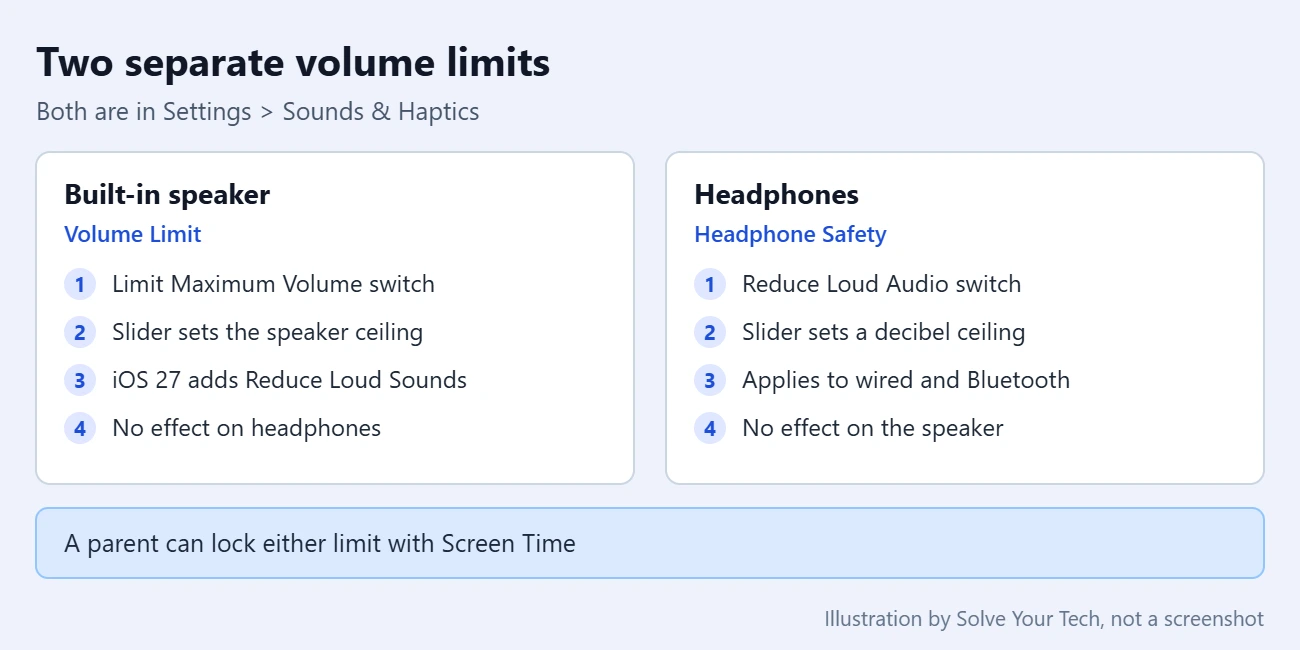
Recent versions of iOS include a limit for the iPhone’s own speaker. When it is on, full volume on the slider is only as loud as the limit allows.
- Open the Settings app.
- Tap Sounds & Haptics.
- Tap Volume Limit. On iOS 27 it sits under a Built-In Speaker heading.
- If Limit Maximum Volume is on, either turn it off or drag the slider to the right to allow a higher level.
- On iOS 27, also look under Built-In Speaker for Reduce Loud Sounds. Apple describes it as softening loud sounds from the speaker. Turn it off if you want the speaker to play without that softening.
To confirm the change, play the same song or video again and press volume up. To undo it, return to the same screen and turn Limit Maximum Volume back on.
If you do not see Volume Limit at all, your version of iOS does not include a speaker limit, so there is nothing to remove. Apple’s Adjust the volume on iPhone page has a version menu at the top where you can check what your iOS release offers.
Raise the Headphone Volume Limit
Headphones have a separate limit that applies whether they are wired or connected by Bluetooth. It has no effect on the speaker, and the speaker limit has no effect on headphones.
- Open Settings and tap Sounds & Haptics.
- Scroll down and tap Headphone Safety.
- If Reduce Loud Audio is on, drag its slider to a higher decibel level, or turn the switch off.
A decibel is the unit used to measure loudness. With Reduce Loud Audio on, Apple says the iPhone analyzes headphone audio and reduces any sound above the level you set. Raising the slider is the more careful choice, because you keep a ceiling in place.
There is a second headphone behavior to know about. If you listen to loud headphone audio long enough to affect your hearing, the iPhone sends a notification, and the next time you connect headphones the volume is automatically set lower. You can turn it up again. Apple notes that Headphone Notifications may be on by default depending on your country or region, and in some places it cannot be turned off. Our guide to changing the headphone volume limit on iPhone walks through that screen in more detail, and Apple explains the notifications in Check your headphone audio levels on iPhone.
If the Limit Is Locked or Grayed Out
Screen Time, Apple’s parental controls and usage feature, can lock both limits. Apple’s guide says a person who set up Screen Time for a family member can go to Settings > Screen Time > Content & Privacy Restrictions, tap Speaker Volume Limit, and choose Don’t Allow. A matching entry locks the headphone limit; Apple’s pages name it Reduce Loud Audio or Reduce Loud Sounds depending on the version.
- It is your own iPhone: open that Screen Time screen, enter your Screen Time passcode if asked, and set the entry to Allow. Then go back to Sounds & Haptics and change the limit.
- A parent or guardian manages the iPhone: the lock is intentional. Ask the person who set it up to change it. This guide does not cover getting around a Screen Time passcode.
Make Ringtones, Alerts, and Calls Louder
These use their own controls, so a full media slider does not make them louder.
| Sound | Where to raise it |
|---|---|
| Music, video, games | Volume buttons during playback, or the Control Center slider |
| Ringtone | Settings > Sounds & Haptics, then drag the ringer volume slider |
| Alerts, alarms, and timers | Same screen. On iOS 27 they match the ringtone unless Match Ringtone Volume is turned off |
| Phone call | Volume up button while the call is connected |
On the Sounds & Haptics screen, Change with Buttons decides whether the side buttons can change ringer volume. When it is off, the buttons only control media playback, and the ringer stays wherever the slider is set. The slider is labeled Ringtone and Alerts on iOS 26. On iOS 27, Apple’s page on changing iPhone sounds and vibrations describes separate sliders for alarms and timers and for alerts and system sounds once Match Ringtone Volume is off.
If the ringer is at the top and you still hear nothing, check Silent mode and Do Not Disturb. Our guide on how to silence or unsilence calls on iPhone covers both.
For a quiet call, press volume up during the call. If that is not enough, Apple’s While on a call page says to swipe down on the call banner, tap Audio, and choose a destination such as Speaker. To skip that step on every call, you can have your iPhone answer calls on speaker automatically.
Check Where the Sound Is Playing
An iPhone that seems silent or weak may be sending audio somewhere else, such as AirPods in a case that is slightly open, a car stereo, or a Bluetooth speaker in another room.
- Start playing audio.
- Open Control Center and tap the playback destination button in the audio controls.
- Choose iPhone to bring the sound back to the phone, or pick the speaker or headphones you want.
Apple notes that the playback destination returns to the iPhone when a Bluetooth accessory moves out of range. Many Bluetooth speakers and headphones also have their own volume buttons, so raise the level on the accessory as well as on the phone. If an accessory will not appear in the list, see our guide on connecting Bluetooth headphones to an iPhone.
Music App Settings That Change Loudness
Two settings in Settings > Apps > Music affect how loud songs sound in the Apple Music app. They do not change other apps or the system maximum.
- Sound Check: Apple describes this as normalizing the volume level of your audio, which means evening out loud and quiet tracks. If your music sounds flatter or softer than you expect, try turning it off.
- EQ: short for equalizer, this picks a preset that changes the balance of bass, mid, and treble. Some presets can make music seem louder, but Apple does not describe any of them as a volume boost, so treat this as a matter of taste and set it back to Off if you do not like the result.
Both are listed in Apple’s Adjust the sound quality in Music on iPhone. On older versions of iOS, the Music settings are on the main Settings list instead of under Apps.
When the Speaker Itself Sounds Weak or Muffled
If every setting is at its highest and the speaker is still quiet or fuzzy, look at the hardware. These steps follow Apple’s article If you hear no sound or distorted sound from your iPhone speaker.
- Remove any case, film, or screen protector that could cover the speaker at the bottom edge or the receiver at the top of the screen. The receiver is the small opening you hold to your ear on a call.
- Look at both openings for lint or dirt.
- If needed, clean the opening with a small, soft-bristled brush that is clean and dry. Do not push pins, toothpicks, or other sharp objects into the opening, and do not use liquids.
- Open Settings > Sounds & Haptics and drag the ringer slider back and forth a few times. You should hear the ringtone get louder and quieter.
Apple says that if you hear no sound during that test, or the speaker button on the slider is dimmed, the speaker might need service. Try a second song or video before you decide, because a recording that was made quietly stays quiet at any volume setting.
If the volume was fine and dropped without warning, our sudden-low-volume troubleshooting guide goes through the likely causes one at a time.
Frequently Asked Questions
Can an iPhone go louder than its maximum volume?
No setting in iOS pushes the built-in speaker past its full level. Turning off Limit Maximum Volume and Reduce Loud Sounds only removes a cap that was holding it below that level. For more volume than the phone can produce, play the audio through a Bluetooth or AirPlay speaker.
Why does my iPhone volume go down by itself?
With headphones, the usual cause is a headphone notification. After the iPhone warns you about loud listening, it sets the volume lower the next time headphones connect. Without headphones, check whether audio switched to a Bluetooth device, and on an iPhone with Face ID check Settings > Accessibility > Face ID & Attention. Apple says Attention Aware Features can lower the volume of some alerts when you are looking at the phone.
Why don’t the volume buttons change my ringer?
Change with Buttons is probably off in Settings > Sounds & Haptics. Turn it on, or drag the ringer slider on that screen instead. Also remember that while audio is playing, the buttons change media volume, not the ringer.
Is it safe to turn off Reduce Loud Audio?
It removes a hearing safeguard, so it is a choice to make with care. Apple’s guide warns about hearing loss from loud audio. Raising the slider a little is a middle option that gives you more volume while keeping a ceiling. You can turn the switch back on at any time in Headphone Safety.
Where is the volume limit that used to be in Music settings?
Older versions of iOS had a volume limit inside the Music settings. On current versions, Apple’s guide lists the limits under Settings > Sounds & Haptics: Headphone Safety for headphones and Volume Limit for the speaker.
Next Step
Start with Settings > Sounds & Haptics and check Volume Limit and Headphone Safety, since those two screens control the actual maximum. If both are already open and the phone is still quiet, check the playback destination and the speaker openings before assuming the speaker needs repair.

Matthew Burleigh is the founder, head writer, and editor of Solve Your Tech, which he launched in 2012. He has written technology tutorials since 2008 and worked in IT since 2003, including small-business support, IT management, and consulting. He holds Bachelor’s and Master’s degrees in Computer Science from Arizona State University.
Matthew writes practical guides for Windows, iPhone and iPad, Microsoft Office, Outlook, Google apps, and Android. Solve Your Tech’s guides are tested on current devices or checked against official product documentation, with clear steps, sources, and update dates.
Read more about Matthew and how Solve Your Tech writes and updates its guides, or report a correction.