To download an MP3 to your iPhone, save the file from its website and find it in the Files app. If you want the song in the Music app’s library, import it into Apple Music on a computer first, then use Apple Devices on Windows or Finder on a Mac to sync it. A Safari download does not automatically become a Music-library song. If the file seems to vanish after saving, see where to find files on your iPhone.
Choose the destination before you start. Files is useful for keeping an individual audio file; Music is the route for a song collection organized by artist, album or playlist. The current computer methods below use separate music-library and device-sync apps. Older iTunes setups have their own route.
Before You Transfer Anything
Keep a separate backup of your original MP3 files and music library. Use an actual audio file that you are allowed to download, such as your own recording or a purchased download. A streaming page or playlist link is not necessarily an MP3 file. Check available iPhone storage before copying a large collection, and try one song first.
Read any replacement warning before continuing. Finder can sync with only one music library at a time. Choosing Erase and Sync replaces the selected content type on the phone with this computer’s content. iTunes has a similar Remove and Sync warning. Cancel if you are not ready to replace those songs; retrieve the original computer library first.
If you already use Sync Library with Apple Music or iTunes Match, read the subscriber section below before choosing manual syncing. Apple’s Windows manual music-sync method requires Sync Library to be off. Turning it off removes downloaded music, so do not toggle it merely to make a missing sync control appear.
Download an MP3 Directly to Files
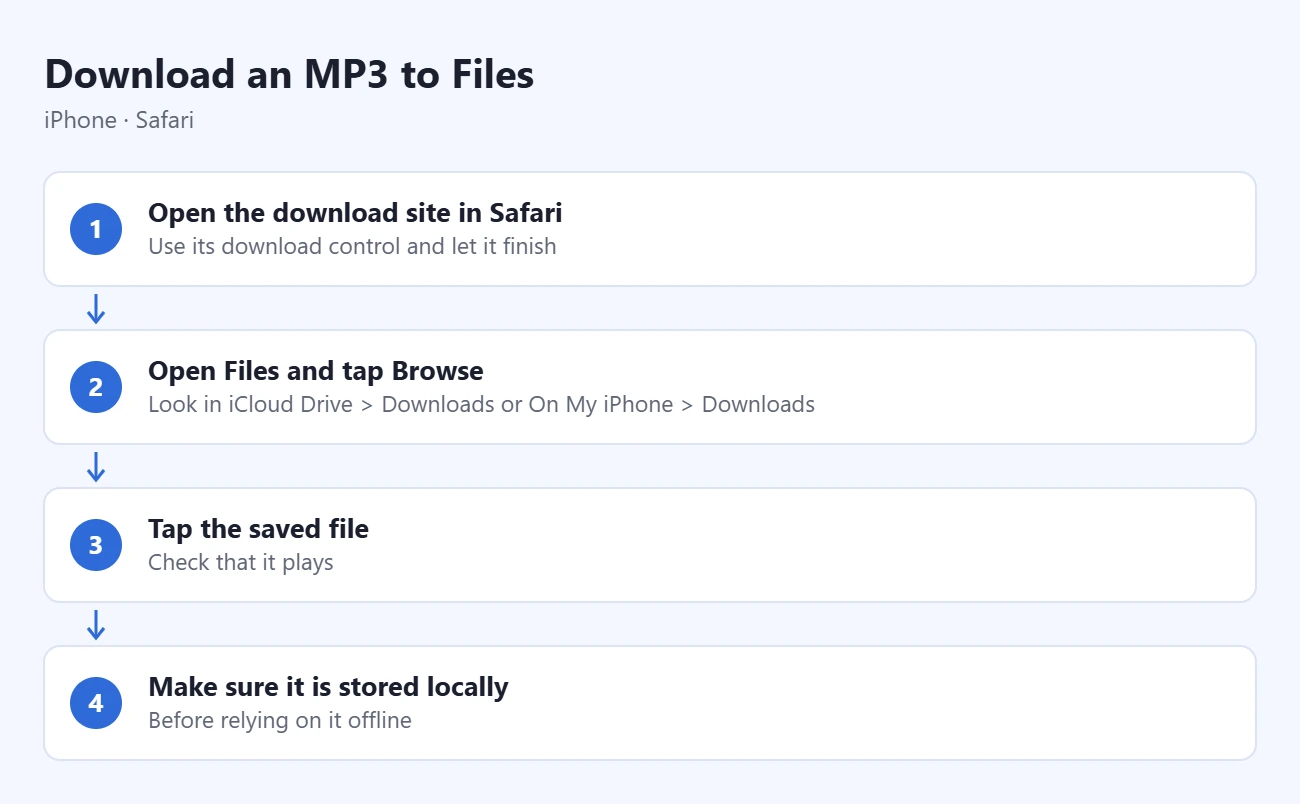
- Open the download website in Safari. Use its actual download control for the MP3, follow any download prompt, and let the transfer finish. Website controls vary; a Play button may only stream the audio.
- Open Files and tap Browse. Look in iCloud Drive > Downloads, or On My iPhone > Downloads if you chose local downloads. Tap Browse again if locations are not visible. If iCloud Drive itself is missing, see how to turn on and open iCloud Drive on an iPhone.
- Find the saved filename and tap it. Check that the completed audio file opens and offers playback. If your installed player is needed, use that app’s documented file-import or sharing route.
- Test the saved file. Make sure it is available locally before relying on it without a connection. A file shown in cloud storage may still need to finish downloading to this phone.
Apple’s download-location instructions also explain how to open Safari’s Downloads list using the Download button after a download. To check the configured folder, go to Settings > Apps > Safari > Downloads. Apple’s Safari settings guide lists iCloud Drive, On My iPhone and Other as destinations. On older iOS versions, Safari may be directly in Settings rather than under Apps.
Saving in iCloud Drive makes the file accessible through that storage account; it is not the same operation as adding a song to Music. If the file exists in Files but is missing from Music, continue with a computer-library method rather than repeatedly downloading it.
Put the MP3 in Music Using a Windows PC
Use Apple Music to manage the songs and Apple Devices to transfer them. Apple requires Apple Music to be installed for this music-sync method. Manual transfer of your own files does not require an Apple Music subscription; the paid Sync Library service is a separate option.
- Import the MP3 into Apple Music on the PC. At the top of its sidebar, select Sidebar Actions > Import, choose the file or folder, and select Open. Find the song and make sure it plays.
- Connect the iPhone with a data-capable USB or USB-C cable. Follow any Trust prompt on the phone, then open Apple Devices and select the iPhone in its sidebar.
- Select Music. Enable Sync music onto [device name]. Choose the entire library or Selected artists, albums, genres and playlists; for a small test, select the playlist or album containing your MP3.
- Review the selection and select Apply. Wait for the transfer to complete. Use the sidebar’s eject control before disconnecting.
These paths follow Apple’s Windows music-import guide and Apple Devices music-sync guide. Keep the original file in a stable location or check your library’s copying settings before moving it: an imported entry can depend on the file remaining where the app expects it.
Put the MP3 in Music Using a Mac
On macOS Catalina or later, Music manages the library and Finder manages device syncing. Importing the file into Music on the Mac is the first stage; it does not by itself copy the file onto the iPhone.
- Open Music and add the MP3. Choose File > Import or File > Add To Library, depending on your copying setting. Select the file or folder and click Open. Check that the song plays.
- Connect the iPhone by USB and open Finder. Select the phone in Finder’s sidebar. Complete any connection or trust prompts before proceeding.
- Select Music and enable music syncing. Review the library or selected-content options that appear and choose the music you want. Stop if a library-replacement warning appears unexpectedly.
- Click Apply. If syncing does not start, click Sync. Wait for completion before disconnecting.
Apple documents the changing import label in its Mac music-import instructions and the transfer in its Finder syncing guide. Preserve your source files and verify the transfer before reorganizing or removing them.
If You Already Use Apple Music or iTunes Match
An existing subscriber can use Sync Library after importing the MP3 into the computer’s music library. This is a cloud music-library feature, separate from iCloud Drive. Apple Music or iTunes Match is required, and the computer and iPhone must use the same Apple Account.
- Back up the library, then check the computer’s Sync Library setting. In Apple Music for Windows, use Sidebar Actions > Settings > General. On a Mac, use Music > Settings > General.
- Enable Sync Library on the iPhone. Open Settings > Apps > Music and turn it on; older iOS versions may list Music directly in Settings. Check the Music account matches the subscription.
- Wait for the library update over an internet connection. Find the song in Music on the iPhone. If you need offline playback, download that library song rather than assuming a cloud listing is already stored on the phone.
See Apple’s cross-device library guide and Sync Library requirements. Eligible imported songs can be matched or uploaded, but Apple Music is not a backup service. If songs are absent, check the originating computer’s cloud status before changing the phone’s account or deleting anything.
Using an Older iTunes Setup
If your supported setup still uses iTunes, import the MP3 into its library first. Apple’s iTunes sync instructions then use a USB connection, the device icon, Music in the Settings list, the sync checkbox and your selected items, followed by Sync and Done. Keep this route separate from Apple Devices and Finder so you do not look for controls in the wrong app.
If the Song Is Still Missing
The file downloaded, but Music cannot find it
Check which destination you used. A Safari MP3 belongs in Files until you import and transfer it through a library method. If you bought the song in the iTunes Store, it is an account purchase instead; our missing purchased-music guide explains redownloading those songs.
The computer lists the song, but it will not play
Try the original file at its saved location. An entry with an exclamation point can mean Music cannot locate that file. Apple’s missing-song troubleshooting guide explains locating the original and checking cloud status. For a Waiting cloud status, keep the originating computer online and update its Cloud Library; wait before checking the phone again.
Syncing reports an unsupported file or insufficient space
Check the actual file and the sync error instead of simply renaming an extension. Apple’s Windows sync troubleshooting documents Apple Devices > [iPhone] > General > Options > Convert higher bit rate songs to. This creates a smaller device copy while retaining the computer original. For space problems, start with fewer selected albums or a small playlist rather than transferring the entire collection.
How to Remove a Manually Synced Song
On Windows, reconnect the phone in Apple Devices, open Music, deselect the item you want removed and select Apply. Keep the computer copy if you may need it again. Deleting an automatically synced item from the computer also removes it from the phone at the next sync. Review selections carefully before applying a change.
Confirm That the Transfer Worked
For the Music-library routes, open Music > Library on the iPhone and find the test song. Artist and album information inside the file can affect where it appears, so search by title if needed. Play it and confirm offline availability before copying the rest of the collection. For the Files route, check the saved filename in the chosen folder and test that local file instead.

Matthew Burleigh is the founder, head writer, and editor of Solve Your Tech, which he launched in 2012. He has written technology tutorials since 2008 and worked in IT since 2003, including small-business support, IT management, and consulting. He holds Bachelor’s and Master’s degrees in Computer Science from Arizona State University.
Matthew writes practical guides for Windows, iPhone and iPad, Microsoft Office, Outlook, Google apps, and Android. Solve Your Tech’s guides are tested on current devices or checked against official product documentation, with clear steps, sources, and update dates.
Read more about Matthew and how Solve Your Tech writes and updates its guides, or report a correction.