No, you can’t create a truly anonymous Facebook account. Facebook requires one account per person, under the name you go by in everyday life, and its rules say accounts that use a false name or date of birth can be restricted or disabled. Facebook has also stopped letting people create additional profiles. What you can do is keep your real account and make it much harder to find: restrict who sees your posts and profile details, limit how people look you up, and post anonymously in Facebook groups that allow it.
This guide explains what the rules say, then walks through the privacy options Facebook documents. The steps are for the Facebook website on a computer and follow Facebook’s Help Center as checked in October 2026. The Facebook app has the same settings, but menus and labels can be arranged differently on a phone.
In this guide
- What Facebook’s rules say about anonymous accounts
- Additional profiles are no longer available
- What stays public no matter what
- How to make your Facebook profile harder to find
- How to post anonymously in a Facebook group
- Other legitimate options
- Troubleshooting
- Frequently asked questions
What Facebook’s rules say about anonymous accounts
Facebook’s Names allowed on Facebook help page describes Facebook as a community where everyone uses the name they use in everyday life. The main points are:
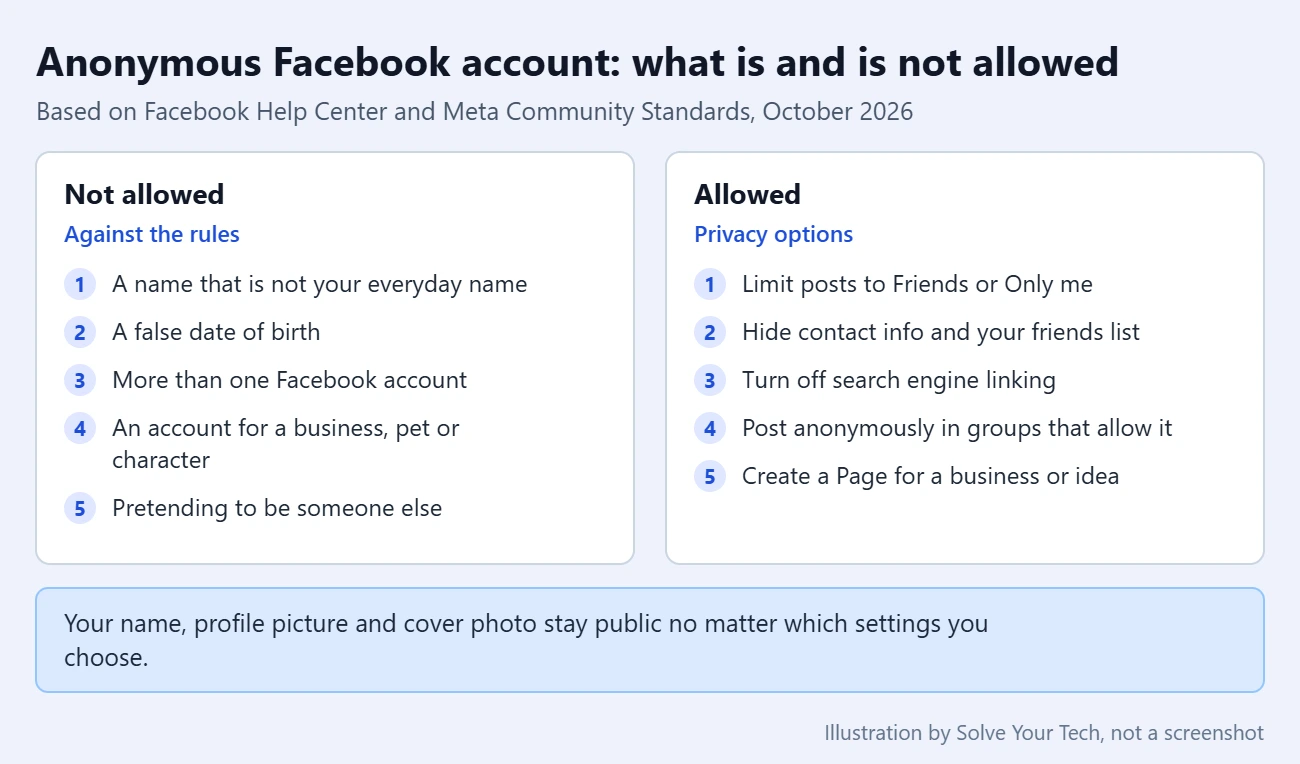
- Your profile name should be the name your friends call you in everyday life, and it should also appear on an ID or document from Facebook’s ID list.
- Nicknames can be used as a first or middle name if they’re a variation of your real name, such as Bob instead of Robert.
- Symbols, numbers, unusual capitalization, titles, and words or phrases in place of a name aren’t allowed.
- Profiles are for individual use only. A business, organization or idea belongs on a Page.
- Pretending to be anything or anyone isn’t allowed.
Meta’s Community Standards go further. The Authentic Identity Representation policy says Facebook requires people to create one account using the name they go by in everyday life. It lists several things that can lead Facebook to ask for more information and then take action, from a temporary restriction up to permanently disabling the profile or account:
- Providing a false date of birth.
- Using a name that is not the name you go by in everyday life.
- Creating or maintaining multiple Facebook accounts.
- Sharing a single account between more than one person.
- Creating an account that represents a business, pet, fictional character or other non-human entity.
The same policy says Meta may require you to verify your identity to keep using certain features, and that it may restrict or permanently disable an account if verification isn’t completed. So an account set up with made-up details can be lost at any time, along with everything in it. That is why this guide doesn’t cover creating one, and why the privacy settings below are the more reliable route.
Additional profiles are no longer available
For a while, Facebook let you add extra profiles to one account, each with its own friends list and Feed, to represent different interests or communities. Many older guides recommend this as a way to keep part of your Facebook life separate.
That option is closed to new users. Facebook’s About additional Facebook profiles page currently states: “You are no longer able to create additional Facebook profiles.” It adds that existing additional profiles have not been affected, so if you already have one you can still switch into it from your main profile.
Additional profiles were never fully anonymous anyway. They sit under the same Facebook account and login as your main profile, and Facebook says it uses information from all of your profiles to personalize your experience. For the current alternatives, see our guide to whether you can make a second Facebook account.
What stays public no matter what
Before changing settings, it helps to know their limits. Facebook’s Public information on Facebook page says some details can always be seen by anyone, including people who aren’t your friends and people off Facebook:
- Your name, profile picture and cover photo.
- Your gender, username and user ID (the account number that appears in your profile’s web address).
- Your age range, language and country.
- Anything you post or comment on a Page or in a public group.
- Comments you leave on someone else’s public post.
Privacy settings control almost everything else. They can’t hide your name, which is the main reason Facebook can’t be used anonymously.
How to make your Facebook profile harder to find
You need to be signed in to your own Facebook account in a web browser on a computer. Work through these in order. None of them removes posts or friends, and each one can be changed back from the same screen unless noted.
1. Run Privacy Checkup
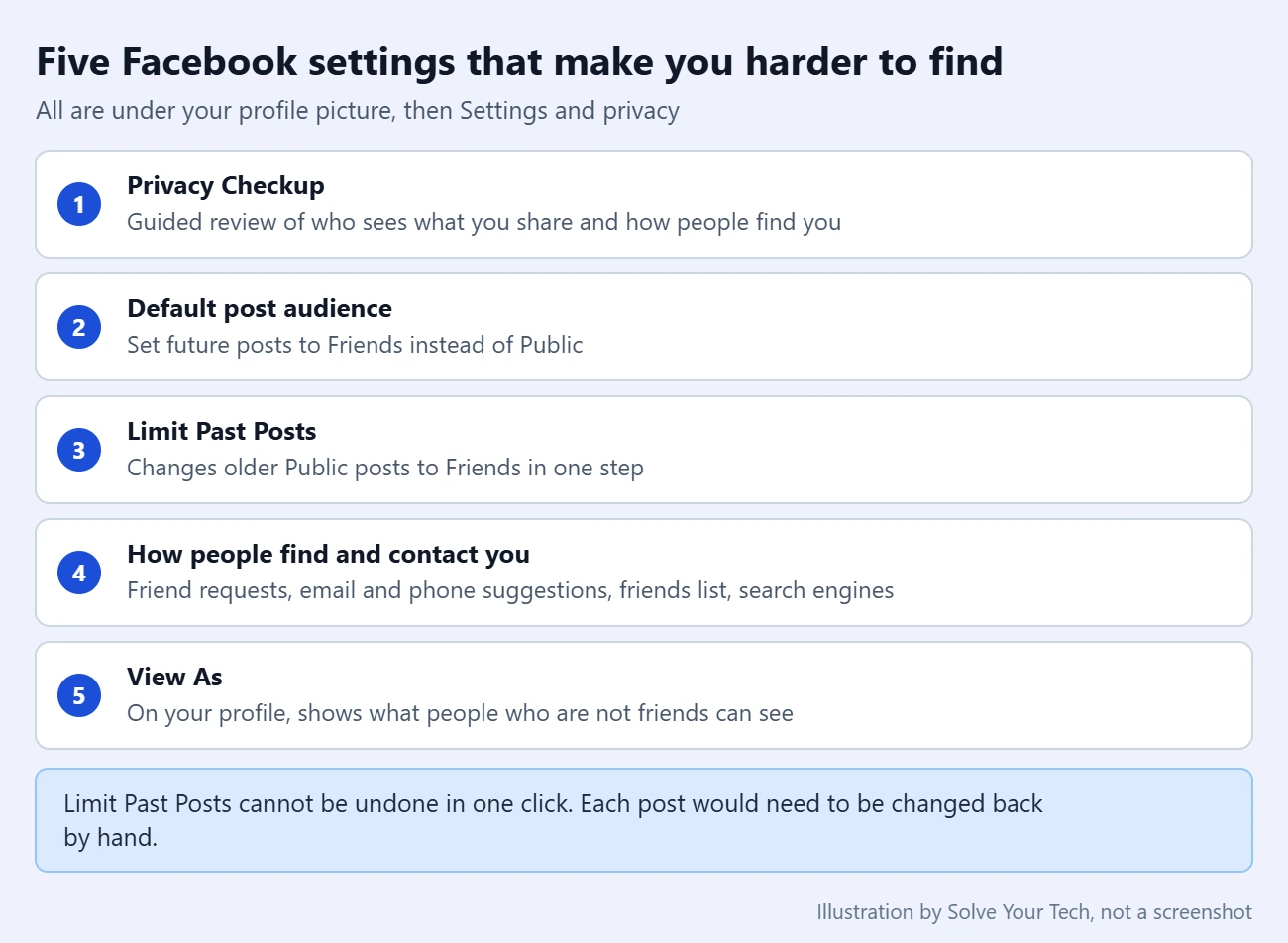
Privacy Checkup is a guided tool that walks you through your main privacy and security settings.
- Click your profile picture in the top right of Facebook.
- Click Settings & privacy, then click Privacy Checkup.
- Open Who can see what you share. Choose who can see profile details such as your phone number, email, birthday and relationship status, and who can see your future and past posts.
- Open How people can find you on Facebook. Choose who can send you friend requests and who can look you up by your phone number or email address.
Facebook’s Privacy Checkup page lists everything the tool covers, including ad preferences and apps you have logged in to with Facebook.
2. Set who sees your posts
The audience selector is the small menu below your name when you write a post. It shows the current audience, such as Friends.
- At the top of your Feed or profile, click the text box next to your profile picture.
- Below your name, click the audience selector.
- Choose Friends or Only me instead of Public.
Facebook notes that picking a new audience this way changes only that one post. The next post goes back to the default audience in your privacy settings, so set the default too. Click your profile picture, select Settings & privacy, click Settings, and look under Audience and visibility for Posts. See Facebook’s Choose who can see your post page for details.
3. Limit your older posts
Warning: Facebook says Limit Past Posts cannot be reversed in one click. To make a post Public again afterward, you would have to change each post individually.
- Click your profile picture, select Settings & privacy, then click Settings.
- On the left, click Posts.
- Next to Limit who can see past posts, click Limit Past Posts.
- Click Limit Past Posts again to confirm.
This changes all your past posts that were visible to more people than your friends so that only Friends can see them. According to Facebook’s previous posts page, it doesn’t change posts shared with a custom audience, and people tagged in a post (and the audience they include for tagged posts) can still see it.
4. Control how people find and contact you
- Click your profile picture, select Settings & privacy, then click Settings.
- Under Audience and visibility, click How people find and contact you.
- Click View next to People with your email address and People with your phone number, and choose No one if you don’t want those details used to suggest your profile. The default is Possible Connections.
- Click Who can see your friends list? and choose Friends or Only me. Facebook says the Friends section of your profile is public by default.
- Turn off the toggle next to Do you want search engines outside of Facebook to link to your profile?
Each of these has limits that Facebook spells out. People You May Know can still suggest you based on information other than your email or phone number. Friends who leave their own friends list public will still show you on it. And the search engine setting only stops search engines from linking directly to your profile. Public information can still be crawled and appear in results, and to remove something from a search engine you have to contact that search engine yourself.
For a fuller walkthrough of these screens, see our guides on making your Facebook account more private and hiding your Facebook friends list.
5. Lock your profile, if the option is offered
A locked profile shows people who aren’t your friends only a limited view. Facebook’s Lock your Facebook profile page says that when a profile is locked, only friends see its photos, posts, stories and the full-resolution profile picture and cover photo, and past Public posts change to Friends. The same page says the feature isn’t available everywhere and can only be used in certain countries. If you have it, our Facebook profile lock guide covers the steps. If you don’t, the four steps above do most of the same job.
6. Check the result with View As
- Click your profile picture, then click your name to open your profile.
- Click Options below your name and select View As.
- Look through the profile. This is what people who aren’t your friends see.
- Click Exit View As in the banner when you’re done.
If something personal still shows, go back to that item on your profile and change its audience. Facebook’s View As page notes that a post hidden from your profile can still be seen by its audience in Feed and search.
How to post anonymously in a Facebook group
This is the one place where Facebook offers real anonymity toward other users. In groups where it’s enabled, you can post, comment and react without other members seeing your name. The post shows as coming from an Anonymous member (private groups) or Anonymous participant (public groups), with an anonymous icon in place of your picture.
Before you post: Facebook states that your name and profile photo are still visible to the group’s admins and moderators and to Facebook’s systems. It also warns that details you include in the post itself could reveal who you are.
- Go to facebook.com/groups and select your group.
- Click Write something…
- Click the toggle next to Post anonymously, then click Got it.
- Write your post, then click Submit.
If the group requires admin approval for posts or for anonymous posts, yours is reviewed first. Otherwise it’s published immediately. Comments you add to your own anonymous post are anonymous too. To go back to posting under your name, click the Post anonymously toggle again to turn it off.
Facebook’s Participate anonymously in a Facebook group page lists the limits: you can’t choose the icon or its color, two anonymous posts with the same color aren’t necessarily from the same person, some post formats are disabled, and you can’t use Live Video, share content or send messages anonymously.
Some groups also offer nicknames. With a group nickname, you post, comment and react under a name such as Stargazer22 with a picture chosen from Facebook’s options, and other members don’t see your main profile name or photo. As with anonymous posts, admins, moderators and Facebook’s systems can still see who you are, and Facebook says nicknames shouldn’t impersonate anyone or misrepresent your identity.
Other legitimate options
- Create a Page for a business or project. Facebook says Pages are for businesses, brands, organizations and public figures, and that anyone with a Facebook account can create one. See Facebook’s Create a Facebook Page instructions.
- Add another name instead of replacing yours. You can list a maiden name, nickname or professional name on your profile under About, then Names, then Add other names. This adds to your everyday name; it doesn’t hide it. Facebook’s other names page has the steps, and our guide to changing your Facebook profile name explains the name rules in more detail.
- Block specific people. Facebook’s own name help page says that if you don’t want someone to see your name or profile, you can block them.
- Keep a copy of your information. If you’re thinking about leaving Facebook instead, first see how to save your photos from Facebook.
Troubleshooting
There is no Post anonymously option in my group
Facebook gives three possible reasons: the feature isn’t available to you for now, it isn’t available in that group for now, or the group admins don’t allow it. There is no setting on your side that forces it on. You can ask an admin whether anonymous participation is enabled for the group.
I can’t find Privacy Checkup, or some of it is missing
Facebook says some Privacy Checkup settings can only be managed from your main profile, the one created when you signed up. If you’re using an additional profile, switch back to your main profile first.
My settings screens look different
Facebook’s help pages note that some settings change based on your profile type, and that people are gradually being moved to Meta Accounts, so account-level settings may appear under either Accounts Center or Meta Account settings. The privacy options in this guide are under Audience and visibility in Settings. Facebook’s View and adjust your privacy settings page lists what’s in that section.
Facebook won’t accept the name I entered
Names with symbols, numbers, unusual capitalization, repeated characters, titles, or words and phrases in place of a name are rejected. Facebook also limits name changes to once every 60 days, and it may ask you to confirm your name.
My profile still shows up in Google or Bing
Turning off search engine linking doesn’t remove existing results. Facebook says search engines may still index publicly accessible information, and that removal requests have to go to the search engine itself.
Frequently asked questions
Can you make a Facebook account without your real name?
Not within Facebook’s rules. Facebook asks for the name you go by in everyday life, and its Community Standards list using a different name as grounds for restricting or disabling an account. A nickname is fine as a first or middle name only if it’s a variation of your real name.
Can I have two Facebook accounts, one personal and one private?
No. Meta’s Authentic Identity Representation policy lists creating or maintaining multiple Facebook accounts among the things that can get an account restricted or disabled. Additional profiles used to cover this need, but Facebook no longer lets you create new ones.
Is anonymous posting in a group completely anonymous?
No. Other members don’t see your name or photo, but Facebook says group admins, moderators and Facebook’s systems still can. What you write can also give you away.
Can I hide my name on Facebook?
No. Your name, profile picture and cover photo are part of your public profile and can be seen by anyone. You can limit nearly everything else, and you can block individual people so they can’t see your profile.
Does a locked or private profile stop people from knowing I looked at their profile?
That’s a separate question from anonymity, and it comes up often. We cover it in whether anyone can see who views a Facebook profile.
Do I need a personal account to manage a Facebook Page?
Facebook says anyone with a Facebook account can create or help manage a Page, so a Page is always created from a personal account. If you plan to buy or sell as well, see how to set up and use Facebook Marketplace.
Next step
Start with Privacy Checkup, then use View As to see your profile the way a stranger does. If what’s left visible is only your name and pictures, you’ve reached the most private setup Facebook allows.

Matthew Burleigh has been writing tech tutorials since 2008. His writing has appeared on dozens of different websites and been read hundreds of millions of times.
After receiving his Bachelor’s and Master’s degrees in Computer Science he spent several years working in IT management for small businesses. However, he now works full time writing content online and creating websites.
His main writing topics include iPhones, Microsoft Office, Google Apps, Android, and Photoshop, but he has also written about many other tech topics as well.