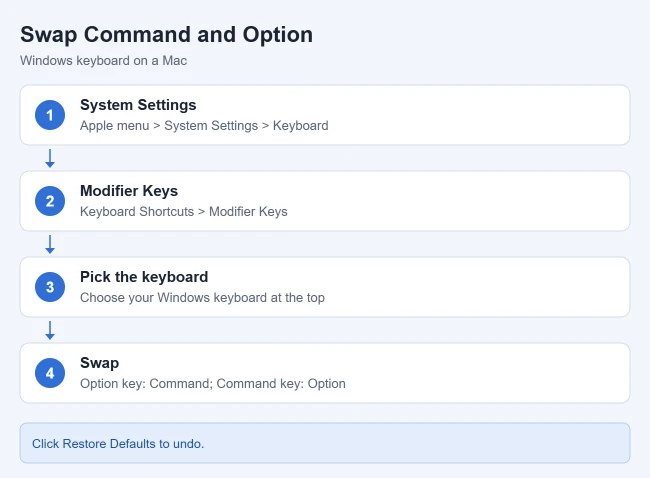
To change the Command key on a Windows keyboard connected to a Mac, open System Settings > Keyboard, click Keyboard Shortcuts, then click Modifier Keys. Choose your Windows keyboard at the top, set the Option key menu to Command and the Command key menu to Option, and click Done. The Alt key next to the space bar then works as Command, just like on an Apple keyboard.
These steps are for macOS Ventura 13 and later, including macOS Tahoe 26 and macOS Golden Gate 27, and follow Apple’s guide to changing the behavior of the modifier keys on Mac. Steps for macOS Monterey 12 and earlier, which use System Preferences, are in their own section below. The steps work with wired USB keyboards, Bluetooth keyboards, and keyboards that use a wireless USB receiver.
How Windows Keys Work on a Mac by Default
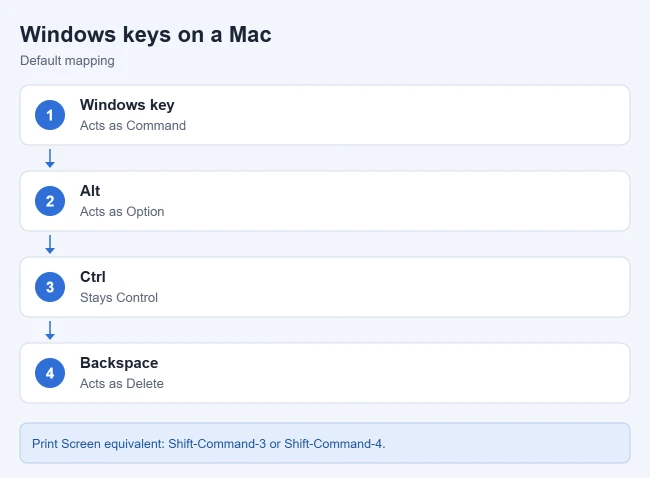
You can plug in almost any Windows keyboard and start typing right away. No driver is needed. The modifier keys are where things get confusing, because macOS reads each Windows key as the closest Mac key:
| Key on a Windows keyboard | What it does on a Mac |
|---|---|
| Windows logo key | Command |
| Alt | Option |
| Ctrl | Control |
| Backspace | Delete (deletes to the left) |
| Delete | Forward delete (deletes to the right) |
| Enter | Return |
Apple’s Mac keyboard shortcuts page tells Windows keyboard users to press Alt in place of Option and the Windows logo key (or Ctrl) in place of Command. Out of the box, it’s the Windows logo key that sends Command. Ctrl only acts as Command after you remap it, which is one of the options covered below.
The real problem is position. An Apple keyboard has Control, Option, Command running toward the space bar. A Windows keyboard has Ctrl, Windows, Alt. So the key your thumb lands on next to the space bar is Alt, which the Mac treats as Option. Press it with C and you get a special character instead of a copy.
If you also use a Windows PC, compare the shortcuts with the steps to print screen in Windows 10.
Before You Start
- Connect the keyboard first. The Windows keyboard has to be connected and working before it appears in Modifier Keys. A keyboard that uses a small wireless receiver may be listed under the receiver’s name rather than the keyboard’s brand.
- Answer the Keyboard Setup Assistant if it opens. This assistant appears when you connect a keyboard the Mac doesn’t immediately recognize, so it can learn the layout: ANSI (the standard North American layout), ISO (the European layout), or JIS (the Japanese layout). Follow its prompts and press the keys it asks for. A wrong answer here causes wrong symbols, not wrong modifier keys.
- Check for a Mac mode switch. Some keyboards made for several devices have a Windows/Mac switch or a key combination that changes modes. In Mac mode, the keyboard may already swap Alt and Windows for you. Choose one approach: use the keyboard’s Mac mode or the macOS swap below, not both, or the keys will end up back where they started.
How to Swap the Command and Option Keys
- Click the Apple menu in the upper-left corner and choose System Settings. The settings window opens.
- Click Keyboard in the sidebar. You may need to scroll down to find it.
- Click the Keyboard Shortcuts button. A new window opens with a list of shortcut categories.
- Click Modifier Keys at the bottom of that list. Menus for Caps Lock, Control, Option, and Command appear on the right.
- Open the Select keyboard menu at the top and choose your Windows keyboard. If only one keyboard is connected, it may already be selected. On a MacBook, don’t skip this step, or the change applies to the built-in keyboard instead.
- Set the Option key menu to Command, then set the Command key menu to Option.
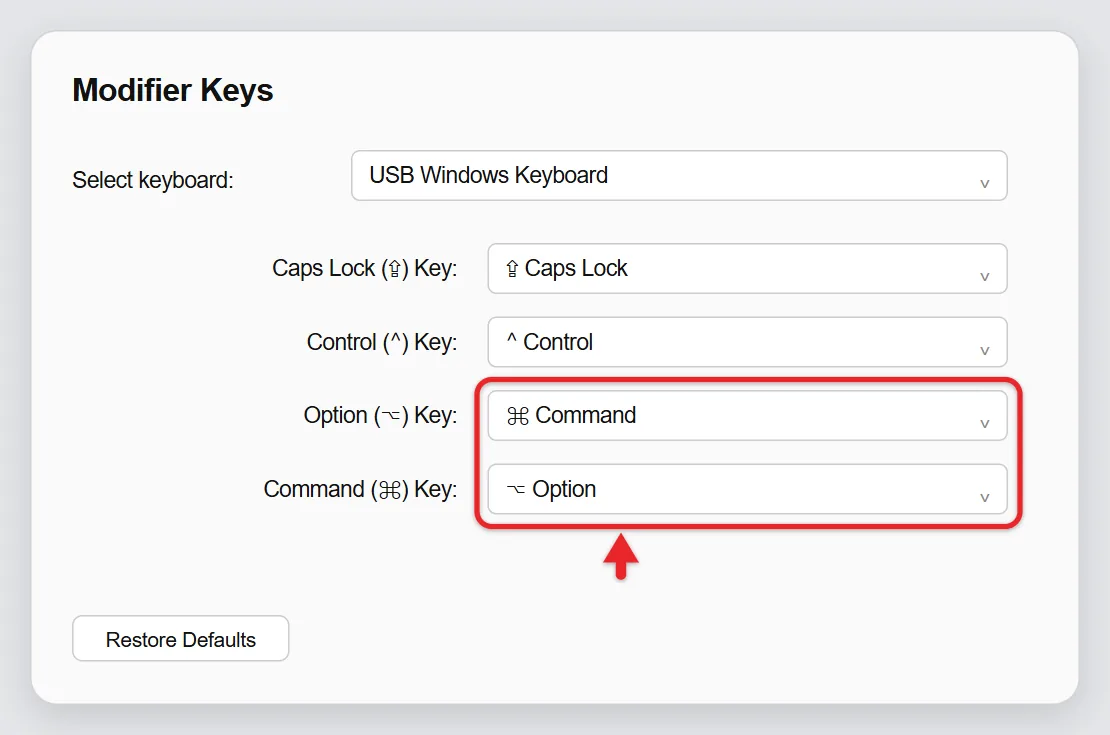
- Click Done. The window closes, and the change takes effect right away. There’s nothing to save and no restart.
The Alt key next to the space bar now acts as Command, and the Windows logo key acts as Option. That matches the order on an Apple keyboard: Control, Option, Command. The labels printed on the keys don’t change, so it helps to remember “Alt is Command” for the first few days.
How to Check That It Worked
Open a document or a note and try a few shortcuts with the key next to the space bar:
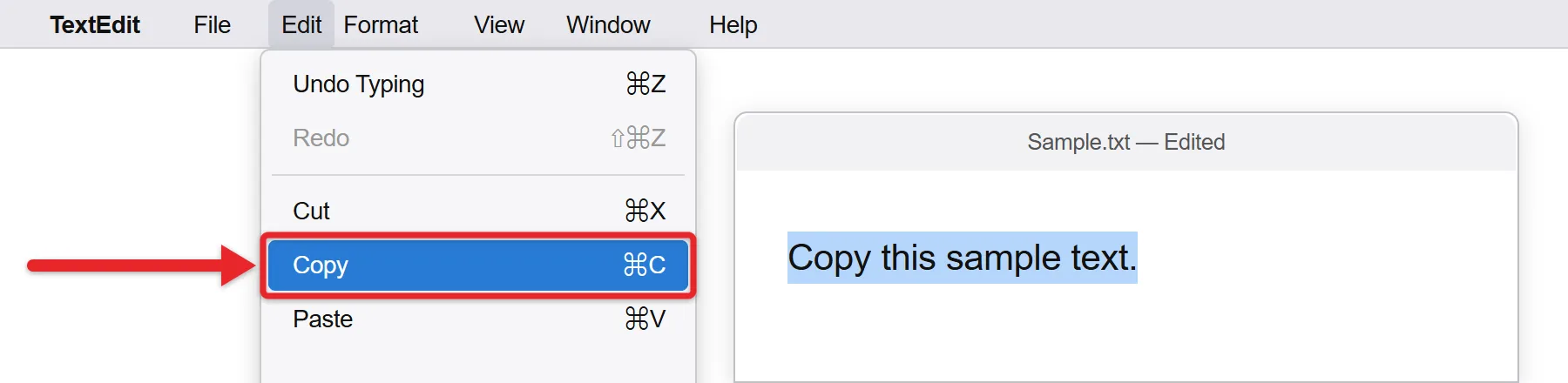
- Select some text and press Alt+C, then Alt+V. The text should copy and paste.
- Press Alt+Tab. The app switcher should appear, the same as Command-Tab on a Mac keyboard.
- Press Alt+Space bar. Spotlight search should open.
If any of these type a strange character or do nothing, go back to Modifier Keys and check that your Windows keyboard, not the built-in keyboard, is selected at the top.
Which Layout Should You Pick?
There are two common setups, and the right one depends on how you work.
| Setup | Key that acts as Command | Best for |
|---|---|---|
| Swap Option and Command | Alt, next to the space bar | People who also use a MacBook or Apple keyboard and want the same thumb position on both |
| Swap Control and Command | Ctrl, in the corner | People who switch between a Windows PC and a Mac all day and want copy, paste, and save on the same key as in Windows |
The first setup is closest to a real Mac keyboard, so it’s the better choice if you’ll ever type on one. The second feels familiar to Windows users, but Mac shortcuts that use Control, like Control-click for a right-click, move to the Windows logo key.
Other Ways to Remap Modifier Keys
You can change the action of each modifier key or set it to No Action. Everything happens in the same Modifier Keys window.
- Make Ctrl act as Command: set the Control key menu to Command and the Command key menu to Control. Ctrl+C now copies, as it does on Windows.
- Turn Caps Lock into Control: Apple gives this as an example for people used to keyboards with Control in that spot. Set the Caps Lock key menu to Control.
- Disable a key: choose No Action for a key you keep pressing by accident, such as Caps Lock.
The changes apply only to the keyboard you selected, so a MacBook’s built-in keyboard keeps its normal layout. Each keyboard remembers its own settings.
If the keyboard stops working when you plug it back into a PC, follow the steps to troubleshoot keyboard issues in Windows 11.
Need the opposite on a Windows PC? PowerToys lets you change keybinds on Windows 11.
If a keyboard types the wrong symbols on a Windows PC, you may need to change the keyboard layout in Windows 11 instead.
Modifier Keys can’t remap ordinary keys like Print Screen, Home, or the menu key. For those, some people use a free third-party app called Karabiner-Elements, and some keyboard makers offer their own Mac software. Install these only from the developer’s or manufacturer’s own website.
Steps for macOS Monterey 12 and Earlier
- Choose Apple menu > System Preferences, then click Keyboard.
- Click the Keyboard tab, then click Modifier Keys near the lower-right corner.
- Choose your Windows keyboard from the Select keyboard menu.
- Set Option to Command and Command to Option.
- Click OK.
How to Undo the Change
Go back to System Settings > Keyboard > Keyboard Shortcuts > Modifier Keys, choose the same keyboard from the menu at the top, and click Restore Defaults. Then click Done. The Windows logo key goes back to Command and Alt goes back to Option.
Mac Equivalents of Common Windows Keys
Apple’s Windows keys on a Mac keyboard page and its shortcuts list cover the keys people miss most. Wherever the table says Command, press the key you set as Command.
| On Windows | On a Mac |
|---|---|
| Ctrl shortcuts (Ctrl+C, Ctrl+S) | Command shortcuts (Command-C, Command-S) |
| Start menu search | Command-Space bar opens Spotlight |
| Right-click | Hold Control and click |
| Ctrl+Alt+Delete for a frozen app | Option-Command-Esc opens Force Quit |
| Home and End within a line | Command-Left Arrow and Command-Right Arrow |
| Page Up and Page Down | Fn-Up Arrow and Fn-Down Arrow, or the Page Up and Page Down keys |
| Forward delete | The Delete key on a Windows keyboard, or Fn-Delete |
| Print Screen | Shift-Command-3 for the whole screen, Shift-Command-4 for an area |
In many Mac apps, the Home and End keys on a Windows keyboard scroll to the top or bottom of the document instead of moving the cursor to the start or end of the line. Use Command with the arrow keys for line movement. There are more capture options when you take a screenshot on a Mac.
Function and Media Keys
The top row on a Windows keyboard is controlled by the keyboard itself, not by Modifier Keys. Many Windows keyboards have their own Fn key or an Fn Lock key that switches the top row between F1 to F12 and media controls like volume.
The macOS setting Use F1, F2, etc. keys as standard function keys, under System Settings > Keyboard > Keyboard Shortcuts > Function Keys, is described in Apple’s function keys guide. It’s meant for Apple keyboards and often has no effect on a Windows keyboard. If volume or brightness keys don’t work, try the keyboard’s own Fn key or its maker’s Mac software.
Troubleshooting
- The keyboard isn’t in the Select keyboard menu: make sure it’s connected and typing, then close and reopen Modifier Keys. For a Bluetooth keyboard, remove it in System Settings > Bluetooth and pair it again.
- Nothing changed after the swap: you probably changed a different keyboard. Open Modifier Keys, pick the Windows keyboard at the top, and set the menus again.
- The keys are swapped the wrong way: the keyboard may be in Mac mode and already swapping Alt and Windows. Click Restore Defaults in Modifier Keys, or switch the keyboard back to Windows mode.
- Symbols like @, quotes, or brackets are wrong: that’s a layout problem, not a modifier problem. Check the input source in System Settings > Keyboard under Text Input, and make sure it matches the language printed on your keys.
- A shortcut still doesn’t work in one app: the app may use a different shortcut. Check that app’s menus, where Mac shortcuts are listed next to each command.
Frequently Asked Questions
Do I need extra software to swap Command and Option?
No. Modifier Keys is built into macOS. You only need third-party software to remap non-modifier keys like Print Screen or Home.
Will this change my MacBook’s built-in keyboard too?
Not if you choose the Windows keyboard in the Select keyboard menu before changing anything. Each keyboard keeps its own settings.
Does the setting stay after I unplug the keyboard?
Yes. macOS remembers the setting for that keyboard and applies it again the next time you connect it.
Which key is the Option key on a Windows keyboard?
Alt, by default. After the swap in this guide, the Windows logo key becomes Option instead.
Can I use the same keyboard on a Windows PC afterward?
Yes. The swap is stored on the Mac, not in the keyboard, so the keyboard works normally when you plug it into a Windows PC.
New to a Mac with a two-button mouse? You can right-click on a Mac, or read about setting up a Mac mini with your own keyboard and mouse.

Matthew Burleigh is the founder, head writer, and editor of Solve Your Tech, which he launched in 2012. He has written technology tutorials since 2008 and worked in IT since 2003, including small-business support, IT management, and consulting. He holds Bachelor’s and Master’s degrees in Computer Science from Arizona State University.
Matthew writes practical guides for Windows, iPhone and iPad, Microsoft Office, Outlook, Google apps, and Android. Solve Your Tech’s guides are checked step by step against the device or app maker’s own documentation and tested on his own devices whenever he has the hardware or software, with clear steps, sources, and update dates.
Read more about Matthew and how Solve Your Tech writes and updates its guides, or report a correction.