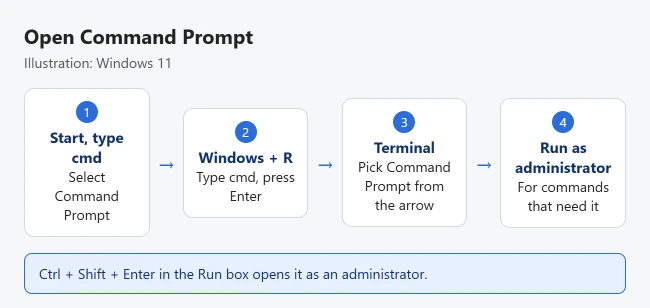
To open Command Prompt in Windows 11, select Start, type cmd, and select Command Prompt. For a keyboard-only route, press Windows key + R, type cmd, and press Enter. If a command needs administrator rights, choose Run as administrator instead of opening the app normally.
This guide covers Windows 11. Command Prompt is the classic Windows command-line tool, a window where you type text commands instead of clicking buttons. Its program file is named cmd.exe, which is why typing cmd finds it. You do not need to install anything, and a standard window works from any user account. Only the administrator option needs an administrator account or password.
Open Command Prompt From Start
This is the shortest route for most people, and it is the same one Microsoft uses in its own support articles.
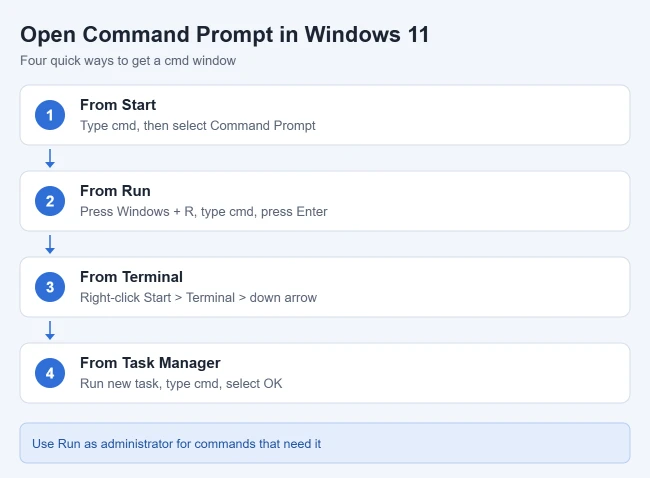
- Select Start on the taskbar, or press the Windows key.
- Type cmd. You can start typing as soon as the Start menu opens. Command Prompt appears at the top of the search results.
- Select Command Prompt, or press Enter, to open a standard window. To open an elevated window instead, select Run as administrator on the right, or right-click Command Prompt and choose it there.
A black window opens with a line that ends in a > symbol and a blinking cursor. That line is the prompt, and it shows the folder you are working in.
Open Command Prompt With the Run Box
The Run box is a small window that starts any program by name. Microsoft lists Windows key + R as the shortcut that opens it.
- Press Windows key + R to open the Run box.
- Type
cmdin the Open field. - Press Enter or select OK.
Command Prompt opens without using Start search, which helps when search is slow or returns web results first. Pressing Ctrl + Shift + Enter in step 3 instead of Enter is the usual way to request an administrator window from the Run box. Windows then asks for permission before the window opens.
Open Command Prompt in Windows Terminal
Windows Terminal is the tabbed command-line app included with Windows 11. It can run Command Prompt, PowerShell, and other shells in separate tabs of one window.
- Right-click Start, or press Windows key + X, and select Terminal. Microsoft calls this list the Quick Link menu.
- Select the down arrow next to the + button in the tab bar.
- Select Command Prompt.
A new tab opens running Command Prompt. Terminal starts with PowerShell unless you change it, so the first tab is usually PowerShell. Terminal also assigns Ctrl + Shift + a number to each entry in that drop-down list, in order. Command Prompt is often second, which makes Ctrl + Shift + 2 the shortcut on many PCs. Check the shortcut shown beside Command Prompt in the menu, because the order can differ.
Make Terminal Open Command Prompt by Default
If you use Command Prompt more than PowerShell, change the default profile. A profile is Terminal’s name for each shell it can open.
- Open Terminal.
- Select the down arrow in the tab bar, then select Settings.
- Select Startup, then set Default profile to Command Prompt.
- Select Save.
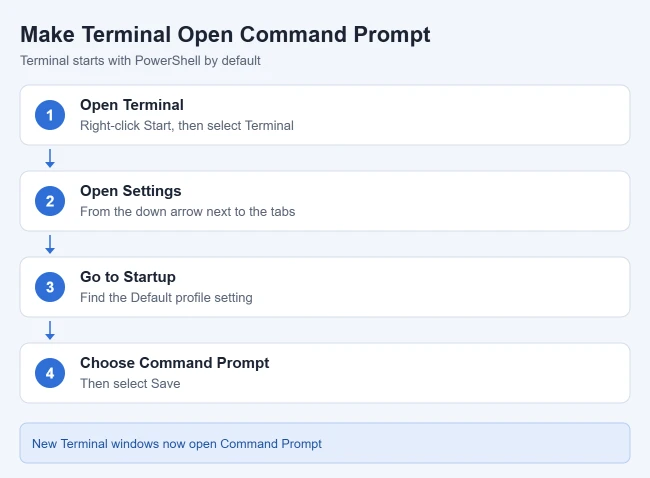
New Terminal windows and new tabs open straight into Command Prompt. To undo the change, return to Startup and set Default profile back to Windows PowerShell. Microsoft describes both settings on its Windows Terminal startup settings page.
More Ways to Open Command Prompt
These routes are useful when Start is not responding, when you want to begin in a particular folder, or when you open Command Prompt often.
From the Windows Tools Folder
Select Start, then select All (labeled All apps on some versions) to see the full app list. Scroll to Windows Tools and open it. A folder window appears with Windows utilities for advanced users. Double-click Command Prompt. The tools in this folder can vary by Windows edition.
From Task Manager
Open Task Manager with Ctrl + Shift + Esc, select Run new task, type cmd, and select OK. Check Create this task with administrative privileges first if you need an administrator window. This route still works when Start or the taskbar is frozen.
In a Specific Folder
Open the folder in File Explorer, click the address bar, type cmd, and press Enter. Command Prompt opens already pointed at that folder, so you can skip the cd commands normally needed to get there. The prompt line shows the folder path, which confirms you are in the right place.
From the Taskbar or Start
Search for cmd, right-click Command Prompt, and select Pin to taskbar or Pin to Start. After that it is one click away. See how to pin apps to the taskbar for more on pinning. To remove it later, right-click the icon and select Unpin from taskbar.
| Method | What to do | Best for |
|---|---|---|
| Start search | Start, type cmd, select Command Prompt | Everyday use |
| Run box | Windows key + R, type cmd, Enter | Keyboard only |
| Terminal | Right-click Start, Terminal, down arrow, Command Prompt | Working in tabs |
| Windows Tools | Start, All, Windows Tools, Command Prompt | Browsing instead of typing |
| Task Manager | Ctrl + Shift + Esc, Run new task, cmd, OK | A frozen Start menu |
| File Explorer | Type cmd in the address bar, Enter | Starting in one folder |
| Taskbar pin | Pin Command Prompt once, then click its icon | Opening it often |
Open Command Prompt as an Administrator
Before you elevate: an administrator window can change system files and settings, and Command Prompt does not ask you to confirm most commands. Only run commands you understand, and copy them from a source you trust.
The same steps work for most desktop programs, as shown in how to run as administrator in Windows 11.
Some commands only work in an elevated window. Microsoft’s instructions for the System File Checker tool, for example, start by opening an elevated command prompt.
- Select Start and type cmd.
- Right-click Command Prompt and select Run as administrator.
- Select Yes when Windows asks for permission. On a standard account, Windows asks for an administrator password instead.
The title bar reads Administrator: Command Prompt. If the word Administrator is missing, the window is not elevated, so close it and try again. See how to run Command Prompt as an admin on Windows 11 for more ways to do this.

Check That It Worked, and Close It
Type ver and press Enter. Command Prompt replies with a line that begins with Microsoft Windows and a version number, which confirms the window is accepting commands. To close it, type exit and press Enter, or select the X in the corner. Opening Command Prompt changes nothing on your PC, so there is nothing to undo.
If Command Prompt Does Not Open the Way You Expect
- Terminal shows PowerShell instead. This is the default. Use the down arrow to open a Command Prompt tab, or change the default profile as described above.
- Command Prompt opens inside a Terminal window. Windows 11 can host command-line apps in Terminal. In Terminal, go to Settings > Startup and look at Default terminal application. Choosing Windows Console Host brings back the classic standalone window, and choosing Windows Terminal reverses it. Either way, the same commands work.
- The Quick Link menu lists Terminal, not Command Prompt. That is normal in Windows 11. Open Terminal and switch tabs, or use Start search or the Run box.
- Search does not show Command Prompt. Use the Run box or Task Manager method, since neither depends on search.
- A command reports that access is denied or that it needs elevation. Close the window and reopen Command Prompt as an administrator.
- A message says the command prompt has been disabled by your administrator. This comes from a policy on a work or school PC. Contact your IT department rather than trying to work around it.
- Windows will not start at all. Microsoft lists Command Prompt among the tools in the Windows Recovery Environment, which appears automatically after repeated failed starts.
Learn Basic Command Prompt Commands
Start with a standard Command Prompt window using the opening steps above. Run cd to display the current folder and dir to list its contents. To enter an existing practice folder, use cd /d "C:\Your\Practice Folder", replacing that example with its actual path; /d also changes the drive. Check the prompt and directory listing. Microsoft documents cd and dir. In a writable practice location, mkdir "CMD Practice" creates a folder if that name is unused; verify it with dir. See the mkdir reference.
To try a programming language from this same window, install Python on Windows 11 and type python to open its interactive prompt.
For a first real project, you can use these same commands to install Jupyter Notebook on Windows 11.
Press the Up arrow to recall a previous command, then edit it before pressing Enter. Type help, or add /? after a command, to see its options. In Windows Terminal, Ctrl+Shift+C and Ctrl+Shift+V copy and paste, and Ctrl+C stops a running command. Microsoft lists these key bindings on its Windows Terminal actions page. To change the font or colors, open the tab drop-down in Terminal and select Settings > Command Prompt > Appearance, as Microsoft’s profile appearance options page describes.
Type echo %PATH% to see the folders Windows searches for commands. To change that list, see how to open and edit environment variables in Windows 11.
For repairs, Microsoft’s DISM and System File Checker instructions need an administrator window. Avoid file-deletion commands such as del while you practice, because deleted files skip the Recycle Bin. Type exit to close the session.
Things to Try Once It’s Open
- Type
ipconfigto find your IP address. - Run CHKDSK to check a drive for errors.
- Activate Windows 11 with a command.
- Type
helpto list built-in commands, or add/?after a command to see its options.
Microsoft’s cmd reference covers the Command Prompt program itself and notes that PowerShell offers more advanced scripting.
Need PowerShell Instead?
PowerShell is a separate shell. To open it, select Start, type PowerShell, and select Windows PowerShell, or right-click Start and choose Terminal, which opens PowerShell by default. Microsoft lists more ways to start Windows PowerShell.
If you have installed PowerShell 7 alongside the built-in Windows PowerShell, here is how to update PowerShell on Windows 11.
Frequently Asked Questions
What is the fastest way to open Command Prompt in Windows 11?
Press Windows key + R, type cmd, and press Enter. It takes three actions and never leaves the keyboard. Pinning Command Prompt to the taskbar is faster still if you prefer the mouse, because it becomes a single click.
Is Command Prompt the same as PowerShell?
No. Microsoft describes them as two separate command-line shells. PowerShell can run Command Prompt commands as well as its own commands, called cmdlets, but Command Prompt cannot run PowerShell cmdlets. See our PowerShell and command-line guides for more.
Is Command Prompt the same as Windows Terminal?
No. Terminal is the window, and Command Prompt is one of the shells that can run inside it. You can use Command Prompt in a Terminal tab or in its own classic window, and the commands behave the same in both.
Does this work in Windows 10?
Mostly. Searching for cmd from Start, the Run box, and Task Manager work the same way in Windows 10. Windows Terminal is not always installed on Windows 10, and the Start menu folder that holds Command Prompt has a different name there.
Do I need to be an administrator to open Command Prompt?
No. Any account can open a standard Command Prompt window. You only need an administrator account, or its password, for the Run as administrator option.

Matthew Burleigh is the founder, head writer, and editor of Solve Your Tech, which he launched in 2012. He has written technology tutorials since 2008 and worked in IT since 2003, including small-business support, IT management, and consulting. He holds Bachelor’s and Master’s degrees in Computer Science from Arizona State University.
Matthew writes practical guides for Windows, iPhone and iPad, Microsoft Office, Outlook, Google apps, and Android. Solve Your Tech’s guides are checked step by step against the device or app maker’s own documentation and tested on his own devices whenever he has the hardware or software, with clear steps, sources, and update dates.
Read more about Matthew and how Solve Your Tech writes and updates its guides, or report a correction.