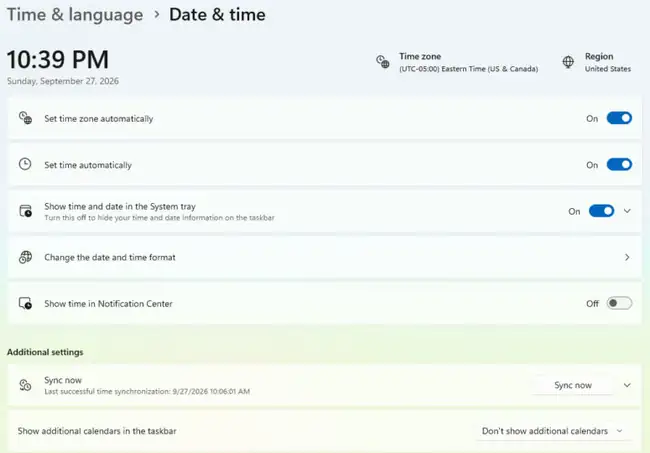
To change the date and time in Windows 11, open Settings > Time & language > Date & time, turn off Set time automatically, then select Change next to Set the date and time manually. Pick the new date and time and select Change.
These steps cover Windows 11 and also match Windows 10, which reached end of support on October 14, 2025.
Most people should leave the time set automatically, because Windows keeps it accurate over the internet. Set it by hand only when the clock is wrong and automatic time isn’t fixing it, or when you need a specific time for testing. You need an administrator account to change the system time. These steps follow Microsoft’s date and time guide.
Change the Date and Time Manually
- Right-click the clock on the taskbar and select Adjust date and time, or open Start > Settings > Time & language > Date & time.
- Turn off Set time automatically.
- Select Change next to Set the date and time manually. Microsoft’s guide calls this row Set the date and time, so the label may be shorter on your PC.
- In the Change date and time window, pick the date, hour, and minute.
- Select Change. The taskbar clock shows the new time right away.
If the Change button is grayed out, Set time automatically is still on. If you changed the time for a test or an old program, turn Set time automatically back on when you’re done so the clock corrects itself.
Set the Time Automatically
- Go to Settings > Time & language > Date & time.
- Turn on Set time automatically.
- Under Additional settings, select Sync now. Windows shows when it last synced successfully.
In Windows 10, Sync now is under Synchronize your clock. Automatic time needs an internet connection. If the time is still wrong, turn Set time automatically off, wait a few seconds, and turn it back on to make Windows check again.
Change the Date and Time in Control Panel
The older Date and Time window still works and is handy if Settings won’t open.
- Press Windows key + R, type timedate.cpl, and press Enter. You can also open Control Panel > Clock and Region > Date and Time.
- On the Date and Time tab, select Change date and time. Approve the User Account Control prompt if it appears.
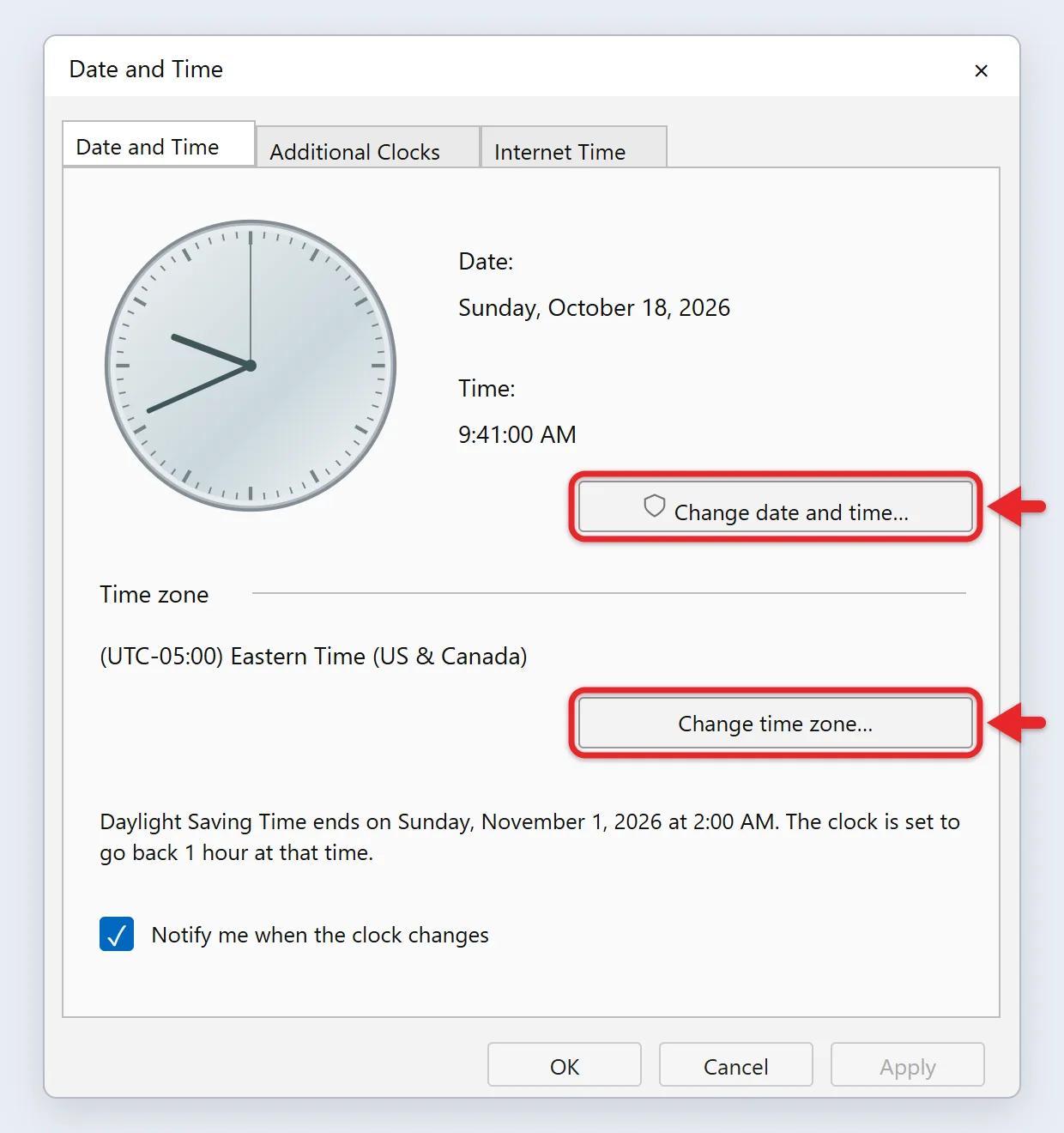
- Pick the date and time, then select OK.
- To change the zone here, select Change time zone, pick one, and select OK.
Change the Internet Time Server
Windows syncs with Microsoft’s time server, time.windows.com, by default. Try Sync now first. If the clock still drifts, switch to a different internet time server:
- Open Control Panel, set View by to Large icons, and select Date and Time.
- Open the Internet Time tab and select Change settings.
- Check Synchronize with an Internet time server and pick another server from the Server list, such as time.nist.gov.
- Select Update now, then OK twice.
If the sync fails, check your internet connection and try another server from the list. A PC on a work network may have no Internet Time tab, because the organization sets the clock. HP’s clock troubleshooting page shows the same dialog.
Change the Time Zone
- Go to Settings > Time & language > Date & time.
- Turn off Set time zone automatically. Otherwise the Time zone menu is grayed out.
- Pick your zone from the Time zone menu. The clock moves to that zone’s time right away.
If you’d rather let Windows pick the zone, leave Set time zone automatically on. Microsoft says the Windows location setting is what lets Windows set the time zone automatically, so check that location is on under Settings > Privacy & security > Location if the zone is wrong.
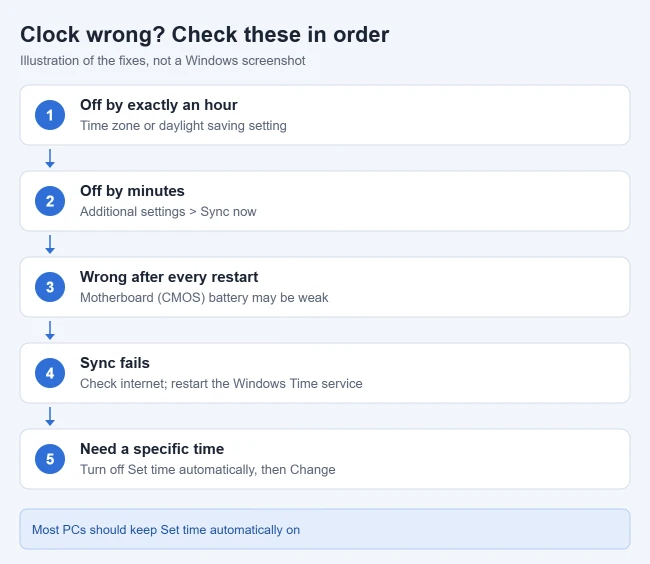
If your clock is off by exactly one hour, check the time zone and daylight saving setting first. Daylight saving time is handled for you when Set time zone automatically is on. When it’s off, turn on Adjust for daylight saving time automatically.
Change the Time With a Command
Open Command Prompt or Terminal as administrator, and turn off Set time automatically first, or Windows will change the time back at the next sync.
Command Prompt
time 14:30
date 09-30-26
The date format follows your region’s settings; running date on its own prompts you with the expected format.
PowerShell
Set-Date -Date "09/30/2026 14:30"Change How the Date and Time Look
The clock’s format is a separate setting from the time itself. Select Change the date and time format on the Date & time page (or Time & language > Language & region > Regional format) to pick short and long date and time styles. From there you can switch to a 12-hour clock or 24-hour time, or change the date format to mm/dd/yyyy. The display language doesn’t change these formats. To change it instead, follow the steps for changing the language in Windows 11.
Show or Hide the Clock on the Taskbar
On the same Date & time page, turn Show time and date in the System tray on or off. To add seconds, turn on Show seconds in system tray clock; this uses more power.
Add a Clock for Another Time Zone
- On the Date & time page, scroll to Related links and select Additional clocks.
- On the Additional Clocks tab, check Show this clock, pick a time zone, and type a name such as London.
- Select OK. Hover over or select the taskbar clock to see the extra time zones.
You can add up to two extra clocks this way. It’s handy if you work with people in other time zones and don’t want to change your own. For a clock on the desktop or more cities, add a clock widget in Windows 11.
Troubleshooting
“Time synchronization failed”
Check your internet connection, then restart the Windows Time service. Open Command Prompt as administrator and run these one at a time:
net stop w32time
net start w32time
w32tm /resync
You can also open the Services app, right-click Windows Time, and choose Restart. On a work network, a firewall or company time server may control syncing, so ask IT.
The time is wrong every time the PC starts
A PC’s firmware keeps time with a small battery on the motherboard, often called the CMOS battery. If that battery is weak, the clock resets whenever the PC loses power, especially on older desktops. Keep Set time automatically on so Windows corrects it after you connect to the internet, and have the battery replaced if it keeps happening.
The settings are grayed out
You’re signed in with a standard account, or a work or school policy manages the time. Sign in as an administrator, or ask IT.
The time zone keeps switching
Windows is guessing the zone from your location. Turn off Set time zone automatically and pick the zone yourself, which is also the better choice on a VPN or near a time zone border.
Frequently Asked Questions
How do I change the date and time in Windows 10?
The steps are almost the same: Settings > Time & Language > Date & time, turn off Set time automatically, and select Change.
Why does the clock change back after I set it?
Set time automatically is still on, so Windows resyncs with the internet time server. Turn it off if you need a manual time.
Does Windows adjust for daylight saving time automatically?
Yes, when Set time zone automatically is on, or when Adjust for daylight saving time automatically is on.
Can a wrong clock cause problems?
Yes. An inaccurate clock can cause trouble connecting to online services, since security checks depend on the correct time. Websites may show certificate errors, and some apps may fail to sign in.
Working with certificates directly? Here’s how to remove certificates from Windows 11.

Matthew Burleigh is the founder, head writer, and editor of Solve Your Tech, which he launched in 2012. He has written technology tutorials since 2008 and worked in IT since 2003, including small-business support, IT management, and consulting. He holds Bachelor’s and Master’s degrees in Computer Science from Arizona State University.
Matthew writes practical guides for Windows, iPhone and iPad, Microsoft Office, Outlook, Google apps, and Android. Solve Your Tech’s guides are checked step by step against the device or app maker’s own documentation and tested on his own devices whenever he has the hardware or software, with clear steps, sources, and update dates.
Read more about Matthew and how Solve Your Tech writes and updates its guides, or report a correction.