Facebook doesn’t offer a documented way to change a cover photo with no post at all, but you can keep the change quiet. Update the cover from your profile, then look for an audience control on the separate “updated their cover photo” post. If it offers Only Me, you can limit that post to yourself. Your current cover photo remains public.
You want a new banner on your profile, but you don’t want an “updated their cover photo” story landing in everyone’s feed.
What Happens When You Change a Cover Photo
Your cover photo is the wide image across the top of your profile, behind your profile picture. When you replace it, Meta says a new cover photo is posted on your profile and may show up in your friends’ Feeds. It is also added to your Cover Photos album.
Two separate things are at play, and it helps to keep them apart:
- The cover photo itself. Meta says your current cover photo is public, so anyone on or off Facebook can see it. No privacy setting or audience choice hides the current cover.
- The update post that announces the change. This is the part you can usually limit, hide or delete.
So the realistic goal is “change it without announcing it,” not “change it so nobody can tell.” Someone who visits your profile will notice the new image either way.
Change the Cover Photo and Check the Update Post Audience
Some app layouts let you limit the update post to yourself. The audience control may be missing on desktop or on your version of the app. Meta’s steps to add or change your cover photo use the labels below, and the website and the app word them differently.
- Open Facebook on a computer or in the app and go to your profile. On a computer, click your profile picture in the top right, then your name. In the iPhone app, tap Menu, then your name.
- On a computer: click Edit cover photo in the bottom right of your cover photo, click Choose cover photo (or Upload Photo if you have no cover yet), then pick Upload Photo to use a file from your computer or Select Photo to use one from your Facebook albums.
- In the iPhone app: tap your cover photo, then tap Upload Photo, Select Photo on Facebook or Create a Collage, and tap the photo you want.
- Drag the image up or down to reposition it, then click Save Changes on a computer or tap Save in the app. Meta says the cover image must be at least 720 pixels wide.
- Go back to your profile and find the new “updated their cover photo” post near the top of your posts.
- Open the update post’s three-dot menu. If it offers Edit post or Edit audience, check whether the post has an audience selector.
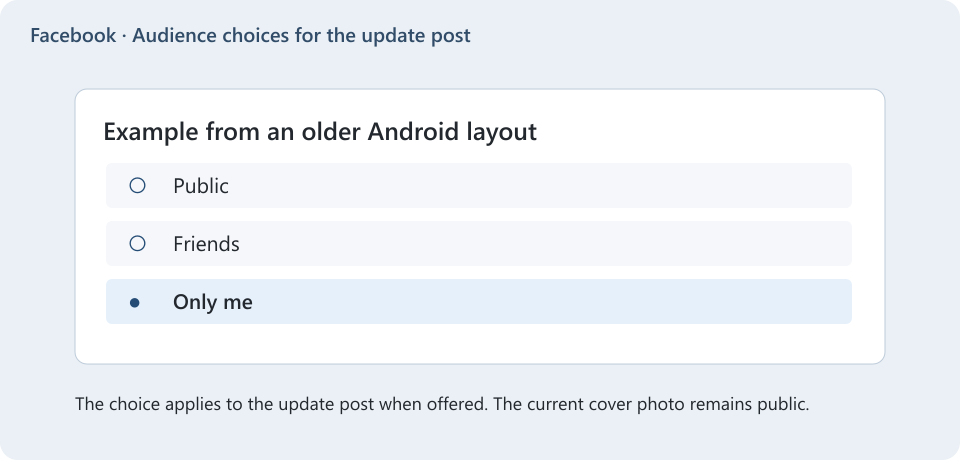
- If Only Me is offered, choose it and save. If there is no audience control, assume the update may still be visible.
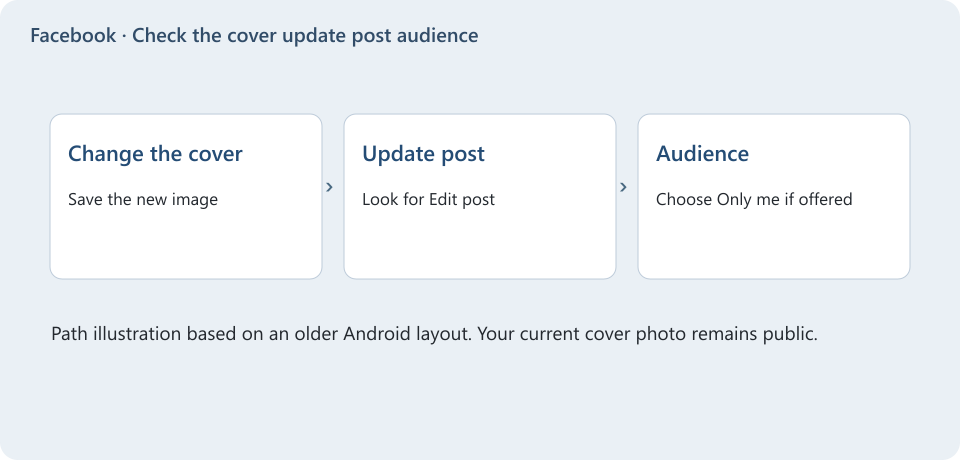
The post may appear in Feeds as soon as you save the cover. Changing its audience afterward cannot undo any views that already happened.
Changing the audience of the post is not the same as changing the audience of the picture. If you want fewer people seeing your profile in general, see how to lock your Facebook profile, which limits what non-friends see. Locking your profile doesn’t hide your current cover photo, which Meta treats as public.
Hide or Delete the Update Post Afterward
If you’ve already changed the cover and the post went out, you can still clean up. Open your profile, find the cover photo update post, and open its three dots menu. Depending on your version, you may see options such as Edit audience, Hide from profile, Move to archive or Move to trash.
| Option | What it is meant to do | When to pick it |
|---|---|---|
| Edit audience to Only Me | Keeps the post but limits it to you | You want the post kept in your history |
| Hide from profile | Takes the post off your profile view | You mainly care about profile visitors |
| Archive or delete | Removes the post from view | You want the announcement gone |
Users commonly report that deleting the announcement post leaves the new cover photo in place, but Facebook’s behavior can change, so check your profile right after you delete it. If the cover reverts, set it again and check whether the update post offers Only Me. None of these options recalls a post from people who already saw it in their Feed.
Can’t find the post? Your activity log may list recent profile changes, and filtering your own posts by date can help. See how to find old Facebook posts without scrolling for ways to jump to a specific date.
Use a Photo Already on Your Profile
A worked example helps here. Say you run a small bakery account on your personal profile and want to swap last season’s banner for a photo of a new storefront sign that you posted a month ago. Choosing that existing photo with Select Photo, rather than uploading it again, avoids creating a second copy of the picture in your albums. You still get an update post, so check whether that post offers Only Me.
To switch back to an earlier cover, repeat the steps above and pick the old image with Select Photo (on a computer, under Choose cover photo; in the app, Select Photo on Facebook). Your past covers are in the Cover Photos album: open your profile, click Photos, then Albums, then Cover Photos.
On the Website vs. the App
The steps are similar, but the buttons differ. On a computer, Edit cover photo sits on the cover image itself and the update post may lack an editable audience. In the iPhone app, you tap the cover photo itself, and other post options are under the three dots in the corner of the post.
If the app keeps showing your old cover after you changed it, or the save button doesn’t respond, try these in order:
- Pull down to refresh your profile, or close and reopen the app.
- Update the Facebook app from the App Store or Google Play.
- Make the change on the website in a computer browser instead. Some people report the website works when the app stalls.
Cover Photos for Groups and Pages
Groups and Pages have their own cover images, and they follow different rules from your personal profile. In a group, generally only admins can change the cover, and members may see a post or notification about the change. On a Page, the people who manage the Page make the change, and the update may appear for the Page’s followers. If you need a quiet change for a group or Page, check the group or Page settings for post options after you save, since they vary by account type.
What Other People Can Still See
Even when the announcement post is hidden, anyone who opens your profile can see the new cover. Your old covers stay in your Cover Photos album, and Meta lets you change the audience of past cover photos with the audience selector on each photo. Old cover photo posts from previous changes may also still be on your profile; review them if you’re tidying up. For a broader privacy pass, see how to make your Facebook account private.
Meta’s page on who can see your Facebook profile picture and cover photo explains where a new cover appears and how to limit past covers.
Facebook Cover Photo Questions
Can I skip the update post entirely?
There’s no documented switch that guarantees no post. Some people report an option at upload time to not share to Feed; if you see one, use it, then still check your profile for a post afterward.
Will my friends get a notification?
Meta says a new cover photo is posted on your profile and may show up in your friends’ Feeds; it doesn’t describe a separate notification. If the update post offers Only Me, selecting it limits who can see the post from that point on.
Does deleting the post remove the cover photo?
Users generally report it doesn’t, but check your profile after deleting. If the cover disappears, set it again.
Can I remove my cover photo instead of replacing it?
Look for a remove option in the cover photo’s edit menu. Availability varies, so on some versions you may only be able to replace it.
Save your new cover and check the separate update post. If you can set its audience to Only Me, confirm the new setting afterward.

Matthew Burleigh is the founder, head writer, and editor of Solve Your Tech, which he launched in 2012. He has written technology tutorials since 2008 and worked in IT since 2003, including small-business support, IT management, and consulting. He holds Bachelor’s and Master’s degrees in Computer Science from Arizona State University.
Matthew writes practical guides for Windows, iPhone and iPad, Microsoft Office, Outlook, Google apps, and Android. Solve Your Tech’s guides are checked step by step against the device or app maker’s own documentation and tested on his own devices whenever he has the hardware or software, with clear steps, sources, and update dates.
Read more about Matthew and how Solve Your Tech writes and updates its guides, or report a correction.