To turn on iCloud Backup on your iPad, open Settings, tap your name, then iCloud > iCloud Backup, and turn on Back Up This iPad. Your iPad then backs up every day when it’s connected to power, locked, and on Wi-Fi. Tap Back Up Now to make a backup right away.
These steps come from Apple’s iPad User Guide page Back up iPad and its support article How to back up your iPhone or iPad with iCloud. They apply to iPadOS 27, the current version, and to iPadOS 17 through iPadOS 26, which use the same path.
Before You Start
- Sign in to iCloud. Your name appears at the top of Settings when you’re signed in with your Apple Account. If you see Sign in to your iPad instead, sign in first.
- Check your free space. Every Apple Account comes with 5GB of free iCloud storage. That fills up fast, since photos, mail, and backups from your other devices share it. The storage section below shows how to check.
- Connect to Wi-Fi. A backup needs a Wi-Fi connection unless your iPad supports backing up over cellular.
How to Enable iCloud Backup on iPad
- Open the Settings app.
- Tap your name at the top.
- Tap iCloud, then iCloud Backup.
- Turn on Back Up This iPad.
- Tap Back Up Now for an immediate backup. Stay on Wi-Fi until it finishes.

A progress bar shows while the backup runs. The first backup can take a long time if you have a lot of app data; later backups are usually quicker because there’s less new data to send. Keep the iPad plugged in for a long first backup.
The date and time of your last backup appears under Back Up Now. That timestamp is how you confirm it worked. From then on, iCloud backs up your iPad automatically each day when it’s charging, locked, and connected to Wi-Fi, so leaving it on the charger overnight is the easiest routine. A recent backup matters most if the iPad goes missing, and this guide to a lost or found iPad shows how Lost Mode helps a finder reach you.
If you previously backed up to a computer, you may see a warning that the device won’t back up to the computer automatically anymore. Tap OK to continue.
What iCloud Backup Saves (and What It Doesn’t)
iCloud Backup stores information that isn’t already kept in iCloud. According to Apple’s article What does iCloud back up?, that includes:
- Device settings, your Home Screen layout, and app organization
- App data, including third-party apps
- Messages, but only if Messages in iCloud is off
- Photos and videos, but only if iCloud Photos is off
- Purchased ringtones
Things that already sync with iCloud, such as iCloud Photos, Messages in iCloud, iCloud Drive, and Notes, aren’t copied into the backup because they’re stored in iCloud separately. Your apps aren’t stored either; the iPad downloads them again from the App Store when you restore.
Keep in mind that syncing isn’t the same as a backup. If you delete a photo with iCloud Photos turned on, it’s deleted on every device that uses that library. If you plan to delete messages from your iPad after 30 days, save anything important first.
How to Back Up Over Cellular
On Wi-Fi + Cellular iPad models that support 5G, your carrier may let you back up over cellular. Go to Settings > your name > iCloud > iCloud Backup and turn Backup Over Cellular on or off. Backups can use a lot of data, so only turn this on if your plan can handle it. If you don’t see the switch, your iPad model or carrier doesn’t offer it, and you’ll need Wi-Fi.
How to Check or Free Up iCloud Space
- Go to Settings > your name > iCloud. The storage used and available appears at the top.
- Tap Storage or Manage Account Storage, then tap Backups.
- Tap the name of this iPad to see the last backup, the next backup size, and the apps included.
- Turn off apps you don’t need backed up, then tap Turn Off to confirm.
The next backup is smaller. Turning off an app also deletes that app’s existing backup data from iCloud, and some apps are always backed up and can’t be turned off.
You can also delete backups from old devices you no longer use. On the Backups screen, tap the old device, tap Turn Off and Delete from iCloud, and confirm. Apple’s iCloud storage guide notes that deleting a backup also turns off iCloud Backup for that device, and a backup that’s being used to restore a device can’t be deleted. The steps to check how much iCloud storage you have left explain the storage bar.
If you get an alert that you don’t have enough storage, follow the onscreen steps to buy more. The steps for buying more iCloud storage on iPad cover the iCloud+ plans.
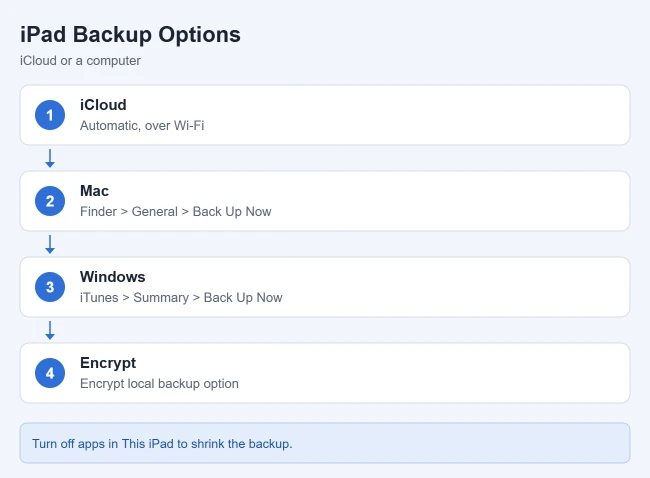
iCloud Backup or Computer Backup?
| iCloud Backup | Computer backup | |
|---|---|---|
| Runs automatically | Yes, daily on power, locked, and Wi-Fi | Only when you connect and start it |
| Needs | Enough iCloud storage | Free space on the Mac or PC |
| Works away from home | Yes | No |
| Password protection | Not needed | Optional Encrypt local backup, required for Health and Activity data |
Many people use iCloud Backup every day and make an occasional computer backup before a big change, such as a major iPadOS update or repair. For a second copy that lives offline, you can also back up an iPad to an external hard drive through a Mac or PC.
Once the backup finishes, you can install a software update on your iPad from Settings or with a computer.
How to Back Up to a Computer Instead
Apple also lets you back up to a computer with a cable:
- Mac: connect the iPad and select it in the Finder sidebar. Click General, select Back up all of the data on your iPad to this Mac, then click Back Up Now. This needs macOS 10.15 or later; older versions use iTunes.
- Windows: use Apple Devices, or iTunes on a PC that still uses it. The Windows steps below explain both routes.
- Encrypt it: select Encrypt local backup before starting and keep the password safely. You need that password to use an encrypted backup; forgetting it prevents you from restoring that backup. Encryption is also required to save Health and Activity data in a computer backup.
Back Up an iPad With Apple Devices on Windows
Connect the iPad to your PC with a USB cable, unlock it, and complete the Trust This Computer prompt if shown. Open Apple Devices, select the iPad in the sidebar, then choose General. Select the option to back up all the iPad’s data to this computer. If you want an encrypted backup, select Encrypt local backup and store its password securely before continuing. Select Back Up Now and leave the device connected until the backup finishes.
When it finishes, choose Manage Backups and check that the new backup is listed; check the displayed backup date and time where available. Apple’s Windows backup guide documents these controls. For a PC still using iTunes rather than Apple Devices, select the iPad’s device button, choose Summary, select This computer, and choose Back Up Now; check the last-backup timestamp afterward. See Apple’s computer-backup instructions for both apps.
Once the iPad has connected with a cable, you can also turn on Wi-Fi sync for your iPad so it can sync with the computer over your home network.
How to Restore an iPad From an iCloud Backup
A backup only matters when you can get it back. Apple’s restore article says a restore happens during setup:
- If the iPad is already set up, erase it first. This removes everything currently on it.
- Turn on the iPad and follow the setup screens until you reach Transfer Your Apps & Data.
- Tap From iCloud Backup and sign in with your Apple Account.
- Choose a backup. Check the date and size, and pick the most recent one.
- Stay on Wi-Fi and power until the progress bar finishes, then complete setup.
Moving to a new iPad? You can also transfer data from your old iPad to a new iPad, including with Quick Start.
Troubleshooting iCloud Backup
- The backup fails or says there isn’t enough storage: check that you have enough iCloud storage for the next backup size shown under Backups. A full account is the most common cause.
- Back Up Now is gray: the iPad isn’t on Wi-Fi and cellular backup is off or unavailable. Connect to Wi-Fi and try again.
- The backup is stuck or very slow: move closer to your router or try another Wi-Fi network, plug in the iPad, and restart it. Then tap Back Up Now again.
- No automatic backups: make sure the iPad is locked, charging, and on Wi-Fi at the same time, such as overnight.
How to Turn Off iCloud Backup
Go to Settings > your name > iCloud > iCloud Backup and turn off Back Up This iPad. Automatic backups stop. Backups stay available for 180 days after you stop using iCloud Backup, so make a computer backup if you need a copy for longer.
Frequently Asked Questions
Why didn’t my iPad back up last night?
Automatic backups need the iPad to be connected to power, locked, and on Wi-Fi, with enough iCloud storage. If any of those is missing, the backup waits. If a broken charger tip blocks the port, Back Up Now still works over Wi-Fi, and the steps to get a broken charger out of an iPad suggest backing up before a repair.
How do I know my iPad is backed up?
Go to Settings > your name > iCloud > iCloud Backup and check the date and time under Back Up Now. If it’s today or yesterday, your backup is current.
Does backing up delete anything from my iPad?
No. A backup only copies data to iCloud. Turning off an app’s backup or deleting an old backup removes data from iCloud, not from your iPad.
Is 5GB of free iCloud storage enough for an iPad backup?
Often not, because the same 5GB also holds photos, mail, and other devices’ backups. Turn off large apps in the backup list or upgrade to iCloud+ if the backup won’t fit.
Related Guides
- How to check storage on your iPad
- How to set or reset your iPad passcode
- How to reset settings on iPad

Matthew Burleigh is the founder, head writer, and editor of Solve Your Tech, which he launched in 2012. He has written technology tutorials since 2008 and worked in IT since 2003, including small-business support, IT management, and consulting. He holds Bachelor’s and Master’s degrees in Computer Science from Arizona State University.
Matthew writes practical guides for Windows, iPhone and iPad, Microsoft Office, Outlook, Google apps, and Android. Solve Your Tech’s guides are checked step by step against the device or app maker’s own documentation and tested on his own devices whenever he has the hardware or software, with clear steps, sources, and update dates.
Read more about Matthew and how Solve Your Tech writes and updates its guides, or report a correction.