This post contains affiliate links. As an Amazon Associate, solveyourtech.com earns from qualifying purchases, at no extra cost to you.
To eject a disc from an Apple USB SuperDrive on a MacBook Air, open Finder and click the Eject icon next to the disc’s name in the sidebar. You can also select the disc on the desktop and choose File > Eject, or press and hold the Eject key if your keyboard has one. The SuperDrive has no eject button of its own, so ejecting always happens from macOS.
MacBook Air models have no built-in disc drive, so if you need to read a CD or DVD you have to use an external drive such as Apple’s USB SuperDrive. Apple covers ejecting in its Mac User Guide article Eject CDs and DVDs from your Mac and in How to connect the Apple USB SuperDrive.
As an Amazon affiliate, I earn from qualifying purchases.
In this article:
- Eject a disc from Finder
- Step-by-step with pictures
- Other ways to eject
- If the disc won’t eject
- FAQs
How to Eject a SuperDrive Disc from Finder
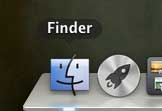
- Click the Finder icon in the Dock.
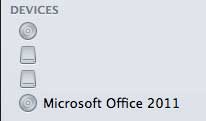
- Find the disc in the Finder sidebar.
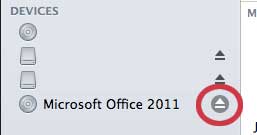
- Click the Eject icon next to the disc’s name.

Result: The SuperDrive pushes the disc out of its slot. You can take it out, insert another disc, or disconnect the drive. Before you store a home-made DVD, consider backing up the DVD to your Mac.
How to Eject a Disc from Apple’s USB SuperDrive (Guide with Pictures)
These screenshots are from an older version of macOS, but the Finder sidebar still works the same way.
Step 1: Click the Finder icon in the Dock at the bottom of the screen.
Step 2: Find the disc in the column at the left side of the window. In this example it’s a Microsoft Office 2011 installation disc.
Step 3: Click the Eject button to the right of the disc name.
Other Ways to Eject a Disc
- File > Eject: Select the disc on the desktop (or in Finder), then choose File > Eject from the menu bar.
- Eject key: If your keyboard has an Eject key, press and hold it.
- Eject menu in the menu bar: Choose Apple menu > System Settings, click CDs & DVDs in the sidebar, then turn on Show eject in menu bar. Apple notes this setting only appears when an optical drive is connected.
If discs and drives don’t appear on your desktop, see how to show drives on the Mac desktop.
What to Do If the Disc Won’t Eject
Apple suggests trying these in order:
- Quit the app using the disc. If you can’t, close any file that’s open from the disc.
- Log out other users who might be using the disc.
- Restart while holding the trackpad button. Choose Apple menu > Restart, then click Restart while pressing and holding the mouse or trackpad button until the disc ejects.
- Use the Option key. Hold Option while the Mac restarts; when the disc appears on screen, select it and press the Eject key.
Apple also says that if the SuperDrive doesn’t respond when it’s plugged into an external display or USB hub, you should connect it directly to a USB port on your Mac.

Result: Once nothing is using the disc, the SuperDrive should eject it normally.
Frequently Asked Questions
Does the Apple USB SuperDrive have an eject button?
No. You eject discs from macOS using Finder, File > Eject, the Eject key or the Eject menu.
Can I use a SuperDrive with a USB-C MacBook Air?
Yes, with an adapter. Apple lists the USB-C to USB Adapter and the USB-C Digital AV and VGA Multiport Adapters as options.
Which Macs work with the Apple USB SuperDrive?
Apple says it works with Mac computers introduced in 2008 or later that don’t have a built-in optical drive.
Can I connect my MacBook Air to a TV to watch the disc?
Yes. See how to connect the 2012 MacBook Air to an HDTV.

Matthew Burleigh has been writing tech tutorials since 2008. His writing has appeared on dozens of different websites and been read hundreds of millions of times.
After receiving his Bachelor’s and Master’s degrees in Computer Science he spent several years working in IT management for small businesses. However, he now works full time writing content online and creating websites.
His main writing topics include iPhones, Microsoft Office, Google Apps, Android, and Photoshop, but he has also written about many other tech topics as well.