To allow pop-ups in the Firefox app on an iPhone, tap the menu button at the bottom of the screen, tap Settings, tap Browsing, and switch off Block Pop-up Windows in the Media section. Sites can then open new windows. Switch it back on when you are done.
A pop-up is a new window or tab that a web page opens by itself, without you tapping a link to it. Firefox normally stops these because most of them are ads. Some legitimate pages rely on them, though, such as a bank that opens a statement, a shipping site that opens a label to print, or a sign-in page that opens a separate verification window.
Before You Start
- What this covers: the Firefox app for iPhone (Firefox for iOS) as its settings are laid out in October 2026. Older versions of the app keep the same switch in a different place, which is covered below.
- What Mozilla documents: Mozilla does not publish a help article for this exact switch. Mozilla Support does confirm the Browsing settings screen and its sections, and Mozilla uses the name Block Pop-up Windows for the setting. The remaining details follow the current app layout, so a label may differ slightly on your phone.
- What it changes: only Firefox. Safari, Chrome, and other browsers on your iPhone keep their own pop-up settings.
- What you need: nothing beyond the app itself. You do not need a Mozilla account.
Warning: the switch works for every site at once. Mozilla does not document a way to allow pop-ups for a single site in Firefox for iOS. While it is off, any page you visit can open extra windows, including misleading ads and fake virus alerts. Plan to turn it back on as soon as the site you trust has finished its task.
How to Allow Pop-Ups in Firefox on iPhone
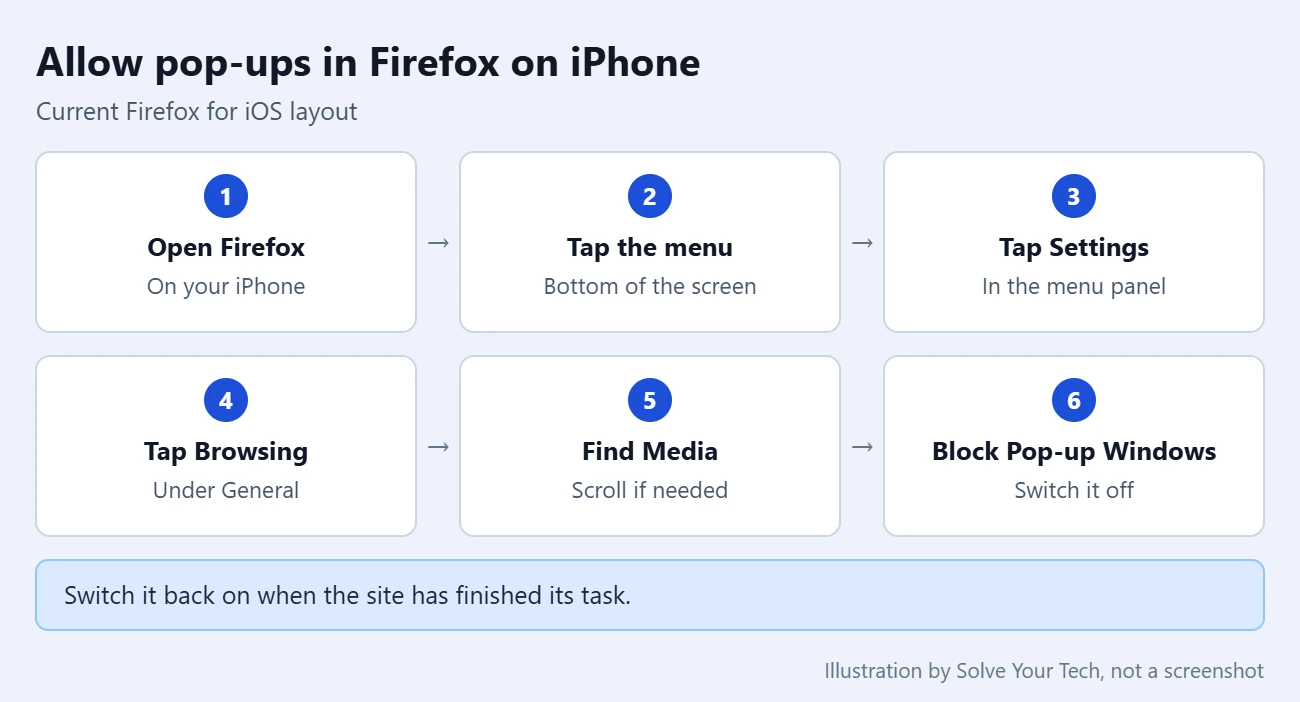
- Open Firefox on your iPhone. Any page or the home screen of the app is fine.
- Tap the menu button. On an iPhone it sits at the bottom of the screen. A menu panel slides up.
- Tap Settings in the menu panel. The Firefox settings list opens.
- In the General group, tap Browsing. A screen with sections for tabs, links, media, and content opens.
- Find the Media section. It also holds the Autoplay setting, so that is a useful landmark.
- Tap the switch next to Block Pop-up Windows so it turns from colored to gray. Gray means the blocker is off and pop-ups are allowed.
- Go back out of Settings. If you see Done in the top corner, tap it. The change applies right away.
Return to the page that needed the pop-up and repeat the action that failed, such as tapping the print or sign-in button. If nothing happens, refresh the page first so it loads with the new setting. Our guide on how to reload a page in the Firefox iPhone app shows where that button is.
If You Do Not See Browsing or Media
Firefox for iOS has moved this switch more than once, so the path depends on the app version.
- Older layout: the Block Pop-up Windows switch appears directly on the main Settings screen instead of inside Browsing. Scroll the list until you see it.
- Menu button looks different: the menu button may show three lines or three dots depending on the version and your toolbar layout. On an iPad it is at the top right.
- Still cannot find it: update Firefox from the App Store, then follow the steps above again. The newest version uses the Browsing screen.
How to Check That It Worked and Turn Blocking Back On
The setting worked if the window you were waiting for opens, usually as a new tab. Look at the tab counter in the toolbar. If the number went up after you tapped the button on the site, the pop-up opened in another tab and you can switch to it.
To undo the change, open the menu, tap Settings, tap Browsing, and switch Block Pop-up Windows back on. Nothing else is affected. Your tabs, history, and saved logins stay as they were.
The Pop-Up Switch Is Not the Ad Blocker
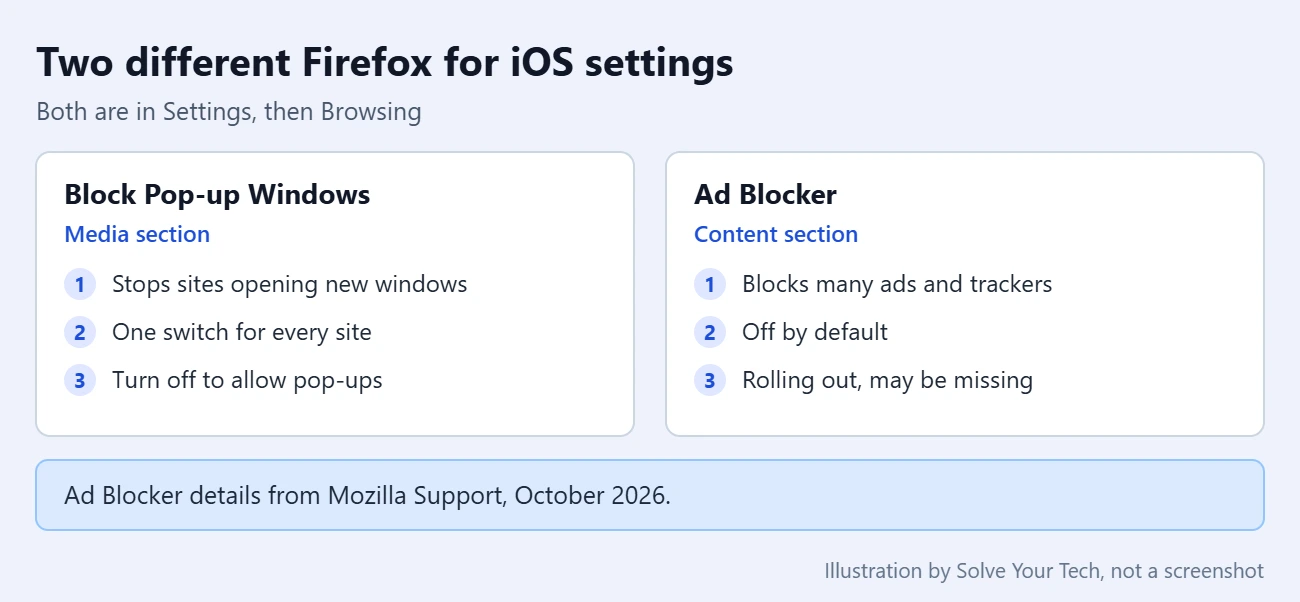
Firefox for iOS has a second setting that can also stop pop-ups. Mozilla describes an optional Ad Blocker in its article on blocking ads in Firefox for iOS. According to Mozilla, it blocks many ads, ad-related trackers, and intrusive formats such as pop-ups and overlays. It is off by default, it is experimental, and it is being released gradually, so it may not be on your phone yet.
If you turned the Ad Blocker on, it can keep blocking a window even after you allow pop-ups. To check, go to Settings, scroll to Browsing, and look at Ad Blocker in the Content section. Mozilla also says you can reach it while browsing: open the menu on a web page and tap Ad Blocker.
A Site Still Says Pop-Ups Are Blocked
Some sites keep showing a pop-up warning even with the switch off. Volunteers on the Mozilla Support forum have noted that a few sites, including some government pages, detect the blocker incorrectly, so turning the switch off is worth trying but is not certain to fix every site. Work through these checks in order.
- Reload the page. A page that loaded while the blocker was on may not try again until it is refreshed.
- Check the Ad Blocker. Turn it off for the moment if it is on, as described above.
- Relax Tracking Protection for that site. Mozilla says the Strict level of Enhanced Tracking Protection can block some website functions. Tap the shield icon next to the address bar and switch protection off for that site, or press and hold the refresh button and tap Reload without Tracking Protection. Both are described in Mozilla’s guide to Enhanced Tracking Protection in Firefox for iOS.
- Clear the site’s stored data. The same shield panel has a Clear cookies and site data option. For a wider cleanup, see how to delete cookies and history in Firefox on iPhone. Expect to sign in to the site again afterward.
- Try the site in Safari. If the task is urgent and Firefox still will not open the window, Safari has its own pop-up setting, covered next.
Allowing Pop-Ups in Safari Instead
Safari’s pop-up setting is not inside the browser. Apple’s page on how to block pop-ups in Safari on iPhone says to open the Settings app, tap Apps, tap Safari, and use the Block Pop-ups switch. Turning it off allows pop-ups in Safari only. It has no effect on Firefox, and the Firefox switch has no effect on Safari.
Frequently Asked Questions
Is it safe to allow pop-ups in Firefox on an iPhone?
It is reasonable for a short time on a site you trust, such as your bank or a government service you typed the address for. The risk comes from leaving the blocker off while you browse other sites. Close any pop-up that claims your iPhone has a virus, offers a prize, or asks you to call a phone number.
Can I allow pop-ups for just one website in Firefox for iOS?
Mozilla does not document a per-site option for the iPhone app. Block Pop-up Windows is a single switch for all sites. The practical approach is to turn it off, finish what you need on the one site, and turn it back on.
Does allowing pop-ups remove cookie banners or newsletter boxes?
No. Those boxes are overlays drawn inside the page itself. They are not separate windows, so the pop-up switch neither blocks nor allows them. Mozilla lists overlays among the formats its optional Ad Blocker can reduce.
Do these steps work in Firefox on an iPad?
Yes, with one difference. Firefox for iPad is the same app, but Mozilla notes the menu button is at the top right of the screen on an iPad. From there, the path through Settings and Browsing is the same.
Does this setting sync to Firefox on my computer?
Treat it as separate. The switch described here belongs to the iPhone app, and Firefox on a computer has its own pop-up settings in a different place. Changing one should not be expected to change the other.
Next Step
Once the bank, form, or label you needed has opened, go back to Settings > Browsing and switch Block Pop-up Windows on again so other sites cannot open windows on their own.

Matthew Burleigh is the founder, head writer, and editor of Solve Your Tech, which he launched in 2012. He has written technology tutorials since 2008 and worked in IT since 2003, including small-business support, IT management, and consulting. He holds Bachelor’s and Master’s degrees in Computer Science from Arizona State University.
Matthew writes practical guides for Windows, iPhone and iPad, Microsoft Office, Outlook, Google apps, and Android. Solve Your Tech’s guides are tested on current devices or checked against official product documentation, with clear steps, sources, and update dates.
Read more about Matthew and how Solve Your Tech writes and updates its guides, or report a correction.