Google Maps shows someone’s location only if they choose to share it with you. Once they have, open the Google Maps app, tap your profile picture or initial, tap Location sharing, and tap the person’s profile. Their position appears on the map.
This guide covers Android, iPhone, iPad, and Google Maps in a computer browser. Google Maps can’t follow someone who hasn’t agreed to it, and secretly tracking a person is illegal in many places. If you only need a meeting point, pin your current location instead.
What you need before you start
Location Sharing is the Google Maps feature that lets one person send their real-time position (a location that keeps updating as they move) to people they pick. Both sides need a few things in place.
- Their permission. The other person has to start the share from their own phone or tablet. You cannot turn it on for them from your device.
- A mobile device on their end. Google says real-time sharing must be started from the Google Maps app on a phone or tablet. A computer can view and manage shares but cannot start one.
- Google Accounts. To share directly with you, they sign in to Google Maps and choose your Google Account. Google also tells the sharer to save your Gmail address in their Google Contacts first. If you have no Google Account, they can send a link instead.
- A phone that is on and connected. Their position can only update while their device has power and an internet connection.
- An eligible account. Location Sharing is not offered in every country or region, can be turned off by the administrator of a work or school (Google Workspace) account, and has age requirements.
Ask the person to follow these steps on their own Android device, iPhone, or iPad. The labels are the same on both platforms.
Before they share: sharing shows you more than a dot on a map. People they share with can always see their name and photo, their device’s recent location even when Google apps are not in use, and the device’s battery level and whether it is charging. They should pick a time limit they are comfortable with.
- Open the Google Maps app and make sure they are signed in to their Google Account.
- Tap their profile picture or initial at the top right, then tap Location sharing.
- Tap New share.
- Choose how long to share, such as a set number of hours or Until you turn this off.
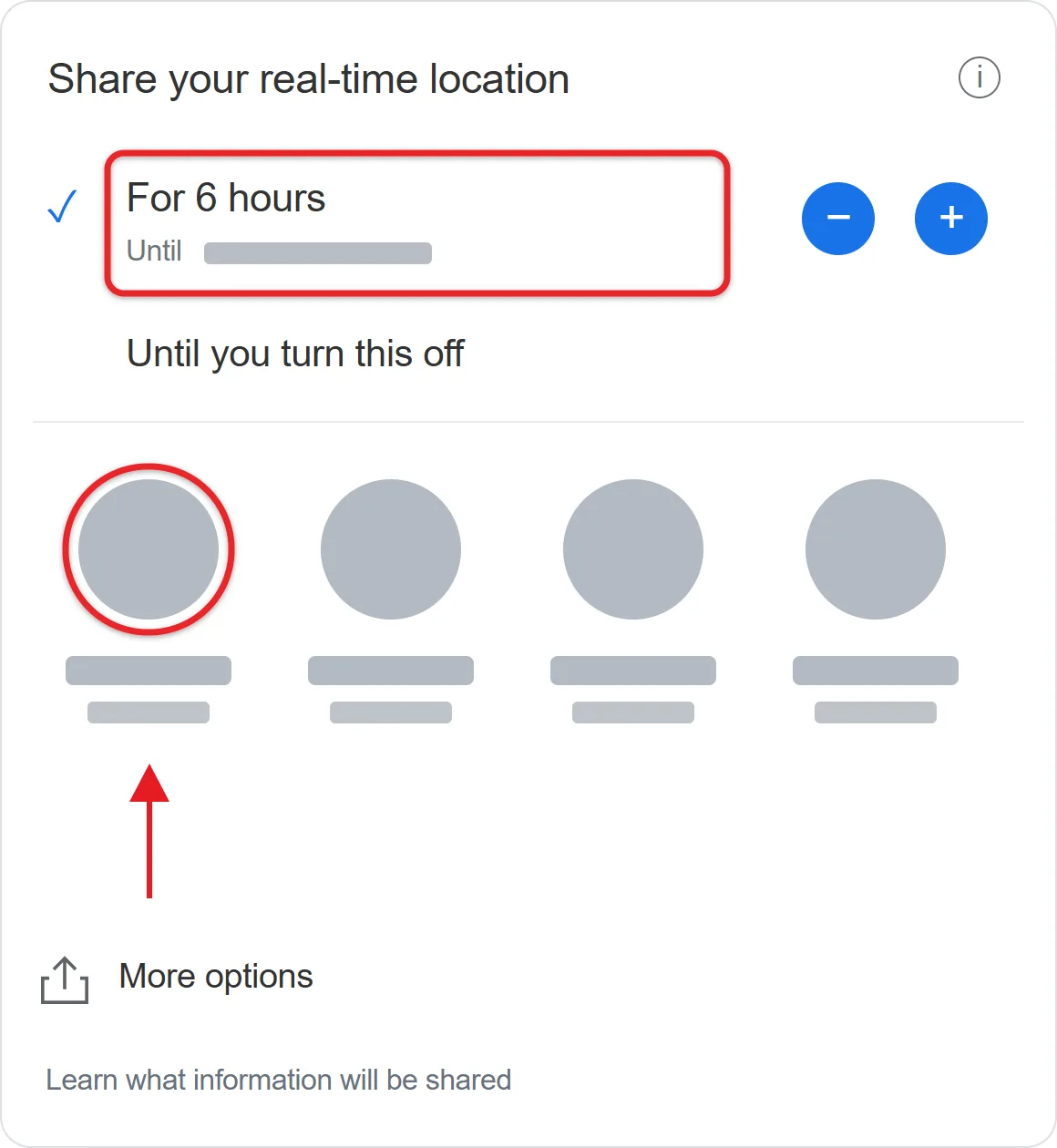
- Tap your profile in the row of suggested people. If you are not listed, they can swipe the row to the right, tap More, and search for your name, phone number, or email address.
- If Google Maps asks for access to their contacts, they can allow it.
- Tap Share.
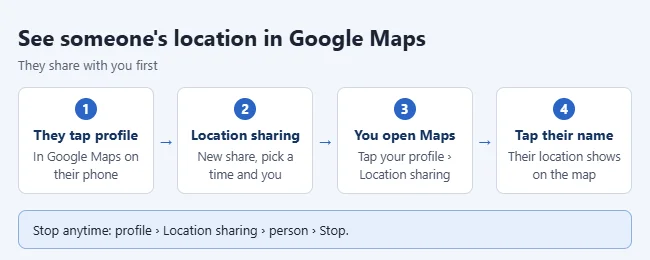
These steps come from Google’s Share your real-time location with others in Google Maps help page, which has separate tabs for Android, iPhone and iPad, and computer.
How to see their location on your phone or tablet
- Open the Google Maps app on your Android device, iPhone, or iPad. Sign in with the Google Account they shared with.
- Tap your profile picture or initial at the top right.
- Tap Location sharing. People who are sharing with you appear at the bottom of the screen.
- Tap the profile of the person you want to find. The map moves to their position.
- If the position looks old, tap the person’s icon, tap More, then tap Refresh.
You know it worked when their photo or initial appears on your map. If nobody is listed under Location sharing, no one is currently sharing with the account you are signed in to.
How to see their location on a computer
- Open Google Maps in your browser and sign in to your Google Account.
- Click Menu (the three lines at the top left).
- Click Location sharing.
- Choose the person you want to find on your map.
The computer version is view-and-manage only. You must use a mobile device to share your own real-time location.
If they send you a link instead
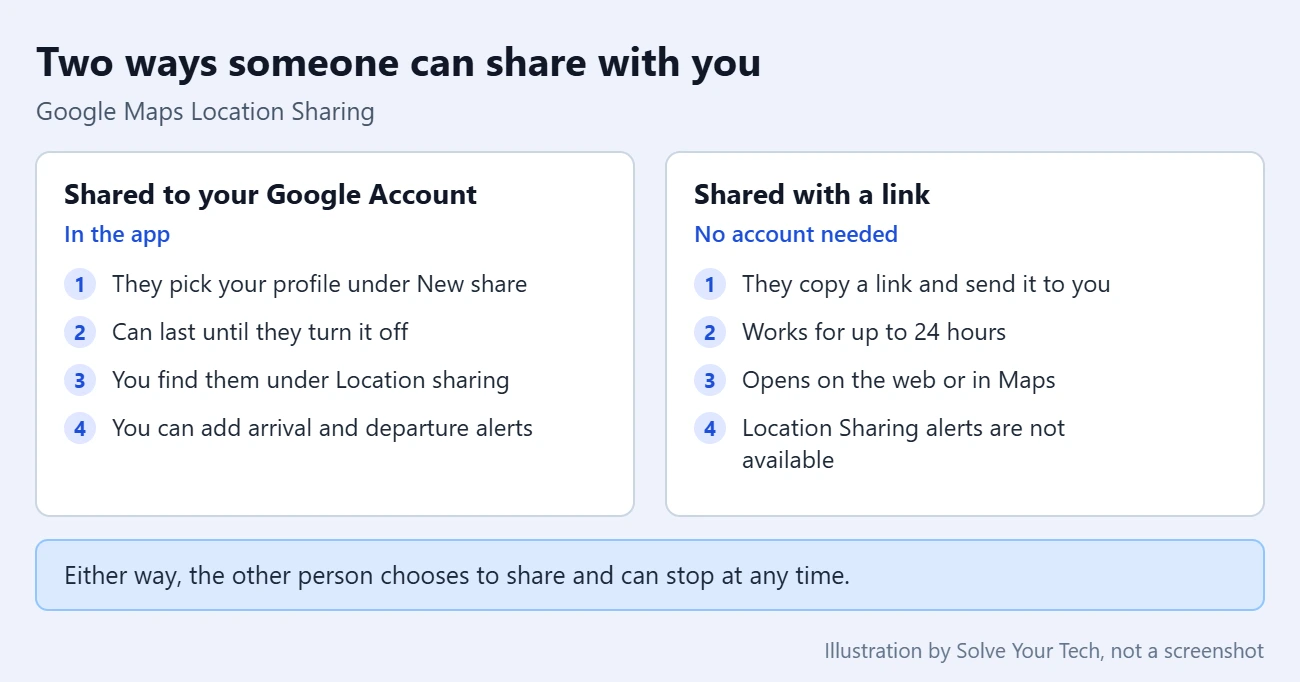
Someone can also share without choosing your Google Account. Under New share, an Android user taps Copy to clipboard and pastes the link into a text or email. An iPhone or iPad user taps Message to send it through iMessage, or More options to pick another app. Open the link they send to see where they are.
A link is more limited. A real-time location can be shared with people who have the link for up to 24 hours, and anyone who has the link can open it, so the sharer should send it only to people they trust.
To send a fixed meeting spot instead of a moving position, drop and share a pin in Google Maps.
You can send a request from Google Maps, but only to a person you have shared your own location with, or who shared theirs with you in the past.
- Open Google Maps, tap your profile picture or initial, then tap Location sharing.
- Tap the contact.
- Tap Request. On Android, tap Request again to confirm.
The person gets a notification, and they also see your email address. They can share with you, ignore the request, or block you. If they block the request, you can no longer ask for their location. A request never turns sharing on by itself.
Get a notice when they arrive or leave
When someone shares with your Google Account, you can add a Location Sharing notification for a place such as home or work.
- In Google Maps, tap your profile picture or initial, then Location sharing.
- Tap the profile of the person who shares with you.
- In the Notifications section, tap Add.
- Choose a location, or add one by entering an address or picking it on the map.
- Choose Every time they arrive, Every time they depart, or both, then save.
This is not a hidden feature. Google emails the sharer to say you added the notification, and they can turn these notifications off in their Google Account. You can add up to five for each person. Google Maps notifications must be turned on for your device, and the alerts are not available for shares sent as a link. The rest of the rules are on the Get Location Sharing notifications page.
Hide someone, or stop sharing your own location
Hiding a person only removes them from your map. It does not stop their share, and it does not affect what they can see of you.
- Hide on a phone or tablet: tap the person’s icon on the map, tap More at the bottom, then tap Hide from map.
- Show them again: go to Location sharing, tap their profile at the bottom, then tap Unhide at the top.
- Hide on a computer: click Menu, then Location sharing, choose the person, and click Hide on map.
To stop sharing your own position, open Location sharing, tap the profile of the person you no longer want to share with, and tap Stop. Sharing ends for that person only. To start again, create a new share.
If you receive a request you do not want to accept, tap No to decline it, or Block to decline and prevent that account from asking again. Blocking also affects how that person can contact you in other Google products.
Why you can’t see someone’s location
- They have not shared, or the share ended. A timed share stops by itself, and a link lasts up to 24 hours. Ask them to start a new share or send them a request.
- You are in the wrong account. The share is tied to one Google Account. Tap your profile picture and check which account is active.
- Their phone is off or offline. Their position cannot update until the device has power and a connection again, so what you see may be out of date. Try Refresh once they are back online.
- You hid them. Open Location sharing, tap their profile, and tap Unhide.
- Location sharing shows a warning. The possible causes are a country or region where the feature is unavailable, a Google Workspace account whose administrator has not turned it on, or an account that is too young.
- Sharing has failed for more than 24 hours. Google’s advice for the sharer is to verify their age, and if that does not help, to create a new share set to Until you turn this off and find the recipient through More. Google also notes that the recipient must have a Gmail account.
- The app is out of date. Update Google Maps from the Play Store or the App Store, then check again.
Frequently asked questions
Can I see someone’s location on Google Maps without them knowing?
No. The other person has to start the share themselves, they can see who they are sharing with, and they can stop at any time. Google Maps has no hidden tracking mode. Following another adult without their knowledge can break stalking or privacy laws, so use Location Sharing only with people who have agreed to it.
Can I find someone by typing their phone number into Google Maps?
No. Searching a number in Google Maps can bring up a business that lists that number, not the position of a person’s phone. A phone number or email address is only useful for helping the sharer find your profile when they create a share.
What can I see when someone shares with me?
You can see their name and photo, their device’s recent location, the device’s battery level and whether it is charging, and their arrival and departure times if you add a Location Sharing notification.
Does the other person need Timeline turned on?
No. Location Sharing works even when Timeline is turned off. Timeline is a private record of your own places and is not something another person can open from their account.
Can I see where my child is?
Google handles this through the Family Link app, not through a secret Maps setting. A parent who manages a child’s Google Account can turn on location sharing in Family Link and see the child’s Android device there. Google’s Find and manage your child’s location page has the setup steps.
Can Google Maps find my own lost phone?
Use Find Hub, Google’s tool for locating a lost Android device that is signed in to your own account. See Google’s Find, secure, or erase a lost Android device instructions. It is meant for your own devices, not for watching someone else’s.
What if we both have iPhones?
Google Maps Location Sharing works on iPhone, but you can also share your location with Apple’s Find My or Messages. If you want to stop being located that way, here is how to turn off Find My iPhone.
Next step
Ask the person to start a share with a time limit, then confirm you can see them under Location sharing. If you are sharing your own position too, review that list now and tap Stop for anyone who no longer needs it. While you’re in Google Maps, you can also write a review on Google for places you’ve visited.

Matthew Burleigh is the founder, head writer, and editor of Solve Your Tech, which he launched in 2012. He has written technology tutorials since 2008 and worked in IT since 2003, including small-business support, IT management, and consulting. He holds Bachelor’s and Master’s degrees in Computer Science from Arizona State University.
Matthew writes practical guides for Windows, iPhone and iPad, Microsoft Office, Outlook, Google apps, and Android. Solve Your Tech’s guides are checked step by step against the device or app maker’s own documentation and tested on his own devices whenever he has the hardware or software, with clear steps, sources, and update dates.
Read more about Matthew and how Solve Your Tech writes and updates its guides, or report a correction.