Facebook has no single “highlights” switch. To stop @highlight alerts, turn off Batch mentions in Settings & privacy > Settings > Notifications > Tags. To quiet a group, change its notification level from Highlights to Off. To clean up your profile, use Edit Featured.
Facebook keeps pinging you that someone mentioned @highlight in a group post, or a profile shows a Featured row you never meant to keep, and you want the noise gone. Find your version of the problem below.
Which Facebook “Highlights” Are You Seeing?
The word shows up in several unrelated places on Facebook, and each one has its own control. Meta’s Help Center uses it for a group notification level and for group highlights in private groups, and it lists @highlight as one kind of batch mention. The row of photos at the top of a profile, which many people call highlights, is what Meta calls the Featured section. Match what you see to the right fix before you change anything.
| What you see | What it is | Where to change it |
|---|---|---|
| A notification saying a friend mentioned @highlight | A batch mention | Notifications > Tags > Batch mentions |
| Group alerts about suggested posts or friends’ posts | The group’s “Highlights” notification level | The group’s Manage notifications screen |
| A request to show your private group post to non-members | Group highlights in a private group | You > Group highlights > Manage, inside the group |
| A row of photos or stories near the top of your profile | The Featured section | Edit Featured in your profile’s Intro section |
If you’ve seen advice about a “Manage Highlights” button on your profile or a Highlights tab in your feed, Meta’s Help Center doesn’t describe either one. Older instructions that mention them most likely mean the profile section Meta now calls Featured.
Stop @highlight Notifications by Turning Off Batch Mentions
A batch mention lets one person notify many people at once from a post, comment, video, story or reel. Meta lists four kinds: @followers (for creators), @attendees (for event hosts), @everyone (for group admins) and @highlight, which it describes as a way to share moments and highlights with friends. So when a friend types @highlight in a post, everyone who can see that post may get a notification about it.
Meta says you only get these notifications for content you could already see, and you won’t get one if you’ve blocked the person who posted, aren’t in the post’s audience, or have already received too many batch-mention notifications that day. Turning off Batch mentions stops the whole category, including @highlight and @followers alerts.
On an iPhone
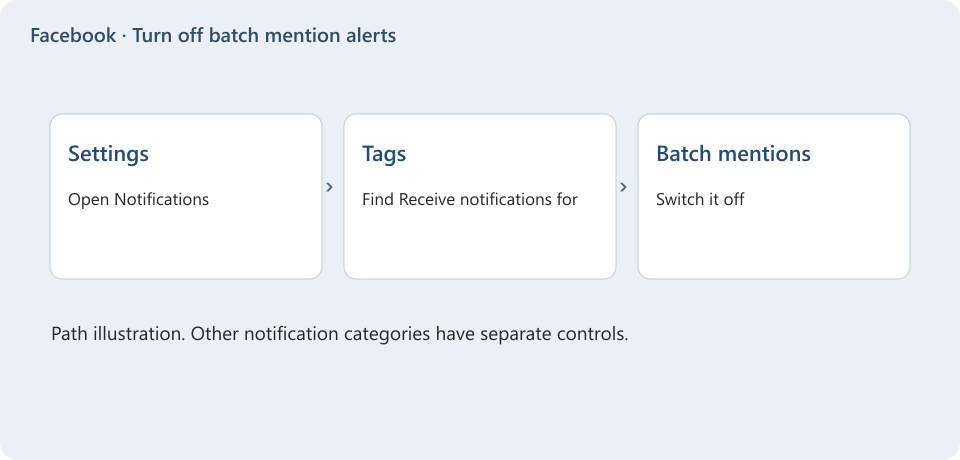
- Open the Facebook app and tap the Menu button (Meta’s iPhone instructions place it in the top left).
- Tap Settings & privacy, then Settings.
- Tap Notifications, then Tags.
- Under Receive notifications for, switch off Batch mentions.
On an Android phone the labels should be similar, but the Menu button may sit in a different corner and the wording can shift between app versions. Look for the same Notifications and Tags screens.
On a Computer
- Go to facebook.com and click your profile picture in the top right.
- Click Settings & privacy, then Settings.
- Click Notifications in the left column, then Tags.
- Under Receive notifications for, switch off Batch mentions.
The setting belongs to your account, so changing it on one device should apply everywhere you’re signed in. Meta’s batch mentions help page also notes that you can turn off batch mentions from one specific group instead of everywhere, which is useful if a single busy group causes all the alerts. That per-group option sits in the group’s notification settings, covered next.
Change a Group’s Notification Level From Highlights
When you join a Facebook group, Meta sets its notifications to Highlights by default. Meta defines that level as notifications for suggested posts and posts from your friends. If you’ve joined a lot of groups, those defaults add up fast, and the alerts look like Facebook is “highlighting” random posts.
Each group offers four in-app levels:
- All Posts: an alert for every post.
- Highlights: suggested posts and posts from your friends (the default).
- Friends’ Posts: only posts from your friends.
- Off: no routine post alerts. You can still get mentions and important updates about the group.
On a Computer
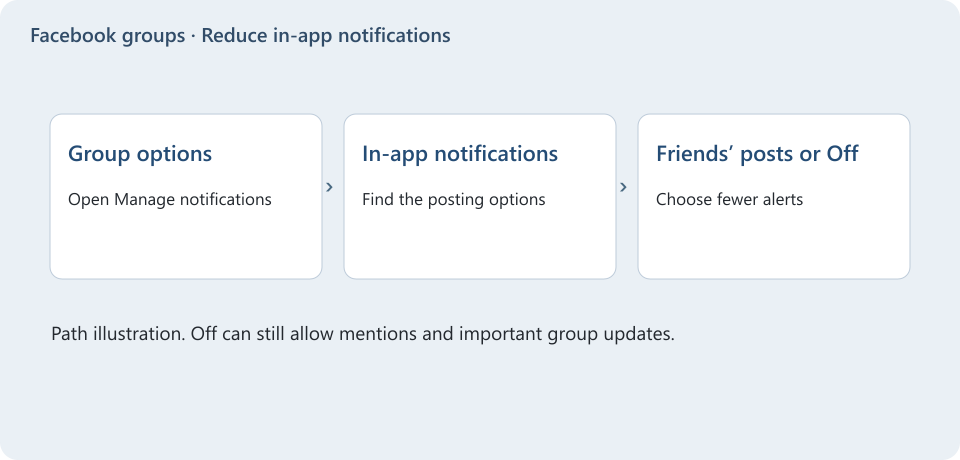
- Go to facebook.com/groups and choose the group.
- Click Options in the top right, below the cover photo.
- Click Manage notifications.
- Pick Friends’ Posts or Off. The same screen also has push notification and member request settings you can adjust.
On an iPhone
- Tap Menu, then Groups (tap See more if you don’t see it), then Your groups, and open the group.
- If you’re a member, tap Options in the top right and then Manage notifications. If you’re an admin, go to Admin home > Personal settings > Manage notifications.
- Choose your in-app level, push setting and batch mention setting.
- Tap Go back to save.
Group admins can use @everyone to reach every member. On a computer, Meta says you can stop those from one group at a time: click the notifications bell, find the @everyone notification, click its options and turn off @everyone notifications from that group.
Group alerts aren’t the only interruptions Facebook sends. If incoming voice and video calls are the bigger nuisance, you can stop Facebook and Messenger calls from ringing as well. Meta notes on its notification settings page that you can’t turn off Facebook notifications entirely, so plan on trimming categories rather than finding one master switch.
Manage Group Highlights in a Private Group
Group highlights is a separate feature that only certain private groups have. It lets posts and comments from a private group appear publicly to people who aren’t members. According to Meta’s page About group highlights for private Facebook groups, nothing you wrote is shown this way unless you approve it, though Meta may use AI to pick which posts to suggest.
An approved highlight can appear at the top of the group’s page for non-members, in Facebook search and in search engines. It includes the text and photos, the post date, and the number of comments and reactions. Your name and profile photo aren’t shown, but Meta warns that the content itself could still reveal who wrote it. Nobody can comment on or react to a highlight.
If You’re a Member
- In the Facebook app, tap Menu > Groups (or See more first) and open the group.
- Tap You.
- Below Group highlights, tap Manage.
- Under Pending, tap Approve or Decline for each suggestion.
- Under Approved, tap Remove highlight on anything you no longer want shown publicly.
If you’ve already left the group, you can’t reach that screen. Meta’s advice is to delete the post or comment itself through your Activity Log.
If You’re an Admin
Meta says admins manage group highlights in the Android and iPhone apps only, not on a computer. Before you start, know that Meta states plainly that the highlights feature can’t be turned off. Admins can hide individual highlights, but hidden ones may still turn up in Facebook search or search engines.
- Tap Menu > Groups > Your groups and open the group you manage.
- Tap Manage, then See all tools under Tool shortcuts.
- Under Moderation, tap View group highlights.
- Open a highlight and tap Hide highlight.
Here’s a typical case. A neighborhood swap group is private, and a member’s post about a found bike gets suggested as a highlight. The member can decline it from the You tab. If it was already approved, the member can remove it, and an admin can hide it too. Neither action switches the feature off for the group.
Remove Photos or Stories From Your Profile’s Featured Section
The row of photos and stories some people call “profile highlights” is the Featured section. Meta’s Featured section help page explains that adding something to Featured makes a copy, so likes and comments on the original don’t carry over, and that Featured items are Public. That public setting is a common reason people want to clear the section out.
Delete a Whole Featured Collection on a Computer
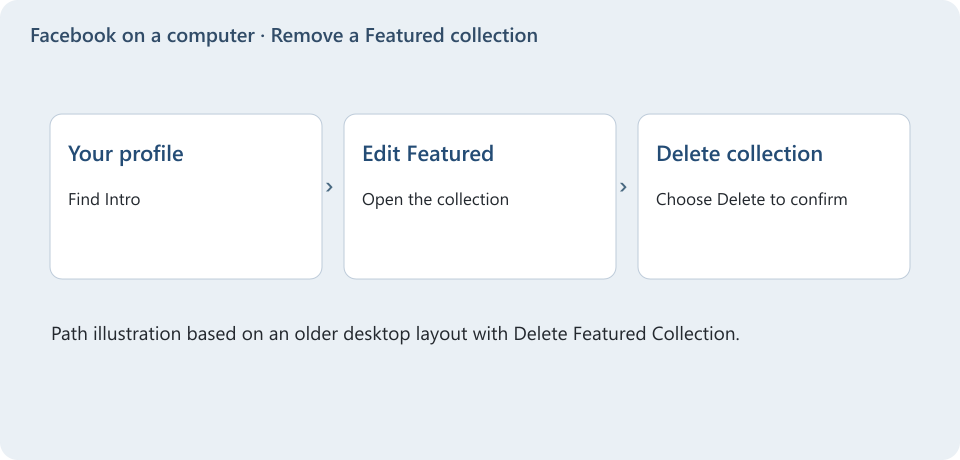
- Click your profile picture in the top right, then your name.
- In the Intro section, click Edit Featured.
- Select the collection, scroll down and click Delete Featured Collection.
- Click Delete to confirm.
Remove One Item but Keep the Collection
- Open Edit Featured and select the collection.
- Click the checkmark on the photo or story you want out, so it’s no longer selected.
- Click Save.
The same edit screen lets you add more items, change the cover photo or rename the collection. In the Facebook app the steps may look a little different; Meta keeps separate versions of this page for iPhone, Android and other apps, so look for Edit Featured from your profile’s Intro area.
Removing something from Featured doesn’t delete the original. A photo stays on your profile with whatever audience it had before, and a story stays in your story archive, visible only to you. If you’d rather tighten who sees the rest of your profile, look at how to lock your Facebook profile.
When the Problem Is Your Feed, Not Highlights
Some people searching for this mean their feed feels full of posts Facebook has chosen for them. Meta’s Help Center doesn’t describe a Highlights feed or tab with an off switch, so the settings above won’t change what your main feed shows. For that, the better route is to reset your Facebook feed with the feed preference tools.
Also keep in mind that Meta is gradually moving people to new account settings screens, so labels can differ slightly between your phone, your computer and a friend’s device. If a menu name doesn’t match exactly, look for the closest wording in the same area.
Check That It Worked and How to Undo It
- Batch mentions: reopen Notifications > Tags and confirm the toggle is off. The next time a friend uses @highlight, you shouldn’t get an alert. Turn the toggle back on to undo.
- Group notifications: reopen Manage notifications in the group and confirm the level you picked. Set it back to Highlights or All Posts any time.
- Group highlights: check the Approved list under You > Group highlights. A declined suggestion won’t appear publicly.
- Featured: view your profile and check the Intro area. A deleted collection doesn’t come back on its own, so rebuild it with Edit Featured if you change your mind.
Facebook Highlights Questions
Does Turning Off Batch Mentions Stop Regular Tags?
Meta’s steps switch off only the Batch mentions item in the Receive notifications for list under Tags, and the other items there keep their own toggles. Meta’s wording about what else stops is broad, so if you still want regular tag alerts, check the other toggles on the Tags screen after you change it.
Why Do I Still Get Alerts From a Group I Muted?
Each group has separate in-app, push and batch mention settings. Check all three in Manage notifications, and on a computer turn off @everyone for that group from the notification itself. Also check that you changed the right group, since each new group you join starts at Highlights.
Can Non-Members See Who Wrote a Group Highlight?
Meta says your name and profile photo aren’t shown, but a photo or details in the post itself could still identify you. If that worries you, decline the suggestion rather than approving it.
Can I Hide Featured Items From Certain Friends?
Meta’s Featured page describes those items as Public and doesn’t list a per-friend audience option. If you don’t want someone to see a featured photo, remove it from the collection.
Start with whichever source sends the most alerts, usually batch mentions, then work through your busiest groups one by one.

Matthew Burleigh is the founder, head writer, and editor of Solve Your Tech, which he launched in 2012. He has written technology tutorials since 2008 and worked in IT since 2003, including small-business support, IT management, and consulting. He holds Bachelor’s and Master’s degrees in Computer Science from Arizona State University.
Matthew writes practical guides for Windows, iPhone and iPad, Microsoft Office, Outlook, Google apps, and Android. Solve Your Tech’s guides are checked step by step against the device or app maker’s own documentation and tested on his own devices whenever he has the hardware or software, with clear steps, sources, and update dates.
Read more about Matthew and how Solve Your Tech writes and updates its guides, or report a correction.