On a home PC, not reliably. Microsoft’s Windows 11 specifications say Windows 11 Home and Windows 11 Pro for personal use need an internet connection and a Microsoft account during first-time setup, and Microsoft has removed the known setup workarounds from recent builds. The dependable way to end up with a local account is to finish setup with a Microsoft account, then switch to a local account in Settings.
This covers current Windows 11 Home and Pro setup, plus the work or school routes in Windows 11 Pro, Enterprise, and Education. It doesn’t cover registry edits, setup commands, or third-party tools that try to get around setup.
What Microsoft Says About Skipping the Sign-In
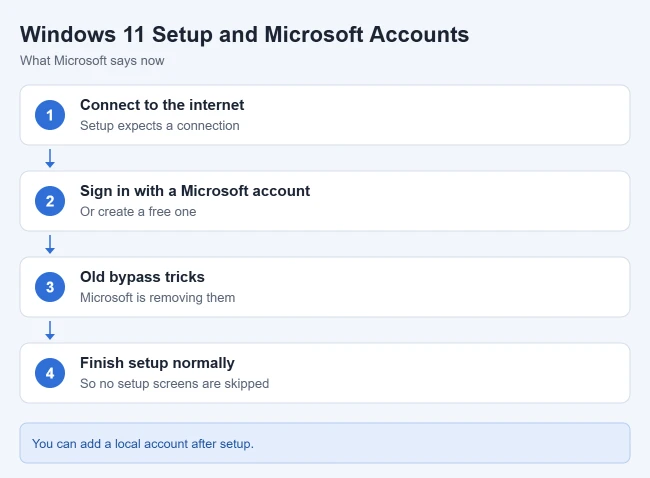
Microsoft has closed the setup shortcuts in two steps, both announced on the Windows Insider blog:
- March 2025: In Dev Channel build 26200.5516, Microsoft said it was removing the bypassnro.cmd script so that all users exit setup with internet connectivity and a Microsoft account. That script was behind the popular OOBE\BYPASSNRO trick.
- October 2025: In Beta Channel build 26120.6772, Microsoft said it was removing known mechanisms for creating a local account in Windows Setup (called OOBE, the out-of-box experience). It explained that these mechanisms could skip critical setup screens and leave a device that isn’t fully configured.
Microsoft hasn’t published a list of retail Windows 11 builds that include these changes, so a trick that worked on older installation media may fail on newer media. Guides that tell you to disconnect from the internet, type a command, enter a made-up email address, or click a hidden link during setup rely on methods Microsoft doesn’t support and keeps closing. Don’t plan around them.
Which Option Fits Your PC
| Your situation | Supported route |
|---|---|
| Home PC with Windows 11 Home or Pro | Set up with a Microsoft account, then switch to or add a local account |
| Work or school PC with Pro, Enterprise, or Education | Choose Set up for work or school and sign in with the account your organization gave you |
| Office PC on an Active Directory domain | Finish setup, then join the domain in Settings |
| IT deploying many PCs | Define local accounts in an answer file, or use Windows Autopilot |
Before You Switch to a Local Account
- Back up your recovery key. Microsoft’s device encryption article says that when you set up a PC with a Microsoft account, device encryption turns on automatically and the recovery key is attached to that account. Save your own copy before you switch.
- Pick a password you’ll remember. Microsoft can’t reset a local account password online. Create a password reset disk or set security questions after you switch.
- Choose a unique user name. Microsoft says it must be different from any other account on the PC.
Method 1: Switch Your Setup Account to a Local Account
This keeps your files, apps, and desktop. Only the way you sign in changes. These steps follow Microsoft’s guide to switching between a local account and a Microsoft account:
- Finish Windows setup by signing in with a Microsoft account. You can create a free one on the sign-in screen, or create an Outlook email account ahead of time.
- Open Settings and select Accounts > Your info. Your name and Microsoft account email appear at the top.
- Under Account settings, select Sign in with a local account instead.
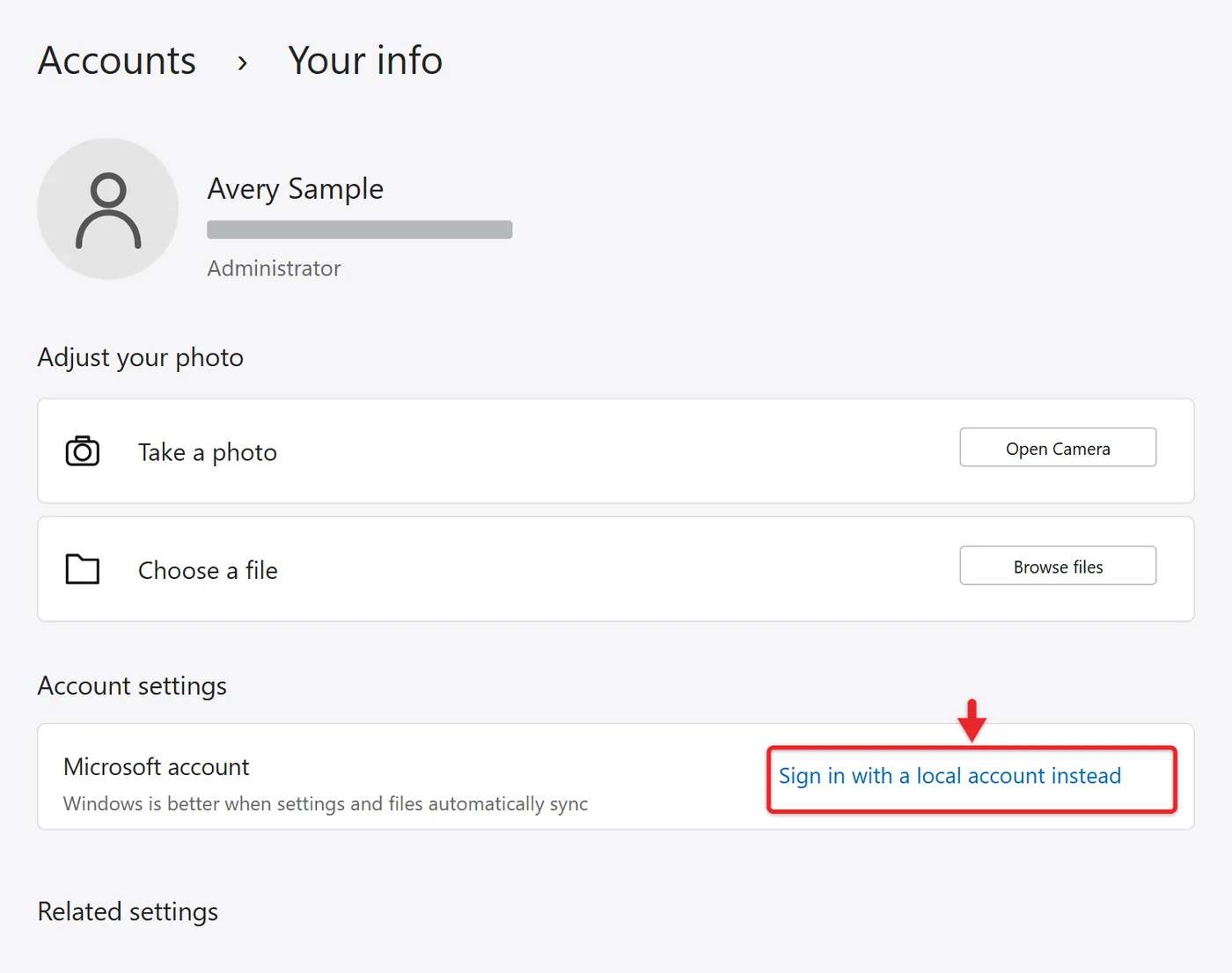
- Confirm your identity with your PIN or Microsoft account password, then select Next.
- Enter a user name, password, and password hint for the local account, then select Next.
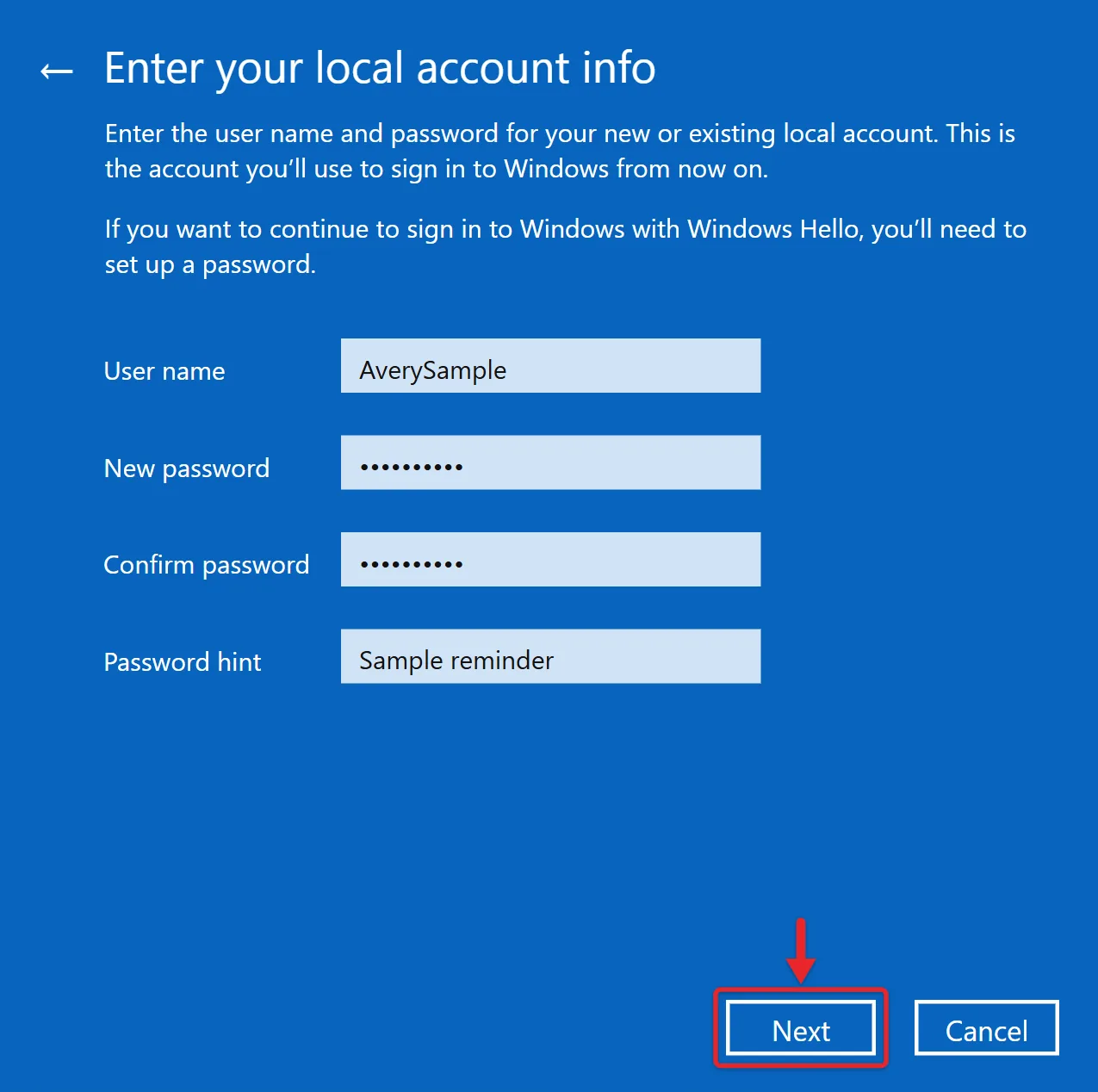
- Select Sign out and finish. Windows signs you out.
- Sign back in with the new local password.
To confirm it worked, open Accounts > Your info again. You should see Local account under your name, and the link now reads Sign in with a Microsoft account instead. For screenshots of each screen, follow the steps for switching to a local account in Windows 11.
Windows may still ask for the PIN you created during setup; you can turn off the PIN on Windows 11 if you want to use the local account password instead.
Method 2: Add a Separate Local Account
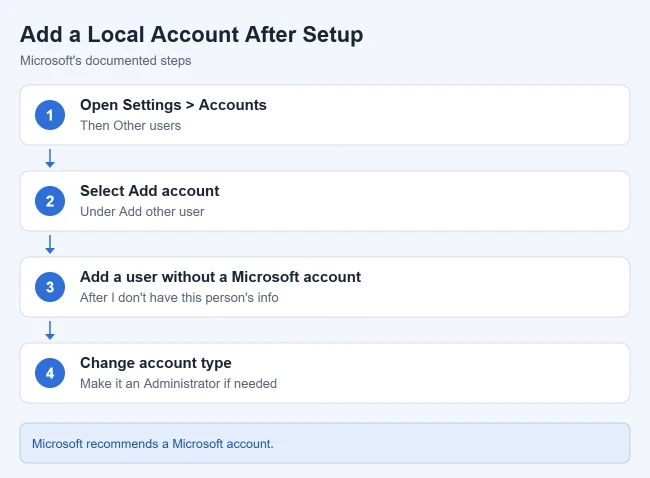
Use this if you want to keep the Microsoft account and add a second user, such as for a shared PC. Microsoft’s article on managing user accounts in Windows lists these steps:
- Open Settings and select Accounts > Other users.
- Under Add other user, select Add account.
- Select I don’t have this person’s sign-in information.
- Select Add a user without a Microsoft account.

- Enter a user name and password, then follow the prompts.
The new account appears under Other users. To give it full control of the PC, select the account, select Change account type next to Account options, choose Administrator, and select OK. Microsoft cautions that you should limit the number of administrators on a device.
A new local account starts with an empty profile, so your files stay with the original account. For the full process, read about creating a local account on Windows 11.
Method 3: Set Up for Work or School (Pro, Enterprise, Education)
If your organization gave you a work or school account, you don’t need a personal Microsoft account. Microsoft’s guide to joining Windows 11 to Microsoft Entra ID during setup describes the flow:
- Connect the PC to the internet and start setup.
- At How would you like to set up this device?, select Set up for work or school.
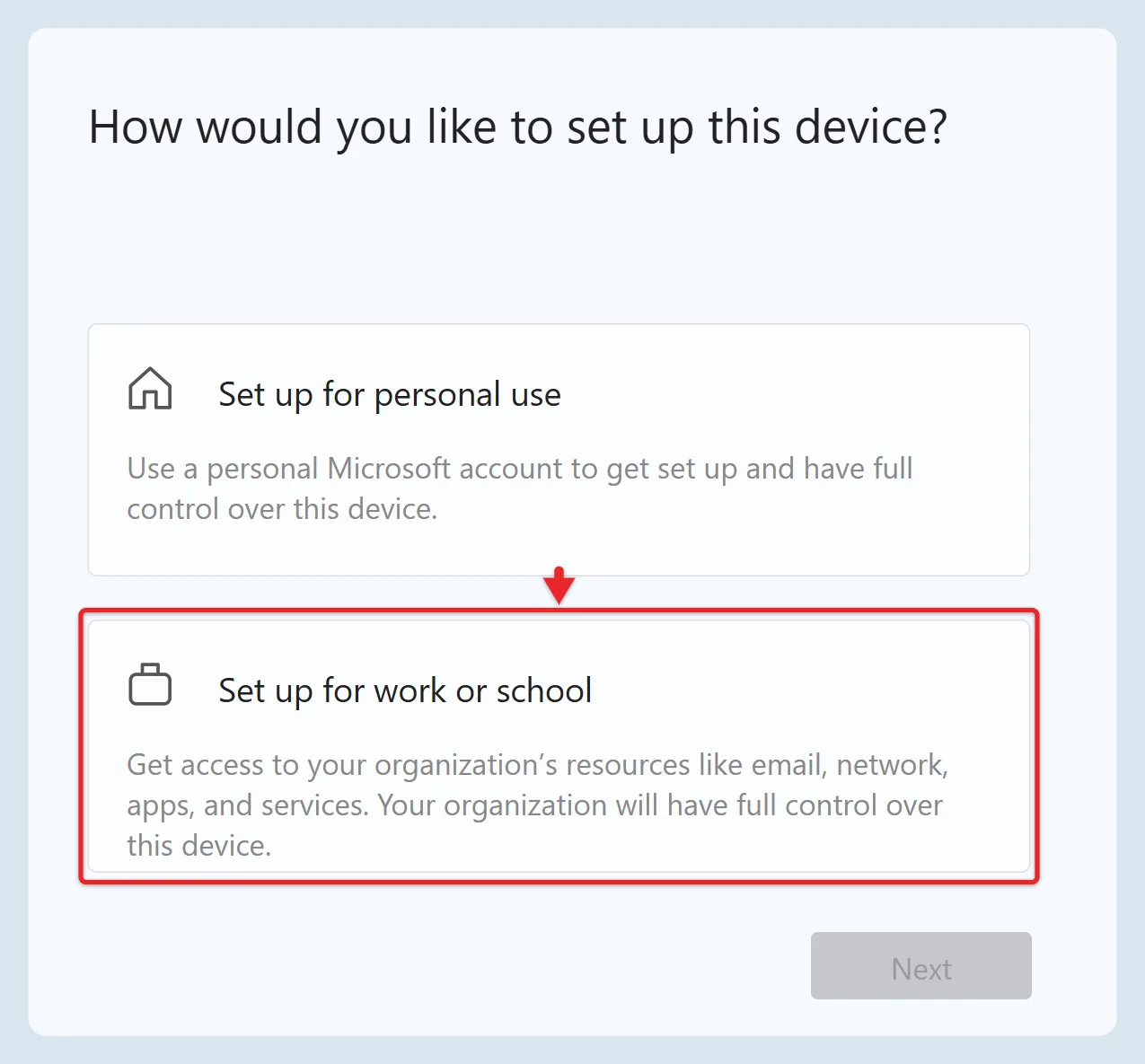
- Enter the account and password your organization provided.
- Follow the remaining prompts. The PC may restart several times.
Windows Home editions don’t support this kind of join, and your organization has to have it set up. To check afterward, open Settings > Accounts > Access work or school.
For an office network that uses Active Directory, finish setup first, then go to Settings > Accounts > Access work or school > Connect and choose Join this device to a local Active Directory domain. Your IT team needs to give you a few details first; they’re listed with the steps for joining a domain in Windows 11.
For IT: Answer Files and Autopilot
IT administrators can still create local accounts during installation by adding them to an unattended answer file (unattend.xml). The method uses the LocalAccounts setting, which runs in the oobeSystem pass. Treat any answer file that holds a password as sensitive, since the stored value is encoded, not encrypted. Organizations that manage many PCs can also provision them through Windows Autopilot and Intune. These are deployment tools, not a setup-screen shortcut for a single home PC.
What Changes With a Local Account
A local account is specific to one device. It’s created on the PC, doesn’t need internet to sign in, and isn’t connected to the cloud. A Microsoft account is tied to an email address you use with Outlook.com, Office, OneDrive, Xbox, and Windows, and works across devices.
With a local account:
- Windows settings stop syncing to your other PCs.
- OneDrive and the Microsoft Store may ask you to sign in. You can sign in to those apps alone without changing how you sign in to Windows.
- Device encryption doesn’t turn on automatically, according to Microsoft.
- A forgotten password can’t be reset online.
The recommended way to sign in to Windows is with a Microsoft account. If you change your mind later, you can remove a Microsoft account from Windows 11 or switch back.
If you signed in during setup with the wrong account, you can change the Microsoft account on Windows 11 without starting over.
If you are reinstalling Windows 11 from a USB drive, here is how to open the boot menu in Windows 11 so the PC starts from it.
When Setup Requires a Network
- Setup won’t continue without a network. Setup needs internet, so plug in an Ethernet cable or connect to a phone hotspot. If Windows finds no network adapter, try a USB Ethernet adapter, or check your PC maker’s support site from another device for help with network drivers.
- The “Sign in with a local account instead” link is missing. Microsoft shows it only while you’re signed in with a Microsoft account. If the page shows Local account under your name, you already use one. On a PC managed by an organization, the option may be blocked.
- Windows says the user name is taken. Pick a name that no other account on the PC uses.
- You’re stuck on the sign-in screen after switching. Enter the new local password, not your Microsoft account password. If your old PIN fails, set a new one in Settings > Accounts > Sign-in options.
Local Account Setup Questions
Can I set up Windows 11 offline?
Not on Windows 11 Home or Pro for personal use. Microsoft requires internet and a Microsoft account during setup and has removed the known offline workarounds. Plan to connect, then switch to a local account afterward. The full set of first-boot screens on an HP model, from region to privacy settings, appears in how to set up a new HP laptop with Windows 11.
Does Windows 11 Pro let me skip the Microsoft account?
Only if the PC belongs to an organization. Pro for personal use has the same requirement as Home, but a Pro PC can be set up with a work or school account through Microsoft Entra ID.
Will I lose my files if I switch to a local account?
No. Switching your current account keeps your profile, files, and apps. Adding a new local account creates a separate user with its own empty folders.
Is it safe to use a bypass tool?
Skipping setup screens can leave a PC that isn’t fully configured, and Microsoft keeps removing these methods. The documented steps above avoid that risk.
Can I go back to a Microsoft account later?
Yes. Open Settings > Accounts > Your info and select Sign in with a Microsoft account instead.
Setting up a new PC or reinstalling? Follow the setup screens from start to finish with these steps for installing Windows 11.

Matthew Burleigh is the founder, head writer, and editor of Solve Your Tech, which he launched in 2012. He has written technology tutorials since 2008 and worked in IT since 2003, including small-business support, IT management, and consulting. He holds Bachelor’s and Master’s degrees in Computer Science from Arizona State University.
Matthew writes practical guides for Windows, iPhone and iPad, Microsoft Office, Outlook, Google apps, and Android. Solve Your Tech’s guides are checked step by step against the device or app maker’s own documentation and tested on his own devices whenever he has the hardware or software, with clear steps, sources, and update dates.
Read more about Matthew and how Solve Your Tech writes and updates its guides, or report a correction.