To share your iTunes music purchases with family, set up Family Sharing on your iPhone or iPad and turn on Purchase Sharing. Each person keeps their own Apple Account and downloads your songs from Family Purchases in iTunes, the Music app on a Mac, Apple Music for Windows, or the iTunes Store app. To share songs you imported from CDs or other files on a home computer, use Home Sharing instead.
These steps match iOS 27 and iPadOS 27 (the paths are the same on iOS 18 and iOS 26), the Music app on a current Mac, iTunes for Windows, and the Apple Music app for Windows. “Apple Account” is Apple’s current name for an Apple ID.
| What you want to share | Use this | Who can use it |
|---|---|---|
| Songs and albums you bought from the iTunes Store | Family Sharing with Purchase Sharing | Up to six people in a family group, each with their own Apple Account |
| A whole computer library, including CD imports, with copying allowed | Home Sharing | Up to five computers, plus iPhones, iPads and Apple TVs, on the same home network and signed in to the same Apple Account |
| A computer library for listening only, with different accounts | Library sharing on your local network | Up to five computers on the same network |
| The Apple Music streaming catalog | An Apple Music Family plan (or Apple One Family) | Up to six people in the same family group |
Family Sharing doesn’t share files you imported yourself, and the two computer options don’t work over the internet. Many families use Family Sharing plus one of the home network options. Apple’s Family Sharing overview explains what each member can share. Moving your own playlist from an iPhone to a computer is a different task, covered in copying an iPhone playlist to iTunes.
One adult acts as the family organizer. The organizer sets up the group, invites everyone, and turns on Purchase Sharing. Members must be in the same country or region, based on the billing address of each Apple Account, and a person can belong to only one family group at a time.
Check the payment setup first. With Purchase Sharing on, family members’ purchases are charged to their own Apple Account balance first, and anything beyond that goes to the organizer’s payment method unless an adult adds their own. Children can be set up with Ask to Buy so a parent approves each purchase. Apple covers the details in its Purchase Sharing guide.
Set Up the Family Group
- On the organizer’s iPhone or iPad, open Settings and tap your name at the top.
- Tap Family, then tap Continue and follow the prompts to create the group.
- To invite people, open Settings > Family, tap the Add Member button, and tap Invite Others. Send the invitation by Messages, AirDrop or in person.
- Each person accepts the invitation on their own device while signed in to their own Apple Account. Their name then appears in the family list. If someone missed it, tap their name and tap Resend Invitation.
Turn On Purchase Sharing
- On the organizer’s device, open Settings > Family.
- Tap Purchase Sharing, then tap Turn On.
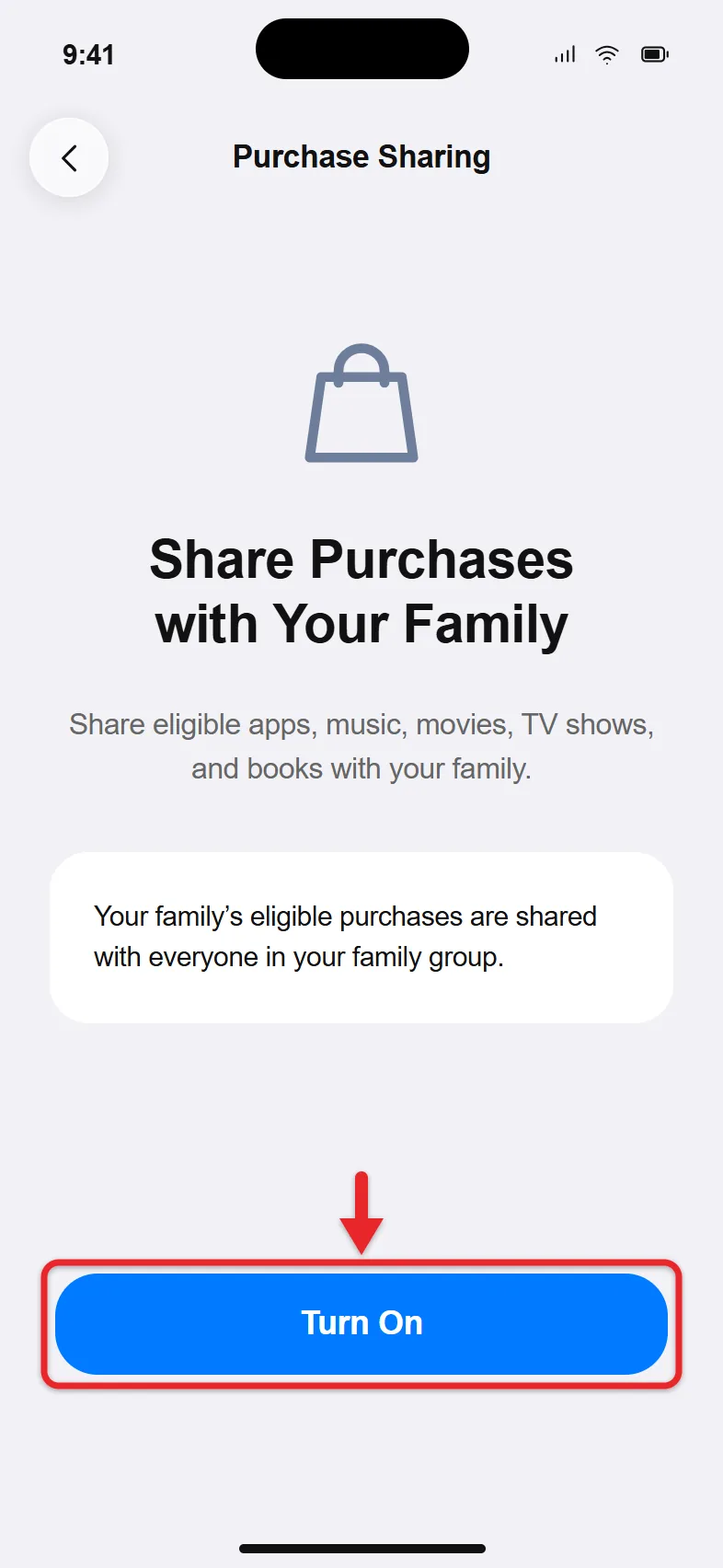
- Tap Purchase Sharing again and check the card listed under Payment Methods. That becomes the shared payment method for the family.
Purchases made before or after setup become available to the group, unless they’re hidden or the item isn’t eligible. Changes can take a little while to show up on other devices.
Download Family Purchases
Each family member does this on their own device, signed in with their own Apple Account. Downloading a family member’s purchase doesn’t cost anything.
In iTunes for Windows
- Open iTunes and choose Account > Family Purchases. If that option is missing, Family Sharing isn’t set up for your account.
- Click the name menu near the top left, next to Purchased, and choose the family member whose music you want.
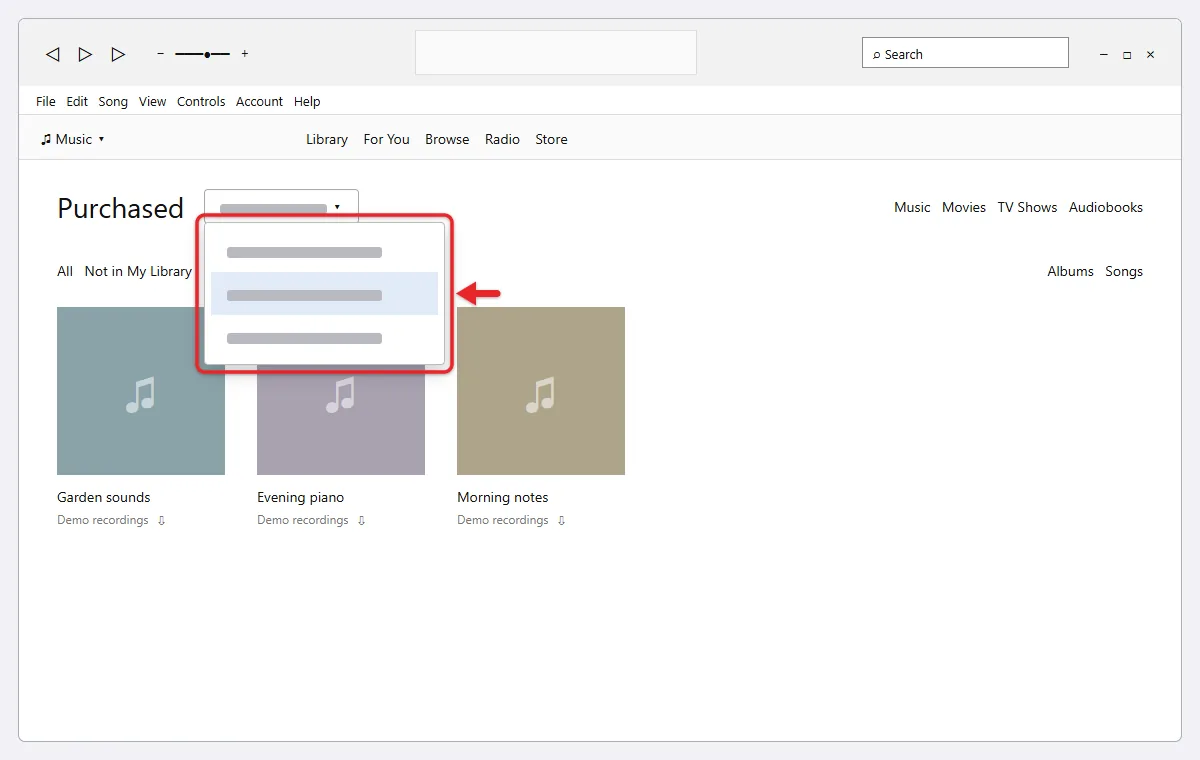
- Click Music, find the album or song, and click the download button (a cloud with a down arrow). It’s added to your library.
Apple’s iTunes for Windows guide to family purchases covers the same steps.
In the Apple Music App for Windows
If you’ve installed Apple Music for Windows, it takes over music from iTunes.
- Open Apple Music and click your name at the bottom of the sidebar.
- Click Family Purchases (it reads Purchased if you aren’t in a family group).
- Choose a family member, then click Albums or Songs and click the download button, or click Download All.
The PC must be authorized with your Apple Account first. Apple lists these steps in its guide to downloading music in Apple Music for Windows.
On a Mac
- Open the Music app and choose Account > Family Purchases (or Purchased).
- Click the pop-up menu next to Purchased and pick a family member.
- Click the download button next to an album or song.
On an iPhone or iPad
- Open the iTunes Store app, tap More and then Purchased, or tap your account picture and then Purchased.
- Tap a family member’s name, then tap Music.
- Tap the download button next to an album. It appears in the Music app’s library.
Shared movies show up in the Apple TV app instead of Music; here is how to download purchased movies on an iPad, including a family member’s.
Home Sharing lets other devices in the house play your whole library, including songs you imported, and lets other computers copy songs from it. Every device has to be signed in to Home Sharing with the same Apple Account, authorized for that account, and connected to the same Wi-Fi or Ethernet network. The computer holding the library must be awake with iTunes or Music open.
Turn On Home Sharing on Windows
- Open iTunes and sign in if asked.
- Choose File > Home Sharing > Turn On Home Sharing.
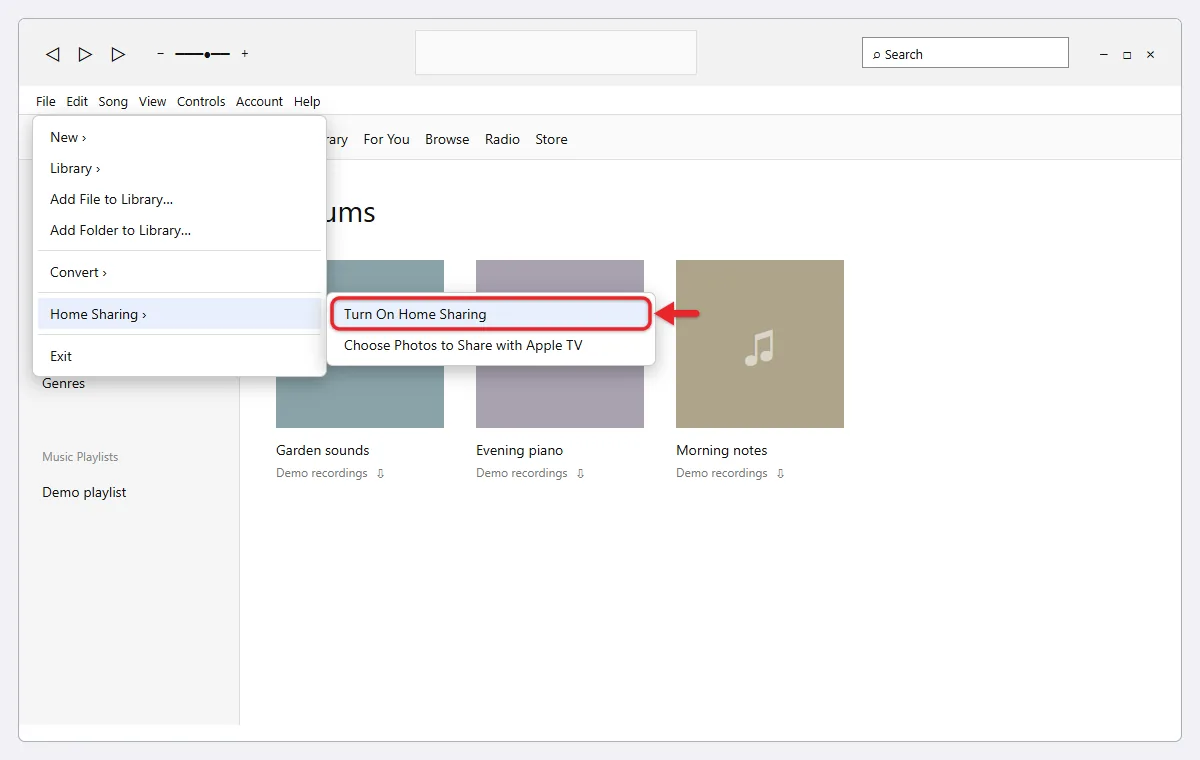
- Enter the Apple Account and password you’ll use for Home Sharing, then click Turn On Home Sharing.
Repeat on each Windows computer that will play the library.
Turn On Home Sharing on a Mac
- Choose Apple menu > System Settings, click General, then click Sharing.
- Turn on Media Sharing, then click the Info button next to it.
- Select Home Sharing, enter your Apple Account, and click Turn On Home Sharing.
Play or Copy From the Shared Library
- On another Windows computer: In iTunes, click the library menu at the top left and choose the shared library. To copy songs, click the Show menu at the bottom of the window, choose Items not in my library, select the songs, and click Import.
- On another Mac: In Music, click the shared library under Library in the sidebar. Click Eject next to it to go back to your own library.
- On an iPhone or iPad: Go to Settings > Apps > Music (Settings > Music on iOS 17 and earlier), tap Sign In under Home Sharing, and use the same Apple Account. In the Music app, tap Library > Home Sharing. If it isn’t listed, tap Edit, select Home Sharing, and tap Done. Songs stream and don’t use storage on the phone.
- On an Apple TV: Go to Settings > Users and Accounts > Home Sharing, turn it on, and open Computers from the Home Screen.
Apple’s Home Sharing setup guide covers all of these devices, and its iTunes guide explains importing from other computers with Home Sharing.
Because Home Sharing uses one Apple Account on every device, it’s best for a household that shares computers. For family members in other homes, use Family Sharing.
Method 3: Let Family Members on Different Accounts Listen
If relatives use their own Apple Accounts on computers in the same house, you can share your library for listening only. They can play the songs but can’t copy them into their own libraries.
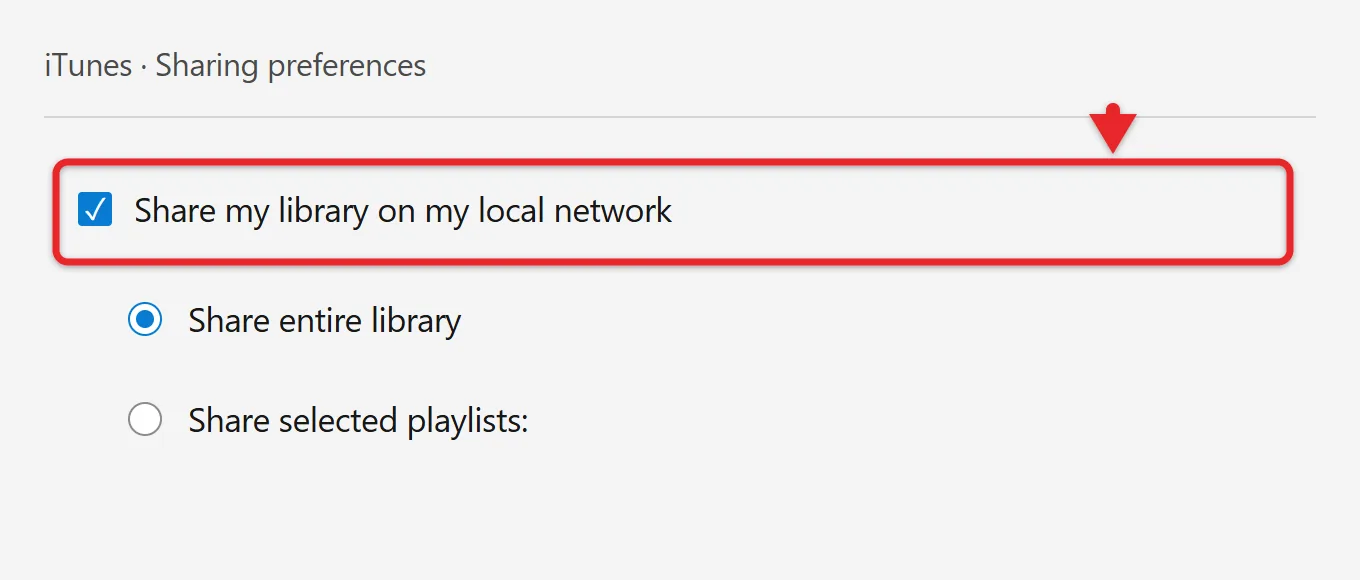
- iTunes for Windows: Choose Edit > Preferences, click Sharing, select Share my library on my local network, choose the whole library or certain playlists, and click OK.
- Mac: Open System Settings > General > Sharing, click the Info button next to Media Sharing, select Share media with guests, click Options, choose what to share, and click OK, then Done.
You can add a password in the same settings. The shared library appears in the other computer’s iTunes or Music sidebar while your computer is on. Apple’s shared library guide for iTunes on Windows lists the limits, including a maximum of five computers.
- No Family Purchases option. The member isn’t in the family group yet, or is signed in with a different account. On the organizer’s device, open Settings > Family and check that the person’s invitation shows as accepted.
- The person buys with a different Apple Account. The account used for Family Sharing must match the one signed in to Media & Purchases. On an iPhone, open Settings > Family > your name > Purchases and choose to share purchases from the other account, or sign out of Media & Purchases and sign in with the family account.
- Some albums are missing. Hidden purchases aren’t shared. The buyer can unhide them on a computer: in Music or iTunes, open their account settings from the Account menu and look under Hidden Purchases (Apple Music for Windows calls it Hidden Items). Imported music and items no longer sold in the store also can’t be shared. Apple’s missing family purchases checklist lists other causes.
- The purchaser turned off their own sharing. Each adult can stop sharing their own purchases from Settings > Family > Purchase Sharing > Stop Purchase Sharing. Doing that also removes their access to everyone else’s purchases.
- Download button is missing or grayed out. The song may already be in your library, or the computer may not be authorized. In iTunes, choose Account > Authorizations > Authorize This Computer.
- Home Sharing library isn’t listed. Make sure the source computer is awake with iTunes or Music open, that every device is on the same network (guest Wi-Fi networks often keep devices apart), and that each one uses the same Home Sharing account. Turning Home Sharing off and back on usually refreshes the list.
If a purchased song is in your account but missing from your phone, check why purchased music may not show in the iPhone Music app, and find past music purchases on your iPhone from the Purchased page.
Family Library Sharing Questions
Can my family share my iTunes library without Family Sharing?
Yes, at home. Home Sharing works if everyone signs in with the same Apple Account, and local network library sharing lets other accounts listen without copying. Signing relatives into your account on their own phones isn’t a good idea, since it also shares your messages, photos and other iCloud data.
Does Family Sharing share songs I imported from CDs?
No. Family Sharing only covers items bought from Apple. Use Home Sharing for imported songs, or copy the files to a shared drive.
How many people can share iTunes purchases?
A family group can have up to six people, including the organizer. Home Sharing and local network sharing each work with up to five computers.
What happens to downloaded songs if someone leaves the family group?
They lose access to music bought by other family members and can’t download it again. Items already shared with them aren’t automatically deleted; they can keep them, buy them again, or delete them. Anyone who leaves also takes their own purchases out of the shared collection. The full rules are in Apple’s article on leaving a Family Sharing group.
Can a child in the family download my music?
Yes. Children in the group see shared purchases like any other member. New purchases they make go through Ask to Buy if a parent turned it on.

Matthew Burleigh is the founder, head writer, and editor of Solve Your Tech, which he launched in 2012. He has written technology tutorials since 2008 and worked in IT since 2003, including small-business support, IT management, and consulting. He holds Bachelor’s and Master’s degrees in Computer Science from Arizona State University.
Matthew writes practical guides for Windows, iPhone and iPad, Microsoft Office, Outlook, Google apps, and Android. Solve Your Tech’s guides are checked step by step against the device or app maker’s own documentation and tested on his own devices whenever he has the hardware or software, with clear steps, sources, and update dates.
Read more about Matthew and how Solve Your Tech writes and updates its guides, or report a correction.