To open the Volume Mixer in Windows 11, right-click the speaker icon on the taskbar and select Open volume mixer. The Volume mixer page in Settings shows a slider for each app that’s playing sound, so you can make one app quieter or send it to different speakers without changing the others. Prefer the old pop-up mixer? Press Windows key + R, type sndvol, and press Enter.
This guide covers Windows 11 Home and Pro. It lists every way to open the mixer, what each control does, how to use the classic mixer and pin it, and what to do when an app is missing or the mixer won’t open. Shortcuts come from Microsoft’s keyboard shortcut list, checked in October 2026.
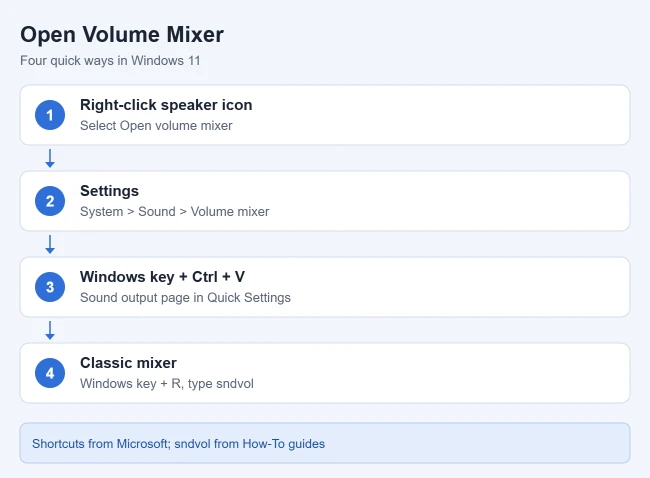
Ways to Open Volume Mixer
From the taskbar
- Right-click the speaker icon near the clock. Result: a short menu appears.
- Select Open volume mixer. Result: Settings opens to the Volume mixer page.
Left-clicking the speaker icon instead opens Quick Settings with a single master volume slider.
From Settings
Open Settings > System > Sound > Volume mixer. You can also search for “Volume mixer” from Start.
With a keyboard shortcut
Microsoft lists Windows key + Ctrl + V to open the sound output page of Quick Settings, which includes the output device, spatial sound and the volume mixer.
What You Can Do in the Volume Mixer
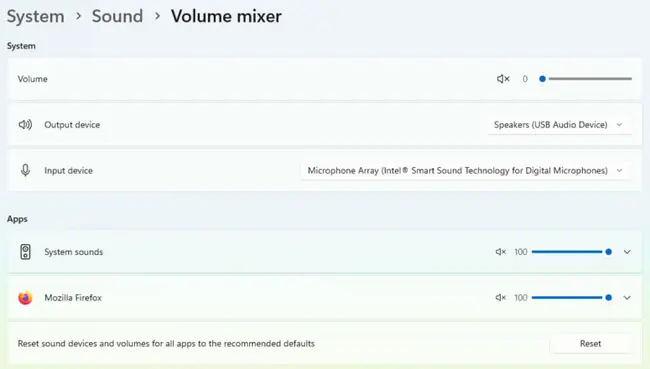
The page has two sections. System holds the master volume, output device and input device. Apps lists each app that’s playing sound, including System sounds.
- Change one app’s volume: drag its slider. ASUS notes you can select an app’s speaker icon to mute just that app.
- Send an app to a different device: expand the app to pick its own output device, such as headphones for a game and speakers for music.
- Start over: select Reset at the bottom to return sound devices and volumes for all apps to the recommended defaults.
Use the Classic Volume Mixer
The older pop-up mixer from Windows 10 is still in Windows 11. This opens the same program, SndVol.exe.
- Press Windows key + R. Result: the Run box opens.
- Type sndvol and press Enter. Result: the classic Volume Mixer window appears with a slider for each app.
- To keep it handy, right-click its taskbar icon while it’s open and select Pin to taskbar. Result: the classic mixer is one click away.
There are other ways to launch the same program: type sndvol.exe in File Explorer’s address bar, use Run new task in Task Manager, or go to Control Panel > Hardware and Sound > Adjust system volume.
Make a desktop shortcut
- Right-click the desktop and select New > Shortcut. Result: the Create Shortcut wizard opens.
- Type sndvol.exe and select Next.
- Name it Volume Mixer and select Finish. Result: double-click it any time to open the classic mixer.
If the Volume Mixer Isn’t Working
- An app isn’t in the list: apps only appear after they start playing sound. Start the audio and check again.
- The taskbar option does nothing: open it from Settings > System > Sound > Volume mixer, or use sndvol.
- An app is silent: check that it isn’t muted or set to a different output device in the mixer.
- No sound at all: see how to fix no sound on Windows 11.
Frequently Asked Questions
Can I get the old volume mixer back permanently?
You can’t replace the new one, but pinning SndVol to the taskbar gives you one-click access to the classic mixer.
Where are the other sound settings?
See how to get to the Sound control panel in Windows 11 and how to turn on sound equalization. To record what your PC is playing, see how to enable Stereo Mix on Windows 11. If notifications seem silent while other sound works, check whether Do not disturb is on.
If one app’s sounds are the problem, it may have its own setting. For example, here’s how to stop QuickBooks from beeping every time you enter an invoice.

Matthew Burleigh is the founder, head writer, and editor of Solve Your Tech, which he launched in 2012. He has written technology tutorials since 2008 and worked in IT since 2003, including small-business support, IT management, and consulting. He holds Bachelor’s and Master’s degrees in Computer Science from Arizona State University.
Matthew writes practical guides for Windows, iPhone and iPad, Microsoft Office, Outlook, Google apps, and Android. Solve Your Tech’s guides are tested on current devices or checked against official product documentation, with clear steps, sources, and update dates.
Read more about Matthew and how Solve Your Tech writes and updates its guides, or report a correction.