You can’t drag the Windows 11 search bar to a new spot by itself. It always sits next to the Start button, but you can move it to the left corner with Settings > Personalization > Taskbar > Taskbar behaviors > Taskbar alignment > Left, or change how it looks under Taskbar items > Search. On PCs that have Microsoft’s newer Taskbar position setting, you can also move the whole taskbar, search included, to the top of the screen.
These steps cover Windows 11 Home and Pro, including versions 24H2 and 25H2. On a work or school PC, your organization may control these settings.
Which Setting Do You Need?
Pick the row that matches what you want the search bar to do.
| What you want | Setting to change | Where it is |
|---|---|---|
| Move search to the left corner | Taskbar alignment > Left | Taskbar behaviors |
| Make the search box smaller or hide it | Search menu | Taskbar items |
| Put search at the top of the screen | Taskbar position > Top | Taskbar behaviors (newer PCs only) |
| Put search at the far right, away from Start | Not possible | No setting exists |
All three settings live on the same page: Settings > Personalization > Taskbar.
Why You Can’t Move the Search Bar Freely
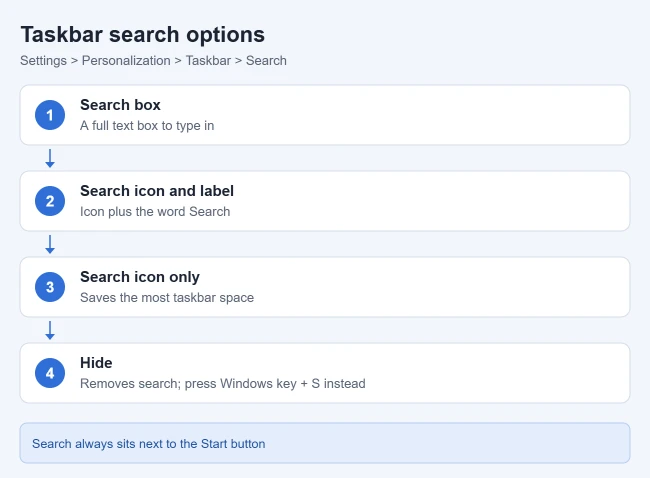
On a horizontal Windows 11 taskbar, the left side holds Widgets, then a group of Start, Search, Task view and your apps, then the system tray on the right. Microsoft’s Customize the taskbar guide lists these components and gives Search four display options, but no setting to move it. App icons can be dragged to reorder; Start and Search can’t. Windows 10 let you unlock the taskbar and drag it to any edge, so people upgrading often look for the same freedom.
The taskbar has plenty of other layout options, all covered in how to customize the Windows 11 taskbar.
If you see a box labeled Address on a Windows 10 PC, that is the Address toolbar on the Windows 10 taskbar, not the search box.
Newer Windows 11 updates can move the whole taskbar instead. Microsoft’s August 2026 update notes (KB5120998, for versions 24H2 and 25H2) describe a gradual rollout of Taskbar behaviors > Taskbar position with bottom, top, left, and right choices. A gradual rollout means the setting reaches PCs in phases, so two up-to-date PCs can look different for a while. Moving the whole taskbar is still not the same as dragging Search on its own: Search always travels with Start.
Move the Search Bar to the Left
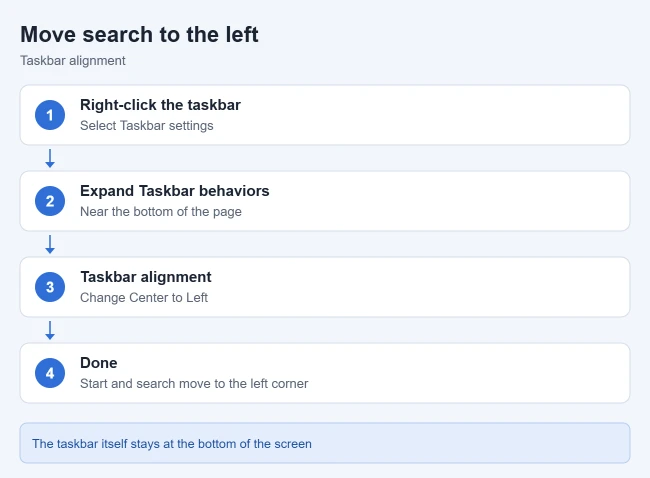
- Right-click the taskbar and select Taskbar settings. The Taskbar page opens.
- Scroll down to Taskbar behaviors. On recent updates this section is already expanded; if it isn’t, select it to show more options.
- Set Taskbar alignment to Left. The Start button, search and your apps move to the left corner, as in Windows 10.
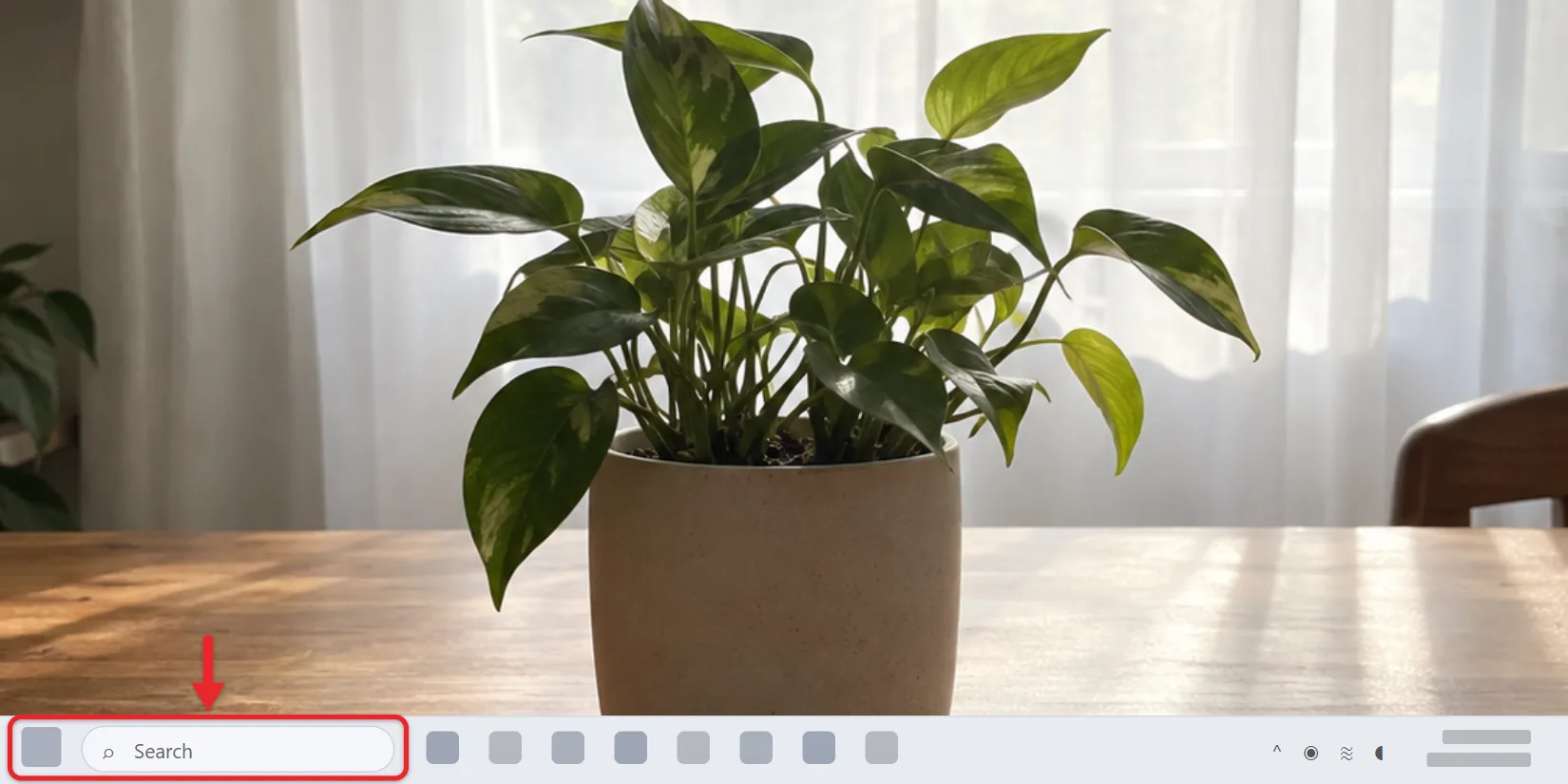
To go back, choose Center, which is the Windows 11 default. Moving the taskbar icons to the left covers this setting in more depth.
Move the Search Bar to the Top of the Screen
This method only works on PCs that have received the Taskbar position setting. It moves the entire taskbar, and Search moves with it.
- Open Settings > Personalization > Taskbar.
- Go to Taskbar behaviors and find Taskbar position. If you don’t see it, your PC doesn’t have the feature yet; see the troubleshooting section below.
- Choose Top. The taskbar jumps to the top edge, with Start and Search in the same order as before.
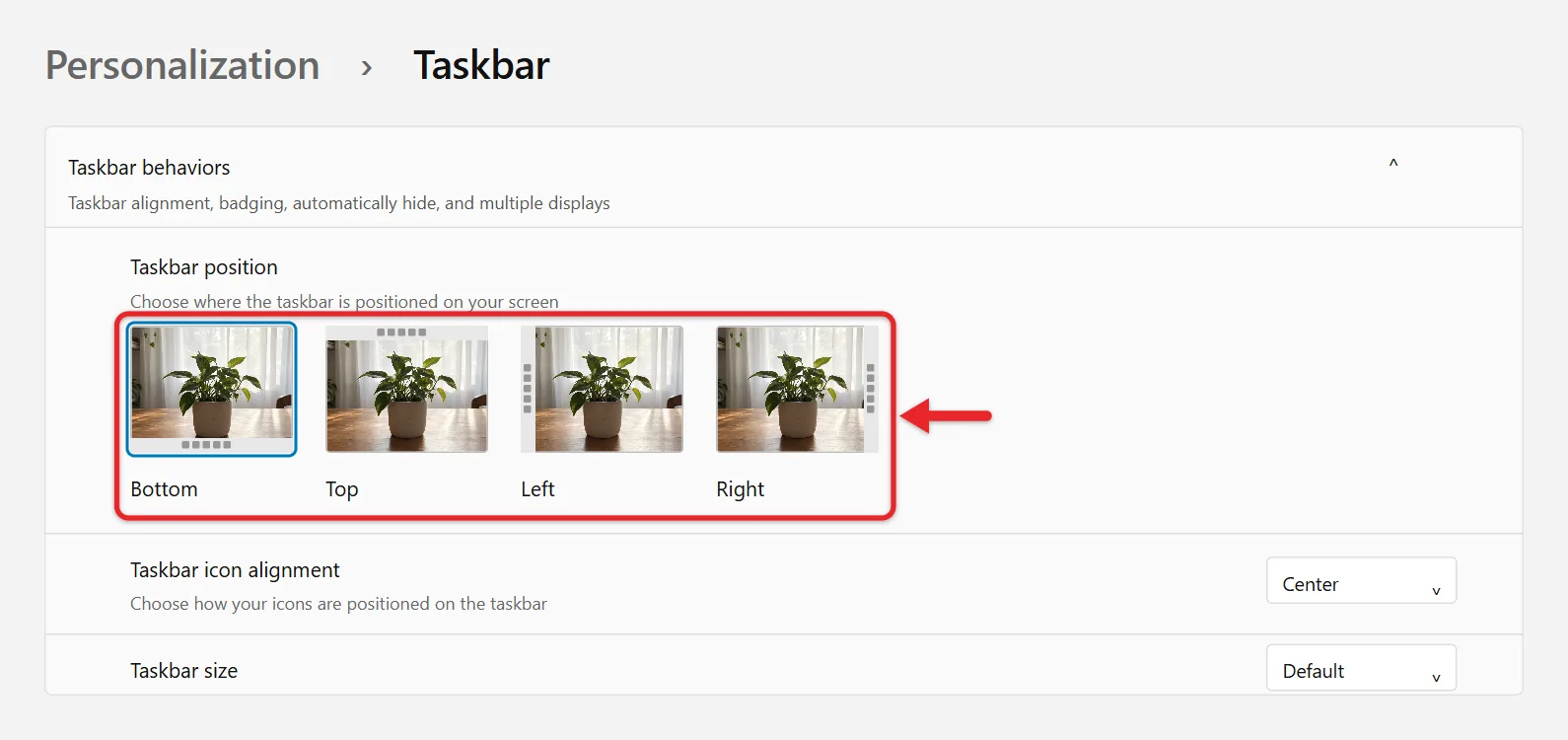
- If you want search in the top-left corner, also set Taskbar alignment to Left.
You can also pick Left or Right in Taskbar position for a vertical taskbar. Microsoft says the full search box is currently supported only at the top or bottom, so on a vertical taskbar plan on using a search icon instead of the typing box. Changing the taskbar location in Windows 11 covers the side positions in more detail. To undo the move, set Taskbar position back to Bottom.
Confirm the Change Worked
Close Settings and look at the taskbar. With Left alignment, the Start button sits at the far left corner and Search is right next to it. Press the Windows key: the Start menu should open from the same side. Sign out and back in once if you want to be sure the setting stuck. If something looks wrong, open Taskbar settings again and pick the previous option; every change here is reversible.
Change or Hide the Search Box
- Right-click an empty part of the taskbar and select Taskbar settings. Settings opens to Personalization > Taskbar.
- Under Taskbar items, open the Search menu. Four choices appear.
- Choose an option. The taskbar changes immediately; there’s nothing to save.
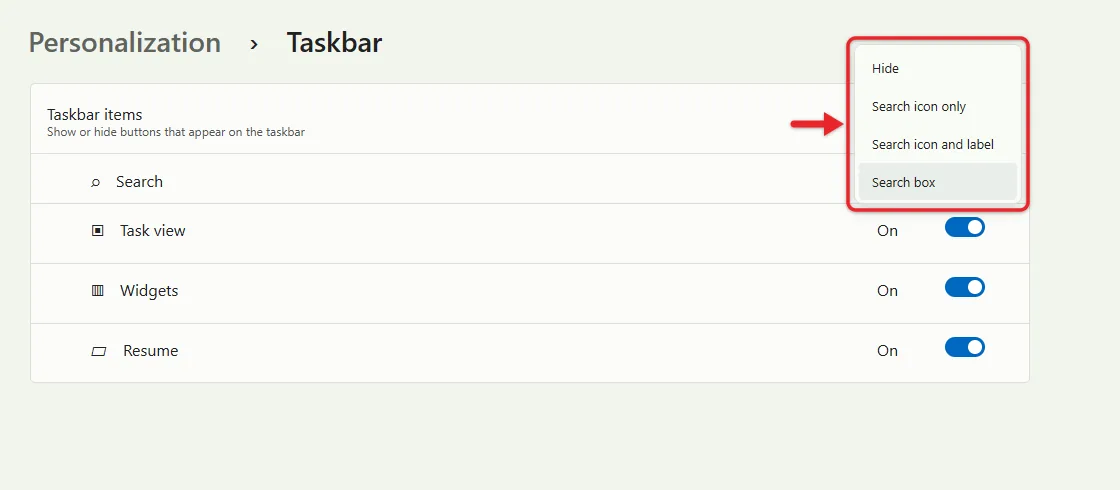
- Search box: a full text box you can type in. It takes the most room.
- Search icon and label: an icon with the word “Search.” Easy to spot, but narrower than the box.
- Search icon only: just the magnifying glass, which saves the most space while keeping one-click access.
- Hide: removes search from the taskbar entirely.
These four options match Microsoft’s guide. A smaller option frees up space for pinned apps, which matters most on small laptop screens. If you search often, the icon and label is a good middle ground. If you always press the Windows key and type, Hide costs you nothing. There is no setting to resize the box itself, so these four styles are the only size choices.
How to Search When the Search Box Is Hidden
- Press Windows key + S. That’s the built-in shortcut for opening search.
- Press the Windows key and start typing. You can search directly from the Start menu.
- Use the search box inside File Explorer or Settings for searches within those apps.
Other Ways to Open Taskbar Settings
- Press Windows key + I to open Settings, then select Personalization and Taskbar.
- Press Windows key + R, type ms-settings:taskbar, and press Enter. This address opens the Taskbar page directly.
These help when the taskbar is hidden or not responding to a right-click.
If the Search Options Are Missing or Grayed Out
- Work or school PC: a policy called Configure search on the taskbar (Computer Configuration > Windows Components > Search) can set the search style and stop users from changing it in Settings. Ask your IT department instead of trying to work around it.
- Not up to date: the four-option Search menu arrived in a 2023 update. If you only see an on/off switch, run Windows Update from Settings > Windows Update, restart, and check again.
- No Taskbar position setting: Microsoft is releasing it in phases, so it may not be on your PC yet even after updating. Use Taskbar alignment in the meantime, and check again after the next monthly update.
- The taskbar doesn’t redraw: restart Windows Explorer. Press Ctrl + Shift + Esc to open Task Manager, find Windows Explorer under Processes, and select Restart. The taskbar disappears for a moment and comes back. If it doesn’t, you’ll need to get the taskbar back in Windows 11.
- Third-party taskbar tools: apps that restyle the taskbar can hide or replace these settings. Remove the tool to get the standard options back.
You may find registry edits online that claim to move the taskbar or force a search style. Microsoft doesn’t support them for this, and feature updates can undo or break them. The Settings options above are safer and easy to reverse.
Frequently Asked Questions
Can I move the search bar to the right side?
You cannot drag Search independently to the right end of the taskbar. On a horizontal taskbar, changing alignment moves Start, Search, and the app group together. Whole-taskbar positioning is a separate option on PCs that have received the rollout described above.
Can I move the whole taskbar to the top?
Yes, on PCs that have received the newer taskbar-position feature. Check Settings > Personalization > Taskbar > Taskbar behaviors > Taskbar position for Top. The feature is rolling out gradually, so older installations and some updated PCs may not show the option yet.
Does hiding search turn off Windows Search?
No. Hiding only removes the box or icon from the taskbar. Search still works from the Start menu and with Windows key + S.
Why did my search icon turn into a big box?
Microsoft’s 2023 announcement explains that the full search box became the default after feedback that the icon wasn’t discoverable enough. Switch back to Search icon only in Taskbar settings.
Can I change which search engine the taskbar search uses?
Windows Search shows web results from Bing, and the taskbar has no setting to switch engines. Your browser’s default search engine is a different setting, and you can change the search engine on Windows 11 there.
Will changing these settings affect my files or apps?
No. Alignment, position, and search style only change how the taskbar looks. Your files, pinned apps, and search history stay the same.

Matthew Burleigh is the founder, head writer, and editor of Solve Your Tech, which he launched in 2012. He has written technology tutorials since 2008 and worked in IT since 2003, including small-business support, IT management, and consulting. He holds Bachelor’s and Master’s degrees in Computer Science from Arizona State University.
Matthew writes practical guides for Windows, iPhone and iPad, Microsoft Office, Outlook, Google apps, and Android. Solve Your Tech’s guides are checked step by step against the device or app maker’s own documentation and tested on his own devices whenever he has the hardware or software, with clear steps, sources, and update dates.
Read more about Matthew and how Solve Your Tech writes and updates its guides, or report a correction.