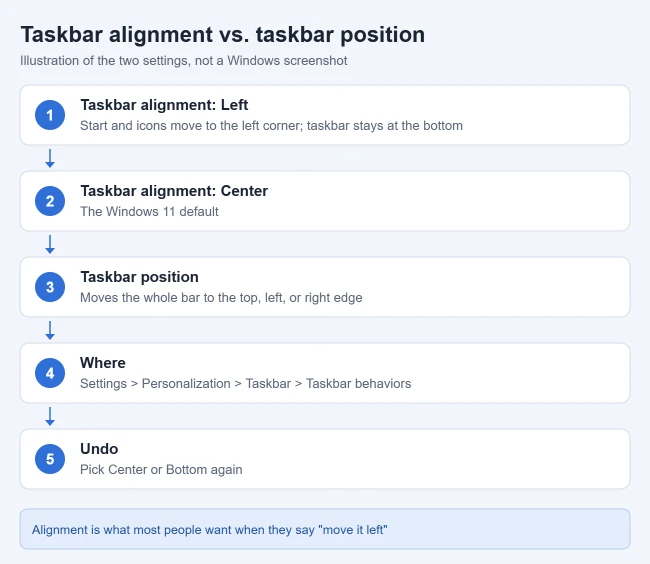
To move the Windows 11 taskbar icons to the left, open Settings > Personalization > Taskbar, expand Taskbar behaviors, and set Taskbar alignment to Left. The Start button and your pinned apps move to the left corner right away, like in Windows 10.
This works on Windows 11 Home and Pro and doesn’t need a restart or admin rights. It only moves the icons; the taskbar stays along the bottom of the screen. If you want the whole bar on the left edge instead, that’s a separate setting covered below.
Align the Taskbar Icons to the Left
- Right-click an empty part of the taskbar and select Taskbar settings. You can also open Settings and go to Personalization > Taskbar.
- Scroll down and select Taskbar behaviors to expand it.
- Open the Taskbar alignment menu.
- Select Left. Expected result: the Start button jumps to the bottom-left corner, followed by Search, Task View, Widgets, and your pinned apps.

Dell’s support article uses the same path. To go back to the default layout, set Taskbar alignment to Center.
Make the Taskbar Feel More Like Windows 10
Aligning left is the big change, but a few more settings on the same page help:
- Widgets: turn it off under Taskbar items if you keep opening it by accident where Start used to be. See how to show or hide the Widgets and weather button for the steps.
- Search: under Taskbar items, choose a search icon or box, or hide it. See how to move the search bar in Windows 11.
- Combine taskbar buttons and hide labels: set it to Never in Taskbar behaviors to show a separate labeled button for each window.
- Pinned apps: drag icons to reorder them, and see how to pin to the taskbar in Windows 11 to choose which apps appear.
Move the Whole Taskbar to the Left Side of the Screen
Taskbar alignment only moves the icons. To move the entire taskbar to the left edge, use the separate Taskbar position setting:
- Right-click an empty spot on the taskbar and select Taskbar settings.
- Open Taskbar behaviors if it’s collapsed.
- Under Taskbar position, select Left. Expected result: the taskbar becomes a vertical bar on the left edge, and Start opens from there.
Microsoft first tested this with Insiders, describing in its Windows Insider blog post that the taskbar can sit on any edge, with icons top-aligned or centered on a side taskbar. It reached regular PCs in the August 2026 update (KB5120998) for Windows 11 versions 24H2 and 25H2 and is rolling out gradually, so your PC may not show it yet. On the left or right side, the search box and the small taskbar size aren’t available. For more, see how to change the taskbar location in Windows 11.
Troubleshooting
Taskbar alignment is missing or grayed out
Make sure you expanded Taskbar behaviors, since the setting is hidden inside it. On a work or school PC, an administrator can lock taskbar settings.
The icons go back to the center
On shared or virtual desktops, such as Azure Virtual Desktop, a Microsoft Q&A thread reports the setting resetting at each sign-in because profiles aren’t kept. IT has to set it for all users. On a normal PC, the setting sticks.
Frequently Asked Questions
Does moving the icons left change the Start menu?
Yes. The Start menu opens from the left corner instead of the center, but its contents stay the same.
Can I move only the Start button?
No. The alignment setting moves the Start button and all taskbar icons together.
Can I bring back the Windows 10 Start menu?
Not with a built-in setting. Aligning left gets you the familiar position, and you can reorganize Start by pinning apps. Third-party apps can restyle Start, but they change system behavior, so use them with care.

Matthew Burleigh is the founder, head writer, and editor of Solve Your Tech, which he launched in 2012. He has written technology tutorials since 2008 and worked in IT since 2003, including small-business support, IT management, and consulting. He holds Bachelor’s and Master’s degrees in Computer Science from Arizona State University.
Matthew writes practical guides for Windows, iPhone and iPad, Microsoft Office, Outlook, Google apps, and Android. Solve Your Tech’s guides are tested on current devices or checked against official product documentation, with clear steps, sources, and update dates.
Read more about Matthew and how Solve Your Tech writes and updates its guides, or report a correction.