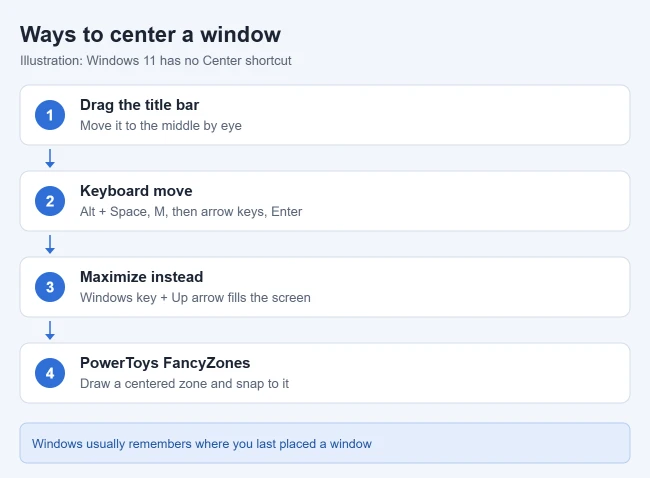
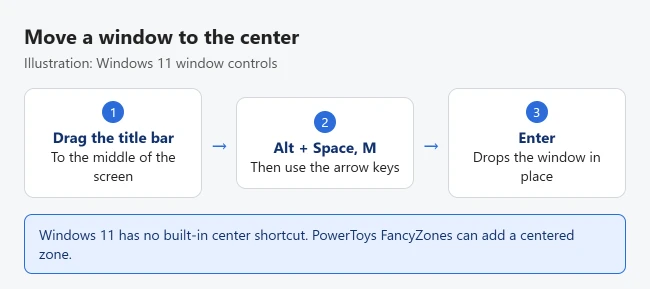
Windows 11 has no built-in “center window” command or keyboard shortcut. To center a window, drag it by its title bar to the middle of the screen, or move it with Alt + Space, M, and the arrow keys; for an exact center spot every time, set up a single middle zone in Microsoft PowerToys FancyZones.
These steps apply to Windows 11 Home and Pro on any current update. The keyboard and drag methods also work the same way in Windows 10. Need a second window of the same app? Here’s how to open multiple windows in Windows 11.
Which Method Should You Use?
| What you want | Best method |
|---|---|
| Center one window right now | Drag the title bar (Method 1) |
| No mouse, or the mouse is awkward | Alt + Space, then M (Method 2) |
| A neat, full or half-screen window | Maximize or Snap (Method 3) |
| The same exact center position every time | PowerToys FancyZones (Method 4) |
| Several apps opening in the same spots daily | PowerToys Workspaces (Method 5) |
Method 1: Drag the Window to the Center
- If the window fills the screen, double-click its title bar. It shrinks to a normal size that you can move.
- To change its size first, point to any edge or corner until the pointer becomes a two-headed arrow, then drag.
- Click and hold the title bar, the strip across the top of the window that holds the app name.
- Drag the window until the space on the left matches the space on the right, then let go. The window stays where you dropped it.
Keep the window away from the very top and the sides of the screen while you drag, or Windows will snap it into a layout instead. A quick way to judge the center: line up the middle of the title bar with the middle of the taskbar when the taskbar icons are centered.
Method 2: Move a Window With the Keyboard
- Click the window to select it, or press Alt + Tab until it’s selected.
- Press Alt + Space. The window menu opens in the top-left corner of the window.
- Press M to choose Move. The pointer changes to a four-way arrow.
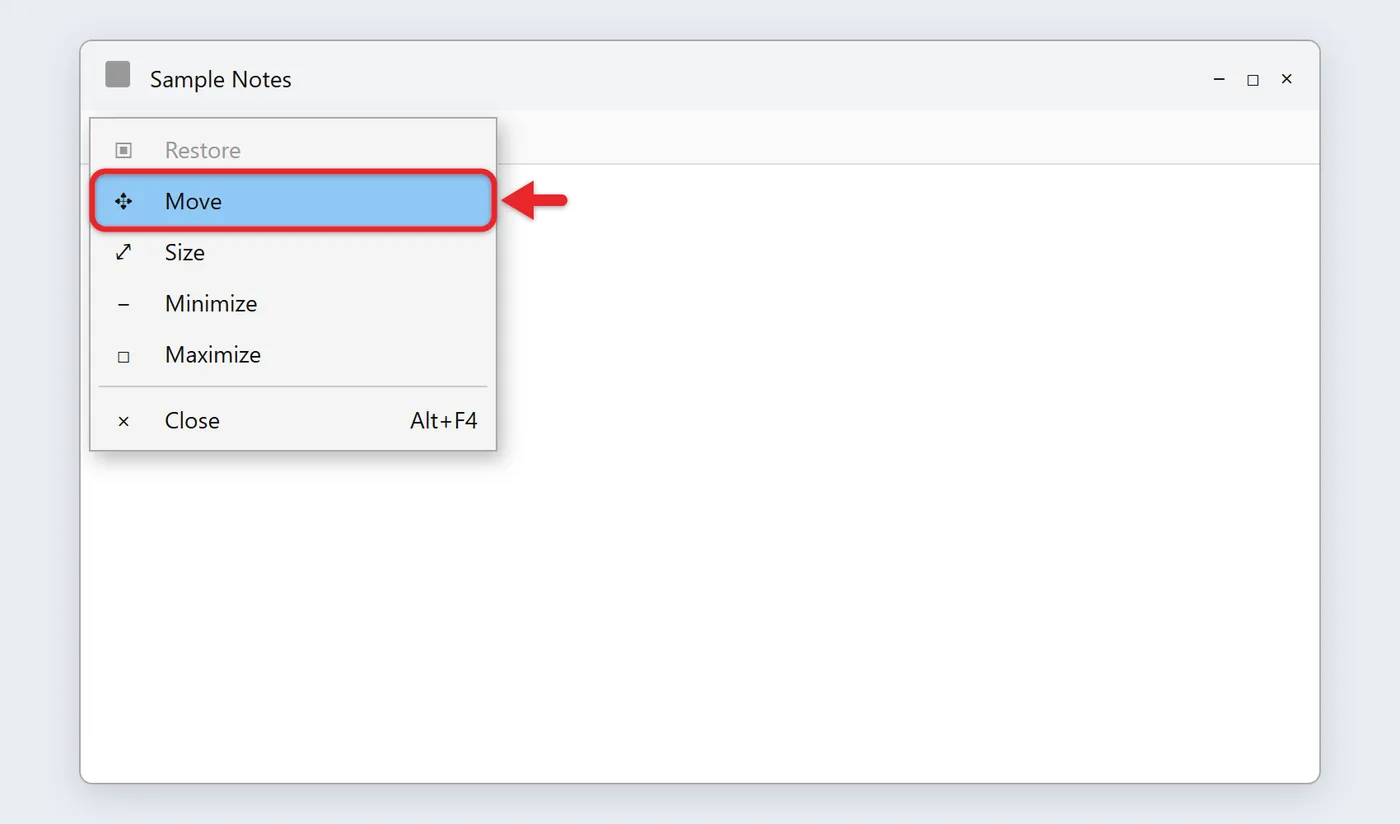
- Press the arrow keys to move the window in small steps.
- Press Enter to drop it, or Esc to put it back where it was.
To resize with the keyboard, press S for Size in step 3 instead. If Move is grayed out, the window is maximized; choose Restore from the same menu first. If Alt + Space opens another app, such as PowerToys Run or a chat assistant, right-click the window’s title bar and choose Move there.
If Alt + Space or the arrow keys don’t respond at all, troubleshoot the keyboard in Windows 11.
Method 3: Maximize, Stretch, or Snap Instead
Often a neatly sized window does the job better than a centered one. These shortcuts come from Microsoft’s keyboard shortcuts list:
- Windows key + Up arrow: maximize the window.
- Windows key + Down arrow: restore a maximized window to its normal size, or minimize it.
- Windows key + Shift + Up arrow: stretch the window from the top to the bottom of the screen without changing its width.
- Windows key + Alt + Up arrow: snap the window to the top half of the screen.
- Windows key + Z: open Snap layouts for the selected window.
You can also open Snap layouts by pointing to the window’s maximize button, or by dragging a window toward the top of the screen until the layout bar appears. On a wide or ultrawide monitor, a three-column layout puts a window in the middle column, which is the closest built-in option to a centered window. The layouts you see depend on your screen size. Microsoft’s Snap guide has the details, and here’s how to split screen on Windows 11.
Method 4: Center Windows Exactly With PowerToys FancyZones
PowerToys is a free set of utilities from Microsoft. Its FancyZones tool lets you draw zones on the screen and drop windows into them. One zone in the middle of the screen works as a reusable center spot.
- Install PowerToys from the Microsoft Store or from the GitHub releases page listed in Microsoft’s PowerToys install guide. It needs Windows 11 or Windows 10 version 2004 or later.
- Open PowerToys, select FancyZones in the left pane, and make sure it’s turned on.
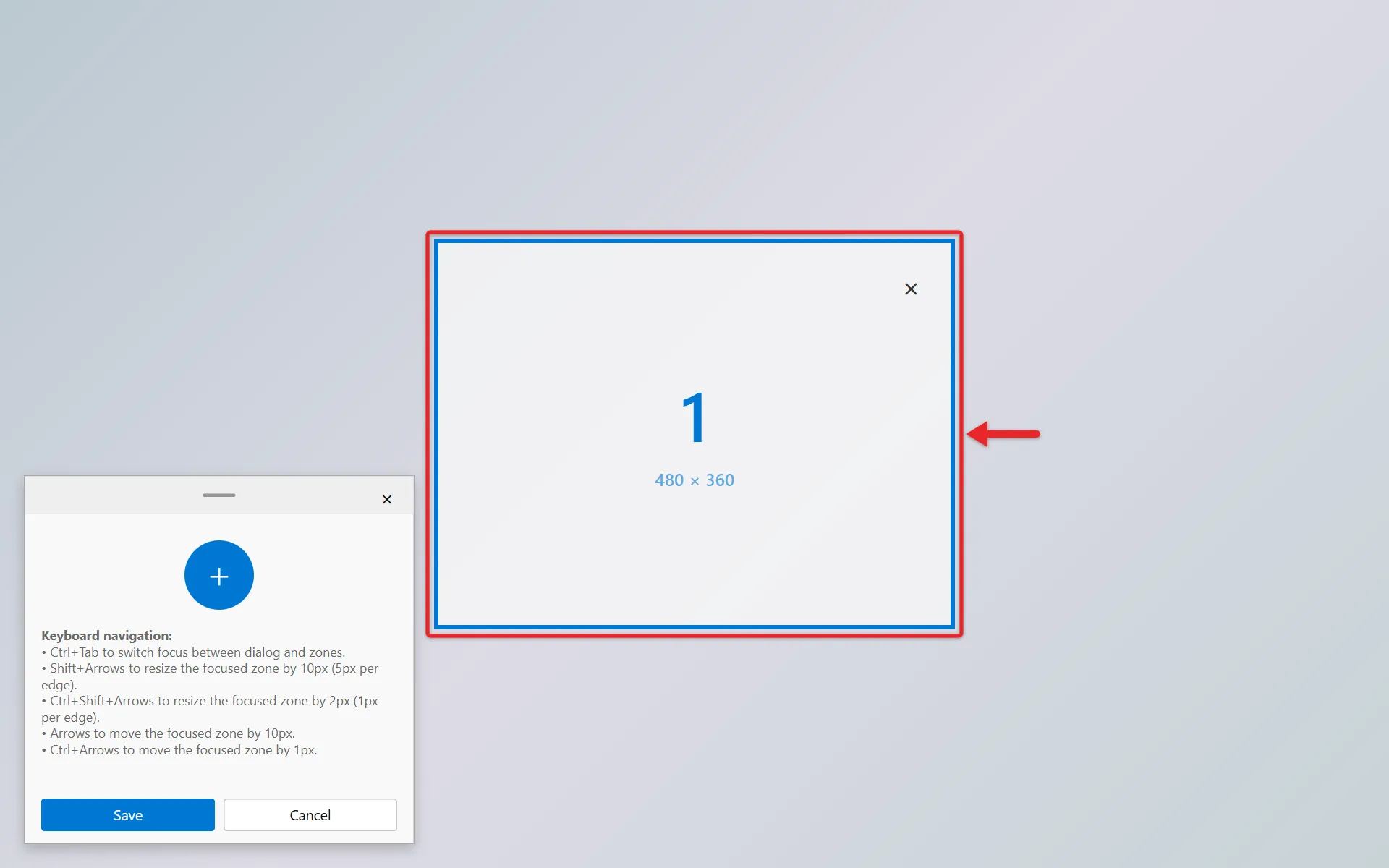
- Select Open layout editor, or press Windows key + Shift + ` (the backtick key, usually above Tab).
- Select Create new layout, choose Canvas, and create it. A canvas layout starts with one zone that you can move and resize like a window.
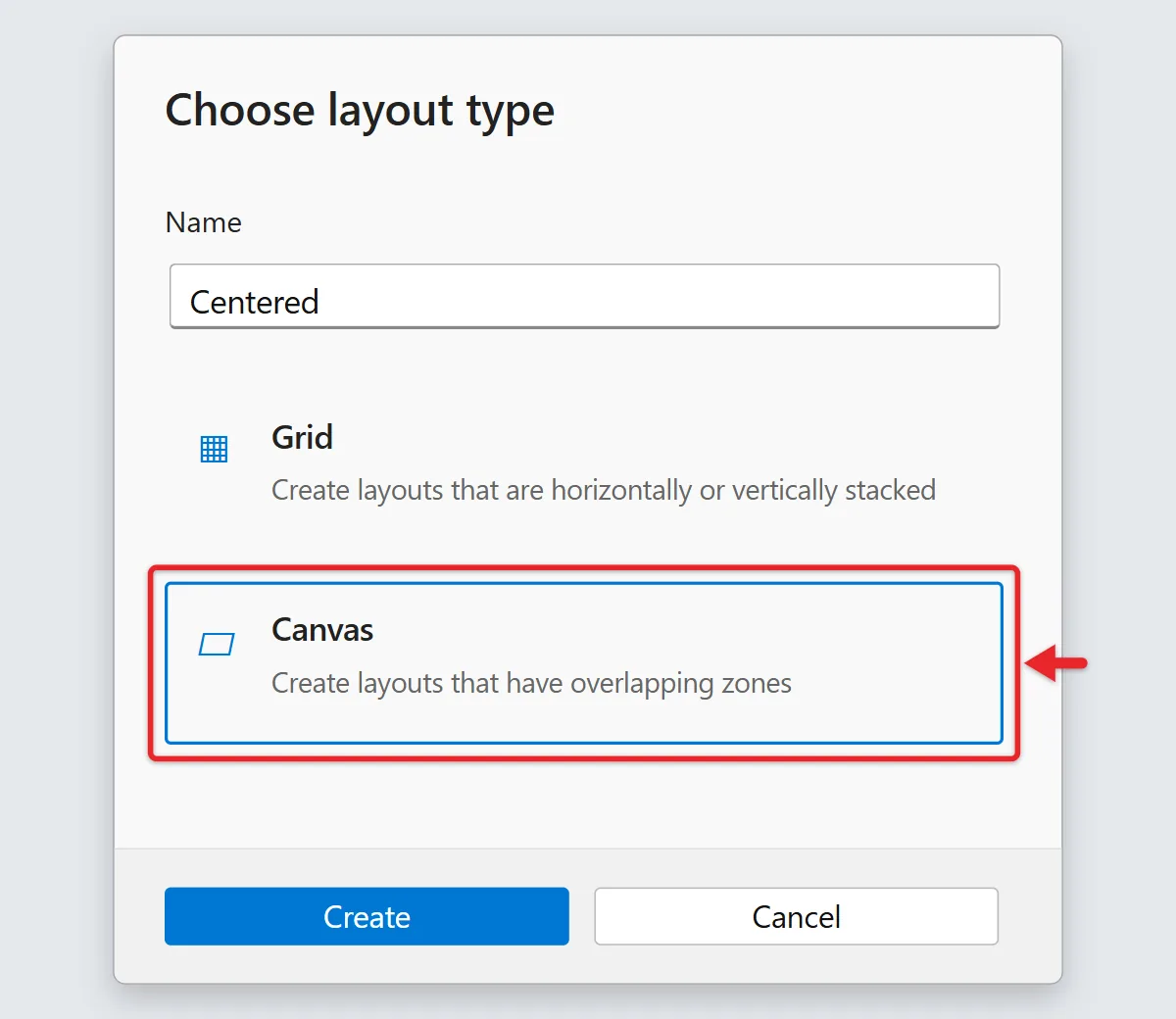
- Drag the zone’s edges to the size you want, then drag the zone to the middle of the screen. Save the layout and make sure it’s the selected layout for that monitor.
- Hold Shift while you drag any window. The zone appears, and dropping the window on it resizes and centers it.
FancyZones can also put a window back in the last zone it used when the app opens again, through the Move newly created windows to the last known zone setting. If you have several monitors, select each screen in the editor and give it its own layout.
Method 5: Open Apps in the Same Place With PowerToys Workspaces
If you open the same apps every day and want them centered or arranged the same way, PowerToys Workspaces saves a layout and relaunches it.
- Turn on Workspaces in PowerToys settings.
- Arrange your windows the way you want, with the center one placed by hand.
- Press Windows key + Ctrl + ` to open the editor, select Create workspace, then select Capture.
- Name the workspace and save it. Select Launch later to open the apps in those positions.
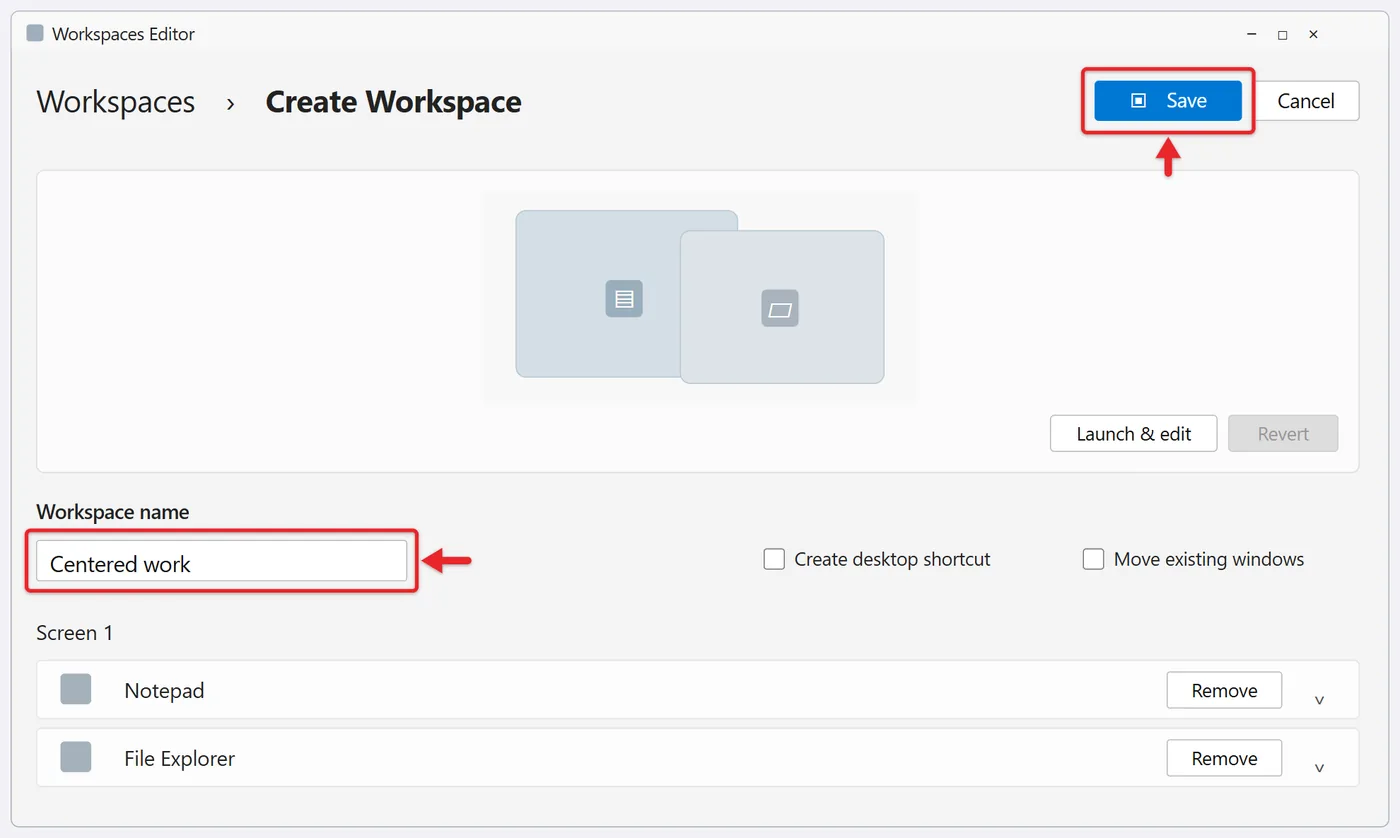
Workspaces opens each app first and then moves it, so you may see windows jump into place.
Move a Window to Another Monitor
Press Windows key + Shift + Left arrow to move the selected window to the monitor on the left, or Windows key + Shift + Right arrow for the monitor on the right. Then drag it to the center or press Windows key + Up arrow to maximize it there. The second screen has to be set up first; here’s how to set up multiple monitors on Windows 11.
If the window looks much bigger or smaller once it lands on the other display, you can adjust screen size on the second monitor with its Scale setting.
Center Taskbar Icons Instead?
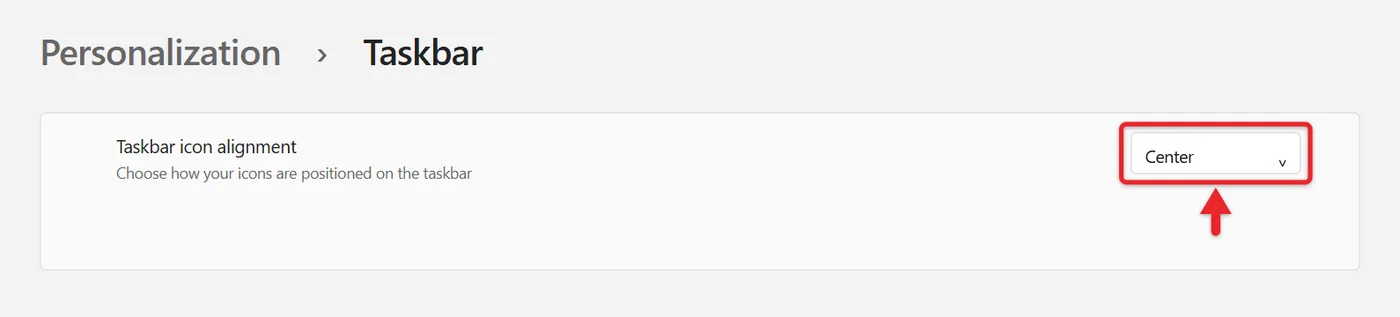
If you meant the Start button and taskbar icons, go to Settings > Personalization > Taskbar, expand Taskbar behaviors, and set Taskbar alignment to Center. You can also move the taskbar icons to the left with the same setting.
Troubleshooting
- The window snaps to a layout while you drag: you’re dragging too close to a screen edge. Keep it away from the edges, or open Settings > System > Multitasking, expand Snap windows, and clear When I drag a window, let me snap it without dragging all the way to the screen edge. You can also turn Snap windows off completely.
- Move is grayed out in the Alt + Space menu: the window is maximized. Choose Restore first.
- The window opens off the screen: select it on the taskbar, press Alt + Space, then M, press any arrow key once, and move the mouse to pull it back. For a window that’s completely hidden, follow these steps to move an off-screen window in Windows 11.
- FancyZones zones don’t appear: check that FancyZones is on and that you’re holding Shift after you start dragging. FancyZones may not work with apps running as administrator, such as Task Manager, unless PowerToys also runs as administrator.
- The app won’t move or resize: full-screen games and some apps control their own window. Look for a windowed or borderless windowed option in the app’s display settings.
How to Check or Undo It
Windows usually remembers where an app’s window was when you closed it, so reopen the app to see whether the position stuck. To undo a centered position, drag the window elsewhere or press Windows key + Up arrow to maximize it. To stop using FancyZones, turn it off in PowerToys; your windows stay where they are.
Frequently Asked Questions
Is there a keyboard shortcut to center a window in Windows 11?
No. Microsoft’s shortcut list has no center command. The closest built-in route is Alt + Space, M, and the arrow keys, or a FancyZones center zone.
Why does my window open too big or in the wrong place?
Most apps reopen at the size and position they had when you last closed them. Resize and place the window, close it normally, and it usually opens that way next time.
Is PowerToys safe to install?
PowerToys is made by Microsoft and is listed in the Microsoft Store. Install it from the Store or Microsoft’s official GitHub releases page, not from download sites.
Can I center a window on a second monitor?
Yes. Move it there with Windows key + Shift + an arrow key, then drag it to the center or use a FancyZones layout made for that monitor.
Next, if you work with two apps at once, try a Snap layout with Windows key + Z instead of centering both.

Matthew Burleigh is the founder, head writer, and editor of Solve Your Tech, which he launched in 2012. He has written technology tutorials since 2008 and worked in IT since 2003, including small-business support, IT management, and consulting. He holds Bachelor’s and Master’s degrees in Computer Science from Arizona State University.
Matthew writes practical guides for Windows, iPhone and iPad, Microsoft Office, Outlook, Google apps, and Android. Solve Your Tech’s guides are checked step by step against the device or app maker’s own documentation and tested on his own devices whenever he has the hardware or software, with clear steps, sources, and update dates.
Read more about Matthew and how Solve Your Tech writes and updates its guides, or report a correction.