Windows 11 doesn’t have a built-in setting to change keybinds, but Microsoft’s free PowerToys app does. Install PowerToys, open its Keyboard Manager, and choose Remap a key or Remap a shortcut. The change works right away, as long as PowerToys is running.
These steps cover Windows 11 (and Windows 10 version 2004 or later) with the current PowerToys release, as described in Microsoft’s Keyboard Manager documentation. A keybind is the key or key combination that triggers an action, such as Ctrl + C for Copy.
What You Need
- A PC running Windows 11, or Windows 10 version 2004 or later, with a 64-bit x64 or Arm processor. Microsoft lists these requirements on its PowerToys install page.
- Permission to install apps. On a work or school PC, your IT department may block PowerToys.
- A few minutes to test each change before you rely on it.
Install PowerToys
- Open the Microsoft Store.
- Search for PowerToys.
- Select Get or Install.
- Open PowerToys when it finishes. Its settings window opens, and a PowerToys icon appears in the system tray near the clock.

You can also install it from Terminal with this command:
winget install Microsoft.PowerToysMicrosoft also offers the installer on its GitHub releases page. Pick the file with x64 in the name for most Intel and AMD PCs, or arm64 for Arm-based PCs such as those with Snapdragon processors.
Remap a Single Key
- In PowerToys, select Keyboard Manager in the left pane.
- Make sure Keyboard Manager is turned on.
- Select Remap a key. PowerToys 0.100 and later open a redesigned editor by default; a Use the new editor switch lets you go back to the older one.
- Select Add key remapping. A new row appears.
- Under Select, pick the key you press, or select the field and press the key. Under To send, pick the key you want it to act as.
- Select OK. If PowerToys warns that a key will be left without a job, select Continue Anyway if that’s what you want.

- Press the key in Notepad or another app to confirm it now does its new job.
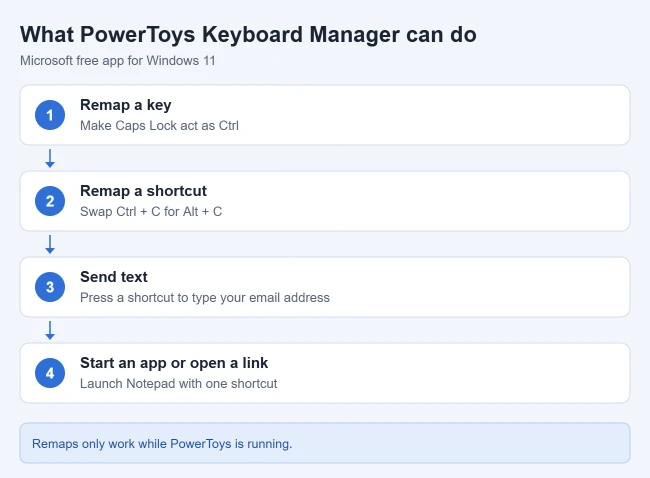
For example, you can make Caps Lock act as Ctrl, or turn a key you never use into Delete. To swap two keys, add a second row that maps them the other way. If an accidental Insert press keeps making Word delete text as you type, you can remap Insert to a key you use.
The warning in step 6 is about an “orphaned” key. If you map A to B and nothing else produces A, you can’t type A anymore. Add a row that maps some other key to A if you still need it. Giving up a key on purpose is useful too, for example when you turn off the Insert key so it stops switching apps into overtype.
A single key can also send a shortcut (for example, make the right Ctrl key send Windows key + Left arrow) or a line of text. Choose the shortcut keys or Text in the To send column.
For example, you could make a spare key send Windows key + period to open the emoji keyboard in Windows 11 with one press.
If you only need a key combination that opens one program, a desktop shortcut also has a Shortcut key box in its Properties window, next to the Target box that controls which program the shortcut opens.
Remap a Keyboard Shortcut
- In Keyboard Manager, select Remap a shortcut.
- Select Add shortcut remapping.
- Enter the shortcut you want to press, then the shortcut or key it should send. Shortcuts must start with Ctrl, Shift, Alt, or the Windows key and end with a regular key, up to four keys in total.
- To limit the change to one app, type its process name, such as msedge.exe or winword.exe, in the Target app box. Leave it empty to apply everywhere.

- Select OK.
To find an app’s process name, open Command Prompt and run tasklist while the app is open. Use the name in the Image Name column. The friendly name you see in Task Manager won’t work.
Two options help when a remap behaves oddly:
- Exact Match: when a shortcut sends a single key, turn this on so the remap fires only when no other keys are held down.
- Chords: select Edit and turn on Allow chords to use two regular keys after the modifier, such as Ctrl + Shift + V, then U. That gives you many more combinations that won’t clash with existing shortcuts.
Make a Shortcut Type Text or Open an App
- Send text: in the To send column, choose Text and type what you want, such as your email address.
- Start an app: choose Start App and enter the path to the program, such as Notepad. You can also add arguments, a start folder, and what happens if the app is already open (show the window, start another copy, or close it).
- Open a link: choose Open URI and enter a web address or ms-settings: page, such as ms-settings:display.

What Keyboard Manager Can’t Do
- It only works while PowerToys is running.
- It doesn’t work on the sign-in or lock screen, or in User Account Control prompts.
- It doesn’t affect apps running as administrator unless PowerToys also runs as administrator (here’s how to run an app as administrator).
- Microsoft doesn’t recommend it for games, where it can lower performance or not work at all.
- Some keys are reserved: Windows key + L and Ctrl + Alt + Delete can’t be remapped, and the Fn key usually can’t either. F1 through F24 can be remapped.
- It can’t treat two keyboards differently. A remap applies to every connected keyboard.
- Remaps follow the key your current input language produces, not its physical position. If you remap A to B and switch to French, the key that types A in French (Q on a US keyboard) now sends B.
Troubleshooting
- A remap stopped working: check that the PowerToys icon is in the system tray. If it isn’t, open PowerToys from Start. In PowerToys General settings, you can make it run at startup.
- Windows key + G still opens Xbox Game Bar: turn off Game Bar in Settings > Gaming > Game Bar, then try again.
- The AltGr key broke: AltGr works as Left Ctrl + Right Alt, so remapping either key can stop AltGr characters from typing. Remove that remap.
- Another keyboard app is interfering: apps that also watch the keyboard, such as Microsoft Mouse and Keyboard Center, can conflict with it. Turn Keyboard Manager off and back on, or close the other app.
- A held key only acts once: the Pause key sends a single press, so it won’t repeat if you map it to Backspace or an arrow key.
Other Ways to Change Keybinds
- Your keyboard maker’s app: Microsoft Mouse and Keyboard Center, Logitech Options+, and similar apps can reassign extra keys on their own keyboards.
- The Copilot key: on PCs that have one, recent Windows 11 updates add Settings > Personalization > Text input > Customize Copilot key on keyboard, which can open a different app. Microsoft limits the choice to packaged apps, such as many Microsoft Store apps. If you don’t see it, PowerToys can remap the key, because the key sends a shortcut (such as Windows key + C or Left Shift + Windows key + F23).
- SharpKeys: a free, open-source tool that writes single-key remaps into the Windows registry, so they work without an app running in the background. It can’t remap shortcuts, and you need to sign out or restart after each change. Registry remaps also apply on the sign-in screen, so don’t remap a key you need to type your password.
Other Keyboard Changes in Settings
- Different layout, such as Dvorak: that’s a Windows setting, so change the keyboard layout in Windows 11 instead.
- The shortcut to switch input languages: go to Settings > Time & language > Typing > Advanced keyboard settings and select Input language hot keys.
- Game controls: change these in each game’s own settings menu.
Frequently Asked Questions
How do I undo a remap?
Open Keyboard Manager, select Remap a key or Remap a shortcut, delete the row with the trash can icon, and select OK. To stop all remaps quickly, turn off Keyboard Manager or close PowerToys.
Can I change what the Fn keys do?
Not with PowerToys in most cases. The Fn key is usually handled by your laptop’s hardware. Check the maker’s app or the BIOS for a Fn Lock or function key setting, as shown in how to change Fn key settings in Windows 11.
Do I need to restart after remapping?
No. Changes take effect as soon as you select OK.
Is PowerToys safe to install?
Yes. PowerToys is made by Microsoft, is free and open source, and is available from the Microsoft Store and Microsoft’s GitHub page.
Can I change a keybind in just one app?
Yes, for shortcuts. Use Remap a shortcut and enter the app’s process name in Target app. Single-key remaps made with Remap a key always apply everywhere.
Next step: if you only want a quick way to open one program, you can also give a desktop shortcut its own key combination in the shortcut’s Properties, as explained in how to make a desktop shortcut in Windows 11.

Matthew Burleigh is the founder, head writer, and editor of Solve Your Tech, which he launched in 2012. He has written technology tutorials since 2008 and worked in IT since 2003, including small-business support, IT management, and consulting. He holds Bachelor’s and Master’s degrees in Computer Science from Arizona State University.
Matthew writes practical guides for Windows, iPhone and iPad, Microsoft Office, Outlook, Google apps, and Android. Solve Your Tech’s guides are checked step by step against the device or app maker’s own documentation and tested on his own devices whenever he has the hardware or software, with clear steps, sources, and update dates.
Read more about Matthew and how Solve Your Tech writes and updates its guides, or report a correction.