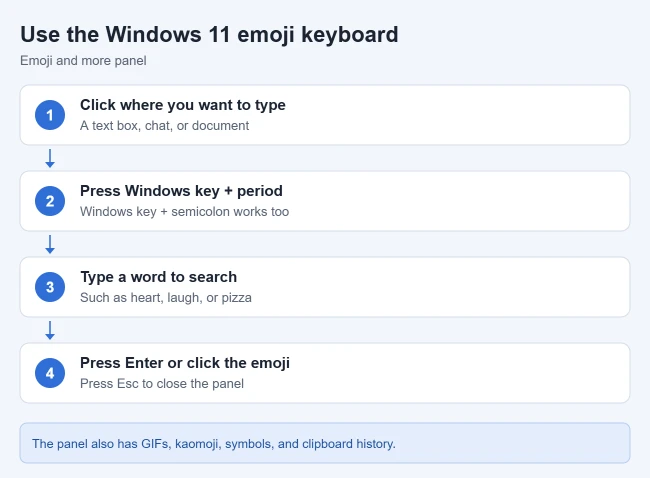
To open the emoji keyboard in Windows 11, click where you want to type and press Windows key + period (.). Windows key + semicolon (;) does the same thing. The emoji panel opens next to your text cursor, and you can click an emoji or type a word to search for one.
This guide covers Windows 11. The same shortcut is listed for Windows 10 in Microsoft’s documentation, although the panel there looks different. You do not need to install or turn on anything first. The only prerequisite is a place to type, such as an email, a document, a chat box, or a search field.
How to Open and Use the Emoji Keyboard
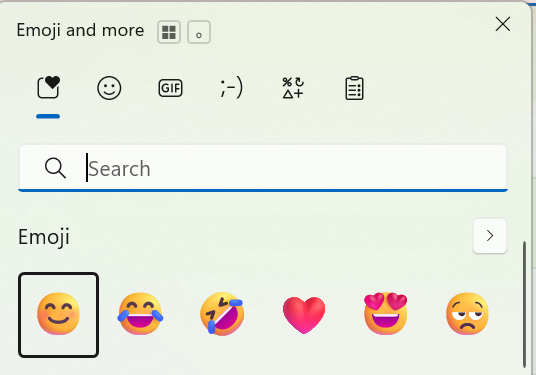
The emoji keyboard, which Microsoft also calls the emoji panel, is a small pop-up window. It is not a separate app, and it only inserts characters where the text cursor is.
- Click in a text box, document, or chat so the blinking text cursor sits where you want the emoji.
- Hold the Windows key (the key with the Windows logo) and press period (.). You can press semicolon (;) instead of the period. The panel appears on screen.
- Keep typing to search. For example, type heart or smile and the panel filters to matching emoji. You can also scroll through the list with the mouse.
- Click an emoji to insert it. To stay on the keyboard, move with the arrow keys and press Enter.
- Press Esc to close the panel, or click anywhere outside it.
To confirm it worked, look at your text: the emoji should appear at the cursor like any other character. To undo it, press Backspace or Ctrl + Z. Nothing about the panel changes a Windows setting, so there is nothing else to reverse.
Microsoft documents this shortcut on its Windows keyboard tips and tricks page and in its full list of keyboard shortcuts in Windows.
What Else Is in the Emoji Panel
The row of icons at the top of the panel switches between different kinds of content. In Windows 11 these include:
- Emoji: the full set of picture characters, grouped into categories such as faces, animals, food, and flags.
- GIFs: short animated images you can search and insert in apps that accept images.
- Kaomoji: faces built from ordinary text characters, such as a shrug or a smiley made of punctuation.
- Symbols: punctuation marks, currency signs, math symbols, and accented letters. Microsoft suggests this tab for characters that are not on your keyboard.
- Clipboard history: a list of things you recently copied. It stays empty until you turn it on by pressing Windows key + V and selecting Turn on.
For more on that last tab, see how to view the clipboard in Windows 11. If you mainly need letters such as é or ñ, our guide on how to type accent marks above letters compares the Symbols tab with other methods.
Open Emoji From the Touch Keyboard
The touch keyboard is the on-screen keyboard that Windows shows on tablets and touchscreen laptops. It has its own emoji button, and you can use it with a mouse even if your screen is not a touchscreen.
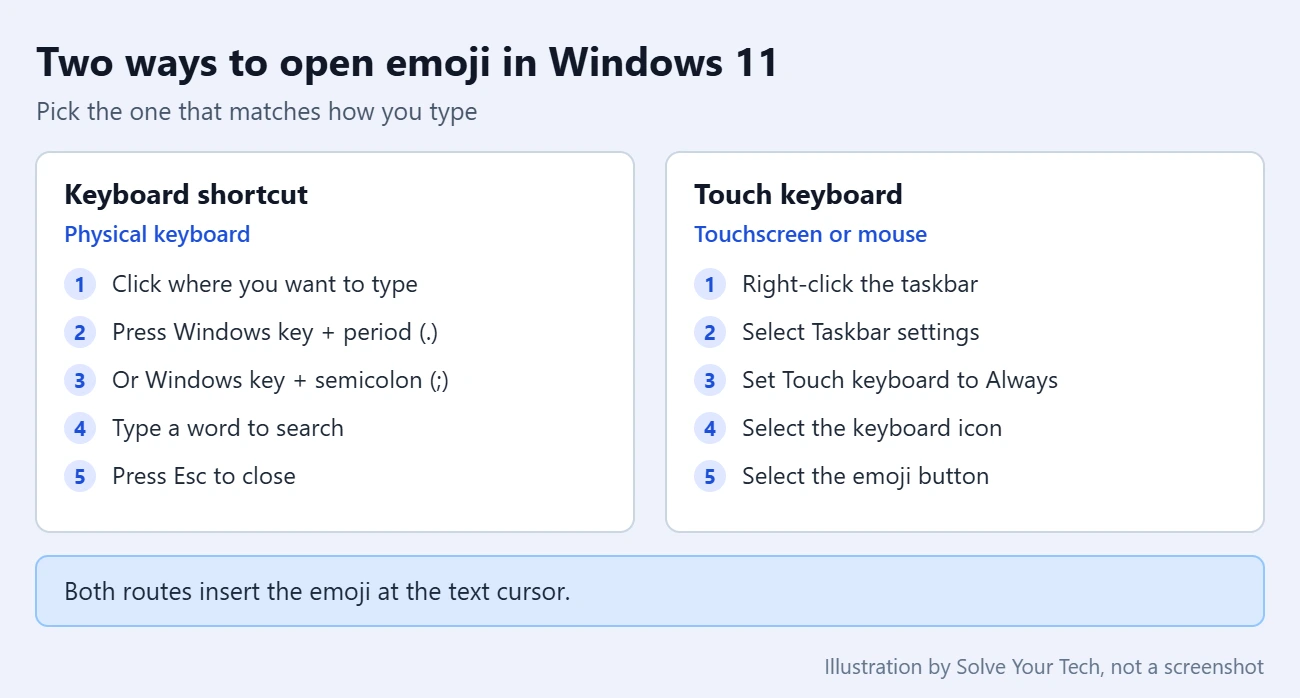
- Right-click the taskbar and select Taskbar settings. On a touchscreen, press and hold the taskbar instead.
- In Personalization > Taskbar, find the System tray icons section.
- Next to Touch keyboard, open the drop-down menu and choose Always. The other choices are Never and When no keyboard attached.
- Select the keyboard icon that now appears in the system tray, at the right end of the taskbar. The touch keyboard opens.
- Select the emoji button on the touch keyboard. It is usually a small smiley or heart icon near the upper-left corner, though its look and position can vary with the keyboard layout and Windows version.
- Select the emoji you want, then close the touch keyboard with the X in its corner.
To undo this, go back to the same menu and choose When no keyboard attached or Never. Be aware that Microsoft says Never also stops the touch keyboard from appearing at all, which you may not want on a tablet. The options are described on Microsoft’s enable and disable the touch keyboard page.
The touch keyboard is not the same tool as the older On-Screen Keyboard accessibility app. If that is the one you need, see how to enable the On-Screen Keyboard in Windows 11 or 10.
Other Ways to Add Emoji
- App emoji buttons: many chat and email apps have their own emoji button next to the message box. Those pickers belong to the app, so they may offer a different set than the Windows panel.
- Right-click menus: some web browsers include an Emoji item when you right-click inside a text field. If you do not see one, use the keyboard shortcut instead.
- Copy and paste: an emoji is a text character, so you can copy one from a message or document and paste it with Ctrl + V.
If the Emoji Panel Won’t Open
Work through these checks in order. Each one is quick, and none of them changes your files.
- Click in a text field first. Microsoft describes the shortcut as something you press during text entry. If nothing on screen is ready for typing, there is nowhere for the emoji to go.
- Try the other shortcut. If Windows key + period does nothing, press Windows key + semicolon (;).
- Check the Windows key. Press the Windows key alone. If the Start menu does not open, the key may be disabled by a gaming mode or key lock on your keyboard, or by a keyboard utility. Check the keyboard maker’s instructions.
- Test in another app. Open Notepad and try there. If it works in Notepad, the first app is likely blocking or reusing the shortcut.
- Restart the PC. A restart clears temporary input problems.
- Install Windows updates. Go to Settings > Windows Update and select Check for updates.
- Use the touch keyboard. The steps in the previous section give you emoji without the shortcut.
On a work or school computer, shortcuts and settings can be restricted by your organization. If the Touch keyboard menu is grayed out or the shortcut never works, ask your IT administrator.
Frequently Asked Questions
What is the shortcut for emoji in Windows 11?
Press Windows key + period (.) or Windows key + semicolon (;) while you are typing. Microsoft lists both as the way to open the emoji panel.
Does the emoji shortcut work in Windows 10?
Yes. Microsoft’s shortcut list shows the same key combination for Windows 10. The Windows 10 panel has a different design, so the tabs described here may not match exactly.
Can I change the skin tone of an emoji?
Many people and hand emoji come in several skin tones. The panel offers a tone choice for emoji that support it. The exact control depends on your Windows version, so look for a tone selector near the people emoji.
Do emoji look the same in every app?
No. Each app and device draws emoji with its own font, so the person reading your message may see a slightly different design. Some older programs show emoji in black and white or as an empty box.
Can I type emoji without a mouse?
Yes. Open the panel with the shortcut, type a word to search, use the arrow keys to highlight an emoji, and press Enter. Press Esc when you are done.
Why is the Clipboard tab empty?
Clipboard history is off until you enable it. Press Windows key + V and select Turn on. Microsoft notes that the history holds up to 25 entries and is cleared when you restart, except for items you pin.
Next Step
Open any text box now and press Windows key + period once so the shortcut sticks. Then try the Symbols tab the next time you need a character that is not on your keyboard.

Matthew Burleigh is the founder, head writer, and editor of Solve Your Tech, which he launched in 2012. He has written technology tutorials since 2008 and worked in IT since 2003, including small-business support, IT management, and consulting. He holds Bachelor’s and Master’s degrees in Computer Science from Arizona State University.
Matthew writes practical guides for Windows, iPhone and iPad, Microsoft Office, Outlook, Google apps, and Android. Solve Your Tech’s guides are tested on current devices or checked against official product documentation, with clear steps, sources, and update dates.
Read more about Matthew and how Solve Your Tech writes and updates its guides, or report a correction.