To remove an app from the desktop without deleting it, right-click its icon and select the Delete (trash can) icon. App icons on the desktop are almost always shortcuts, which are small links to a program stored elsewhere on your PC. Deleting the shortcut removes only the link. The app stays installed and still opens from the Start menu.
This guide is written for Windows 11 Home and Pro. The same ideas apply to Windows 10, where the right-click menu shows the word Delete instead of a trash can icon. You don’t need an administrator account to remove shortcuts from your own desktop.
Check Whether the Icon Is a Shortcut
Take a few seconds to confirm what the icon is before you delete it. A shortcut can go without any loss. An actual file, folder, or program file saved on the desktop is the real item, and deleting it removes that item from the desktop.

- Look for the arrow. A shortcut normally has a small curved arrow in the bottom-left corner of its icon.
- Open Properties. Right-click the icon and select Properties. A shortcut shows a Shortcut tab with a Target box that lists where the real app lives. To point the icon at something else, change the program or file the shortcut opens.
- Read the file type. On the General tab, a shortcut is listed as Shortcut (.lnk). If it says Application (.exe) or names a document type, the icon is the actual file.

Microsoft’s developer documentation on Shell links describes a shortcut as a separate object that points to another item, which is why removing one doesn’t touch the app it opens.
Remove One App Shortcut From the Desktop
- Press Windows key + D to show the desktop if windows are covering it.
- Right-click the app’s icon. A short menu opens with a row of small icons at the top.
- Select the Delete (trash can) icon. You can also click the icon once and press the Delete key on your keyboard.
- If Windows asks you to confirm, select Yes.

The icon disappears from the desktop and the shortcut goes to the Recycle Bin. Nothing is uninstalled.
If the icon has no arrow, it may be the actual file or folder. Don’t delete it. Move it into a folder such as Documents instead, as described below.
Remove Several Shortcuts at Once
- Click the first shortcut you want to remove.
- Hold Ctrl and click each additional shortcut. You can also drag a box around a group of icons with the mouse.
- Check that every selected icon is a shortcut. Click an icon again while holding Ctrl to drop it from the selection.
- Press Delete, or right-click one of the selected icons and choose the trash can icon.
Dragging the selected icons onto the Recycle Bin icon does the same thing.
Hide All Desktop Icons Without Removing Any
If you want an empty desktop for a presentation or a screen share, hide the icons instead of deleting them.
- Right-click an empty area of the desktop.
- Select View.
- Select Show desktop icons to remove the check mark.

Every icon vanishes at once, and nothing is deleted. Repeat the steps and select Show desktop icons again to bring them all back.
If you’d rather keep the icons but make them smaller, resize the desktop icons in Windows 11 instead.
Microsoft documents this reversible Show desktop icons setting and notes that you can still reach the hidden items by opening File Explorer and selecting Desktop in the navigation pane. The setting only changes the view. It does not hide an installed app from Start, from File Explorer, or from another person who uses the PC.
Move Shortcuts Into a Folder Instead
Moving is the right choice when you want to keep a shortcut for later, or when the icon turned out to be an actual file.
- Open File Explorer and select Documents.
- Right-click an empty area, select New > Folder, and give the folder a name such as Shortcuts.
- Drag the icons from the desktop into that folder.
A folder created on the desktop itself still leaves one icon there, so a folder in Documents gives you the cleanest result. To put a shortcut back, drag it from the folder to the desktop.
Remove System Icons Like Recycle Bin and This PC
Icons such as Recycle Bin, This PC, and Network are not shortcuts, and they are turned on or off in a settings window.
- Open Settings and select Personalization > Themes.
- Select Desktop icon settings.
- Clear the check box next to each icon you don’t want, then select OK.
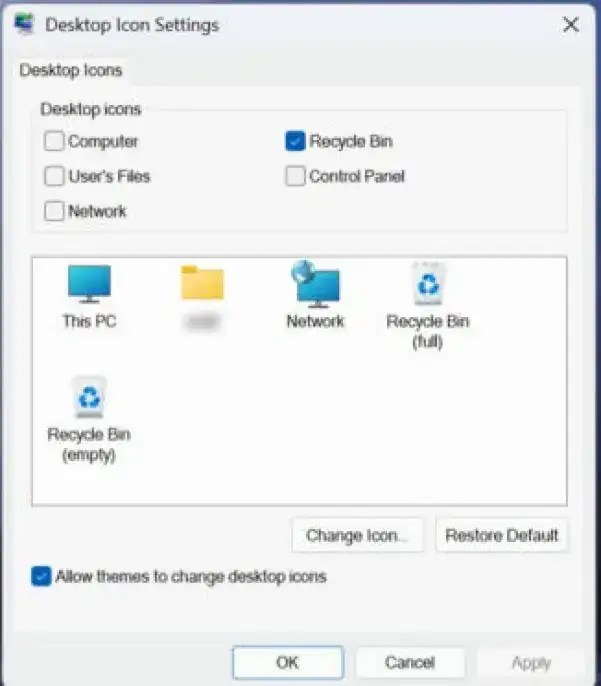
For more detail, read about removing the Recycle Bin from the desktop and adding or removing desktop icons in Windows 11.
If you removed it by mistake, here is how to show This PC on the desktop again.
Keep Quick Access to the App
A desktop shortcut is only one way to open an app. Set up another one before or after you remove it.
- Start: select Start and type the app’s name, then press Enter.
- Taskbar: type the app’s name in the search box on the taskbar, right-click the app in the results, and select Pin to taskbar. If the app is already open, right-click its taskbar icon and choose the same option. Both methods appear in Microsoft’s guide to customizing the taskbar, and there are more options for pinning to the taskbar in Windows 11.
The same goes for websites you use like apps; for example, you can pin Gmail to the taskbar in Windows 11 instead of keeping a desktop icon for it.
Confirm the App Is Still Installed, or Undo the Change
To confirm that only the shortcut is gone, select Start and type the app’s name. It should appear in the results and open normally. You can also check Settings > Apps > Installed apps, where the app should still be listed.
To get a deleted shortcut back, open the Recycle Bin, right-click the shortcut, and select Restore. Pressing Ctrl + Z right after deleting usually reverses it too. If the Recycle Bin has been emptied, make a new shortcut: select Start, select All, and drag the app from the list onto the desktop. There are other methods for making a desktop shortcut in Windows 11 too.
If you emptied the Recycle Bin and removed the Chrome icon, you can put a new Chrome shortcut on the desktop from Start.
When Windows Asks for Permission or There’s No Trash Icon
Windows asks for administrator permission
Some installers place a shortcut on the shared desktop that every account on the PC sees. Removing one of those may require an administrator to approve the change. If you don’t have that access, use Show desktop icons to hide the icons instead.
There’s no trash can icon in the menu
Select Show more options at the bottom of the right-click menu to open the full menu, which includes Delete. Pressing the Delete key works as well. If the icon is Recycle Bin, This PC, or another system icon, use Desktop icon settings.
All my icons disappeared
The Show desktop icons option is probably turned off. Right-click the desktop, select View, and check it again. If that isn’t it, check the other causes in getting back to the normal desktop in Windows 11.
The shortcut comes back
Some apps recreate their desktop shortcut when they update or when you reinstall them. Delete it again, and look for an option to skip the desktop shortcut in the app’s own settings or installer. If deleted icons keep reappearing after updates or on every account, see how to remove desktop shortcuts in Windows 11 for the Public Desktop and OneDrive causes.
Once the desktop is clear, pin the two or three apps you open every day to the taskbar so they stay one click away, and leave the rest to Start search.
Desktop Icon Removal Questions
Does deleting a desktop icon uninstall the app?
No, as long as the icon is a shortcut. Deleting a shortcut removes the link on the desktop, and the app stays installed and listed in the Start menu. Only deleting an actual program file or running an uninstall removes the app.
Do I need to empty the Recycle Bin afterward?
No. The icon leaves the desktop as soon as you delete it. Leaving the shortcut in the Recycle Bin gives you an easy way to restore it, and a shortcut takes up almost no storage space.
Why do apps keep adding desktop icons?
Many installers add a desktop shortcut by default. Watch for a check box such as “Create a desktop shortcut” during setup and clear it before you continue. Not every installer offers that choice.
Can I hide just one icon and keep the rest?
Windows has no per-icon hide switch on the desktop menu. Show desktop icons hides all of them together. To clear a single icon, delete it if it’s a shortcut or move it into a folder.
How do I actually uninstall an app?
Go to Settings > Apps > Installed apps, select the three dots next to the app, and choose Uninstall. Microsoft’s uninstall guide covers other methods. For a walkthrough of each one, read about uninstalling a program on Windows 11.

Matthew Burleigh is the founder, head writer, and editor of Solve Your Tech, which he launched in 2012. He has written technology tutorials since 2008 and worked in IT since 2003, including small-business support, IT management, and consulting. He holds Bachelor’s and Master’s degrees in Computer Science from Arizona State University.
Matthew writes practical guides for Windows, iPhone and iPad, Microsoft Office, Outlook, Google apps, and Android. Solve Your Tech’s guides are checked step by step against the device or app maker’s own documentation and tested on his own devices whenever he has the hardware or software, with clear steps, sources, and update dates.
Read more about Matthew and how Solve Your Tech writes and updates its guides, or report a correction.