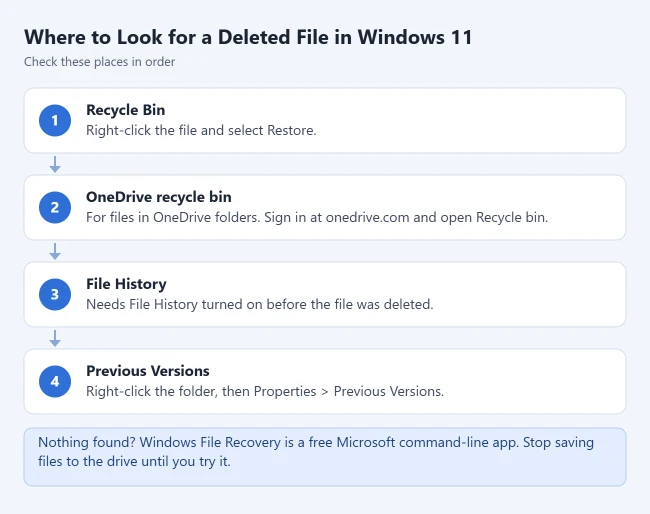
To find deleted files on Windows 11, open the Recycle Bin on your desktop, right-click the file, and select Restore. The file goes back to the folder it was deleted from. If it isn’t in the Recycle Bin, check the OneDrive recycle bin, File History, Previous Versions, and then Microsoft’s free Windows File Recovery app, in that order.
These steps cover Windows 11 Home and Pro with Microsoft’s built-in tools. Most of them also work on Windows 10, which is covered in its own section near the end.
Which Method to Try First
| Where the file was | Check first | What you need |
|---|---|---|
| On your PC, deleted normally | Recycle Bin | Nothing |
| In a OneDrive folder | Windows Recycle Bin, then the OneDrive recycle bin | Your Microsoft account |
| Deleted with Shift + Delete, or the bin was emptied | File History or Previous Versions | A backup made before the deletion |
| No bin copy and no backup | Windows File Recovery | A second drive to save to |
If you just deleted the file and haven’t done anything else in that folder, press Ctrl + Z in File Explorer right away. That undoes the last delete. It won’t work after a restart or after you’ve done other file actions, such as copying, moving or renaming files.
Check the Recycle Bin
Most files you delete from your PC’s drive go here first.
- Double-click Recycle Bin on the desktop. If it isn’t there, press Windows key + S, type Recycle Bin, and open it. (You can also put the Recycle Bin back on the desktop.) A File Explorer window opens with a list of deleted items.
- Find your file. Select the Date Deleted column header to sort by the most recent deletions, or type the name into the search box. The Original Location column shows the folder each item came from.
- Right-click the file and select Restore. The file disappears from the Recycle Bin and returns to its original folder.
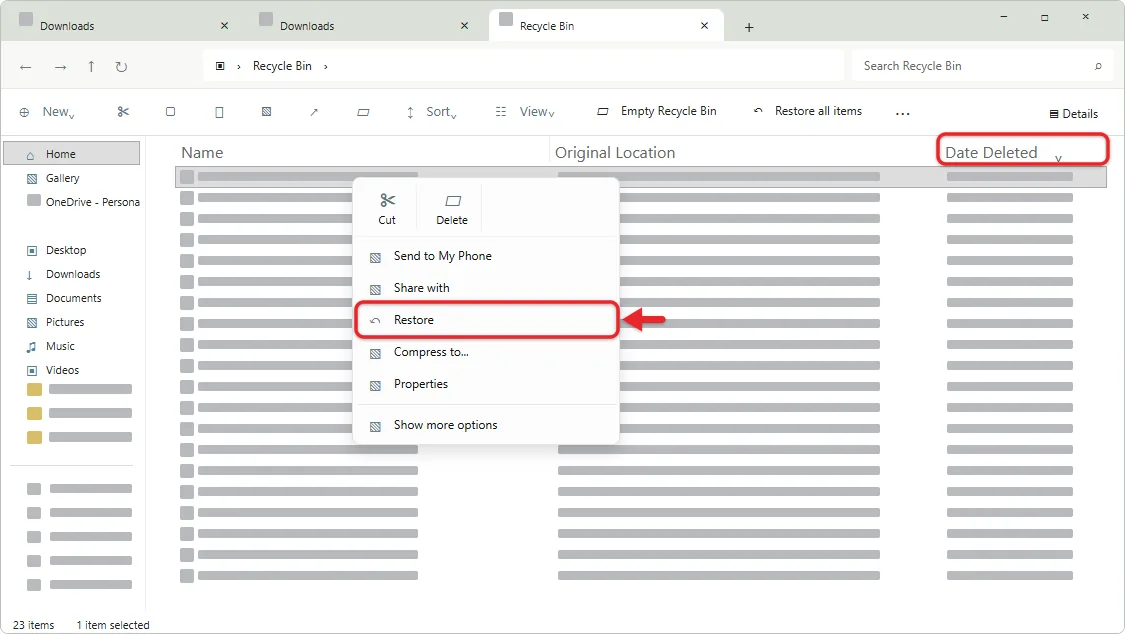
- Open the folder shown in Original Location to confirm the file is back.
If the Recycle Bin icon is missing from the desktop, you can bring it back when you add desktop icons in Windows 11. To restore several files at once, select them while holding Ctrl, then right-click and choose Restore. You can also drag a file out of the Recycle Bin into any folder if you want it somewhere new.
Why a File Might Not Be in the Recycle Bin
- You deleted it with Shift + Delete, which skips the bin.
- It was too large for the space the Recycle Bin is allowed to use.
- It came from a USB drive, SD card or network location. Those deletions are usually permanent.
- The bin was emptied, by you or by Storage Sense. Storage Sense can remove items on a schedule if you set Delete files in my recycle bin if they have been there for over under Settings > System > Storage > Storage Sense.
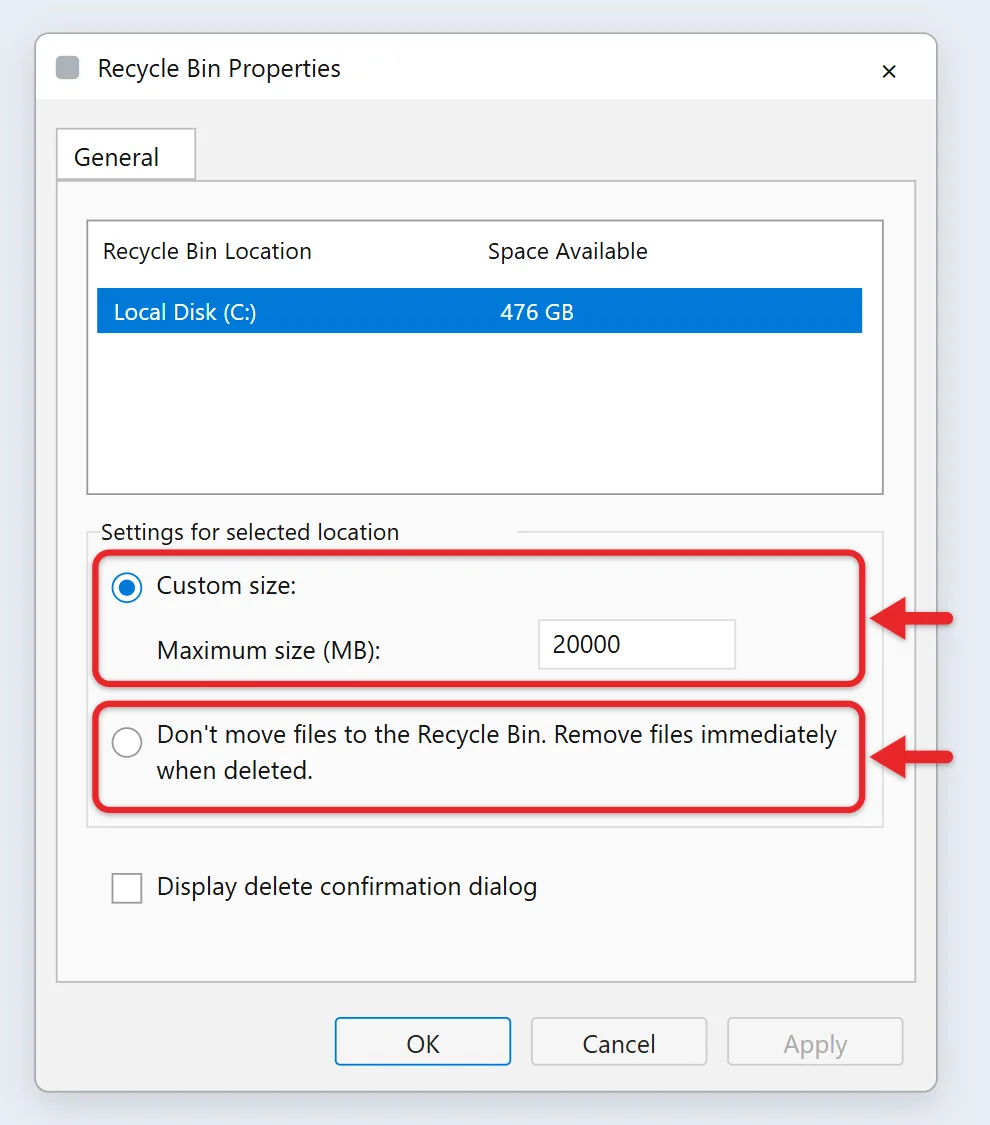
- Someone turned on Don’t move files to the Recycle Bin. To check, right-click Recycle Bin, select Properties, and look at the settings for each drive. Choose Custom size if you want deleted files to go to the bin again.
Check the OneDrive Recycle Bin
If the file was in a OneDrive folder, such as Desktop or Documents when OneDrive backup is on, it may be in the OneDrive recycle bin instead. That is where files go when you delete files from OneDrive on Windows 11. A file that was stored on the PC usually goes to the Windows Recycle Bin too, but an online-only file (one with a cloud icon) does not. It only goes to the OneDrive recycle bin.
- Go to onedrive.com in a browser and sign in with the same Microsoft account you use on the PC.
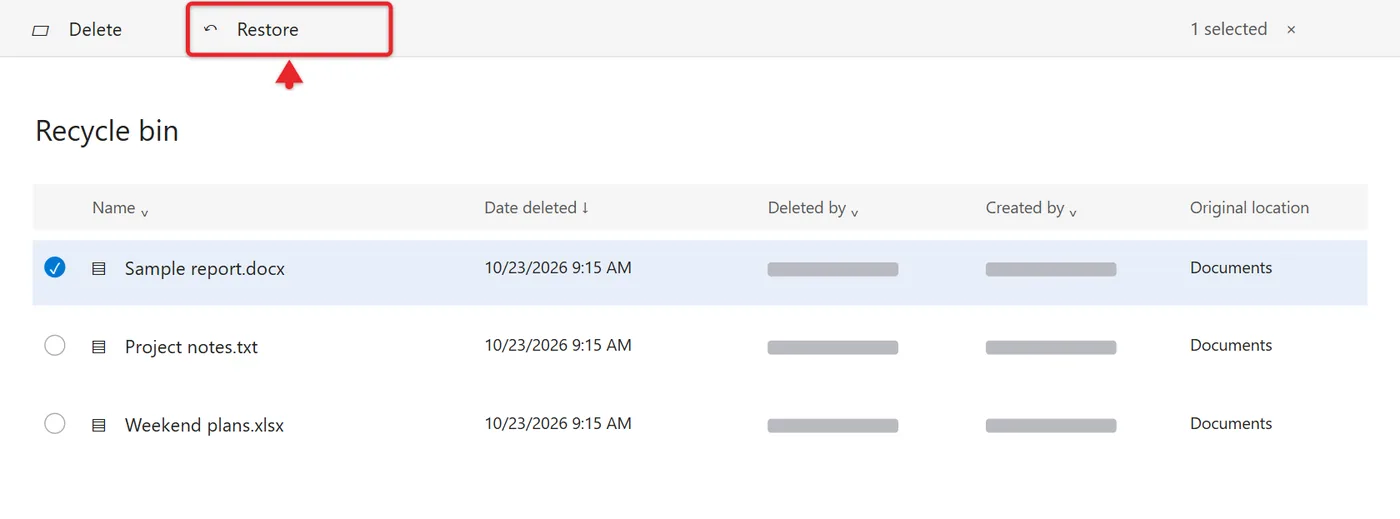
- Select Recycle bin in the left pane. A list of deleted files and folders appears.
- Point to the file, select the round check box next to it, then select Restore. The file returns to its OneDrive folder and syncs back to your PC.
Files in the OneDrive recycle bin for personal accounts are deleted automatically after 30 days. Work or school accounts keep them for 93 days unless an administrator changed that. Items from your Personal Vault only show up after you unlock it with Show Personal Vault items. See Microsoft’s OneDrive restore guide. Microsoft 365 subscribers can also restore their whole OneDrive to an earlier point, which helps after a large accidental deletion.
Restore From File History
This only works if File History was turned on and backing up to a drive before the file was deleted. It is not on by default. You can check by opening Control Panel > System and Security > File History.
- Connect the external drive or network location that holds your File History backups.
- Press Windows key + S, type Restore your files with File History, and open it. A window shows your backed-up folders.
- Browse to the folder that held the file. Use the arrows at the bottom to move back to an older backup. The date and time at the top tell you which backup you are looking at.
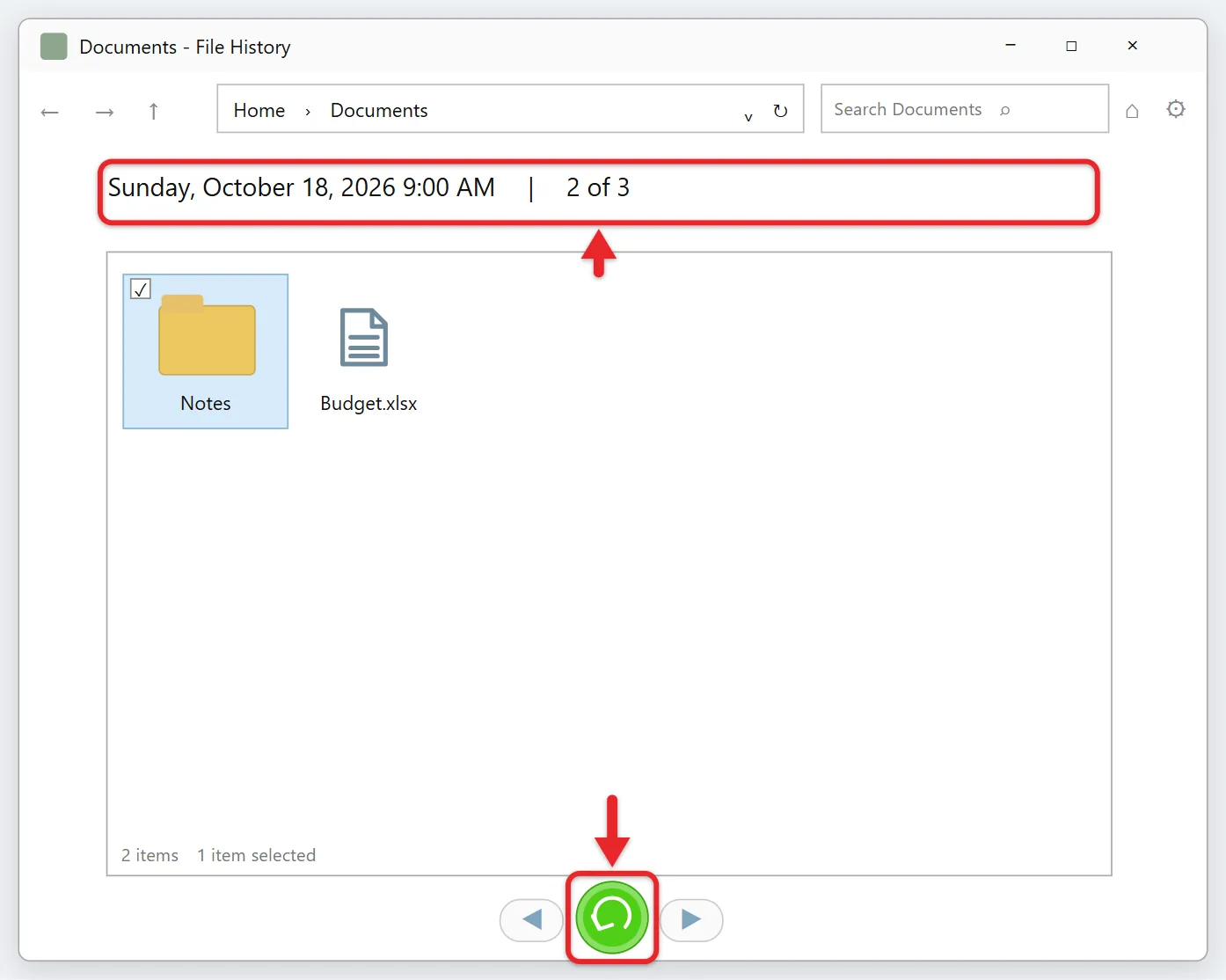
- Select the file, then select the green Restore button. To save it somewhere else instead, right-click the green button and choose Restore to.
The file is copied back to its folder. If a file with the same name already exists there, Windows asks whether to replace it, skip it, or compare the two.
Restore a Previous Version of the Folder
The Previous Versions tab lists saved copies of a folder from File History backups and, on some PCs, from restore points. If you have neither, the list is empty.
- Open File Explorer with Windows key + E.
- Right-click the folder that held the file and select Properties. You can also right-click the folder and choose Show more options > Restore previous versions.
- Open the Previous Versions tab.
- Pick a version from before the file was deleted and select Open to look inside it.
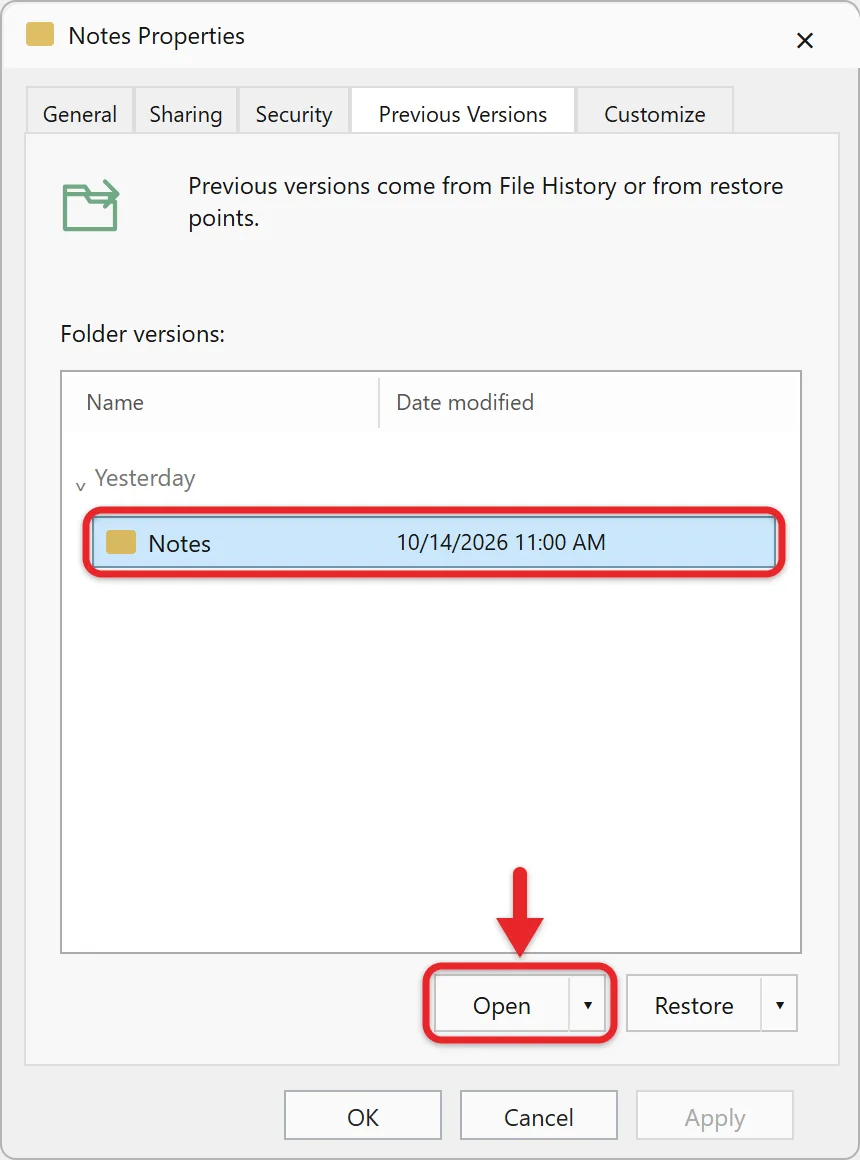
- Copy the file you need to a safe location, such as your Desktop.
Avoid the plain Restore button on this tab unless you want the whole folder rolled back. Restoring in place replaces the current folder and can’t be undone. Restore to saves the old version in a different place instead.
If no previous versions are available, Windows has no usable saved version of that folder to offer. Check any separate backup you actually made. If you used the older Backup and Restore (Windows 7) tool in Control Panel, open it and choose Restore my files. A full system image is different: restoring one replaces everything on the drive, so don’t use it to get one file back.
System Restore does not recover deleted personal documents; it rolls back system files and settings. The System Restore guide explains the difference.
For a Word file that still exists but was changed, Word has its own options to restore previous versions and AutoRecover copies.
Recover Files With Windows File Recovery
If the file isn’t in any recycle bin or backup, Microsoft’s free Windows File Recovery app can sometimes get it back from internal drives, external drives, and USB drives. It doesn’t work for cloud storage or network shares. It runs from a command line, so type the commands carefully.

- Stop saving new files to the drive that held the lost file. New data can overwrite it.
- Connect a second drive to save the results to, such as a USB flash drive or external drive, if your PC has only one drive. The source and destination must be different drives.
- Install Windows File Recovery from the Microsoft Store. Installing an app writes to the C: drive, so if the lost file was on C:, save nothing else there afterward.
- Press the Windows key, type Windows File Recovery, open it, and select Yes when asked. A Command Prompt window opens.
- Type a command that names the drive to search, then a different drive to save to. For example, this looks for Word and PDF files on C: and saves them to E:
winfr C: E: /regular /n *.docx /n *.pdf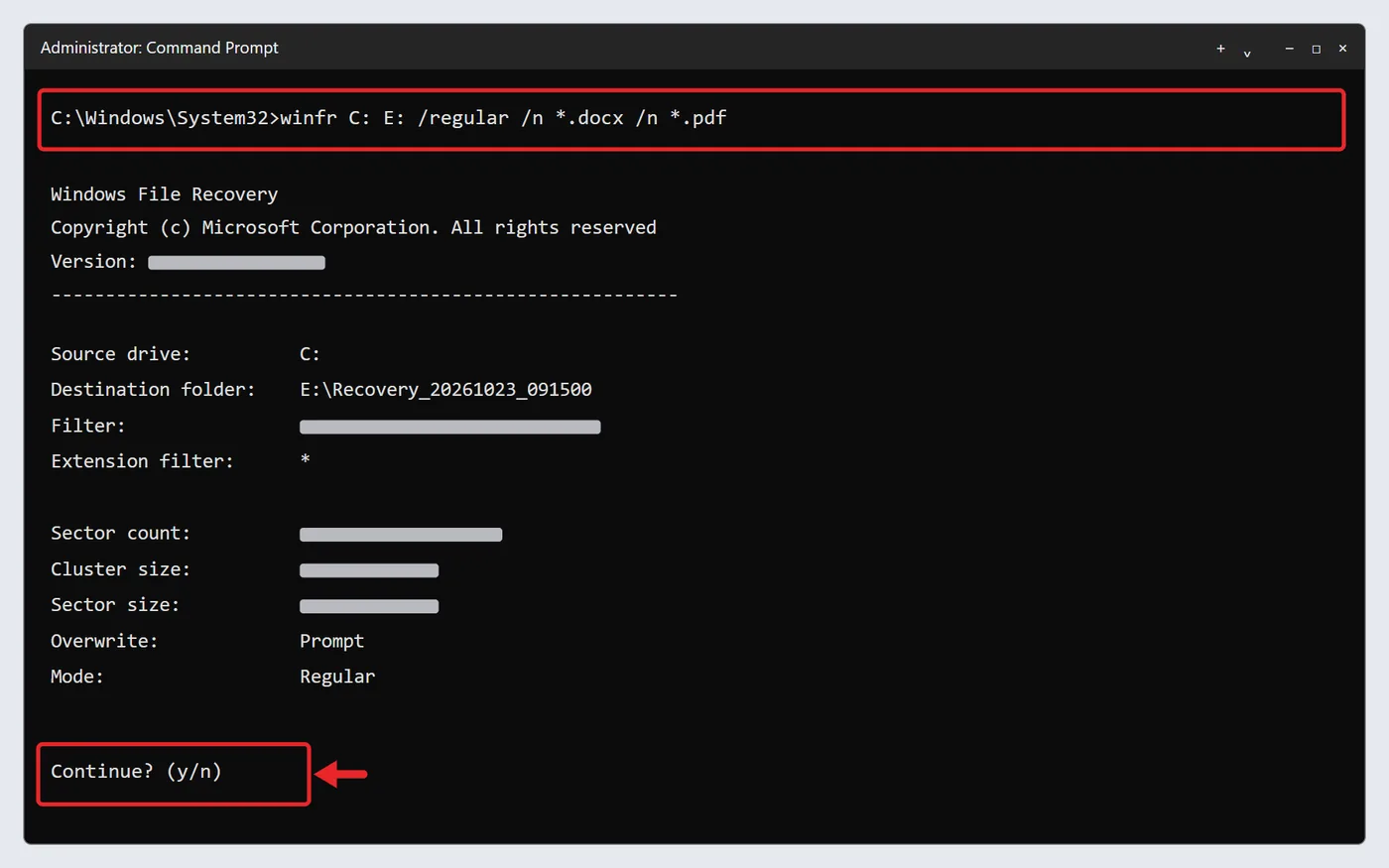
- Enter Y to start. Recovered files go into a Recovery_ folder, named with the date and time, on the destination drive.
- Open the recovered files to make sure they work before you rely on them.
Use /regular for files recently deleted from an NTFS drive (most PC drives), and /extensive for older deletions, formatted or corrupted drives, and FAT or exFAT drives such as SD cards and many USB sticks. If you’re not sure, start with Regular.
You can also search by folder or name. To look for everything that was in your Documents folder, use winfr C: E: /regular /n \Users\YourName\Documents\ and replace YourName with the name of your user folder. Keep the backslash at the end of a folder path, and put any path that contains spaces in quotation marks. To search by part of a name, use wildcards, such as /n *invoice*.
If You Used Shift + Delete or Emptied the Bin
Check existing cloud and offline backups first. If you need recovery from the original drive, stop using it as much as possible: saving files, installing software, or creating a new partition can overwrite recoverable data. Windows File Recovery must save results to a different drive, such as an external drive.
Use the command and mode guidance above, keep the original disk intact, and check the recovered copies before you count on them. Recovery may not work, especially once SSD data is no longer available. For irreplaceable files or a failing drive, get professional recovery help instead of making repeated attempts. See Microsoft’s recovery limitations.
Recover Deleted Files on Windows 10
Microsoft ended support for Windows 10 on October 14, 2025, so these PCs no longer get security updates. The recovery tools still work.
On Windows 10, open Recycle Bin, select the file, and choose Restore to return it to its original folder. For a OneDrive-synced file, check the online recycle bin separately. If you already used File History, search Start for Restore your files with File History, choose the folder and backup date, select the file, and use Restore. If no backup or bin copy exists, Microsoft’s Windows File Recovery supports Windows 10 as well; use the different-drive output and mode instructions above. A restore point is not a substitute for a personal-file backup.
How to Avoid Losing Files Next Time
- Turn on File History with an external drive, or set up a backup of Windows 11 to an external hard drive.
- Use OneDrive folder backup for Desktop, Documents and Pictures, so deleted files land in the OneDrive recycle bin as well.
- Keep the Recycle Bin on, and check it before you empty it.
- Read the Storage Sense settings before you turn it on, so it doesn’t empty the bin sooner than you expect.
Deleted File Recovery Questions
How long do files stay in the Recycle Bin?
Files stay until you empty the bin or it runs out of space. Storage Sense can also delete them on a schedule if you turned that setting on.
Can I recover a file after emptying the Recycle Bin?
Sometimes. Try File History, Previous Versions, or Windows File Recovery. The sooner you try, the better your chances, because new files can overwrite the space the deleted file used.
Is File History turned on by default?
No. You have to turn it on in Control Panel > System and Security > File History and choose a drive. It can’t restore files deleted before it started backing up.
Where did my deleted file go if it’s not in the Recycle Bin?
It may have been deleted with Shift + Delete, from a USB drive, or from OneDrive. Check the OneDrive recycle bin first if the file was in a synced folder. A file also disappears from OneDrive when it is moved out of the OneDrive folder, which is what happens when you move files from OneDrive to your PC.
Does Windows File Recovery work on an SSD?
It can, but results are less likely. SSDs often clear the space a deleted file used soon after the delete, so act quickly and keep using the drive as little as possible.
A file that isn’t deleted but just can’t be found may turn up when you look at recent files in Windows 11.

Matthew Burleigh is the founder, head writer, and editor of Solve Your Tech, which he launched in 2012. He has written technology tutorials since 2008 and worked in IT since 2003, including small-business support, IT management, and consulting. He holds Bachelor’s and Master’s degrees in Computer Science from Arizona State University.
Matthew writes practical guides for Windows, iPhone and iPad, Microsoft Office, Outlook, Google apps, and Android. Solve Your Tech’s guides are checked step by step against the device or app maker’s own documentation and tested on his own devices whenever he has the hardware or software, with clear steps, sources, and update dates.
Read more about Matthew and how Solve Your Tech writes and updates its guides, or report a correction.