This post contains affiliate links. As an Amazon Associate, solveyourtech.com earns from qualifying purchases, at no extra cost to you.
To back up Windows 11 to an external hard drive, plug in the drive, open Control Panel > File History, select Select drive, choose the external drive, and select Turn on. File History copies your personal folders to the drive and keeps saving new versions every hour while the drive is connected. For a copy of the entire system, including Windows and your apps, use the system image tool described below.
These steps work on current Windows 11 Home and Pro, and the same built-in tools exist in Windows 10.
Which Backup Method Should You Use?
Windows 11 has several ways to put a backup on an external drive, and they protect different things. Many people use two: File History for everyday file protection and a system image before big changes.
| Method | What it saves | Runs automatically | Best for |
|---|---|---|---|
| File History | Your libraries, Desktop, Contacts and Favorites, with older versions | Yes, every hour by default | Getting back a deleted or changed file |
| Backup and Restore (Windows 7) | Chosen folders, plus an optional system image | Yes, weekly by default | A scheduled backup that includes a full image |
| System image | Everything on the Windows drive, including Windows and apps | No, you run it | Restoring the whole PC after a drive failure |
| Copy and paste | Only the files you pick | No | A quick one-time copy |
| Disk clone | An exact copy of the whole disk on another drive | No | Moving to a new drive |
The Windows Backup app in Settings is not on this list because it saves to OneDrive, not to an external drive. More on that below.
An External Drive With Enough Space
What you need: an external drive with more free space than your files. A portable hard drive like the WD 2TB Elements Portable costs less per terabyte. A portable SSD like the Samsung T7 1TB is faster and tougher.
- Enough space. For File History, plan on at least the size of the folders you back up, plus room for older versions. For a system image, the drive needs more free space than the used space on your C: drive. Check the used space in File Explorer by right-clicking Local Disk (C:) and selecting Properties.
- The right format for a system image. The system image tool needs an NTFS drive. Many new external drives come formatted as exFAT, which works for File History and copying files but not for an image. Formatting erases the drive, so move any files off it first. To change a drive from exFAT to NTFS, follow the steps to format an external hard drive in Windows 11.
- A dedicated drive if you can. File History and system images can share a drive with other files, but a drive used only for backups is easier to keep track of and less likely to be erased by accident.
- Your BitLocker recovery key. If your Windows drive is encrypted with BitLocker or device encryption, have the recovery key saved somewhere other than the PC before you rely on a system image. You may need it to restore.
- Time and power. The first backup can take an hour or more on a large drive. Plug a laptop into power and leave the external drive connected until it finishes.
Back Up Your Files With File History
File History is the best choice for most people because it runs on its own and keeps older versions of your files. It saves copies of your libraries (Documents, Music, Pictures and Videos), your Desktop, Contacts and Favorites.
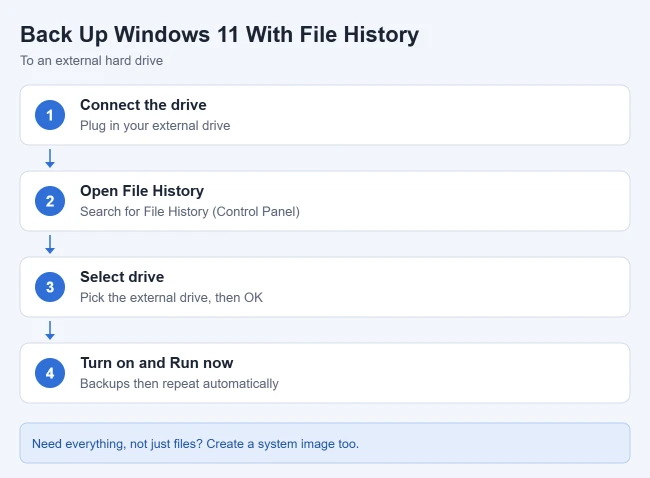
- Connect the external drive.
- Press Windows key + S, type File History, and open it. It opens in Control Panel. You can also reach it through Control Panel > System and Security > File History.
- Select Select drive in the left pane, pick the external drive, and select OK.
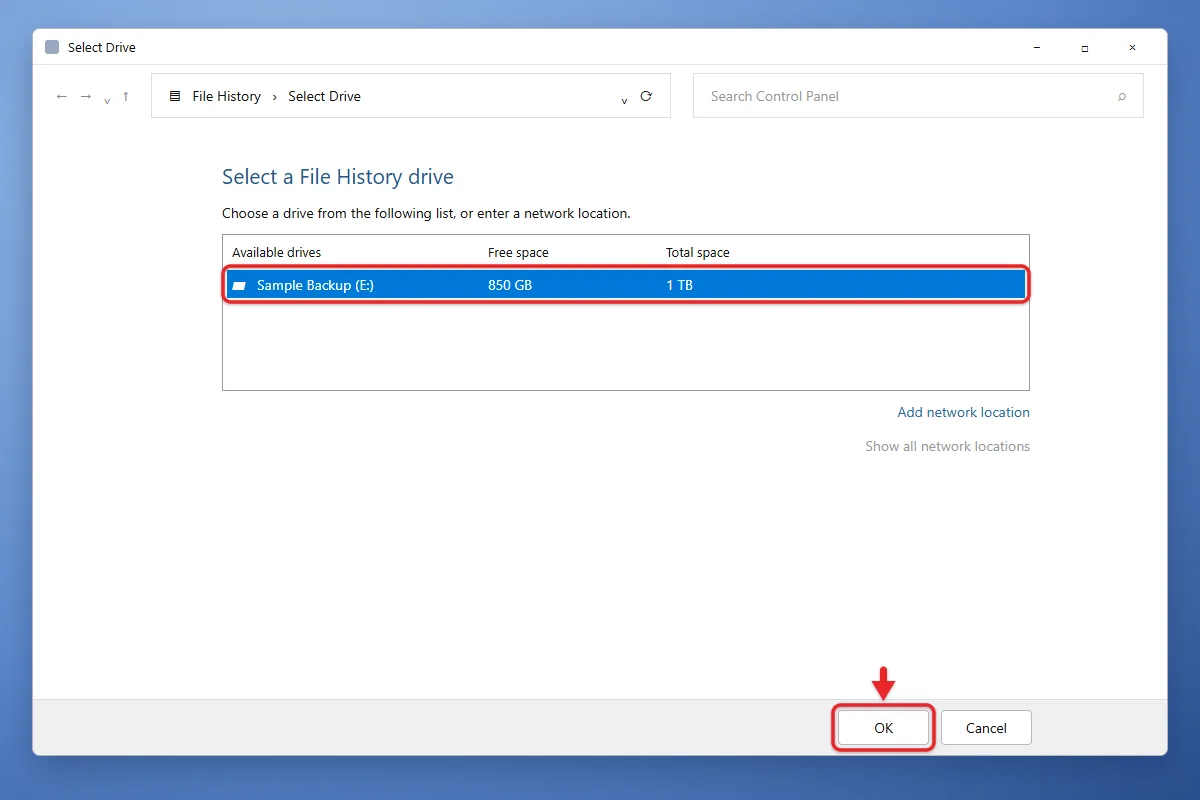
- If Windows asks whether to move your existing files to the new drive, choose Yes to keep earlier File History versions, or No to start fresh.
- Select Turn on. The page now says File History is on and shows the drive name.
- To start a backup right away, select Run now. The page shows the date and time of the last copy when it finishes.
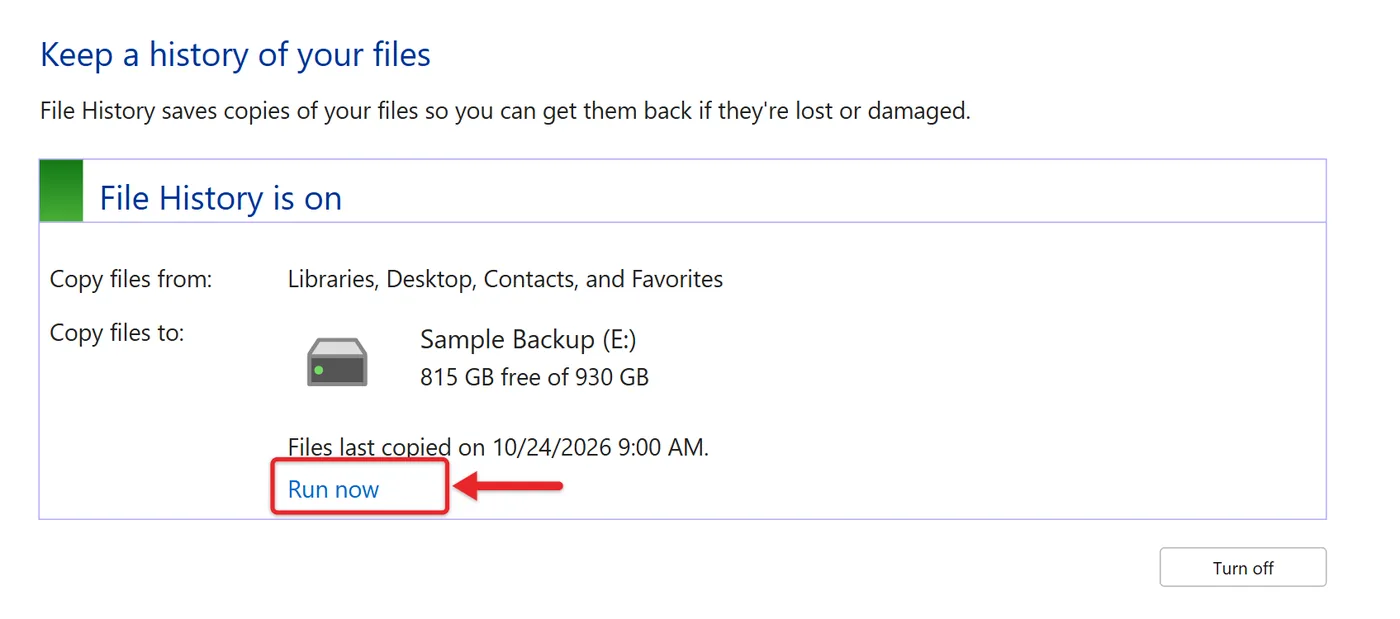
File History keeps working in the background. Each time you connect the drive, it catches up on changes, so plug it in regularly if you unplug it between backups.
Change How Often It Saves and What It Skips
- Select Advanced settings to change Save copies of files (every hour is the default) and Keep saved versions (the default is forever). Choose a shorter period for versions if the drive fills up, or use Clean up versions on the same page to delete old copies.
- Select Exclude folders to leave out large folders you don’t need, such as a Videos folder you already keep elsewhere.
- To back up a folder that isn’t in your libraries, right-click the folder in File Explorer, select Show more options > Include in library, and add it to a library. File History then picks it up on its next run.
Microsoft covers these options in its File History guide. Norton 360 backing up the same folders? Once File History has finished its first run, you can turn off Norton 360 backups so you only keep one.
OneNote has its own backup setting, and you can point it at the same drive with these OneNote backup steps.
Restore a File From File History
- Connect the backup drive and open File History.
- Select Restore personal files in the left pane.
- Browse to the file or folder. Use the arrow buttons at the bottom to move between dates.
- Select the item and the green Restore button. If a file with the same name exists, Windows asks whether to replace it, skip it, or compare the two.
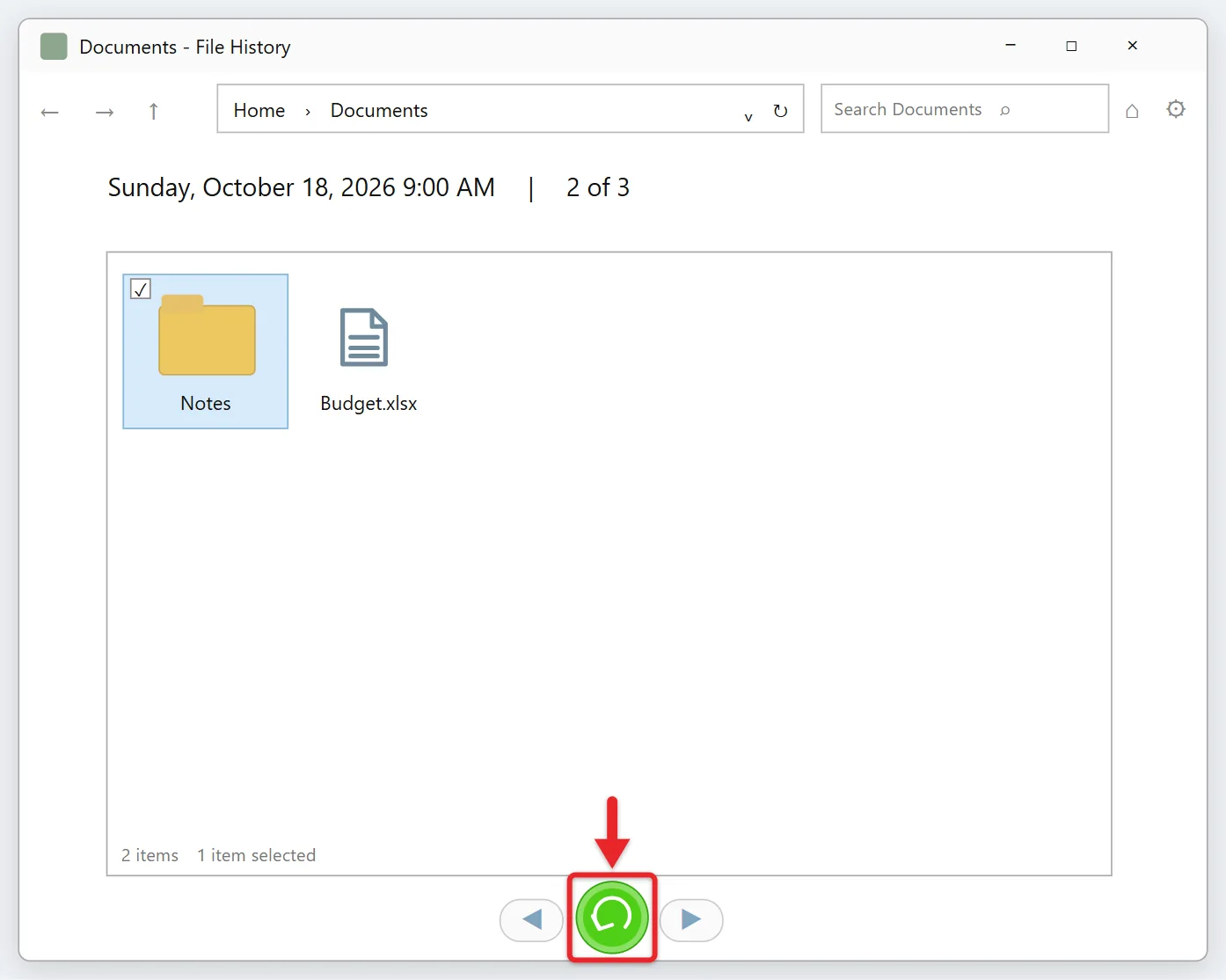
You can also right-click a folder in File Explorer and select Restore previous versions. On the Previous Versions tab, pick a date. Choose Restore to… under the Restore menu if you want to keep the current copy too, because a plain restore replaces the current version and can’t be undone.
Create a Full System Image
A system image copies everything on the drive, including Windows and your apps, so you can restore the whole PC. Microsoft no longer develops this tool, but it’s still included. A system image is different from a restore point, which saves only system files and settings; creating a restore point in Windows 11 gives you that lighter safety net.
- Open Control Panel and select Backup and Restore (Windows 7). It’s under System and Security.
- Select Create a system image in the left pane.
- Choose On a hard disk and pick the external drive.
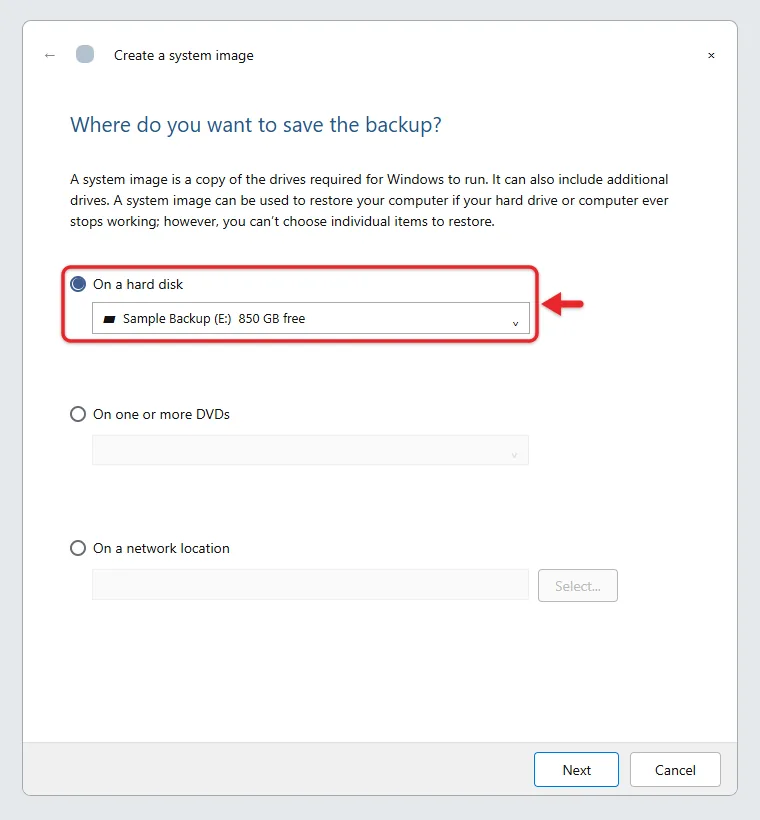
- Select Next. The next screen lists the drives in the image. The EFI system partition and your Windows drive are checked and can’t be cleared. Add other internal drives only if the backup drive has room for them.
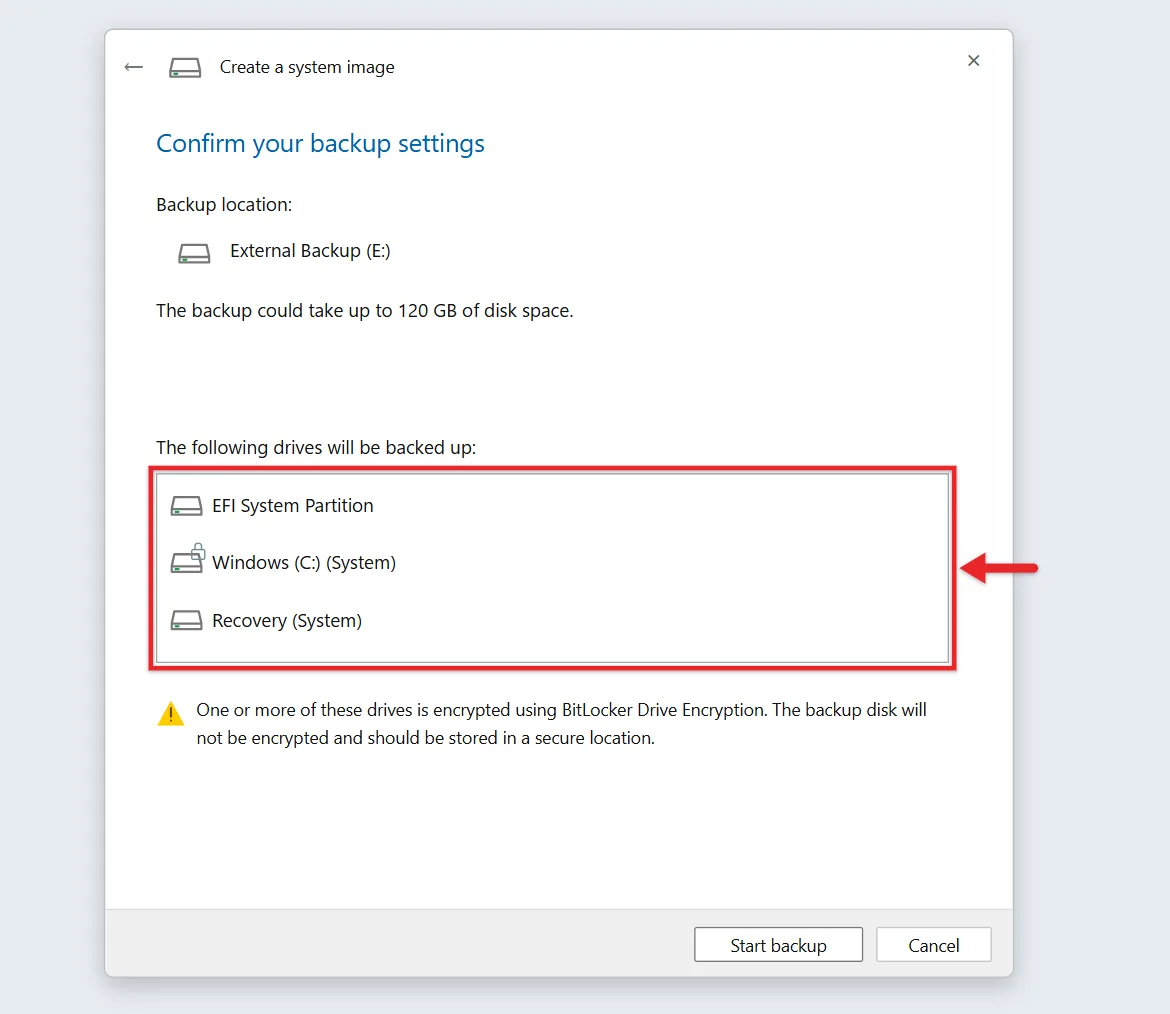
- Select Start backup. A progress bar appears, and you can keep using the PC.
- When the image is done, Windows may offer to create a system repair disc. Select No if you have a Windows 11 recovery USB or installation USB, then select Close.
The image is saved in a folder named WindowsImageBackup on the external drive. Don’t rename or move that folder, or Windows won’t find the image when you need it. Running the tool again to the same drive replaces the earlier image with a new one.
Microsoft lists System Image Backup on its deprecated features page and suggests third-party tools for full-disk backup. It still works in Windows 11, but keep File History running as well rather than depending on the image alone.
Still on Windows 10? Here’s how to back up Windows 10 to an external hard drive.
Restore the PC From a System Image
Restoring an image erases everything currently on the target drive and puts back the PC exactly as it was on the day of the image. Copy any newer files somewhere safe first, and restore only to the same PC.
- Connect the drive that holds the image.
- If Windows starts, open Settings > System > Recovery and select Restart now next to Advanced startup. If Windows won’t start, boot from a Windows 11 recovery or installation USB instead and choose Repair your computer.
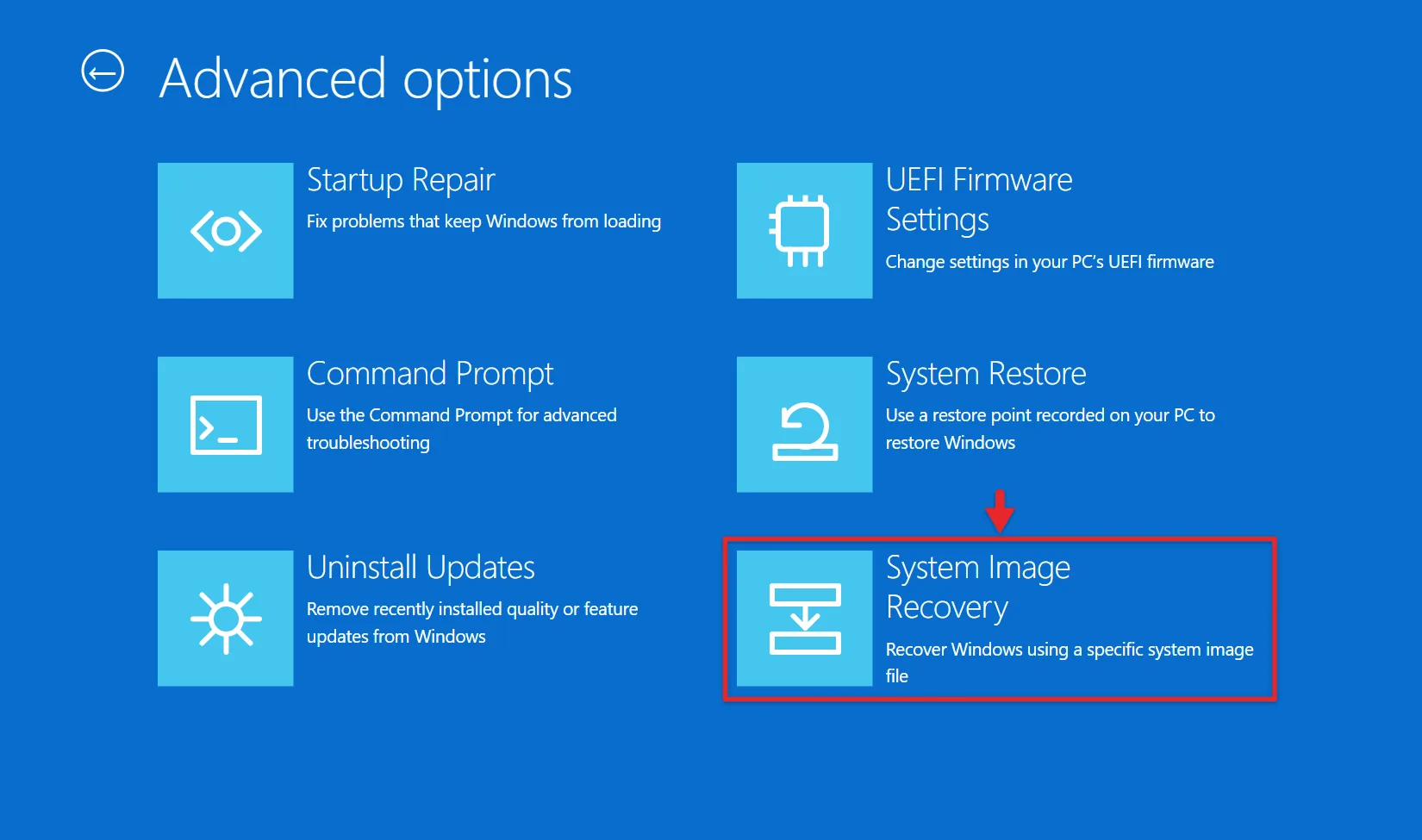
- Select Troubleshoot > Advanced options. If you don’t see the option you need, select See more recovery options.
- Select System Image Recovery and choose the Windows install if asked.
- Keep Use the latest available system image selected, or pick an older one, then select Next and Finish.
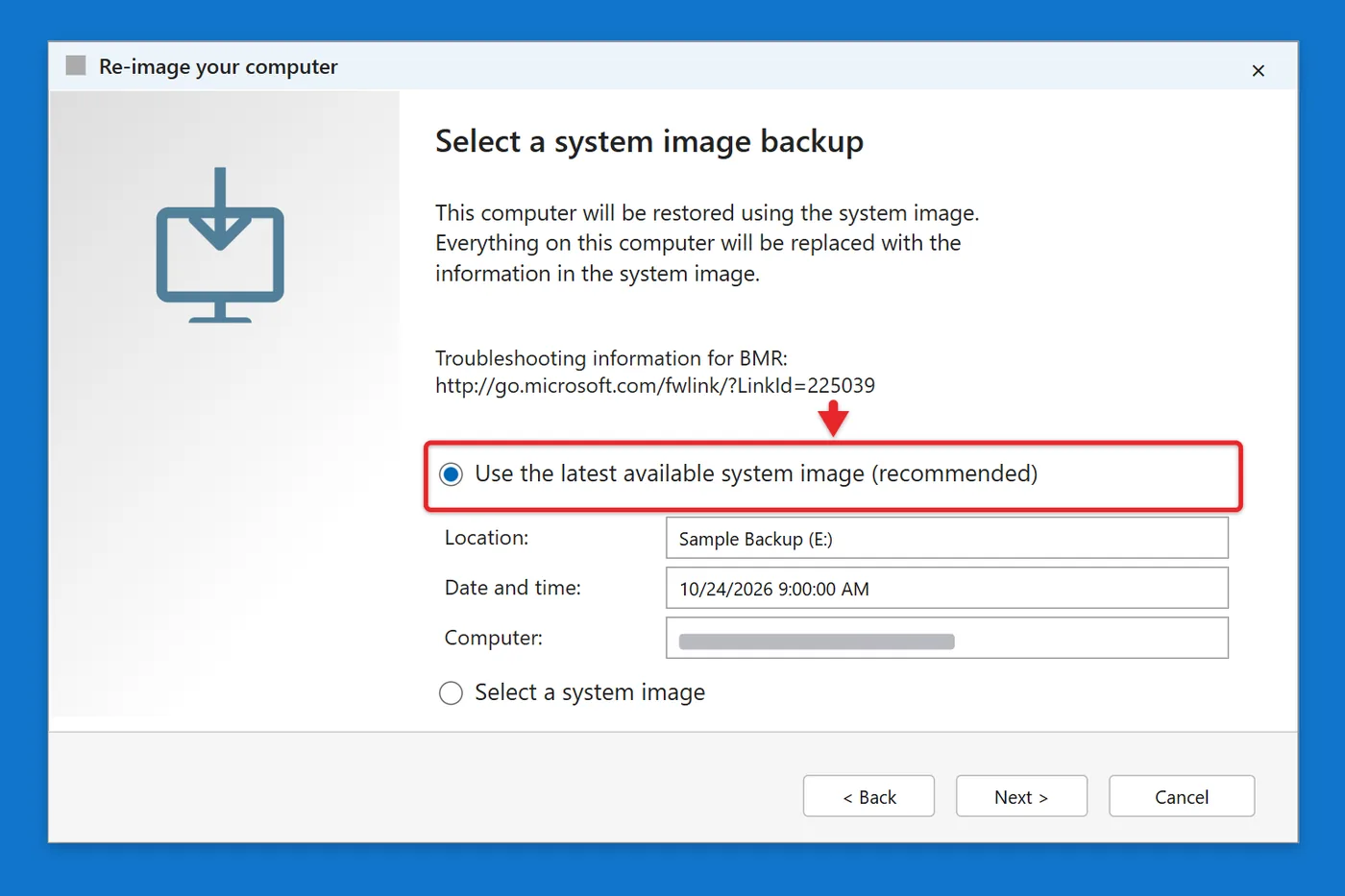
- Confirm the warning and wait. Enter your BitLocker recovery key if Windows asks for it.
Schedule Backups With Backup and Restore (Windows 7)
The same Control Panel page can also run a weekly backup of your files and a system image together.
- Open Control Panel > Backup and Restore (Windows 7) and select Set up backup.
- Pick the external drive and select Next.
- Choose Let Windows choose to back up your user folders and a system image, or Let me choose to pick folders and clear the image option. Select Next.
- Select Change schedule to set the day and time, then select Save settings and run backup.
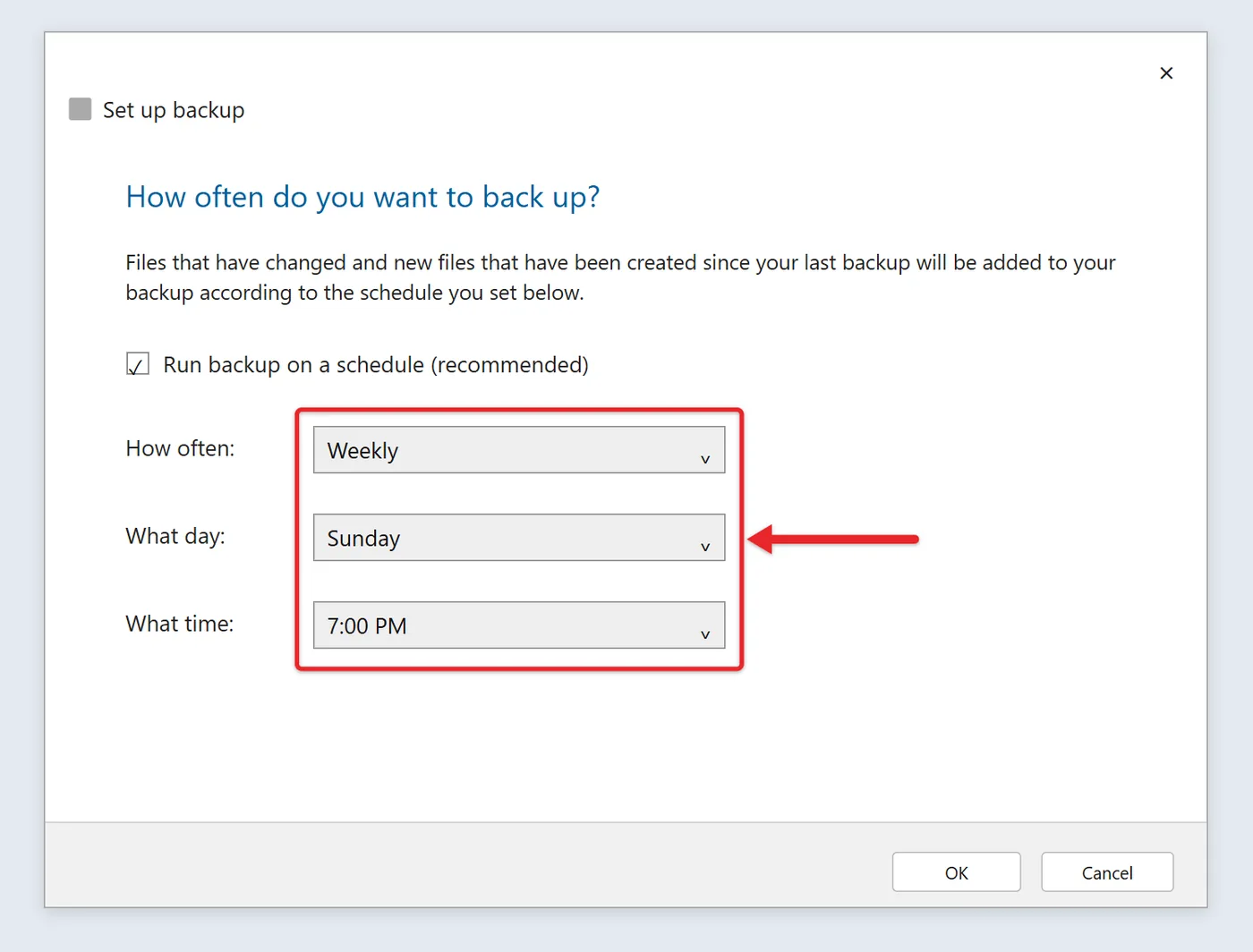
The scheduled backup runs only when the drive is plugged in at that time. To get files back from it, open the same page and select Restore my files.
Make an Image From the Command Line
If you are comfortable with the command line, the built-in wbadmin tool makes the same kind of image. Open Terminal (Admin) and run this, replacing E: with the letter of your external drive:
wbadmin start backup -backupTarget:E: -include:C: -allCritical -quiet
The -allCritical switch adds the partitions Windows needs to start, and -quiet skips the prompts. All the switches are listed in the wbadmin start backup reference. Double-check the drive letter first.
Copy Files to an External Drive and Check Them
Connect the drive directly to the PC, using its power supply if required. Press Windows + E, choose This PC, and open the external drive by its name and drive letter. Make a new destination folder. In a second File Explorer window, select the source files or folders and press Ctrl + C, then open the destination and press Ctrl + V. Wait for copying to finish.
If the drive is not listed under This PC, follow our steps to fix a USB drive not showing up in Windows 11.
Open several files from the external drive and compare important folders before considering the copy complete. Use Copy for a backup; Cut moves files away from the original location. To move them deliberately, keep a separate verified backup and check the destination before removing originals. Microsoft’s external-storage transfer guide explains copying and checking files.
Close any files on the drive, then click the taskbar’s Safely Remove Hardware and Eject Media icon and choose Eject for that drive. Unplug it once Windows says it’s safe. If it says the drive is in use, close the app using it and try again. See Microsoft’s safe removal instructions. If a drive with files you need doesn’t show up, check its cable, power and a different port; don’t format or initialize it just to make it appear.
What About the Windows Backup App?
The Windows Backup app saves your folders, settings, and app list to OneDrive, not to an external drive. It’s useful for moving to a new PC, but it doesn’t replace a drive backup. It needs a personal Microsoft account, and a free account includes only 5 GB of OneDrive storage. See Microsoft’s Windows Backup guide for what it includes. To reinstall Windows itself if the PC won’t start, also make a Windows 11 recovery USB. Moving from an older PC? You can also transfer data from Windows 10 to Windows 11. If you want an online backup service instead, see these CrashPlan backup instructions.
A fresh backup is also the first thing to do before you reset all settings in Windows 11.
Clone a Disk to Another Drive
A clone copies a disk’s partitions straight to another drive, while a backup image is a file you restore later. Cloning overwrites everything on the destination drive. Keep a separate backup, identify both drives by model and capacity, and make sure the destination has room for all the partitions. One current tool is Macrium Reflect X, which you can download from Macrium. Check its license and price first, because Macrium no longer offers the old Reflect Free edition.
To clone a disk in Reflect X:
- Open Create Backups > Local Disks, select the source disk, and choose Clone this disk….
- Select Select a disk to clone to… and pick the destination drive.
- Select Copy Partitions. For a Windows startup disk, include all the system partitions. Resize them if needed, and stop if they won’t fit.
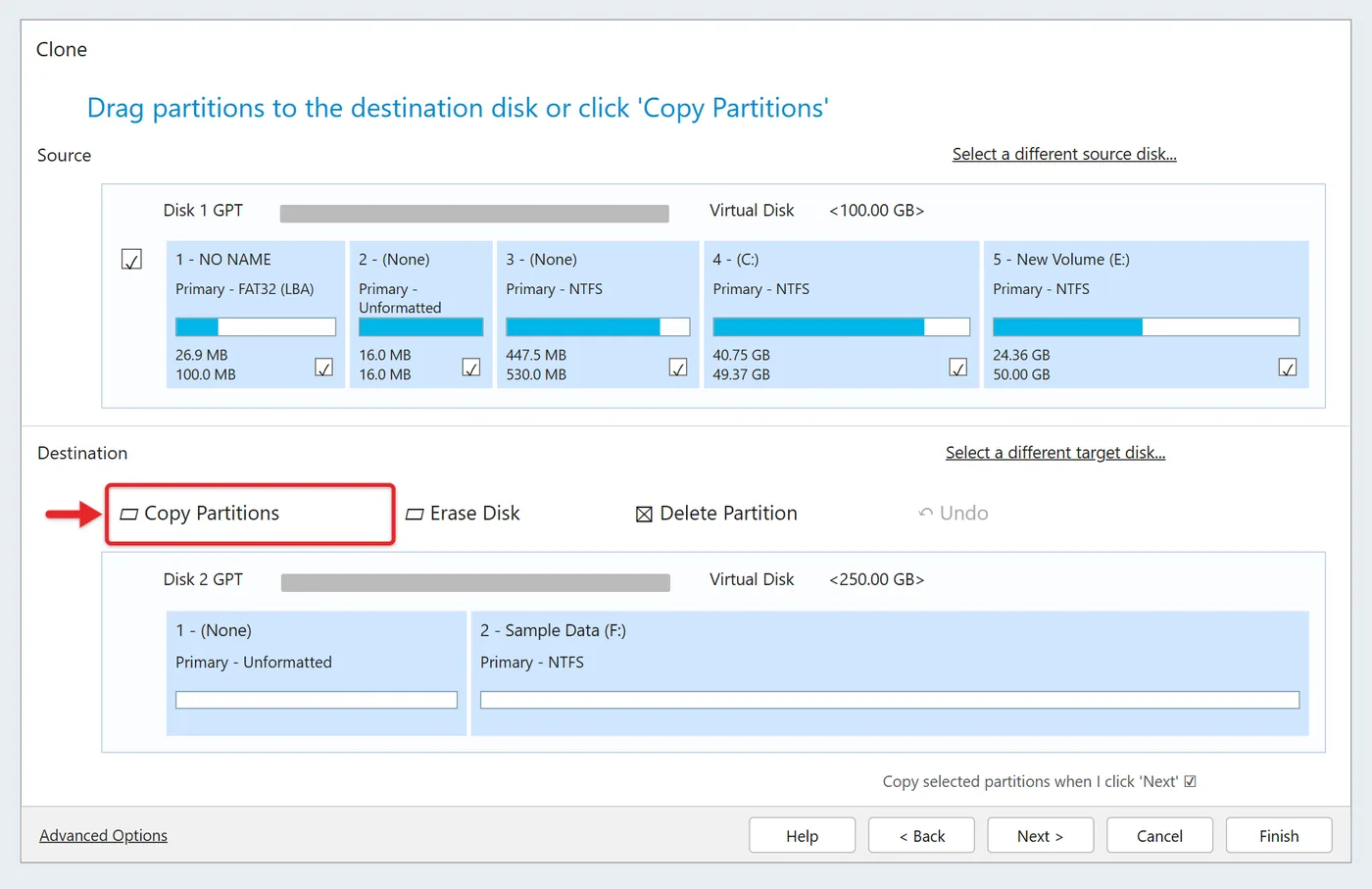
- Skip the schedule for a one-time clone. Review the summary and select Finish.
- Select Run this backup now in Backup Save Options, check the destination one more time, and accept the overwrite warning.
- Wait for Reflect X to report success. Don’t interrupt the clone.
Refresh Local Disks to see the new partitions, then open some files on the destination. Macrium’s clone wizard guide covers each screen, and its Reflect X cloning walkthrough shows them. If the clone replaces your startup disk, follow the PC maker’s instructions to install it, and make sure Windows starts from it before you retire the old disk. A clone connected over USB won’t boot on every PC.
If the Backup Doesn’t Work
- The drive isn’t listed in Select drive. Make sure it shows in File Explorer under This PC. Try another USB port or cable, and use the drive’s power adapter if it has one. A drive that holds your Windows files can’t be chosen.
- “This drive cannot be used to store a system image because it is not formatted with NTFS.” Copy any files off the drive, then right-click it in File Explorer, select Format, choose NTFS, and select Start. Formatting erases the drive.
- The drive doesn’t have enough space. Exclude large folders in File History, shorten Keep saved versions, or use a bigger drive. For a system image, free up space on C: or use a drive larger than the used space.
- File History says the drive was disconnected. Reconnect the drive and select Run now. The backup resumes from where it stopped.
- USB flash drives. Small flash drives often fill up and are slow. Use an external hard drive or SSD for a system image.
- The backup option is missing on a work PC. Your organization may manage backups. Ask your IT team before changing anything.
How to Check That Your Backup Worked
Open the external drive in File Explorer. File History stores its copies in a FileHistory folder, and a system image sits in WindowsImageBackup. In File History, the main page shows when the last copy was made. Test a restore of one unimportant file to a different folder now, so you know the steps before you need them.
A good habit is to keep at least one more copy in a separate place, such as a second drive stored away from the PC or a cloud service. A single drive kept next to the computer won’t help after a theft or fire.
Mirrored drives don’t replace this either: if you set up RAID in Windows 11, a deleted file disappears from both drives at once.
Windows Backup Questions
How do I restore files from File History?
Open File History and select Restore personal files. Browse to the file, pick a version, and select the green Restore button. For other ways to get files back, learn how to find deleted files on Windows 11.
Can I keep using the drive for other files?
Yes. File History uses its own folder on the drive, and a system image uses the WindowsImageBackup folder. Leave those folders alone and keep enough free space for future backups.
How much space do I need?
At least as much as the files you’re backing up, plus extra room for older versions. A drive twice that size is a good target.
Does File History back up my apps and Windows settings?
No. File History saves personal files only. To be able to restore Windows and your installed apps, make a system image, and reinstall apps by hand if you only have a file backup.
Can I restore a system image to a different computer?
It isn’t a good idea. A system image is meant for the same PC, even after a drive replacement. To move files to a new PC, use File History or copy the files instead.
How often should I back up?
Leave File History running so it saves every hour while the drive is connected, and plug the drive in at least weekly. Make a new system image before a major Windows update or hardware change.
To copy just a few files instead of setting up File History, you can put files on a flash drive. A small set of files can also go on a disc for a separate offline copy, and here is how to burn a data CD in Windows 11.

Matthew Burleigh is the founder, head writer, and editor of Solve Your Tech, which he launched in 2012. He has written technology tutorials since 2008 and worked in IT since 2003, including small-business support, IT management, and consulting. He holds Bachelor’s and Master’s degrees in Computer Science from Arizona State University.
Matthew writes practical guides for Windows, iPhone and iPad, Microsoft Office, Outlook, Google apps, and Android. Solve Your Tech’s guides are checked step by step against the device or app maker’s own documentation and tested on his own devices whenever he has the hardware or software, with clear steps, sources, and update dates.
Read more about Matthew and how Solve Your Tech writes and updates its guides, or report a correction.