To sync OneDrive on Windows 11, select the OneDrive cloud icon near the clock, sign in with your Microsoft account, and follow the setup screens. After that, anything you save in the OneDrive folder in File Explorer syncs automatically whenever you are online. There is no sync button to press. Status icons next to each file show what has synced.
This guide covers the OneDrive sync app that comes with Windows 11. The steps follow Microsoft’s current instructions in Sync your computer’s files and folders with OneDrive.
What OneDrive Sync Does
Syncing means OneDrive keeps the files in the OneDrive folder on your PC matched with the copies stored in your OneDrive account online (the “cloud”). It works in both directions. Microsoft says that if you add, change, or delete a file or folder in your OneDrive folder, the same thing happens on the OneDrive website, and the reverse is also true.
That last part matters. Sync is not a one-way backup. Deleting a synced file on your PC also deletes it from OneDrive online and from your other devices.
What You Need
- A Windows 11 PC. Microsoft notes that OneDrive is already installed on Windows 11, so there is usually nothing to download.
- An account. A personal Microsoft account, or a work or school account.
- An internet connection. Changes sync when you are online.
- Enough OneDrive storage. If you go over your Microsoft storage limit, Microsoft says you will not be able to upload, edit, or sync new files.
How to Set Up OneDrive Sync on Windows 11
- Select the OneDrive cloud icon in the notification area, near the clock. If you do not see it, select the small arrow next to the clock to show hidden icons. If it is still missing, press the Windows key, type OneDrive, and open the OneDrive app.
- Enter your Microsoft account, or your work or school account, and select Sign in. Finish any password or verification prompts.
- On the This is your OneDrive folder screen, select Next to accept the default folder location. To store the folder somewhere else, select Change location first. Microsoft calls this the best time to make that change.
- On the All your files, ready and on-demand screen, look at how files are marked as online-only, locally available, or always available. Select Next.
- Follow any remaining screens. The setup may also offer to back up folders such as Desktop, Documents, and Pictures. You can turn that on now or later.
- Open File Explorer and select OneDrive in the left pane. Your files appear there, and the cloud icon stays on the taskbar.
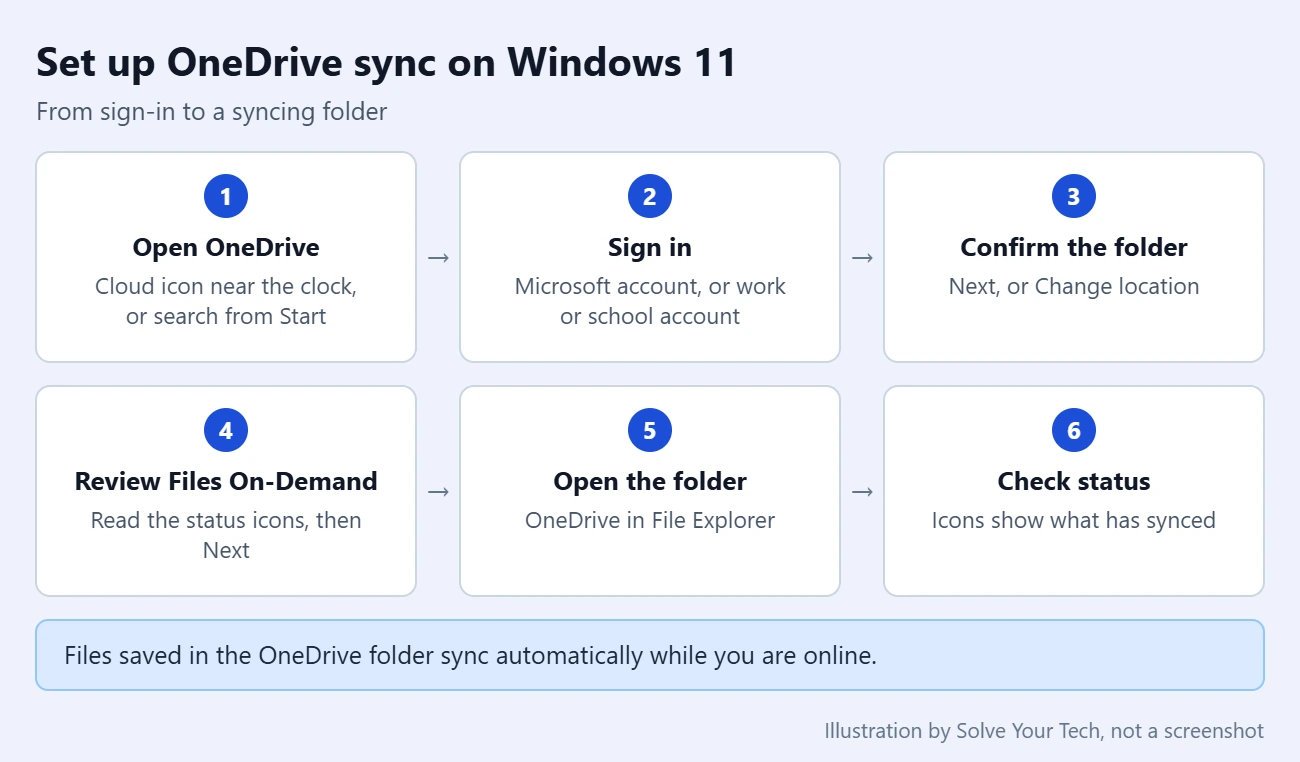
The exact screens can vary a little with your OneDrive version and account type. If you use more than one account, Microsoft says personal files appear under OneDrive – Personal and work or school files appear under OneDrive – [CompanyName]. You can add several work or school accounts, but only one personal OneDrive account.
Sync a File or Folder
Once setup is done, syncing a file takes one action: put it in the OneDrive folder.
- Open File Explorer and select OneDrive in the left pane.
- Drag a file or folder into it, or save a document there from an app.
- Watch the status icon next to the item. Circular arrows mean it is syncing.
Dragging a file into the OneDrive folder from another folder on the same drive normally moves it instead of copying it. Copy and paste if you want to keep the original where it is.
Choose Which OneDrive Folders Sync to This PC
You do not have to keep every OneDrive folder on every computer. Before you change this, know what it does: Microsoft says that if you uncheck a folder you are syncing, the folder is removed from your computer, but the folder and its contents are still available online.
- Select the OneDrive cloud icon near the clock.
- Select the gear icon (Help & Settings), then Settings.
- Go to the Account tab.
- Select Choose folders.
- Uncheck any folders you do not want on this computer, then select OK.
A few limits apply. You can only pick folders that are already in your OneDrive. You cannot uncheck certain folders that are important to the PC, including Documents, Desktop, Pictures, and your Personal Vault. These choices apply only to this computer and this account. To undo the change, open Choose folders again and check the folder. See Microsoft’s Choose which OneDrive folders you want to sync for details.
Back Up Desktop, Documents, and Pictures
Standard Windows folders such as Desktop, Documents, Music, Pictures, and Videos are not automatically part of OneDrive. Folder backup adds them, so they sync like everything else.
- Open OneDrive settings (cloud icon, gear icon, Settings).
- Go to the Sync and backup tab.
- Select Manage backup.
- Turn on the switch for any folder that says Not backed up, then select Save changes.
To stop later, turn the folder’s switch off in the same place. OneDrive then asks whether to keep the files only in OneDrive or only on your PC, so read that prompt carefully before you choose. Microsoft’s Back up your folders with OneDrive explains both options.
Save Disk Space With Files On-Demand
Files On-Demand lets you see all your OneDrive files in File Explorer without downloading all of them. An online-only file takes no space on the PC and downloads when you open it. Microsoft says Files On-Demand is turned on by default starting with OneDrive build 23.066.
- Keep a file offline: right-click a file or folder in the OneDrive folder and select Always keep on this device.
- Remove the local copy: right-click it and select Free up space. The file stays in OneDrive. It is not deleted.
- If the option is off: open OneDrive settings, go to Sync and backup, expand Advanced settings, and turn on Files On-Demand.
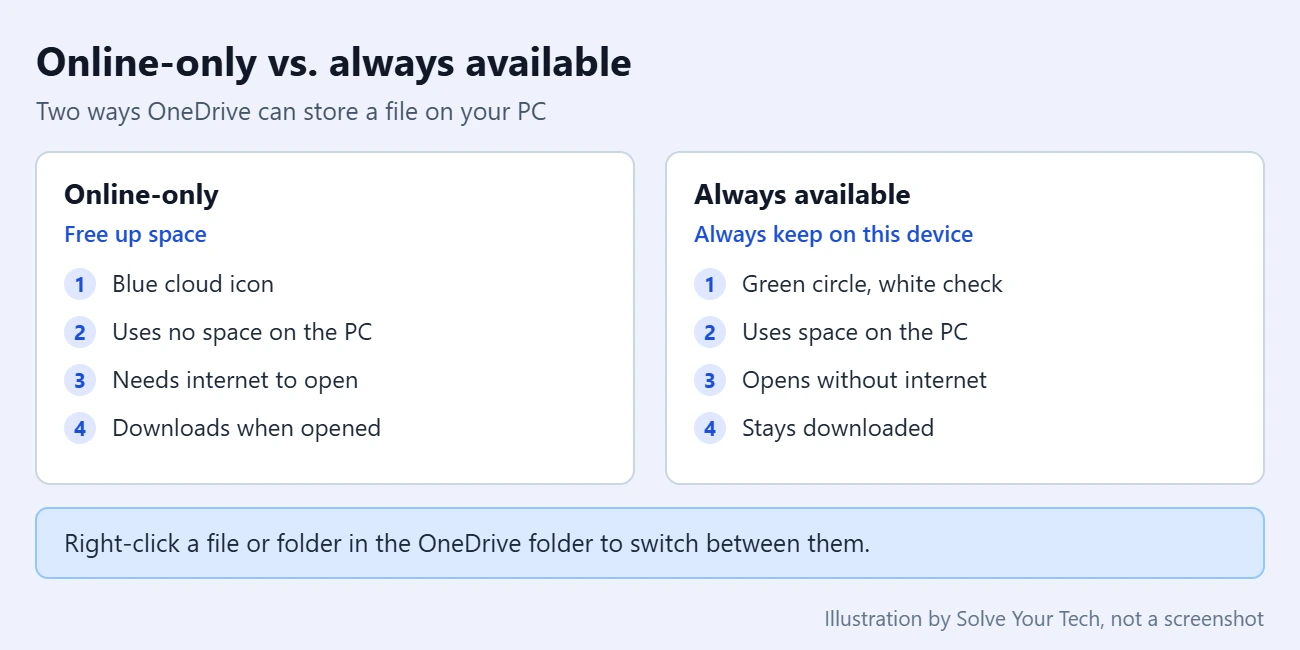
You cannot open an online-only file without an internet connection, so mark anything you need on a trip as Always keep on this device before you leave. More detail is in Microsoft’s Files On-Demand guide for Windows.
Check That OneDrive Is Syncing
Status icons appear on the OneDrive taskbar icon and next to files in File Explorer.
| Icon | Meaning |
|---|---|
| Circular arrows | Sync is in progress. |
| Blue cloud | Online-only. The file is not stored on this PC. |
| White circle with a green check | Locally available. The file was opened and downloaded. |
| Green circle with a white check | Marked Always keep on this device. |
| Red circle with a white cross | A file or folder cannot sync. |
| Pause symbol on the cloud | Syncing is paused. |
| Gray cloud with a line through it | You are not signed in, or setup is not finished. |
Microsoft lists every icon in What do the OneDrive icons mean?
For a quick test, save a small file in the OneDrive folder, wait for the circular arrows to go away, and then look for the file on the OneDrive website or another device signed in to the same account.
Pause and Resume Syncing
OneDrive has no manual “sync now” control because it syncs on its own. You can pause it, though, which helps on a slow or metered connection.
- Right-click the OneDrive cloud icon on the taskbar.
- Choose Pause syncing and pick 2, 8, or 24 hours. The icon shows a pause symbol.
- To start again early, select the paused icon and choose Resume syncing. Otherwise, syncing resumes when the time runs out.
Microsoft notes that OneDrive pauses automatically when the PC enters battery saver mode or is on a metered network. Pausing and resuming can also help when OneDrive shows “Processing changes” for a long time. See How to pause and resume OneDrive sync. To uninstall the app, see how to completely remove OneDrive from Windows 11. To stop it for good, see how to turn off OneDrive on Windows 11.
If OneDrive Is Not Syncing
Work through these checks in order. Each one matches a cause Microsoft documents.
- No cloud icon: the icon may be hidden, or OneDrive may not be running. Check the hidden icons arrow, then open OneDrive from Start.
- Gray cloud with a line: you are signed out or setup is not finished. Open the OneDrive app and sign in.
- Pause symbol: select the icon and choose Resume syncing. Also check whether battery saver or a metered connection is on.
- Storage is full: new files will not sync until you free up space or get more storage.
- A file name is not allowed: names cannot start or end with a space or include any of these characters:
" * : < > ? / \ |Rename the file. In Windows, select it and press F2. - A file is too large: OneDrive cannot sync a file over 250 GB.
- Red cross: select the OneDrive icon to read the specific error.
Microsoft’s Fix OneDrive sync problems page sorts fixes by the icon you see, and the full naming rules are in Restrictions and limitations in OneDrive and SharePoint.
If sync is still stuck, a reset is the next step. Microsoft says you will not lose files or data by resetting OneDrive, but it disconnects your sync connections and runs a full sync afterward, and you have to choose your folders again. Our guide on how to clear the OneDrive cache on Windows 11 walks through it, and Microsoft’s own steps are in Reset OneDrive.
Frequently Asked Questions
Is there a way to force OneDrive to sync right now?
OneDrive does not have a manual sync button. It syncs automatically when you are online. If it seems stuck, Microsoft suggests pausing and then resuming sync, which can clear a long “Processing changes” status.
Does deleting a file on my PC delete it from OneDrive?
Yes, if the file is in the OneDrive folder. The deletion syncs to OneDrive online and to your other devices. Microsoft says deleted items can be restored from the OneDrive recycle bin on the web for up to 30 days with a personal account, or up to 93 days with a work or school account. To remove only the local copy, use Free up space instead. For the full process, see how to delete files from OneDrive on Windows 11.
Do synced files use space on my computer?
Only the ones that are downloaded. Online-only files with the blue cloud icon take no space. Files you have opened, and files marked Always keep on this device, are stored on the PC.
Can I sync a folder that is outside the OneDrive folder?
OneDrive syncs what is inside the OneDrive folder. Folder backup brings in Desktop, Documents, Pictures, Music, and Videos. For anything else, move or copy it into the OneDrive folder. Microsoft notes that folders not in your OneDrive, such as those on an external USB drive, cannot be selected for sync.
How do I move files out of OneDrive?
Moving a file out of the OneDrive folder downloads it to the new location and removes it from OneDrive. The steps are in how to move files from OneDrive to your PC.
Can I use the same OneDrive on two computers?
Yes. Sign in to OneDrive with the same account on each PC, and files in the OneDrive folder stay matched across them. The Choose folders setting is separate on each computer, so you can keep different folders on each one.
Next Steps
With sync running, turn on folder backup for the folders you use most, and mark travel files as Always keep on this device. Moving big files into OneDrive? See how to upload large files to OneDrive. To keep a local copy of your notes too, here is how to back up your notebooks in OneNote.

Matthew Burleigh has been writing tech tutorials since 2008. His writing has appeared on dozens of different websites and been read hundreds of millions of times.
After receiving his Bachelor’s and Master’s degrees in Computer Science he spent several years working in IT management for small businesses. However, he now works full time writing content online and creating websites.
His main writing topics include iPhones, Microsoft Office, Google Apps, Android, and Photoshop, but he has also written about many other tech topics as well.