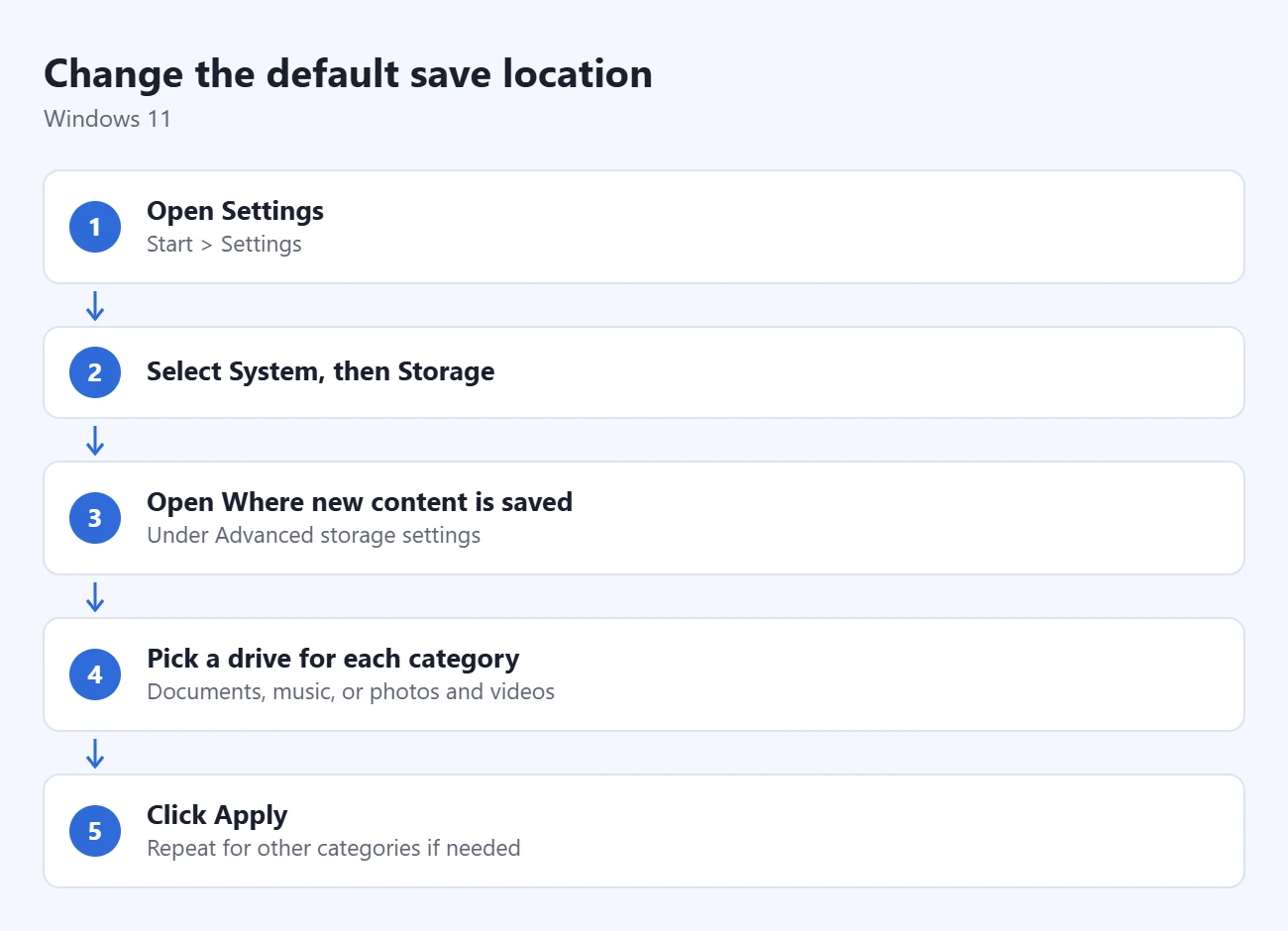
To change the default save drive in Windows 11, open Settings > System > Storage > Advanced storage settings > Where new content is saved. Choose a drive for the content type you want to change, then click Apply.
These steps cover Windows 11 Home and Pro. Windows 10 reaches the same setting by a shorter path, shown in its own section below; Windows 10 reached end of support on October 14, 2025.
This setting picks a drive for each type of new content, not a folder, and some apps ignore it. Browser downloads, Office save dialogs and OneDrive folder backup have their own settings, covered below. To move the Documents folder itself, use the folder’s Location tab, also explained below.
Which Setting Do You Need?
| What you want | Where to change it |
|---|---|
| New documents, music, photos, videos or Store apps on another drive | Settings > System > Storage > Where new content is saved |
| Documents, Pictures or Desktop folder, including existing files, on another drive | The folder’s Properties > Location tab |
| Word, Excel or PowerPoint to save to the PC instead of OneDrive | File > Options > Save in each app |
| Files to stop going into OneDrive | OneDrive settings > Sync and backup > Manage backup |
| Browser downloads somewhere else | The browser’s download settings |
Most people who want everything off C: use both of the first two rows: the drive setting for new apps and media, and the Location tab for the folders they save into every day.
Before Choosing a Different Drive
Connect the drive and check its available space in File Explorer > This PC. Choose a destination you expect to keep available. An external drive cannot supply files while it is disconnected, and a second partition on the same physical disk is not a separate backup.
If you can’t find your drives, open This PC or add it to the desktop. A brand-new internal drive won’t appear until it’s set up, so initialize the SSD in Windows 11 first. Back up important files before reorganizing them.
Change Where New Content Is Saved
- Open Start > Settings, or press Windows key + I.
- Select System, then Storage. A bar shows how full your C: drive is.
- Expand Advanced storage settings, then open Where new content is saved.
- Find the category you want, such as new documents, music, or photos and videos. Open its drive dropdown and select the destination.
- Click Apply for that changed setting. Repeat for other categories only if you want them changed too.
The change takes effect right away; you don’t need to restart. Microsoft’s Windows 11 storage instructions document this route. Its storage settings overview explains the separate content categories.
The dropdown selects a drive, such as C: or D:, rather than letting you type an arbitrary folder. Selecting D: for documents does not mean every program will save directly into a folder you created named D:\Projects.
What each category controls
- New apps will save to: where new Microsoft Store apps install. Desktop programs you download from a website ask for their own install folder, so pick the drive in that installer instead.
- New documents will save to, New music will save to, New photos and videos will save to: where Windows and Microsoft apps put new files of that type. New photos and videos also decides where the Camera app saves pictures.
- New movies and TV shows will save to: where Microsoft Store video downloads go.
Your screen may show an extra category, such as offline maps, depending on your Windows version. Each category takes one drive; you can’t split one category across two drives.
Check What Your App Actually Does
Create a small test file in the app you normally use. Look at the folder shown in its save dialog, save the file, and find it in File Explorer. Check the full path, not just the folder name.
If the app still offers the old location, change the app’s own default-folder setting, or pick the folder with Save As. Many apps remember the last folder you used and ignore the Windows setting.
For one document, Microsoft’s save-location help explains choosing This PC or OneDrive in the save dialog and then selecting a folder. Browser download folders are also configured in the browser, and you can change the default download location in Windows 11 for Edge, Chrome and Firefox.
Why Documents May Still Go to OneDrive
OneDrive can back up Desktop, Documents and Pictures independently of the Windows storage preference. A Documents folder whose path includes OneDrive is still inside OneDrive even though its name looks local. To take those folders out of the cloud, turn off OneDrive on Windows 11.
To check or stop folder backup for one folder:
- Select the OneDrive cloud icon near the clock, then the gear icon, then Settings.
- Select the Sync and backup tab, then Manage backup.
- Turn off the switch for the folder you want to keep local.

- Choose where the files should stay, then confirm.
Before stopping backup, read the offered file-location choice: keeping files only on the PC removes them from OneDrive, while keeping them only in OneDrive removes them from the computer. Download cloud-only files first when instructed, and keep an independent backup. Microsoft’s folder-backup instructions cover the error messages you may see, such as files that couldn’t be moved because they were open or online-only.
For existing files, the OneDrive-to-PC steps explain the difference between moving, copying and keeping an offline copy.
Save New Office Files to the PC Instead of OneDrive
For one file in desktop Word, Excel or PowerPoint on Windows, use File > Save As > Browse (or the offered This PC option) and choose a folder whose full path is outside OneDrive. Pressing F12 opens the same Save As window directly. Create a local folder if needed, save the file and reopen that exact copy from File Explorer. A Documents or Desktop label can still point inside OneDrive when folder backup is enabled. Microsoft’s Office save guide describes choosing the destination. Files kept on the PC this way won’t use AutoSave, and this walkthrough on stopping OneDrive auto save in Windows 11 covers the Office default checkbox too.
To save new files to your PC by default in a desktop Office app, open File > Options > Save, check Save to Computer by default, set Default local file location to a folder outside OneDrive, and choose OK. The setting is per app, so repeat it in Word, Excel, and PowerPoint. Microsoft documents these default save controls. If the same page in your version also shows an option to create new files in the cloud automatically, turn it off, restart the app and test with a new blank file. Local files don’t get Microsoft 365’s cloud AutoSave, so keep them backed up.
Dropbox has its own folder setting too: to put your Dropbox files on another drive, move the Dropbox folder location from the Dropbox app.
How to Move the Documents Folder to Another Drive
This method picks an exact folder and can bring your existing files along, which the Settings dropdown can’t do. Before you start, create a new, empty folder on the other drive, such as D:\Documents. Don’t choose the drive itself (D:) or a folder that another user folder already uses, because Windows would treat that whole location as Documents and undoing it becomes messy.
To move the Documents folder itself, so apps that save to Documents use the new drive:
- Open File Explorer, right-click Documents in the left pane, and select Properties.
- Select the Location tab, then select Move.

- Pick the folder you created on the new drive, such as D:\Documents, and choose Select Folder.
- Select Apply, choose Yes to move your existing files, then select OK.

- To undo it later, return to the Location tab and select Restore Default.
The path box on the Location tab now shows the new folder, and Documents in File Explorer opens it. If the path still includes OneDrive, folder backup is on; stop it first using the OneDrive steps above.
The same steps work for Pictures, Music, Videos, Downloads and Desktop.
Move Store Apps You Already Installed
The New apps will save to setting only affects apps installed after the change. To move one that’s already on C:, open Settings > Apps > Installed apps, select the three dots next to the app and choose Move, then pick the drive. The option appears only for apps that support it; programs installed from a website usually need to be uninstalled and reinstalled to the new drive.
Change Where New Content Is Saved in Windows 10
- Open Start > Settings > System > Storage.
- Select Change where new content is saved.
- Pick a drive under the category you want, then select Apply.
The categories and their behavior match Windows 11. Microsoft’s camera roll help shows both versions’ paths side by side.
Troubleshooting and Reverting the Change
- The drive is missing: make sure it’s connected and shows up in This PC. Windows only lists drives it can see. Don’t format a drive to make it appear, because formatting erases it.
- Existing files remain on C: selecting a new destination does not itself move your current collection. Manage existing files separately after confirming a backup, or use the Location tab method above.
- The drive is full or disconnected: reconnect it, choose an available destination, or save elsewhere on purpose. Not every app will fall back to C: on its own. Apps installed on an external drive won’t open until it’s reconnected, so an internal drive is safer for apps.
- The setting is grayed out or changes back: on a work or school PC, your organization may control storage locations. Ask your IT department.
- You want to undo the preference: return to the same Windows 11 page, choose the previous drive and click Apply. Files already saved elsewhere remain there.
Microsoft also shows this setting in its photos and videos save-location guidance. A new default only affects new files, so it won’t free up space on C: by itself. To find what is filling the drive, see what’s taking up space on your PC in Windows 11.
Frequently Asked Questions
Does changing the default save location move my existing files?
No. The Settings dropdown only affects new files and new app installs. To move existing documents, use the folder’s Location tab and choose Yes when Windows offers to move the files.
Can I choose a specific folder instead of a drive?
Not in Settings. For an exact folder, move the user folder with the Location tab, or set a default folder inside the app, such as Default local file location in Word.
Why do my downloads still go to the C: drive?
Downloads aren’t one of the Settings categories, and browsers keep their own download path. Move the Downloads folder with its Location tab or change the folder in the browser’s settings.
Can I use an external drive as the default?
Yes, if it appears in This PC. Files and apps saved there are unavailable whenever the drive is unplugged, so reconnect it before opening them.
Will changing the save location make my PC faster?
Not directly. It keeps C: from filling up, and low free space can slow the PC and block Windows updates. A faster drive helps only with files stored on it.

Matthew Burleigh is the founder, head writer, and editor of Solve Your Tech, which he launched in 2012. He has written technology tutorials since 2008 and worked in IT since 2003, including small-business support, IT management, and consulting. He holds Bachelor’s and Master’s degrees in Computer Science from Arizona State University.
Matthew writes practical guides for Windows, iPhone and iPad, Microsoft Office, Outlook, Google apps, and Android. Solve Your Tech’s guides are checked step by step against the device or app maker’s own documentation and tested on his own devices whenever he has the hardware or software, with clear steps, sources, and update dates.
Read more about Matthew and how Solve Your Tech writes and updates its guides, or report a correction.