To move files from OneDrive to your PC, open File Explorer, select the files in your OneDrive folder, press Ctrl + X, open a folder outside OneDrive, and press Ctrl + V. Moving files out of the OneDrive folder also removes them from OneDrive online and from your other devices. To keep a copy in both places, copy with Ctrl + C instead.
This guide covers Windows 11 with the OneDrive sync app that comes with it. The same steps work with a personal Microsoft account and with a work or school account, although an organization can lock some settings. If your Desktop, Documents, or Pictures folder is the thing living in OneDrive, skip to the folder backup section, because those folders need a different method.
Before You Move Anything
A few quick checks prevent the most common problems.
- Sign in to OneDrive. You should see a cloud icon in the notification area at the right end of the taskbar, and a OneDrive entry in the left pane of File Explorer.
- Stay online. Files that exist only in the cloud have to download before they can be moved.
- Check your free disk space. Online-only files take up no room on your PC until they download, so a large OneDrive can need far more space than it appears to use now.
- Pick a destination outside OneDrive. Anything inside the OneDrive folder keeps syncing. A new folder such as
C:\Filesworks well. If your Documents folder is backed up to OneDrive, it counts as inside OneDrive too. - Close the files first. A document that is open in Word, Excel, or another app may refuse to move.
Move or Copy: Decide First
The OneDrive folder on your PC is a synced folder. Syncing means that a change you make in that folder is repeated in your online storage and on every other device signed in to the same account. That is why the choice between moving and copying matters.
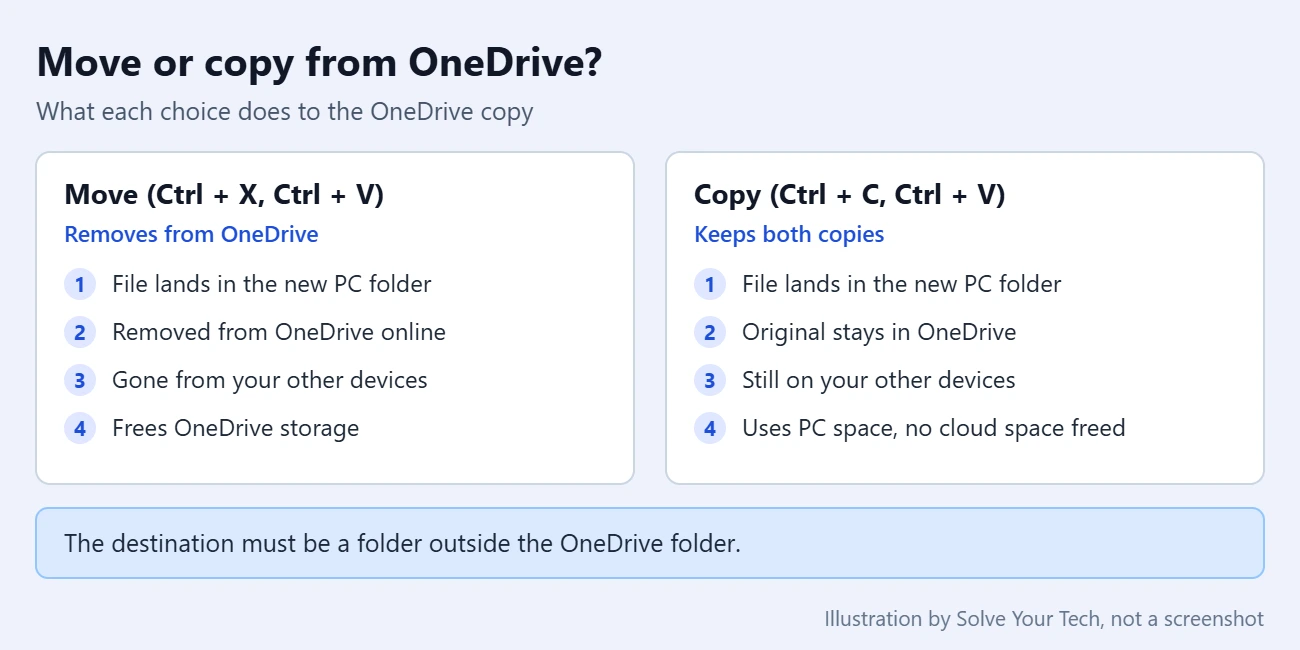
Microsoft states it plainly in its Files On-Demand documentation: when you move files outside the OneDrive folder, the files download to the new folder and are removed from your OneDrive. If a phone, tablet, or second computer still needs those files, copy them instead of moving them.
Move Files Out of OneDrive With File Explorer
This is the shortest reliable route for individual files and ordinary folders.
- Open File Explorer with Windows key + E.
- Select your OneDrive folder in the left pane. It is usually labeled with your name or with Personal.
- Select the files or folders to move. Hold Ctrl and click to pick several, or press Ctrl + A to select everything in the current folder.
- Press Ctrl + X to cut them. The icons fade slightly to show they are waiting to be moved.
- Open a folder that is not inside OneDrive, such as a new folder on your C: drive.
- Press Ctrl + V to paste. A progress window appears while Windows downloads any online-only files and places them in the new folder.
To copy instead, press Ctrl + C in step 4. Everything else is the same, and the originals stay in OneDrive.
You can also drag files from one File Explorer window to another. Windows chooses between moving and copying based on where the destination is, so cut and paste is the more predictable option when the difference matters.
For files already stored outside OneDrive, our guide to moving files instead of copying them in Windows 11 explains cut and paste, Shift-drag, transfers between local drives, and checks to make before removing any duplicate copies.
A safer order for important files
If the files are irreplaceable, copy them first, open a few from the new folder to confirm they work, and only then delete the originals from the OneDrive folder. It takes a minute longer, and you are never left with a half-finished move.
Download Online-Only Files First
OneDrive uses a feature called Files On-Demand, which shows every file in File Explorer without storing all of them on your PC. The Status column tells you where each file really is.
| Status icon | What it means | Before you move it |
|---|---|---|
| Blue cloud | Online-only. The file is in OneDrive and takes no space on the PC. | It must download, so you need an internet connection. |
| Green check mark in a white circle | Locally available. The file was opened and downloaded to this PC. | Ready to move. |
| White check mark in a solid green circle | Always kept on this device. | Ready to move. |
| Circular arrows | A sync is in progress. | Wait until it finishes. |
For a big move, download everything in advance so the move does not stall halfway:
- In File Explorer, right-click the file or folder inside OneDrive.
- Select Always keep on this device.
- Wait for the icons to change to the solid green circle. A large folder can take a while.
To download your entire OneDrive at once, select the OneDrive cloud icon in the notification area, select the Help & Settings gear icon, then Settings. Open the Sync and backup tab, expand Advanced settings, and under Files On-Demand select Download all files. Microsoft describes this as the same as choosing Always keep on this device for the whole OneDrive folder, so make sure the drive has room for all of it.
If Desktop, Documents, or Pictures Are in OneDrive
When folder backup is on, Windows stores your Desktop, Documents, and Pictures folders inside OneDrive. You cannot fix that by cutting and pasting the folders themselves. Turn off the backup instead, and let OneDrive put the files back.
Warning: the option you pick in step 5 decides where your files end up. Choosing to keep them only on your PC removes them from OneDrive online, so they will no longer be available on your other devices.
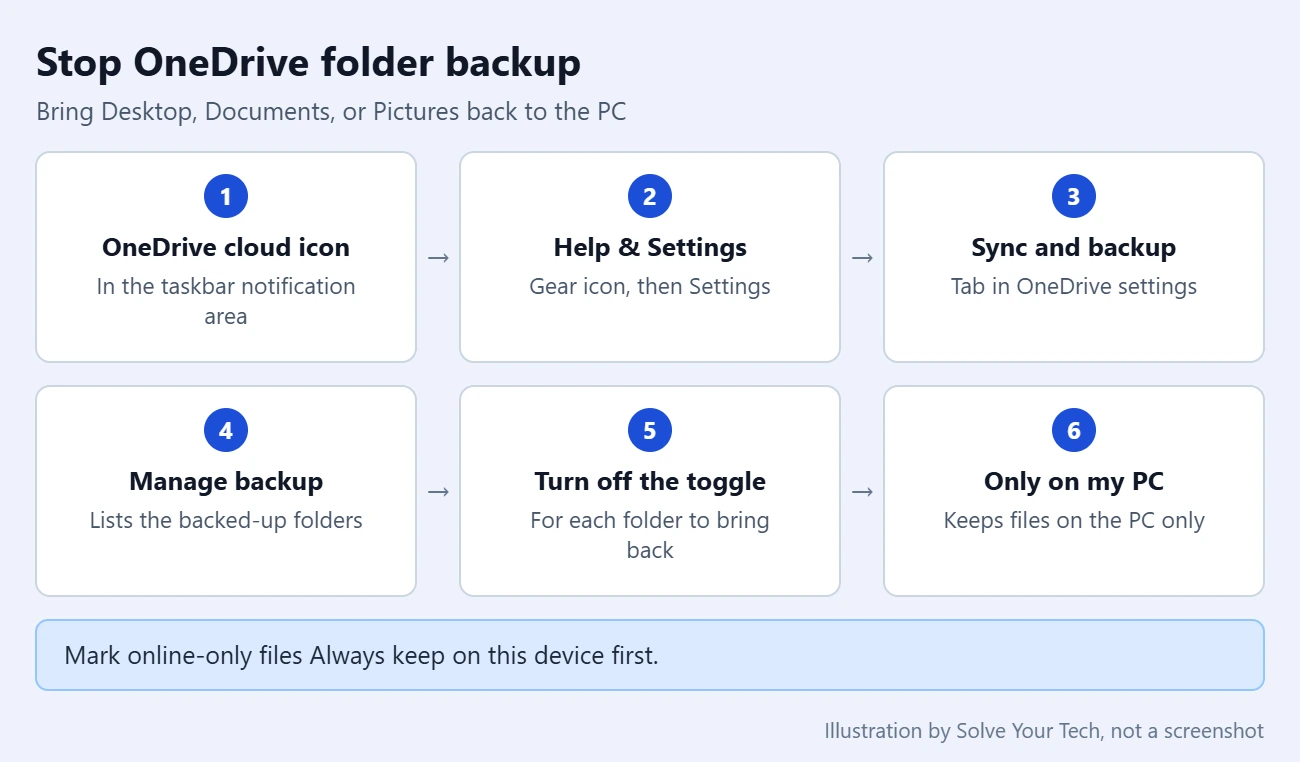
- In File Explorer, right-click the backed-up folder, such as Documents, and select Always keep on this device. Wait for the download to finish.
- Select the OneDrive cloud icon in the notification area, then the Help & Settings gear icon, then Settings.
- Open the Sync and backup tab and select Manage backup.
- Turn off the toggle for the folder you want to bring back.
- When OneDrive asks what to do with the files, choose the option to keep them only on my PC.
- Repeat for any other folder in the list.
Step 1 matters. According to Microsoft’s folder backup instructions, a folder that still contains cloud-only files produces the message “Some files couldn’t be moved,” and asks you to change them to Always keep on this device first. Microsoft also notes that OneNote notebooks cannot be moved this way, because notebooks are cloud-based files, and that any open file has to be saved and closed before it can move.
Download Files From the OneDrive Website
Use the website when the OneDrive app is not set up on the PC, or when you want a one-time copy without touching sync. A download always leaves the original in OneDrive.
- Go to onedrive.com in your browser and sign in.
- Open My files.
- Point to a file or folder and select the circle that appears. Select more items the same way, or press Ctrl + A to select everything in the folder.
- Select Download in the toolbar at the top. The button only appears once something is selected.
- If your browser asks, choose where to save the download. Many browsers save straight to the Downloads folder.
A single file downloads as itself. Several files or a folder arrive as one .zip file, which is a compressed package. Right-click it in File Explorer and select Extract All to get normal files and folders.
Microsoft lists a few limits in its download instructions. OneNote notebooks cannot be downloaded, items in the Shared view have to be opened and saved one at a time, and a single download is capped at 250 GB and 10,000 files. If you are clearing out OneDrive storage, save the download outside your OneDrive folder, check it, and then delete the OneDrive copies.
Which Method Should You Use?
| Your situation | Best method | Stays in OneDrive? |
|---|---|---|
| A few files or folders to take out of OneDrive | Cut and paste in File Explorer | No |
| You want a local copy and the cloud copy | Copy and paste, or Always keep on this device | Yes |
| Desktop, Documents, or Pictures are in OneDrive | Turn off folder backup and keep files only on the PC | No |
| OneDrive is not set up on this PC | Download from the OneDrive website | Yes |
How to Confirm the Move Worked
- Open the destination folder and check that the files are there. Files outside OneDrive have no status icon at all.
- Open one or two files to make sure they are complete.
- Disconnect from the internet for a moment and open a file again. A file that is truly on your PC opens without a connection.
- Select the OneDrive cloud icon in the notification area and wait until it reports that your files are synced. After that, the moved files should no longer appear at onedrive.com.
How to Undo a Move
Right after a move, press Ctrl + Z in File Explorer to reverse it. Later on, cut the files from the PC folder and paste them back into the OneDrive folder. They upload again and return to your other devices.
If something went missing along the way, check the recycle bin at onedrive.com. Microsoft says a personal account can restore deleted OneDrive files for 30 days, and a work or school account for 93 days unless an administrator changed the setting. Select Recycle bin in the navigation pane, select the items, and select Restore. Our guide on how to find deleted files on Windows 11 covers the Recycle Bin on the PC as well.
Troubleshooting
There is no OneDrive folder in File Explorer
OneDrive is not signed in or not running. Select Start, type OneDrive, open the app, and sign in. If you would rather not set it up, use the website method instead.
The move stops or a file will not download
Check your internet connection and make sure sync is not paused. Then confirm the drive has enough free space for the files. Marking the folder Always keep on this device and waiting for the download to finish before you move it avoids most of these stalls.
“Some files couldn’t be moved” when you stop folder backup
The folder still contains online-only files. Right-click the folder, select Always keep on this device, wait for the icons to turn solid green, and turn off the backup again.
The files came back into OneDrive
The destination was probably a folder that OneDrive backs up, such as Documents or Desktop. Either turn off backup for that folder under Manage backup, or move the files to a folder that is clearly outside OneDrive.
Manage backup or another setting is unavailable
On a work or school PC, your organization can control OneDrive settings, including folder backup. Ask your IT administrator before trying to work around it.
Always keep on this device is missing
The option only appears for items inside the OneDrive folder, and only when Files On-Demand is on. Microsoft says Files On-Demand is enabled by default in current versions of OneDrive, so updating the app is the first thing to try.
Frequently Asked Questions
Will moving files out of OneDrive delete them?
They are removed from OneDrive online and from other devices that sync with your account, but they are kept on your PC in the new location. If you do not want to keep the files at all, see how to delete files from OneDrive on Windows 11.
How do I keep files on my PC and in OneDrive?
Right-click the file or folder in OneDrive and select Always keep on this device. A full copy stays on your PC and in OneDrive, and changes keep syncing. If you want a separate copy that does not sync, copy the file to a folder outside OneDrive with Ctrl + C and Ctrl + V.
Does moving files free up OneDrive storage?
Yes. Once the files are out of the OneDrive folder and the sync finishes, they no longer count against your OneDrive storage. Copying files or downloading them from the website does not free any cloud space until you delete the OneDrive originals.
How do I free up space on my PC without moving files?
Right-click a file or folder in OneDrive and select Free up space. It becomes online-only, stays in OneDrive, and downloads again when you open it. For more ways to reclaim space, see how to clear the OneDrive cache on Windows 11.
Can I move files from OneDrive to an external drive?
Yes. An external drive or USB flash drive is outside the OneDrive folder, so the steps are the same. Open the drive under This PC in File Explorer and paste the files there. If you are not sure where your drives are listed, see how to find the C drive on Windows 11.
How do I stop using OneDrive after moving my files?
Microsoft’s recommended way to stop using OneDrive is to unlink it: open OneDrive settings, go to the Account tab, and select Unlink this PC. Your files stay available at onedrive.com. Move or download everything you want on the PC before you unlink. For the full walkthrough, see how to turn off OneDrive on Windows 11, or how to completely remove OneDrive from Windows 11 to uninstall the app as well.
Next Steps
Once your files are where you want them, decide whether new files should keep landing in OneDrive. Our guide on how to change the default save location in Windows 11 shows where that is set. If you plan to keep using OneDrive for some folders, how to sync OneDrive on Windows 11 explains how to choose what syncs.
Working in the browser? Here is how to download a copy of a workbook from Excel Online. Need to send a large file from OneDrive instead? Here is how to upload large files to OneDrive, plus how to manage sharing permissions.

Matthew Burleigh is the founder, head writer, and editor of Solve Your Tech, which he launched in 2012. He has written technology tutorials since 2008 and worked in IT since 2003, including small-business support, IT management, and consulting. He holds Bachelor’s and Master’s degrees in Computer Science from Arizona State University.
Matthew writes practical guides for Windows, iPhone and iPad, Microsoft Office, Outlook, Google apps, and Android. Solve Your Tech’s guides are tested on current devices or checked against official product documentation, with clear steps, sources, and update dates.
Read more about Matthew and how Solve Your Tech writes and updates its guides, or report a correction.