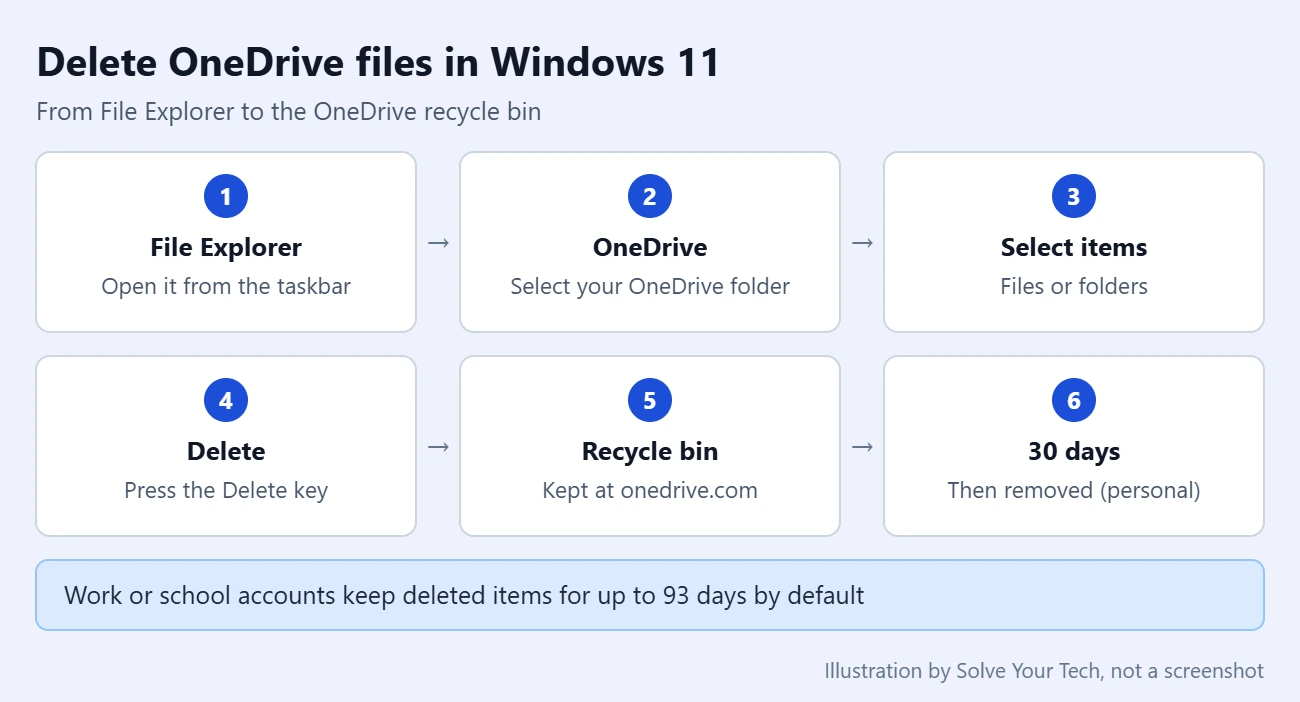
To delete files from OneDrive on Windows 11, open File Explorer, select your OneDrive folder, select the files, and press the Delete key. The files are removed from your PC, from OneDrive online, and from every other device that uses the same account. They stay in the OneDrive recycle bin for a limited time, so you can still get them back. If you only want to clear space on your PC and keep the files in OneDrive, right-click them and select Free up space instead.
These steps cover the OneDrive app built into current Windows 11 releases and OneDrive on the web, for personal Microsoft accounts and work or school accounts, as Microsoft documents them. Windows 10 uses the same OneDrive app and the same steps.
Before You Delete Anything
OneDrive is a sync service. Sync means the OneDrive folder on your PC and your storage at onedrive.com are kept identical, so a change in one place is copied to the other. That is why deleting a file in the OneDrive folder is not the same as deleting an ordinary file on your hard drive.
Microsoft sums up the three choices this way: delete the file to remove it from both places, move it out of the OneDrive folder to keep it only on your PC, or use Files On-Demand to keep it only online. Check these points first:
- You need to be signed in. The OneDrive folder only appears in File Explorer when the OneDrive app is signed in on that PC. These steps are the same for personal accounts and for work or school accounts, but the recovery period is different.
- Your Desktop, Documents, and Pictures folders may be part of OneDrive. If OneDrive folder backup is turned on, files in those folders are stored in OneDrive, and deleting them there deletes them from OneDrive as well. Microsoft’s Back up your folders with OneDrive page covers the setup.
- Shared files are deleted for everyone. Deleting an item you have shared removes it for the people you shared it with, too. You may want to change or stop sharing them in OneDrive first.
- Recovery has a time limit. Deleted files can be restored for 30 days on a personal account, and for 93 days on a work or school account unless an administrator has changed that setting.
Before deleting OneNote files, back up your notebooks in OneNote.
Delete OneDrive Files in File Explorer
This method removes the files from your PC and from OneDrive at the same time. To keep the files on your computer instead, move them from OneDrive to your PC rather than deleting them.
- Select File Explorer on the taskbar. It is the folder icon. You can also press Windows key + E.
- Select OneDrive in the left pane. It has a cloud icon, and the name may include your account, such as OneDrive – Personal or OneDrive – followed by your organization’s name. If you have more than one, pick the account that holds the files.
- Open the folder that holds the files, then select the items you want to remove. Hold Ctrl while you click to select several items, or press Ctrl + A to select everything in the current folder.
- Press the Delete key on your keyboard. You can also right-click the selection and select the trash can icon at the top or bottom of the menu.
- If OneDrive asks whether you meant to delete the items, confirm. This prompt can appear when you delete a shared item or a large number of files at once.
The items disappear from the folder, and OneDrive removes them from your online storage the next time it syncs. Deleting a folder deletes everything inside it, so open the folder and look through it first.
Microsoft covers the same steps in Delete files or folders in OneDrive.
Word can also delete a OneDrive document from inside the app.
Find the files worth deleting
If you are deleting to free up OneDrive storage, start with the biggest items. In File Explorer, open the OneDrive folder, select Sort on the toolbar, and choose Size to list large files first, or choose Date modified to find files you have not touched in a long time. On the web, Microsoft’s Manage your OneDrive storage page shows what is taking up space and lets you empty the recycle bin.
Remove Files From Your PC but Keep Them in OneDrive
If the goal is more free space on your PC, you do not need to delete anything. A OneDrive feature called Files On-Demand can turn a file into an online-only file. An online-only file is still listed in File Explorer, but its contents are stored only in OneDrive, so it does not use space on your drive.
- Open File Explorer and select OneDrive.
- Right-click the file or folder.
- Select Free up space. If you don’t see it, select Show more options first.
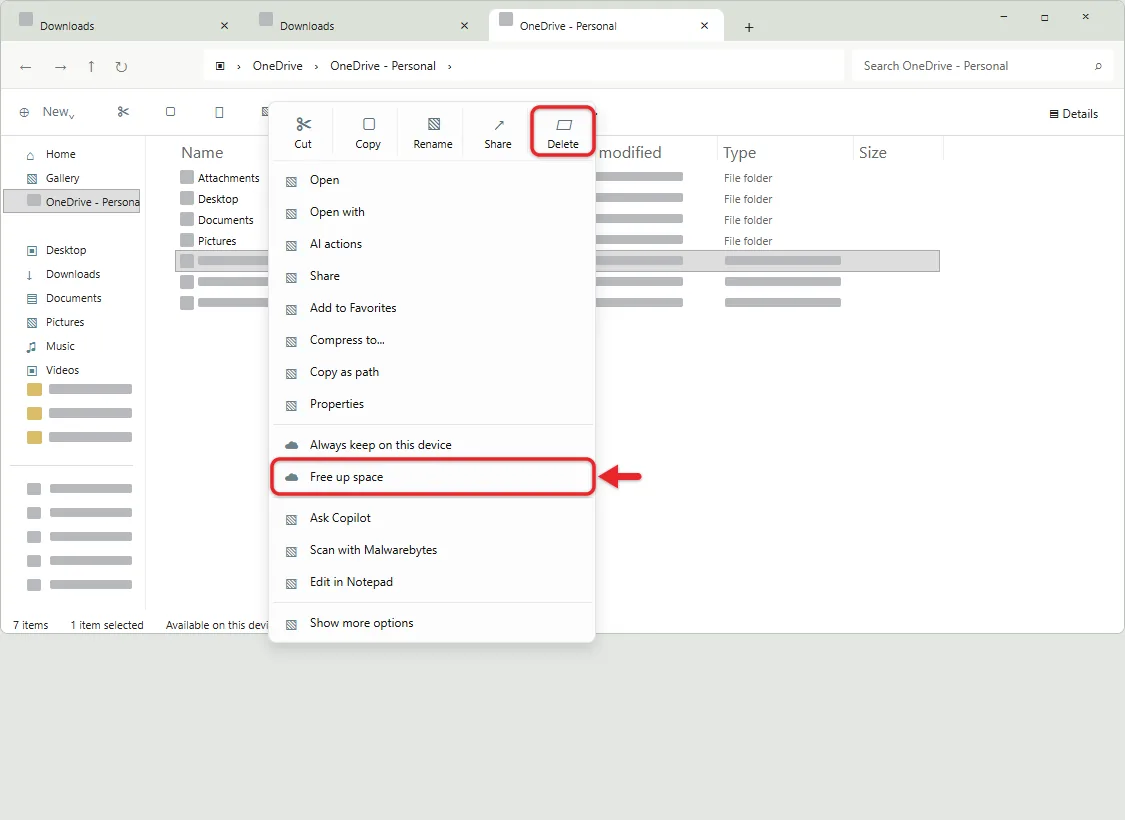
The item now shows a blue cloud icon. It downloads again when you open it, which needs an internet connection. To reverse this for something you need offline, right-click it and select Always keep on this device. Those items show a solid green circle with a white check mark. A green check mark without the solid circle means the file is on your PC because you opened it, and you can free up its space again at any time.
Free up space only helps your PC. It does not reduce how much OneDrive storage you use, because the file is still in the cloud.
Be careful with online-only files. Deleting an online-only file from your device deletes it from OneDrive on all devices and online. It also does not go to the Windows Recycle Bin, so the OneDrive recycle bin is the only place to recover it.
Let Windows free up space automatically
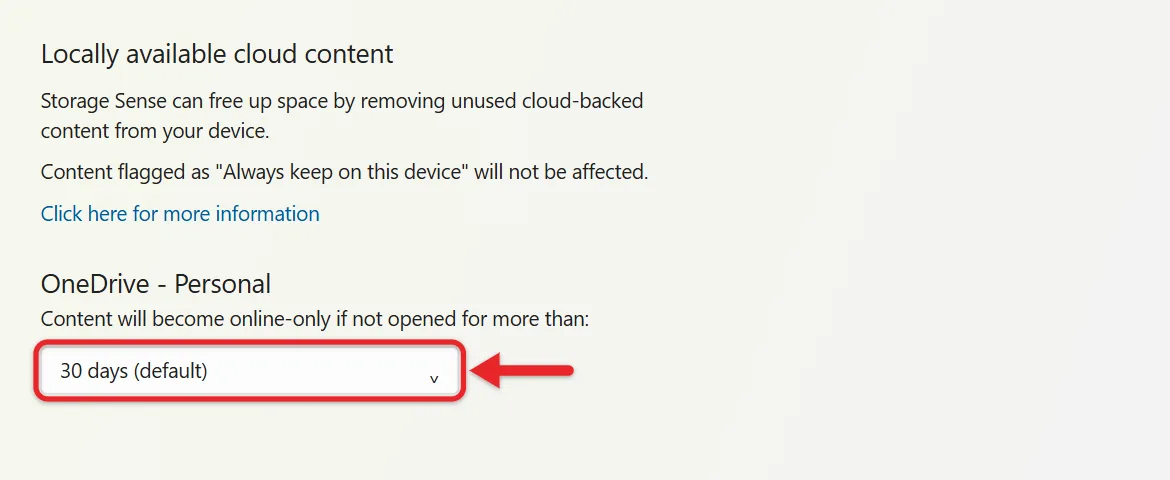
Windows 11 can make OneDrive files online-only for you with Storage Sense. Open Settings > System > Storage > Storage Sense. Under your OneDrive account, choose how long a file can go unopened before it becomes online-only. Storage Sense then turns locally available files into online-only files after the time you pick, so they stay in OneDrive and stop using space on the PC.
Stop a whole folder from syncing to this PC
You can also stop a whole folder from appearing on this PC. Open OneDrive settings, go to the Account tab, select Choose folders, and clear the check box for the folder. The folder is removed from the computer while its contents stay available online. See Microsoft’s Files On-Demand guide for more detail, and how to clear the OneDrive cache on Windows 11 for other space and sync fixes.
Remove Files From OneDrive but Keep Them on Your PC
To do the opposite, move the files out of the OneDrive folder. Microsoft’s guidance is to use File Explorer to move the file to a different folder on your computer that is outside OneDrive.
- In your OneDrive folder, select the files or folders.
- Press Ctrl + X to cut them.
- Open a folder that is not inside OneDrive, such as a folder you create directly on the C: drive.
- Press Ctrl + V to paste them.
Online-only files download to the new folder as they move, so stay connected to the internet and make sure the PC has enough free space. Once OneDrive syncs, the files are gone from your online storage and exist only on this PC. Open the new folder and check that everything arrived before you go further. The files are no longer backed up by OneDrive, so keep another copy of anything important.
Do not pick Desktop, Documents, or Pictures as the destination if OneDrive backs up those folders, because the files would still be in OneDrive. To stop syncing rather than delete anything, you can turn off OneDrive on Windows 11.
Delete Files at OneDrive.com
You can delete from a web browser as well. This is useful when the OneDrive app on your PC is not syncing, or when your account is over its storage limit. To get the app working again, read about getting OneDrive to sync again on Windows 11.
- Go to onedrive.com and sign in with your Microsoft account, or with your work or school account.
- Point to each file or folder you want to delete and select the circle check box that appears.
- Select Delete on the bar at the top of the page. You can also right-click a selected item and select Delete.
The deletion syncs to your PC, and the files disappear from the OneDrive folder in File Explorer.
Delete Files in the OneDrive Mobile App
The OneDrive app on a phone deletes from the same storage, so the file disappears from your PC too. Microsoft’s Android steps:
- Open the OneDrive app and find the file.
- Tap and hold the file. To select more, tap the circles next to other files.
- Tap Delete, then tap OK to confirm.
The Android app lets you delete up to 20 items at a time. For larger cleanups, use onedrive.com or File Explorer. The iPhone and iPad app works the same way: select the items and tap Delete. Microsoft’s steps are in Delete, purge, or restore files using the OneDrive mobile app.
Confirm the Deletion and Free Up Storage
To confirm that a file is gone, sign in at onedrive.com and look in the folder where it was stored. Then select Recycle bin in the navigation pane. Your deleted items should be listed there.
Deleted files keep counting toward your OneDrive storage until they leave the recycle bin. If you need the space right away, select the items in the recycle bin and delete them there, or use the option to empty the whole recycle bin. When the recycle bin is full, the oldest items are deleted automatically after three days.
Warning: You cannot restore files or folders after they have been permanently deleted from the OneDrive recycle bin. Only remove items from the recycle bin when you are sure you will not need them.
There may be a short delay before the freed space shows in your storage total.
How to Undo a Deletion
You have two places to look.
- OneDrive recycle bin: Sign in at onedrive.com, select Recycle bin, select the circle check box next to each item, and select Restore. The item returns to OneDrive and syncs back to your PC. Files deleted from Personal Vault are hidden in the recycle bin until you select Show Personal Vault items.
- Windows Recycle Bin: If the file was stored on your PC when you deleted it, open the Recycle Bin on your desktop, right-click the file, and select Restore. It returns to its original folder. If you need help finding it, read about where the Recycle Bin is in Windows 11 and how to empty it.
You can only restore files that were in your own OneDrive, not files someone else shared with you. If you have a Microsoft 365 subscription, Microsoft also lets you restore your entire OneDrive to an earlier point in the last 30 days, which helps after a large mistaken deletion. Microsoft’s guide to restoring deleted OneDrive files walks through the full process, and you can also find deleted files on Windows 11.
Troubleshooting
OneDrive is missing from File Explorer
The OneDrive app is probably not running or not signed in. Select Start, type OneDrive, open the app, and sign in. If you would rather not set it up on this PC, delete the files at onedrive.com instead.
A file won’t delete
A file that is open in another app, such as a Word document you are editing, can’t be deleted until you close it. Close the app, wait for OneDrive to finish syncing, and try again. For other stubborn files, you can force delete them in Windows 11.
Your OneDrive is full or read-only
When a personal account goes over its storage limit, your files become read-only. You can still download and delete them, but you can’t upload, edit, or sync new files. Delete files at onedrive.com, then empty the recycle bin. Microsoft also suggests removing folders that other people shared with you, because they can count toward your storage. Microsoft freezes an account left over its limit for three months, and after six months the files might be deleted for good. Its My OneDrive says it’s full page has the details.
There is no Free up space option
That option is part of Files On-Demand. Select the OneDrive cloud icon in the notification area, which is the group of icons next to the clock. Select the Help & Settings gear icon, then Settings. On the Sync and backup tab, expand Advanced settings and check the Files On-Demand setting. Files On-Demand is on by default in current OneDrive versions, and the control may appear as a toggle or as Free up disk space and Download all files buttons. The option also does nothing useful for a file that is already online-only.
There is no Delete option on the website
If you do not see Delete on the top bar or in the right-click menu, you may not have permission to delete that file or folder. This is common with items other people shared with you. On a work or school account with retention turned on by an administrator, you need to empty a folder completely before you can delete it.
A deleted file is still on another device
Each device has to sync before the change appears there. Make sure the other device is online and that OneDrive is signed in and not paused.
Frequently Asked Questions
Can I get a deleted OneDrive file back?
Yes, for a limited time. Personal accounts can restore files deleted within the last 30 days from the OneDrive recycle bin at onedrive.com. Work or school accounts get 93 days unless an administrator has changed the setting. After a file is permanently deleted from the recycle bin, it cannot be restored.
Does deleting a file from OneDrive delete it from my computer?
Yes, if the file is in the OneDrive folder that syncs to your computer. Deleting it in File Explorer or at onedrive.com removes it from both places. To keep a copy on the computer, move the file to a folder outside OneDrive before you delete anything.
Does Free up space delete my files?
No. Changing a file to online-only does not delete it from your OneDrive. The file stops using space on your PC, and you can still see it on the OneDrive website and in the OneDrive mobile apps.
Why isn’t my OneDrive storage going down?
The deleted files are probably still in the OneDrive recycle bin. At onedrive.com, select Recycle bin, select the files, and delete them from there to remove them for good. The storage total can then take a little while to update.
Why do deleted files come back?
A device that hasn’t synced yet can still hold its own copy and upload it again. Check that OneDrive is signed in and up to date on each device that uses your account, then delete the file again at onedrive.com.
How do I stop using OneDrive?
Deleting files does not turn OneDrive off. To stop using it altogether, you can completely remove OneDrive from Windows 11.
Next Step
After a large cleanup, open the OneDrive recycle bin at onedrive.com and look through it once before you empty it. It is the last place to catch a file you removed by mistake.

Matthew Burleigh is the founder, head writer, and editor of Solve Your Tech, which he launched in 2012. He has written technology tutorials since 2008 and worked in IT since 2003, including small-business support, IT management, and consulting. He holds Bachelor’s and Master’s degrees in Computer Science from Arizona State University.
Matthew writes practical guides for Windows, iPhone and iPad, Microsoft Office, Outlook, Google apps, and Android. Solve Your Tech’s guides are checked step by step against the device or app maker’s own documentation and tested on his own devices whenever he has the hardware or software, with clear steps, sources, and update dates.
Read more about Matthew and how Solve Your Tech writes and updates its guides, or report a correction.