To open a BIN file in Windows 10, first identify what created it. For a BIN/CUE disc image, you can browse and extract its files with AnyBurn Free, or mount its CUE file with a compatible virtual-drive tool. A firmware update or an application’s BIN data needs that device’s or application’s own instructions; a disc-image program is not a universal BIN opener.
Start with the download page, accompanying readme, or sender’s description. Keep an untouched copy of the original files. The steps below cover Windows 10 and ordinary data-disc images, not every file with a .bin ending.
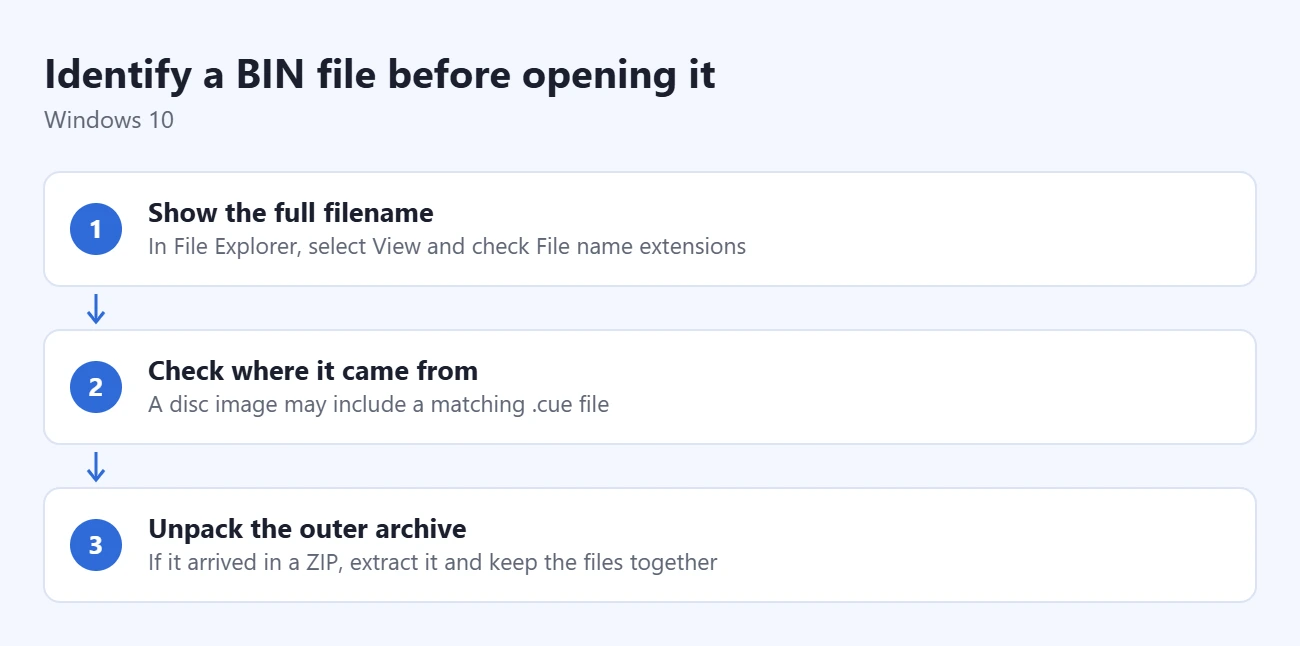
Identify the BIN File Before Opening It
- Show the full filename. Open File Explorer, select View, then check File name extensions in the Show/hide group. This is Microsoft’s Windows 10 extension-display route.
- Check its origin. A disc-image download may include a matching
.cuefile. A download from a router manufacturer’s firmware page serves a different purpose. If the source gives no format information, ask the sender before choosing an opener. - Unpack the outer archive. If the BIN and CUE arrived inside a ZIP, extract the ZIP in Windows first. Keep the related files together in their extracted folder.
Do not change .bin to .iso, .zip, or .exe to make it open. Microsoft explains that changing an extension does not convert the contents. An icon or an app suggestion also does not establish the actual format.
Browse and Extract a BIN/CUE Data-Disc Image
A CUE file describes a disc’s tracks; its associated BIN holds the track data. Use this method only when your source identifies the files as a disc image. It creates accessible copies of files without burning a physical disc. If you do need a physical disc, see how to burn an image file to a disc with ImgBurn, which lists BIN and CUE among its supported formats. If you need more than one disc, the same program can burn multiple disc copies in one job.
AnyBurn’s official download page lists Windows 10 support and includes image browsing, extraction and conversion in the Free edition. Choose Free for this task; Pro is a separate trial edition. Download from the vendor and follow its setup instructions.
- Choose the image tool. Open AnyBurn and select Browse / Extract image file.
- Select the image. Use the browse button, select the CUE or BIN and choose Open, then Next. With the matching pair available, AnyBurn associates the two files.
- Review the contents. Browse the displayed folders. Select the items you need and choose Next. If nothing is selected, the extraction workflow processes all files and folders.
- Choose a separate output folder. Keep Overwrite existing files off so replacements require a prompt. You can enable Open the folder after extraction.
- Extract and inspect. Choose Next and wait for the successful-extraction message. Open the output folder and check the expected items before using them.
The vendor documents this in its BIN/CUE extraction tutorial and general image-extraction guide. Extracting a package does not install its software or make its contents trustworthy. Use the package’s own readme for the next step.
Mount the Disc Image Instead
Mounting makes a disc image appear as a virtual optical drive. WinCDEmu lists CUE support and Windows 10 compatibility. For a BIN/CUE pair, select the CUE file rather than assuming an arbitrary BIN is mountable.
- Install WinCDEmu from its official site, then find the CUE and associated BIN files.
- Right-click the CUE and choose Select drive letter & mount.
- Choose an available drive letter and select OK. Open the new virtual drive in File Explorer to inspect its contents.
- When finished, right-click that virtual drive and select Eject. This removes the mounted drive, not your saved image files.
These controls follow the vendor’s mounting tutorial. Compatibility still depends on the image. Do not accept a prompt to format a drive just because an image will not open.
Should You Convert BIN to ISO?
Extraction or mounting may already solve the task. If another tool specifically needs ISO, AnyBurn documents disc-image conversion to ISO: choose Convert image files, select the source, set ISO as the output format, review the separate destination and choose Convert Now. Keep the original until you have checked the result.
Do not treat conversion as a repair for unrelated BIN data. The vendor’s format explanation says ISO holds one data track, while BIN/CUE can describe multiple tracks, including audio or video. Conversion is not a universal substitute for keeping a mixed-track disc’s original layout.
Firmware and Application BIN Files
A firmware BIN is usually supplied to the device’s update process, not opened as a Windows document. For example, TP-Link’s router instructions select an extracted BIN in the router’s firmware-upgrade page. The same guide also uses config.bin for a settings backup, which is a different task. For the full process, see how to update router firmware.
Follow the exact product’s instructions. For firmware, verify the model, hardware version and region before updating; the wrong firmware can damage a device. Do not use a configuration backup as firmware. For an application’s own data file, use that application’s documented import or loading process rather than editing or converting the file experimentally.
If the File Still Will Not Open
- No CUE file: check the original archive and download instructions. Obtain the original descriptor when the disc-image workflow requires it; do not invent track details from an example found online.
- Missing referenced BIN: keep the complete image set together with its original filenames. A CUE from a different download is not a reliable replacement.
- Invalid image or no files listed: check the source’s format description and whether the download completed. Try a fresh copy from that source if appropriate; not every BIN contains browsable files.
- Output problems: choose a writable folder with enough free space. Use a new folder to separate the extracted contents from existing work.
Frequently Asked Questions
Will 7-Zip open every BIN file?
No. The extension alone is not enough to select an archive program. Use the instructions for the actual format; this guide’s extraction method specifically concerns BIN/CUE disc images.
Can I read it in Notepad?
A BIN is not necessarily a text document. Opening it in a text editor may show unreadable data and does not provide the disc browsing or device-update workflow you need. Avoid saving changes to the original.
Does opening the file install a program?
Browsing or extracting shows or copies the contents. Installation is a separate action. Identify the file first, choose the appropriate method, and keep the originals until you have verified the result.

Matthew Burleigh has been writing tech tutorials since 2008. His writing has appeared on dozens of different websites and been read hundreds of millions of times.
After receiving his Bachelor’s and Master’s degrees in Computer Science he spent several years working in IT management for small businesses. However, he now works full time writing content online and creating websites.
His main writing topics include iPhones, Microsoft Office, Google Apps, Android, and Photoshop, but he has also written about many other tech topics as well.