To install an APK on Windows 11, use an Android emulator such as BlueStacks 5: install it, select Install APK on its side toolbar, choose the APK file, and open the app from the emulator’s home screen. Windows can’t run APK files on its own, and Microsoft’s Windows Subsystem for Android (WSA) and the Amazon Appstore were removed from the Microsoft Store on March 5, 2025.
These steps apply to Windows 11 Home and Pro. BlueStacks 5 and Google Play Games also run on Windows 10, but Windows 10 reached end of support on October 14, 2025, so it no longer gets security updates.
Before You Start
An APK (Android Package) is the installer file for an Android app. On a phone, the Play Store handles it for you. On a PC, you need software that acts like an Android device. Check these first:
- You’re not in S mode. S mode only allows Microsoft Store apps, so emulator installers are blocked. See how to exit S mode in Windows 11 if your PC uses it.
- Virtualization is on. Emulators run much better with hardware virtualization turned on in your PC’s firmware.
- You have an admin account. BlueStacks and Google Play Games both need administrator rights to install.
- The APK comes from a source you trust, such as the app developer’s own website.
Which Option Should You Use?
| What you want | Best option | Installs an APK file? |
|---|---|---|
| Run a specific Android app from an APK | BlueStacks 5 or another emulator from its maker’s site | Yes |
| Play Android games | Google Play Games on PC | No, Google’s catalog only |
| Use an app already on your Android phone | Phone Link | No, the app runs on the phone |
| Test your own app as a developer | Android Studio’s Android Emulator | Yes |
| Use a popular service | The Windows app or website | Not needed |
How to Install an APK With BlueStacks 5
BlueStacks 5 is a free Android emulator that installs APK files directly on Windows 11. Follow these steps:
- Check your PC against the BlueStacks 5 system requirements. The minimum is 4 GB of RAM and 5 GB of free disk space; BlueStacks recommends 8 GB of RAM, an SSD and virtualization turned on.
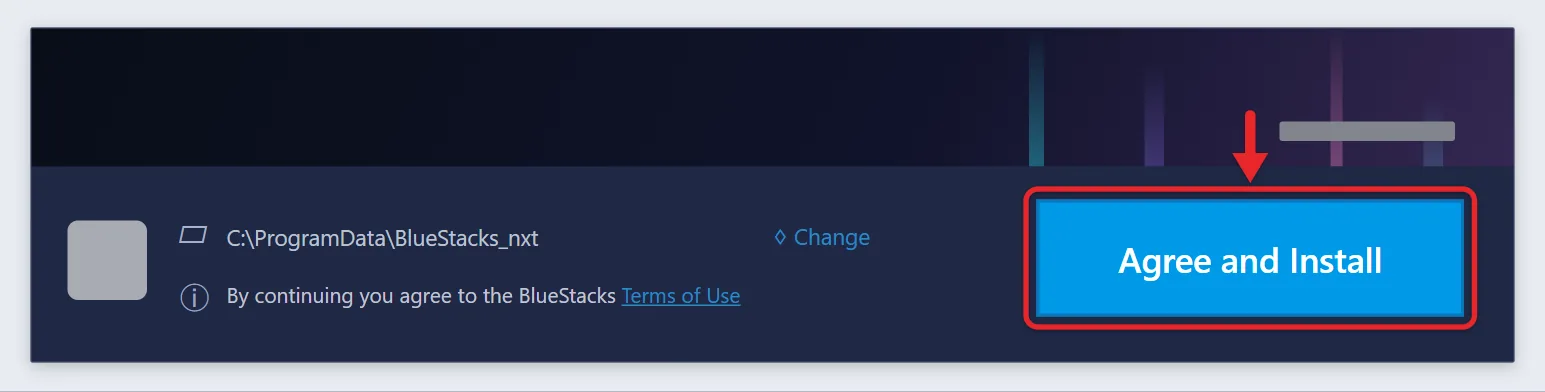
- Download BlueStacks 5 from bluestacks.com, open the installer, and select Agree and Install. BlueStacks opens on its own when setup finishes. The publisher’s installation guide covers this setup.
- Save the APK from the app’s developer to a folder you can find, such as Downloads.
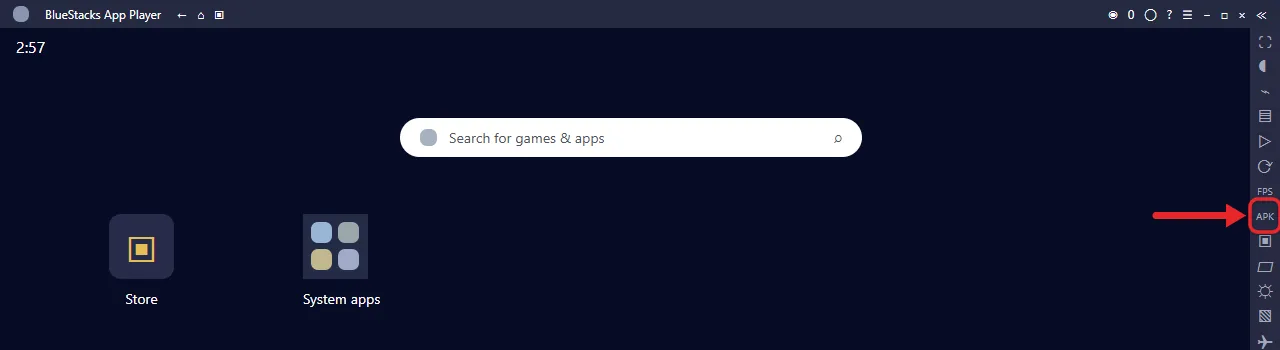
- In BlueStacks 5, select Install APK on the side toolbar. A File Explorer window opens.
- Choose the APK file and select Open. The installation starts. You can also drag the APK from File Explorer onto the BlueStacks home screen.
- When the app icon appears on the BlueStacks home screen, click it to open the app.
You don’t need to sign in to Google to install a local APK. Sign-in is only for the Play Store inside BlueStacks. BlueStacks documents both APK installation methods, and both also accept .xapk files, a bundle format some apps use.
If Hyper-V is turned on
If you use Hyper-V, WSL2 or other Microsoft virtualization features, you don’t need to turn them off. BlueStacks says version 5.20 and later run with Hyper-V on or off, and downloading from its official site with Hyper-V on installs the compatible build automatically. Its Hyper-V requirements page lists the extra steps, including adding your account to the Hyper-V Administrators group.
What Happened to Android Apps on Windows 11?
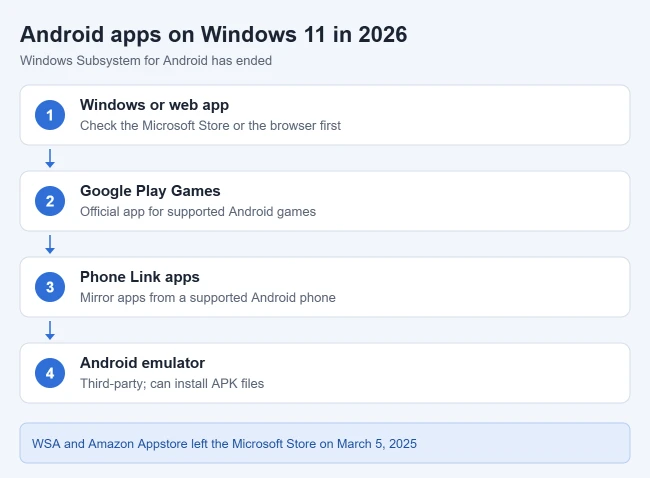
For a while, Windows 11 could run Android apps through Windows Subsystem for Android, installed along with the Amazon Appstore. Microsoft’s WSA documentation, now archived, states that starting March 5, 2025, WSA and the Amazon Appstore are no longer available in the Microsoft Store. Amazon’s discontinuation notice says apps installed from the Amazon Appstore on Windows 11 are no longer supported after that date.
That’s why many older guides no longer work. They describe installing the Amazon Appstore, turning on Developer mode in WSA, and sideloading APKs with tools like WSA PacMan or Android’s ADB. Microsoft Store apps with “APK Installer” in the name were built on WSA too. All of these depend on a feature Microsoft has retired.
Option 1: Use a Windows or Web Version of the App
Before reaching for an emulator, check whether the app already exists for Windows. Many popular services have a Windows app in the Microsoft Store or a full website you can use in a browser. Search the Microsoft Store for the app’s name, or visit the service’s website and look for a download or web sign-in.
For example, you don’t need the Android app to watch JioHotstar on a Windows 11 laptop, because the website works in Edge or Chrome.
Option 2: Google Play Games on PC
For games, Google’s own app is the official route. It doesn’t install APK files; you get games from Google’s catalog.
Check the requirements
Google’s requirements page lists these minimums:
- Windows 10 (v2004) or later
- A solid-state drive (SSD) with 10 GB of free space
- 8 GB of RAM
- Intel UHD Graphics 630 or a comparable GPU
- 4 physical CPU cores
- A Windows admin account, with hardware virtualization turned on
You also need a personal Google Account and a Play country set to a supported country or region.
Install it
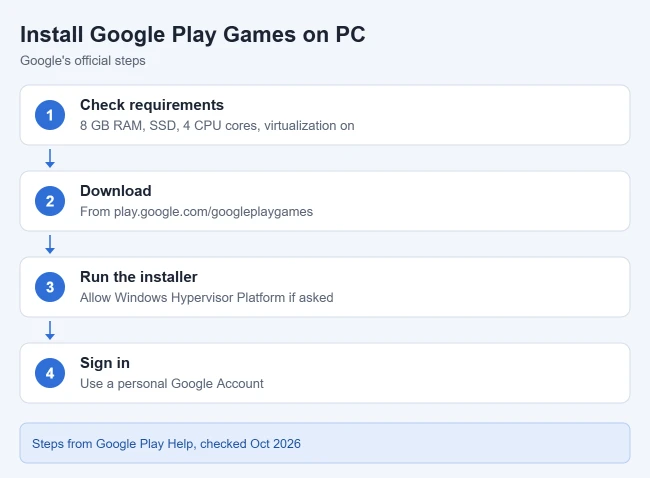
These steps follow Google’s install guide:
- Go to play.google.com/googleplaygames and select Download. The installer downloads.
- Open the downloaded file and follow the prompts. Installation can take a few minutes.
- If you’re asked to turn on Windows Hypervisor Platform, allow it and restart your PC.
- Sign in with the same Google Account you use on your phone so your game progress syncs across devices.
Google notes two catches. Other emulators may stop working once Windows Hypervisor Platform is on, and only the first user who installed Google Play Games on a PC can open it. If installation fails, Google suggests uninstalling it from Windows apps settings, restarting, and installing again. For more on Google’s apps and Windows, see how to get Google Play on Windows 11.
Option 3: Use Your Phone’s Apps With Phone Link
If you have a supported Android phone, Microsoft’s Phone Link app can show your phone’s apps on your PC. Microsoft’s Phone Link apps page says you can open apps installed on your phone from the Apps section, use them with your mouse and keyboard, and right-click one to pin it to Start or the taskbar. Select Samsung and HONOR phones can open several apps at once; other phones open one at a time. The apps still run on your phone, so nothing is installed on Windows.
Microsoft recommends keeping the phone and PC on the same Wi-Fi network and band, and at least 8 GB of RAM on the PC. Phone Link doesn’t support multiple Android profiles or work or school accounts, and some games need a touchscreen PC. Our guide to connecting a phone to a Windows 11 laptop covers the setup.
Option 4: Android Studio’s Emulator (for Developers)
If you build or test Android apps, Google’s Android Studio includes an official Android Emulator. Google’s emulator file guide says to drag the APK onto the emulator screen, follow the APK Installer dialog, and find the app in the emulated device’s app list. It’s a heavy developer tool, so for everyday use an emulator like BlueStacks is easier.
Option 5: Another Third-Party Android Emulator
Other emulators can install APK files as well. If you go this route:
- Download the emulator only from the developer’s official website, never from a download mirror.
- Check its system requirements before installing.
- Turn on virtualization in your PC’s firmware. See how to turn on hardware virtualization in Windows 11.
- Expect conflicts with other virtualization tools; Google warns that other emulators might not work while Windows Hypervisor Platform is on.
Stay Safe With APK Files
APK files from unknown websites can contain malware, and sites that collect APKs can’t always prove a file is the developer’s original. Get apps from Google Play inside the emulator or from the developer’s own site. Keep Windows Security turned on so it scans what you download, and don’t turn it off to force an install. Apps installed from an APK usually don’t update on their own, so download new versions from the same official source.
Troubleshooting
The emulator installer won’t run
Check whether your PC is in S mode (Settings > System > Activation). Also confirm you’re signed in with an administrator account.
BlueStacks is slow or says virtualization is off
Turn on virtualization in your firmware. Microsoft’s path is Settings > System > Recovery > Advanced startup > Restart now, then Troubleshoot > Advanced options > UEFI Firmware Settings. The setting’s name varies by PC maker, so check your manufacturer’s instructions and change only that setting.
The APK installs but the app won’t open or keeps crashing
Not every app runs in an emulator. Some apps check for a certified phone or use copy protection, and streaming apps may refuse to play video. Update BlueStacks, then try the app’s Play Store version inside BlueStacks. If it still fails, use the app’s website or Phone Link instead.
Another emulator stopped working after installing Google Play Games
Google Play Games turns on Windows Hypervisor Platform, which some older emulators can’t run alongside. Update the other emulator to a version that supports Hyper-V, or turn off Windows Hypervisor Platform when you need it.
How to Remove an App or the Emulator
To remove BlueStacks or Google Play Games, open Settings > Apps > Installed apps, select the three dots next to the app, and choose Uninstall. Removing the emulator also removes the Android apps you installed inside it.
Frequently Asked Questions
Does Windows Subsystem for Android still work if I already installed it?
Microsoft removed it from the Microsoft Store, and Amazon stopped supporting Appstore apps on Windows 11 after March 5, 2025. It may still open on some PCs, but it no longer gets updates and can stop working at any time.
Can I open an APK file to see what’s inside?
An APK is a ZIP-style archive, so tools like 7-Zip can open it. That doesn’t install or run the app.
Can Google Play Games install any Android app?
No. It’s for games in Google’s PC catalog. Google lets you filter out games that may not run well on your PC.
Do I need a Google account to install an APK in BlueStacks?
No. Installing a local APK works without signing in. You only need a Google account to download apps from the Play Store inside BlueStacks.
How do I install an APK on an Android phone?
See how to install an APK on Android.

Matthew Burleigh is the founder, head writer, and editor of Solve Your Tech, which he launched in 2012. He has written technology tutorials since 2008 and worked in IT since 2003, including small-business support, IT management, and consulting. He holds Bachelor’s and Master’s degrees in Computer Science from Arizona State University.
Matthew writes practical guides for Windows, iPhone and iPad, Microsoft Office, Outlook, Google apps, and Android. Solve Your Tech’s guides are checked step by step against the device or app maker’s own documentation and tested on his own devices whenever he has the hardware or software, with clear steps, sources, and update dates.
Read more about Matthew and how Solve Your Tech writes and updates its guides, or report a correction.