To convert an iPhone photo to JPG, open it in Photos, tap Share, choose Preview, then tap the file name, choose Export, pick JPEG and save the copy. On an iPhone without Preview, the Files app’s Convert Image quick action or a short Shortcuts workflow makes the same JPG copy.
These steps cover iPhones running iOS 27 and iOS 26, which include the Preview app. The Files, Shortcuts and camera-settings methods also work on earlier versions of iOS that are still in use. JPG and JPEG are two names for the same image format.
Why Your iPhone Photos Aren’t JPG
iPhones save photos in HEIF format by default, and the files end in .heic. Apple calls this the High Efficiency format because it takes less storage space than JPEG at similar quality. Apple devices open HEIC files without trouble, but some websites, job and school portals, older Windows apps and Android phones reject them or show an error.
Converting creates a new JPEG copy. Your original photo stays in the Photos library unchanged, and renaming a file from .heic to .jpg does not convert it. The image inside stays HEIC, so a site that checks the file will still reject it.
If you only need a second copy in the same format, duplicate the photo in the Photos app instead.
| Method | Best for | Needs |
|---|---|---|
| Preview | One photo you want to resize or shrink before uploading | iOS 26 or later |
| Files > Convert Image | Photos you’ve already saved to Files | A file copy in Files |
| Copy and paste into Files | A quick JPG of one or several photos | Nothing extra |
| Shortcuts | Converting often with one tap | A one-time setup |
| Camera > Formats | Making new photos JPEG from now on | Doesn’t change old photos |
Convert a Photo With Preview (iOS 26 and Later)
- Open Photos and tap the picture you want to convert. It opens full screen.
- Tap the Share button (the square with an upward arrow).
- Tap Preview in the row of app icons. If it isn’t there, swipe to the end of the row and tap More. The photo opens in Preview.
- Tap the file name at the top of the screen to open the actions menu, then tap Export.
- Choose JPEG as the format. Drag the size slider to the left if a website has an upload limit, because lower settings make a smaller file.
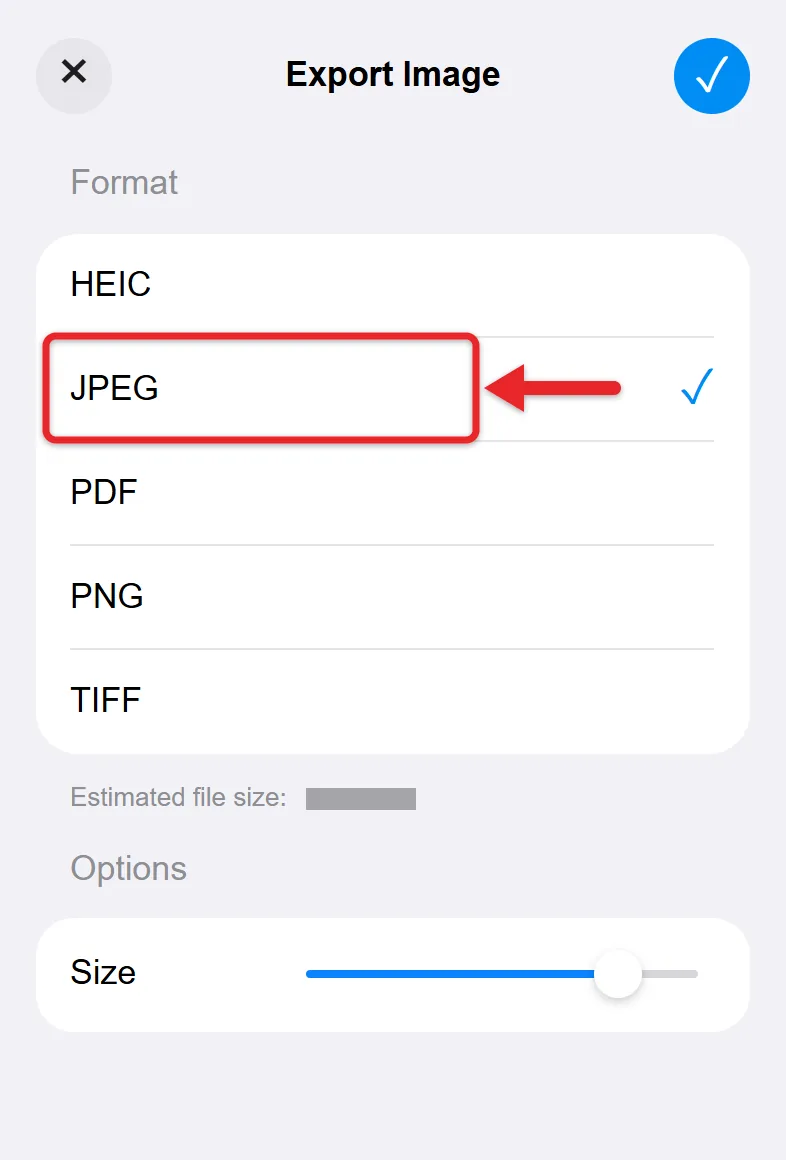
- Tap Done (the check mark), pick a folder in On My iPhone or iCloud Drive, change the name in Save As if you want, and tap Save.
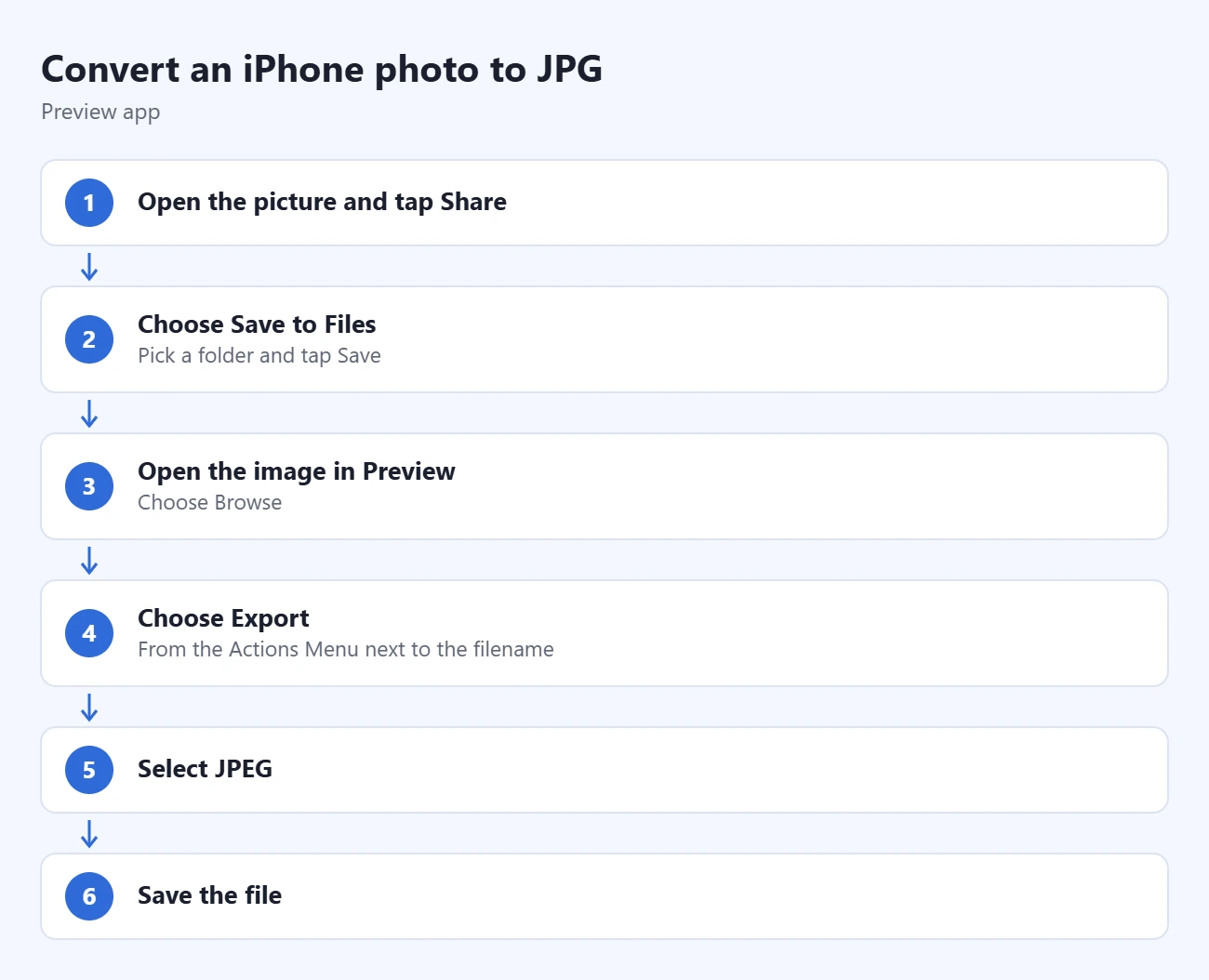
The JPG copy is now in the folder you chose, ready to attach or upload from the Files picker. If the picture is already saved in Files, you can skip the share sheet: open Preview, tap Browse, find the image and start at step 4. Apple documents opening images in Preview and exporting them in another format.
Preview is also the easiest place to shrink a photo that’s too large for a form. Before exporting, tap the More button (three dots) and use Adjust Size to enter a smaller width in pixels. Leave Scale Proportionally on so the picture isn’t stretched.
When you’re done, open iCloud Drive in Files and look for a Preview folder. Delete any working copies you don’t need so they don’t use your iCloud storage.
Convert a Photo in the Files App
Files has a Convert Image command in its Quick Actions menu. Files can’t see your Photos library, so save a file copy first.
- In Photos, open the picture, tap Share, then tap Save to Files.
- Choose a folder in On My iPhone or iCloud Drive and tap Save.
- Open the Files app and go to that folder.
- Touch and hold the image, then tap Quick Actions > Convert Image.
- Choose JPEG. If Files asks for a size, choose Actual Size to keep the full resolution, or a smaller size for a lighter upload.
The JPG appears in the same folder next to the original file. If you don’t see Convert Image under Quick Actions, use Preview or the Shortcuts method instead.
Copy and Paste Photos Into Files
This is the fastest way to get JPG copies of several photos at once, with no setup.
- In Photos, tap Select and tap each picture you want.
- Tap Share, then tap Copy Photos (or Copy Photo for one picture).
- Open Files and open a folder in On My iPhone or iCloud Drive.
- Touch and hold an empty spot in the folder and tap Paste.
The photos appear as image files in that folder. Pasted copies usually arrive as JPEG, but the result can vary, so check one file with Get Info (described below) before you upload a batch.
Use Shortcuts to Convert Photos With One Tap
A three-action shortcut, Select Photos, Convert Image and Save File, saves a JPEG copy to Files every time you run it. It takes a minute to build and is worth it if you convert photos often.
- Open Shortcuts and tap + to create a shortcut. Name it something you’ll recognize, such as Save Photo as JPG.
- Use Add Action or the search field to add Select Photos. Turn on Select Multiple in its options if you want to convert several photos at once.
- Add Convert Image below it. Set the format to JPEG and make sure its input is the selected photos. Keep Preserve Metadata on if you want to keep the date and location.
- Add Save File below Convert Image. Its input must be the converted image, not the original photo. Leave Ask Where to Save on.
- Tap Done, then tap the shortcut to run it. Select a photo, allow access when asked, and choose a folder when the save screen appears.
Apple’s guides explain creating a custom shortcut, how Select Photos passes its result into Convert Image, and the actions that convert content from one format to another. To run the shortcut from Photos instead, open its settings and turn on Show in Share Sheet; it then appears in the share sheet when you share a picture.
Check the JPG Before Uploading It
- Open Files and find the new copy.
- Touch and hold it, then tap Get Info.
- Check the file type. It should say JPEG image, not HEIC. Apple’s Files guide covers this menu.
Open the copy to make sure it looks right. When a website gives you a choice of Photo Library, Take Photo or Choose File, tap Choose File and pick the JPG in Files. Picking the original from Photos again may send the HEIC version.
When you send a photo by AirDrop, Messages or email, the iPhone might share it in a more compatible format such as JPEG. You can ask for that directly in Photos:
- Open the photo, tap Share, then tap Options at the top of the share sheet.
- Choose Most Compatible, then tap Done and pick where to send it.
Current sends the photo in its original format. Because the conversion isn’t guaranteed, check the received file when the destination specifically requires JPG. See Apple’s photo-sharing options.
Get JPGs When You Move Photos to a Computer
If the photos are headed to a computer anyway, you can convert them during the transfer or on the computer.
- Transfer by cable: go to Settings > Apps > Photos and, under Transfer to Mac or PC, choose Automatic. Media imported over USB might then be converted to JPEG or H.264. Keep Originals keeps them as HEIC. For the full import process, follow the steps for transferring iPhone photos to a PC.
- On a Mac: in the Photos app, select the pictures and choose File > Export > Export [number] Photos. Set Photo Kind to JPEG, choose a quality and size, click Export, pick a folder and click Export again. Apple covers the options in its Mac Photos export guide.
- On Windows: if the photos already arrived as HEIC, convert HEIC to JPG on Windows 11.
If your PC can’t display a HEIC original, you can also open HEIC files on Windows 11 for free without converting them.
Save Future Camera Photos as JPEG
- Open Settings and tap Camera. On some versions, it’s under Settings > Apps > Camera.
- Tap Formats.
- Choose Most Compatible.
New photos now save as JPEG and new videos as H.264. Photos you already took don’t change. To go back to the space-saving HEIF and HEVC formats, choose High Efficiency. This setting appears only on devices that can capture those formats. Apple’s HEIF and HEVC guide has more about it.
Before you switch, think about storage. JPEG files are larger, so a phone that’s nearly full fills up faster. Many people keep High Efficiency and make JPG copies only when a site asks for one.
What Changes When You Convert to JPG
- Quality: JPEG uses lossy compression, so a little detail is discarded each time it’s saved. At a high quality setting the difference is hard to see. Convert once from the original rather than re-saving a JPG again and again.
- File size: a JPG is usually bigger than the HEIC it came from, unless you lower the quality or size.
- Live Photos and Portrait photos: a JPG is a single still image. The motion from a Live Photo and the depth effect you can adjust later in Portrait photos don’t carry over to the copy.
- HDR brightness: photos that look extra bright on the iPhone can look flatter as JPG, because JPEG doesn’t store the same high dynamic range data.
- Date and location: most methods keep this information. If you’re posting publicly and don’t want to share where a photo was taken, turn off location before sharing in Share > Options.
Keep the original HEIC in Photos until you’ve checked the JPG.
If the Conversion Doesn’t Work
- Preview isn’t on your iPhone. Preview comes with iOS 26 and later. Check your version in Settings > General > About. If you’re on iOS 26 or later and can’t find it, swipe down on the Home Screen and search for Preview, or check the App Library.
- Convert Image is missing from Quick Actions. Make sure you’re touching and holding an image file inside the Files app, not a photo in the Photos app. If it still isn’t listed on your version of iOS, use Preview or Shortcuts.
- The saved file is still HEIC. In a shortcut, check that Save File uses the converted image as its input. If you renamed the file yourself, delete it and export a real copy.
- The website still rejects the photo. The file may be too large. Export again with the size slider lower, or use Adjust Size in Preview to reduce the width.
- The photo uploads sideways. Some sites ignore the rotation information stored in the file. Open the photo in Preview, rotate it, and export a new JPG.
- Shortcuts stops partway through a big batch. Convert smaller groups at a time, or use the copy-and-paste method.
Frequently Asked Questions
Are JPG and JPEG the same?
Yes. They’re the same format, and the .jpg and .jpeg file extensions are interchangeable. Websites that ask for JPG accept JPEG files.
Does converting delete the original photo?
No. Every method here makes a separate copy. The original stays in the Photos library until you delete it yourself.
Can I convert several photos at once?
Yes. Copy and paste a selection into Files, turn on Select Multiple in the Shortcuts method, or export several photos at once from Photos on a Mac.
Why are some of my pictures already JPG or PNG?
Photos saved from websites or received from other phones are often already JPEG, and photos taken with Most Compatible turned on are JPEG. Screenshots are usually PNG files. A site that asks for JPG may also accept PNG, so check its upload instructions.
Do I need a converter app or website?
No. Preview, Files, Shortcuts and the camera setting come with the iPhone. Online converters work, but they upload your photo to someone else’s server, so avoid them for personal or sensitive pictures.
For a form that needs a PDF instead, you can save a picture as a PDF on an iPhone.

Matthew Burleigh is the founder, head writer, and editor of Solve Your Tech, which he launched in 2012. He has written technology tutorials since 2008 and worked in IT since 2003, including small-business support, IT management, and consulting. He holds Bachelor’s and Master’s degrees in Computer Science from Arizona State University.
Matthew writes practical guides for Windows, iPhone and iPad, Microsoft Office, Outlook, Google apps, and Android. Solve Your Tech’s guides are checked step by step against the device or app maker’s own documentation and tested on his own devices whenever he has the hardware or software, with clear steps, sources, and update dates.
Read more about Matthew and how Solve Your Tech writes and updates its guides, or report a correction.