To connect an iPad to a projector, plug Apple’s video adapter for your iPad’s port (USB-C Display AV or USB-C VGA Multi-port Adapter, or Lightning Digital AV or Lightning to VGA Adapter) into the iPad, run an HDMI or VGA cable to the projector, and switch the projector to that input. AirPlay works wirelessly through an Apple TV or AirPlay receiver.
The meeting room projector has an HDMI cable hanging off the cart, and the slides are on your iPad.
Check Your iPad’s Port and the Projector’s Inputs
Two things decide which adapter you need: the port on the iPad and the video input on the projector.
- iPad port: USB-C is an oval connector; Lightning is a thinner, flat connector. Apple’s list of USB-C iPads includes iPad Pro 11-inch (1st generation) and 12.9-inch (3rd generation) and later, iPad Air (4th generation) and later, iPad mini (6th generation) and later, iPad (10th generation) and iPad (A16).
- Projector input: HDMI is the small, flat port found on most current projectors. VGA is the older blue port with 15 pins and two screws. Some projectors also accept video over USB-C.
Pick HDMI whenever the projector has it. As explained below, VGA carries no sound and can block some protected video.
Connect a USB-C iPad With a Cable
Apple says a USB-C iPad may be able to plug straight into a USB or Thunderbolt 3 port on a display. If the projector has a USB-C port that accepts video (check its manual), try the iPad’s own cable first. Otherwise, use an adapter:
- Connect the HDMI or VGA cable to the projector.
- Connect the other end of that cable to a USB-C Display AV Adapter (HDMI) or a USB-C VGA Multi-port Adapter (VGA).
- If your adapter has a USB-C charging port and you plan to charge during the presentation, plug the iPad’s charge cable and power adapter into it now.
- Plug the adapter into the iPad’s USB-C port.
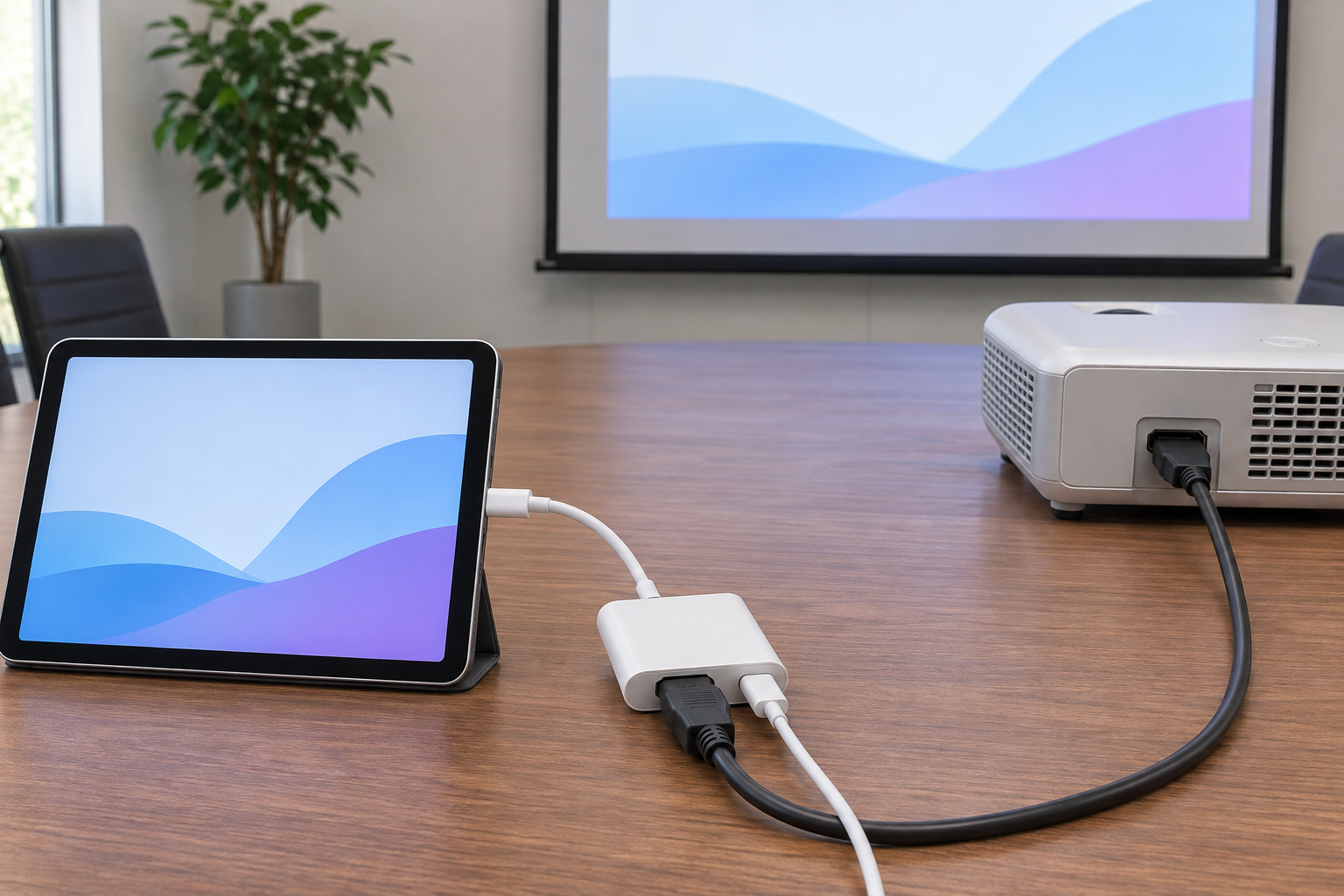
- Switch the projector to the input you used (see the input section below).
Connecting the cables to the adapter before the adapter goes into the iPad is Apple’s own advice for its USB-C Digital AV Multiport Adapter, and Apple says video should appear within about 10 seconds. Apple’s page on connecting iPad to a display with a cable lists the adapters for both port types.
Connect a Lightning iPad With a Cable
- Plug a Lightning Digital AV Adapter (HDMI) or a Lightning to VGA Adapter (VGA) into the iPad’s Lightning port.
- Connect an HDMI or VGA cable to the adapter.
- Connect the other end to the projector.
- To charge while presenting, connect the charge cable to the adapter’s extra Lightning port and plug the power adapter into an outlet.
- Switch the projector to the right input.
Switch the Projector to the Right Input

Most “no signal” screens are a projector still showing a different input. Press the Input or Source button on the projector or its remote and step through the options until you reach the port you used, such as HDMI 1 or Computer/VGA. Labels vary by brand, so check the projector’s manual if the names aren’t clear.
If the picture is stretched, cropped or doesn’t fill the screen, use the projector’s own aspect ratio or zoom setting. Apple’s pages don’t describe an aspect ratio control for external displays in iPad Settings, so treat this as a projector-side adjustment.
Connect Wirelessly With AirPlay
AirPlay needs a receiver at the projector end: either an Apple TV plugged into the projector’s HDMI port, or a projector with AirPlay built in (check its specs). Apple’s requirement is an Apple TV 4K or an AirPlay 2-enabled smart TV, with the iPad on the same Wi-Fi network.
- Swipe down from the upper-right corner of the iPad to open Control Center.
- Tap the Screen Mirroring button.
- Choose the Apple TV or receiver. If a passcode appears on the projected screen, enter it on the iPad.

- When you’re done, open Control Center, tap Screen Mirroring, then tap Stop Mirroring.
Apple’s page on streaming video and mirroring the iPad screen covers the AirPlay options, and mirroring an iPad to a TV walks through the same process with a TV, including streaming a single video. For a shared room, a cable is usually the safer choice: it doesn’t depend on the guest Wi-Fi, and nobody else can pick your iPad from a list by mistake.
Mirror or Extend: What Appears on the Projector
According to Apple, a connected display shows one of three things:
- A mirror of the iPad screen. This is what you see in most apps: everything on the iPad, including notifications, appears on the projector.
- A second-screen view. Some video apps play the video on the projector while the iPad shows the controls.
- An extended display, on supported iPad models, where the projector becomes a separate workspace.
Extended display works through Stage Manager. Turn it on from the Stage Manager button in Control Center, or in Settings > Multitasking & Gestures > Stage Manager. Apple’s Stage Manager article lists these models for moving apps and windows to an external display with iPadOS 26: iPad Air 13-inch and 11-inch (M3), iPad Pro 13-inch and 11-inch (M4), iPad Air 13-inch and 11-inch (M2), iPad Pro 12.9-inch (5th generation and later), iPad Pro 11-inch (3rd generation and later), and iPad Air (5th generation). Newer models may not be on that list yet, so check Apple’s page for yours.
On a supported model, move an app to the projector by touching and holding the window control at the top of the window, then tapping Move to Display. Tap Move to iPad to bring it back. This helps for a training session where the slides go on the wall and your speaker notes stay on the iPad.
Sound, Resolution and Charging
Sound: HDMI carries audio to the projector (or its speakers). VGA doesn’t carry audio at all, so with a VGA adapter, Apple says to connect audio to the headset jack on the projector or a stereo, or switch to a Digital AV (HDMI) adapter.
Resolution: many projectors are 1080p, so the iPad’s maximum output rarely matters. On USB-C iPads, Apple says its USB-C Digital AV Multiport Adapter shows the Home Screen and apps at 1080p and 60Hz and can switch to match video content. The Match Content option for this is in Settings > Display & Brightness. Apple’s article on the iPad USB-C port lists the maximum resolution each USB-C model can send.
Charging: a long presentation drains the battery quickly with the screen on. Apple’s Lightning adapters have an extra port for the charge cable, and its USB-C Digital AV Multiport Adapter has a USB-C charging port, so bring the iPad’s charger and plug it into the adapter.
Fix No Picture, No Sound or an HDCP Alert
Work through these in order. Apple’s page on getting help with Digital AV adapters covers the same checks.
- Check the input. Confirm the projector is on the port the cable goes into.
- Reconnect the adapter. Unplug it from the iPad and plug it back in. If the display still doesn’t wake, Apple suggests unplugging the display from power and plugging it in again.
- Test the cable. Try the HDMI or VGA cable with another device, or swap in a known good one.
- Remove extras. Take out extension cables and converters between the adapter and the projector. Apple says DVI, composite and component converters aren’t compatible.
- Update iPadOS in Settings > General > Software Update.
- Try another app. Apple notes that some apps don’t support the adapter.
HDCP alert or black video: HDCP is copy protection used for movies, TV shows and streaming apps. Apple says this content needs an HDCP-compatible connection, and connections that aren’t, such as the Apple VGA adapter, show an alert instead. Apple’s USB-C Digital AV Multiport Adapter is HDCP compliant, so HDMI to an HDCP-capable projector is the route for streaming video.
AirPlay issues: make sure both devices are on, close together and on the same Wi-Fi network, and restart both if the receiver doesn’t appear. Apple’s AirPlay troubleshooting article also covers no sound, which is often the volume on the iPad or the receiver.
iPad Projector Questions
Can I use a generic USB-C to HDMI adapter?
Apple’s USB-C port article describes USB-C to HDMI adapters in general, not just Apple’s, so a third-party adapter may work. The resolution it can carry depends on the adapter and your iPad model.
Will notifications show up on the projector?
When the iPad mirrors, anything on its screen shows on the projector. Turn on a Focus such as Do Not Disturb before you start if you don’t want messages popping up in front of the room.
Can I play a movie from the iPad on a home projector?
Yes, over HDMI or AirPlay. With a cable, movies and streaming apps need an HDCP-compatible connection such as HDMI; VGA shows an alert instead. Some video apps don’t support AirPlay at all, so if one won’t show up, try the cable.
My projector uses a Fire TV Stick. Can I use that?
Possibly, but it isn’t an Apple receiver, so it works differently. Connecting an iPad to a Fire TV Stick explains the options.
Before the meeting starts, connect everything once, open your slides, and check sound if you’ll need it. That five-minute test catches the wrong adapter or input long before the audience arrives.

Matthew Burleigh is the founder, head writer, and editor of Solve Your Tech, which he launched in 2012. He has written technology tutorials since 2008 and worked in IT since 2003, including small-business support, IT management, and consulting. He holds Bachelor’s and Master’s degrees in Computer Science from Arizona State University.
Matthew writes practical guides for Windows, iPhone and iPad, Microsoft Office, Outlook, Google apps, and Android. Solve Your Tech’s guides are checked step by step against the device or app maker’s own documentation and tested on his own devices whenever he has the hardware or software, with clear steps, sources, and update dates.
Read more about Matthew and how Solve Your Tech writes and updates its guides, or report a correction.