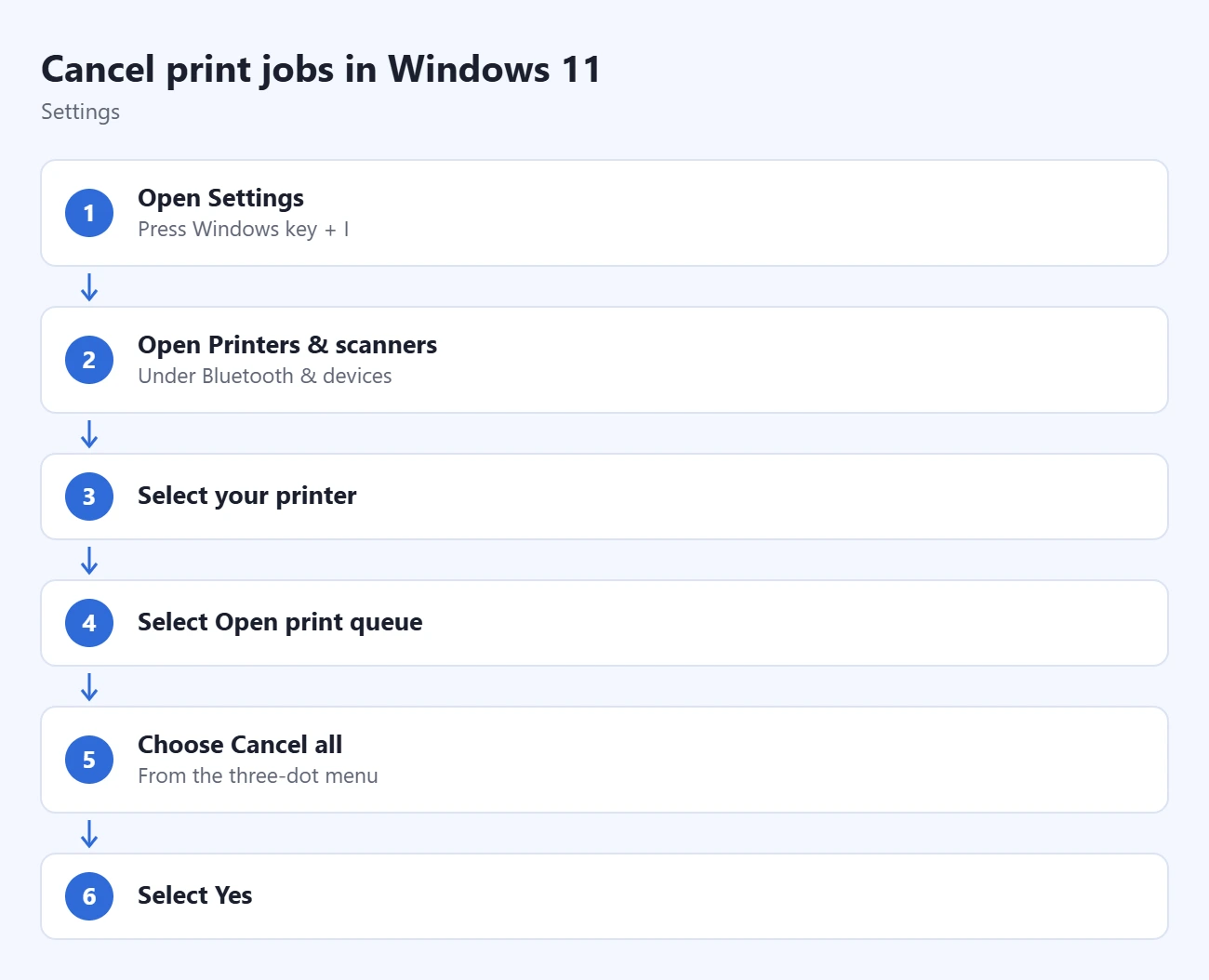
To clear the printer queue in Windows 11, open Settings > Bluetooth & devices > Printers & scanners, select your printer, select Open print queue, then select the three dots and Cancel all. For Windows 10, use the separate Settings path below. Try normal cancellation first, then restart Print Spooler. Only clear the spool folder if jobs remain stuck.
Cancelling a job discards that pending print request. Clearing the spool folder affects all printers using that PC’s spooler, not just the selected printer. It does not delete your original documents, but you will need to send discarded jobs again. Coordinate with other users on a shared PC or print server. Instructions reviewed against Microsoft documentation on October 2, 2026.
Cancel Print Jobs in Windows 11
- Press Windows key + I to open Settings.
- Select Bluetooth & devices, then Printers & scanners.
- Select your printer.
- Select Open print queue.
- Select the three-dot menu and choose Cancel all. To cancel one document, right-click it and select Cancel.
- Select Yes to confirm.
Cancel Print Jobs in Windows 10
Open Settings > Devices > Printers & scanners, select the intended printer, then Open queue. Right-click a job and choose Cancel, or select it and use Document > Cancel. In the classic queue, Printer > Cancel All Documents cancels the whole queue for that printer. Check the names before confirming.
Restart Print Spooler Before Clearing Files
Press Windows key + R, enter services.msc, and press Enter. Find Print Spooler, right-click it and select Restart. Administrator permission may be needed. Reopen the print queue to see whether the stuck job is gone. If it is, stop here and try one short print job. If jobs often stall partway through, you can also adjust the print spooler settings for a printer, as shown in our HP LaserJet P2055dn guide.
Clear the Spool Folder Only if Jobs Remain Stuck
Use this when documents stay in the queue with a status like Deleting or Error. (The queue only shows pending jobs; to see what already printed, see how to check print history in Windows 11.)
- In Services, right-click Print Spooler and select Stop. Confirm it has stopped before deleting anything.
- Press Windows key + R, enter
%windir%\System32\spool\PRINTERS, and press Enter. This is the spool folder inside your Windows installation. Check the folder path before proceeding. - If Windows requests administrator permission, proceed only if you are authorized to manage this PC. Delete the job files inside the PRINTERS folder. Do not delete the folder or files in its parent directory. If files are still locked, confirm the spooler is stopped; do not force-delete unrelated files.
- Return to Services, right-click Print Spooler and select Start.
- Reopen the print queue, then send one short test document. Resubmit other discarded jobs only after printing works.
The discarded jobs should no longer be in the queue. This does not guarantee that a cable, network or printer error is fixed. If jobs immediately get stuck again, inspect the printer’s error display and connection, or use our offline-printer guide. Microsoft walks through the same fix in its stuck print job guide, and the Printer troubleshooter can also help; see how to run a troubleshooter in Windows 11. If jobs keep getting stuck, an outdated driver is a common cause; see how to update a printer driver in Windows 11.
Frequently Asked Questions
Why won’t my print job cancel?
The Print Spooler service may be stuck. Restarting it and clearing the PRINTERS folder removes jobs that won’t cancel normally.
What does clearing the PRINTERS folder remove?
It discards the queued copies waiting to print through this spooler. Your original documents remain, but pending jobs for other printers and users may also be lost. Stop the spooler first, verify the exact folder and coordinate shared printing before clearing it.
How do I add or set up a printer?
See how to add a printer in Windows 11 or 10.

Matthew Burleigh is the founder, head writer, and editor of Solve Your Tech, which he launched in 2012. He has written technology tutorials since 2008 and worked in IT since 2003, including small-business support, IT management, and consulting. He holds Bachelor’s and Master’s degrees in Computer Science from Arizona State University.
Matthew writes practical guides for Windows, iPhone and iPad, Microsoft Office, Outlook, Google apps, and Android. Solve Your Tech’s guides are tested on current devices or checked against official product documentation, with clear steps, sources, and update dates.
Read more about Matthew and how Solve Your Tech writes and updates its guides, or report a correction.