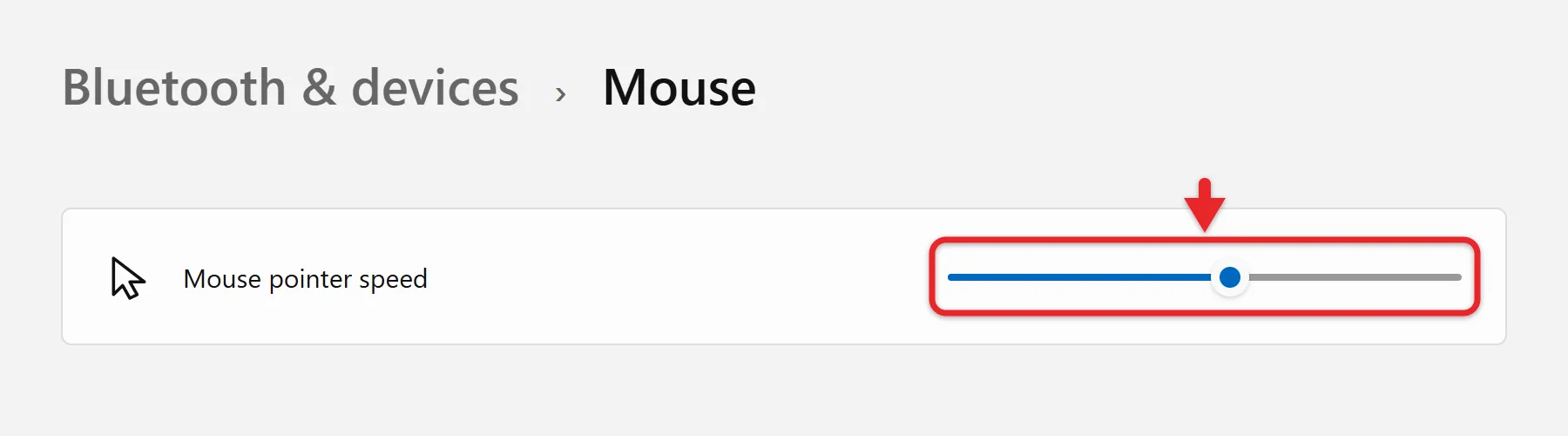
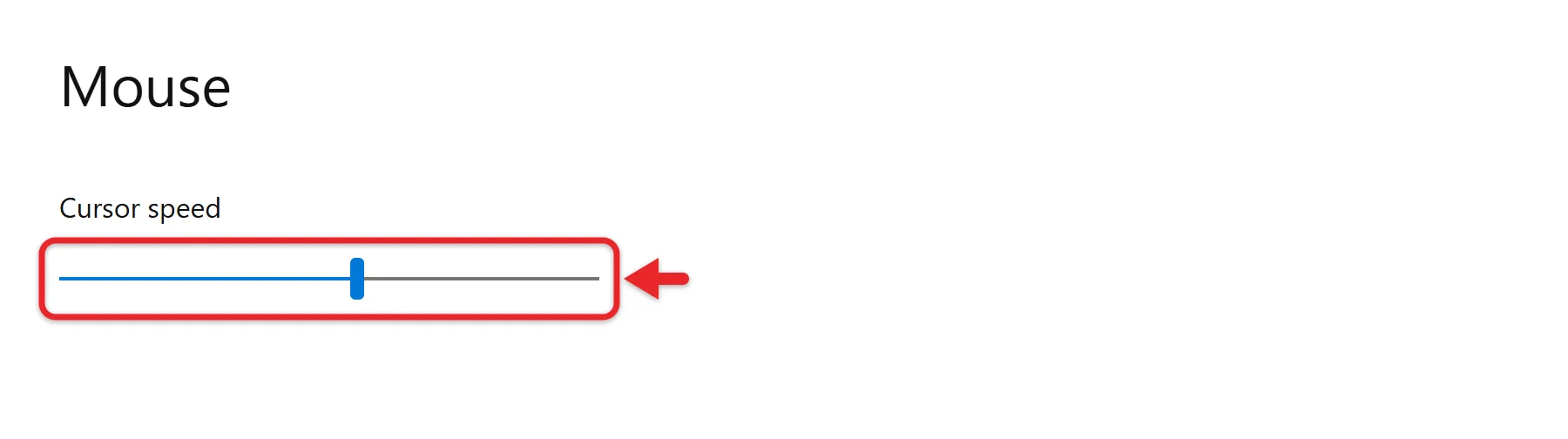
To change your mouse pointer speed in Windows 11, select Start > Settings > Bluetooth & devices > Mouse, then drag the Mouse pointer speed slider. In Windows 10, go to Start > Settings > Devices > Mouse and drag the Cursor speed slider instead.
These steps cover Windows 11 and Windows 10 and follow Microsoft’s Change mouse settings article. Windows 10 reached end of support on October 14, 2025, but its Mouse settings still work the same way. The Control Panel method below also works on both versions.
What the Speed Setting Does
Pointer speed decides how far the pointer travels on screen for each inch you move the mouse. Windows stores it as a number from 1 (slowest) to 20 (fastest), and 10 is the default, according to Microsoft’s SystemParametersInfo documentation. The slider in the middle position is that default.
A few things to know before you start:
- The change takes effect the moment you let go of the slider. There’s no Save button.
- The setting belongs to your Windows user account. Other people who sign in to the same PC keep their own speed.
- Mouse and touchpad speeds are separate. Changing one doesn’t change the other.
How to Change Mouse Pointer Speed
Windows 11
- Press Windows key + I to open Settings, or select Start > Settings.
- Select Bluetooth & devices in the left pane, then select Mouse. The Mouse page opens with the speed slider near the top.
- Drag the Mouse pointer speed slider left to slow the pointer or right to speed it up.
- Move the mouse around the screen to test the new speed, and drag the slider again until it feels right.
Windows 10
- Press Windows key + I, or select Start > Settings.
- Select Devices, then select Mouse in the left pane.
- Drag the Cursor speed slider.
- Test the pointer and adjust again if needed.
If you don’t see a Cursor speed slider, your copy of Windows 10 is an older build. Use the Control Panel method below, which has the same setting.
You can also type mouse in the search box on the taskbar and select Mouse settings to jump straight to this page in either version.
Change Pointer Speed in Control Panel
The classic Mouse Properties window still exists in Windows 11 and Windows 10. It’s useful when the Settings slider is missing, or when you want to change speed and pointer precision in one place.
- Press Windows key + R to open the Run box, type main.cpl, and press Enter. You can also select Additional mouse settings (Windows 10: Additional mouse options) under Related settings on the Mouse page in Settings.
- Open the Pointer Options tab.
- Under Motion, drag the Select a pointer speed slider toward Slow or Fast.
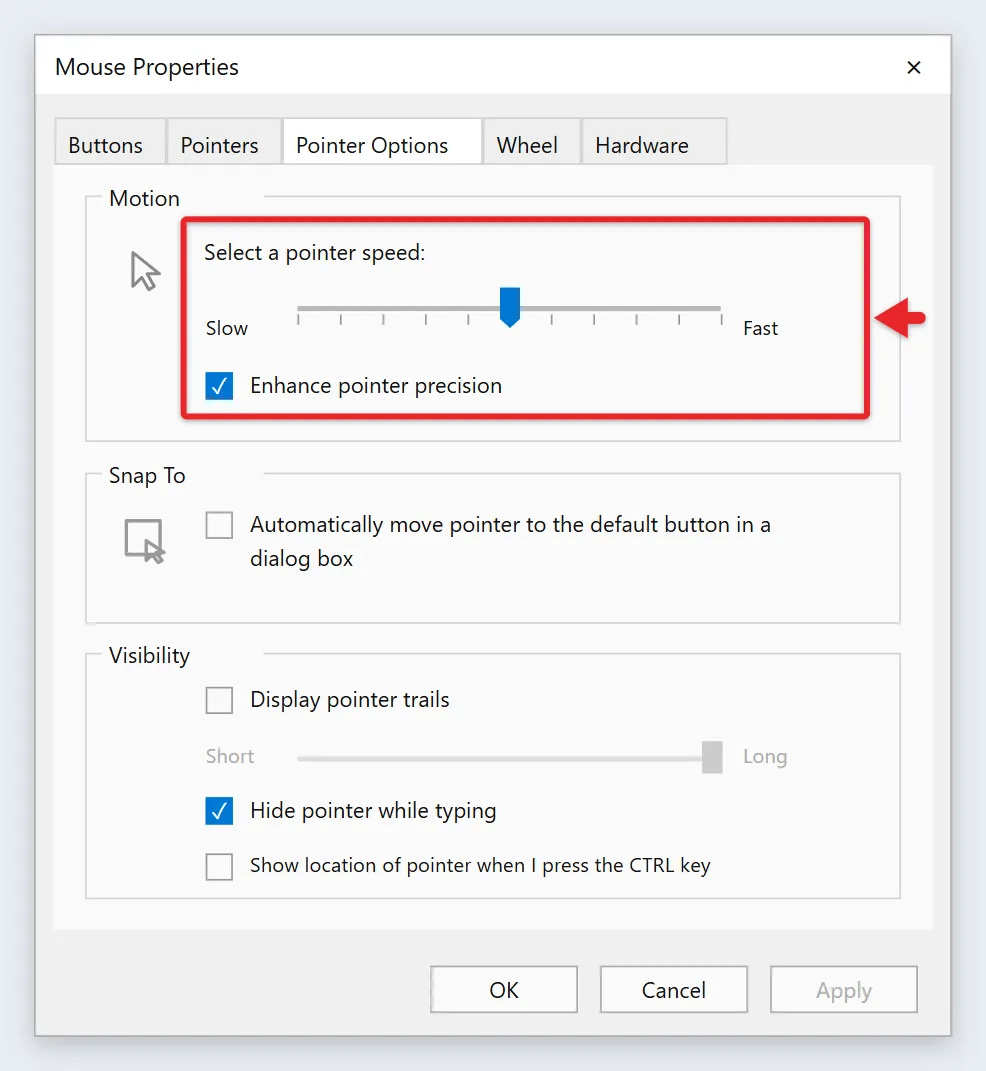
- Select Apply to try the speed, then OK to close the window.
This slider and the one in Settings control the same value, so a change in one shows up in the other.
Pick a Speed That Works for You
There’s no correct number. Use these rules of thumb as a starting point:
| Situation | What to try |
|---|---|
| You overshoot small buttons, like a window’s close button | Move the slider a step or two toward slow |
| You have to lift and move the mouse to cross the screen | Move the slider toward fast |
| A large monitor or two screens side by side | A faster setting so the pointer covers the extra space |
| Photo editing or detailed design work | A slower setting, with Enhance pointer precision tested both ways |
| Games | Set sensitivity inside the game; most games use their own setting during play |
To check a setting, move the pointer from one edge of the screen to the other in one relaxed motion, then click something small, such as a link in a webpage. If both feel comfortable, keep it. Change one thing at a time so you know which change helped.
Make the Pointer More Accurate
Microsoft says Enhance pointer precision makes the pointer more accurate when you move the mouse slowly. With it on, how far the pointer moves also depends on how fast you move the mouse, so quick flicks travel farther than slow movements. This is often called mouse acceleration.
- Windows 11: in Settings > Bluetooth & devices > Mouse, turn Enhance pointer precision on or off.
- Windows 10: in Settings > Devices > Mouse, select Additional mouse options, open the Pointer Options tab, and under Motion, check or clear Enhance pointer precision.
Leave it on for everyday browsing and office work if small targets are hard to hit. Try turning it off if the same hand movement seems to land the pointer in different places, which some gamers and designers prefer.
Pointer Speed vs. Mouse DPI
The Windows pointer-speed slider changes how far the pointer travels; it does not set your mouse sensor to a particular DPI value. DPI (dots per inch) is a setting on the mouse itself that controls how sensitive its sensor is. If your mouse supports adjustable DPI, identify its model and check the manufacturer’s instructions. Press its assigned DPI button to cycle through supported levels, or use the manufacturer’s compatible app to choose a numerical DPI setting and save the profile.
For example, the Logitech G705’s DPI button sits below the wheel: it switches among 800, 1600, and 3200 DPI, with custom levels available through G HUB. Those values and controls apply to that model, not every mouse. Record the old level, test the new one in your usual app, and restore the previous profile if needed. A fixed-DPI mouse can still use Windows’ pointer-speed adjustment above.
A good order is to set DPI on the mouse first, then fine-tune with the Windows slider. If the pointer is still too slow with the Windows slider all the way to the right, a higher DPI level is the only way to make it faster. Editing the registry won’t help, because it uses the same 1 to 20 range as the slider.
How to Change Double-Click Speed
- Open Mouse settings (Bluetooth & devices > Mouse in Windows 11, or Devices > Mouse in Windows 10).
- Under Related settings, select Additional mouse settings (Windows 10: Additional mouse options).
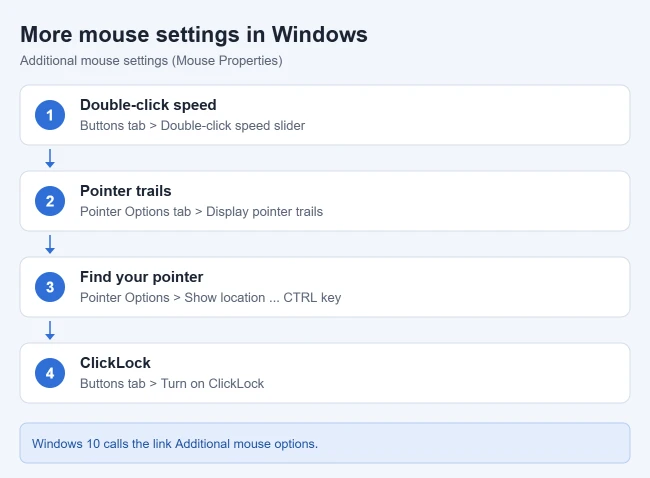
- On the Buttons tab, drag the Speed slider under Double-click speed.
- Select OK.
Windows recognizes a double-click at the speed you set. Slow it down if your double-clicks keep registering as two single clicks.
How to Add or Remove Mouse Pointer Trails
- Open Additional mouse settings as above.
- Open the Pointer Options tab.
- Under Visibility, check or uncheck Display pointer trails. Use the slider to make the trail shorter or longer.
- Select OK.
With trails on, the pointer leaves a short trail as it moves, which makes it easier to follow. On the same tab, Microsoft also lists Hide pointer while typing so the pointer doesn’t block text you’re typing.
Change Scrolling Settings
In Windows 11, scroll settings are on the main Bluetooth & devices > Mouse page under Scrolling:
- Roll the mouse wheel to scroll: choose Multiple lines at a time or One screen at a time.
- Lines to scroll at a time: set how far each notch of the wheel scrolls.
- Scroll inactive windows when hovering over them: scroll a window without clicking it first.
- Scrolling direction: choose Down motion scrolls down or Down motion scrolls up.
Windows 10 has the first three settings on its Devices > Mouse page. For horizontal scrolling, open Additional mouse settings, select the Wheel tab, and enter how many characters to scroll. Your mouse has to support horizontal scrolling for this to work.
If an Apple Magic Mouse moves and clicks but its touch surface does not scroll on Windows 11, see the Magic Mouse scrolling guide. It separates Bluetooth pairing from scrolling-driver support and explains compatibility and licensing before installation.
Other Mouse Settings
- Swap buttons: in Windows 11, use Primary mouse button on the Mouse page to choose Left or Right.
- Find your pointer: on the Pointer Options tab, check Show location of pointer when I press the CTRL key. Windows circles the pointer when you press Ctrl.
- ClickLock: on the Buttons tab, check Turn on ClickLock to highlight or drag items without holding down the mouse button.
- Snap To: on the Pointer Options tab, Snap To moves the pointer to the default button in dialog boxes. Some apps may not support it.
- Pointer size and style: go to Settings > Accessibility > Mouse pointer and touch in Windows 11.
- Mouse keys: to move the pointer with the numeric keypad, go to Settings > Accessibility > Mouse in Windows 11 and turn on Mouse keys. Microsoft’s Mouse keys guide explains the separate Mouse keys speed settings on that page.
Troubleshooting Pointer Speed
The speed changes back by itself. Mouse software from the manufacturer can apply its own profile when Windows starts or when a certain app opens. Open that app and set the speed or DPI there, or remove the per-app profile. Also check whether you bumped the DPI button on the mouse; many mice show the current level with a light.
The slider is grayed out or missing. On a work or school PC, your organization may manage mouse settings, and only its IT team can change them. On Windows 10, an older build may not show Cursor speed in Settings; use main.cpl instead.
The pointer jumps, stutters, or drifts. That’s usually not a speed problem. Try a different USB port, move a wireless receiver closer to the mouse, replace weak batteries, and use the mouse on a mat or a non-glossy surface. If it continues, open Device Manager, expand Mice and other pointing devices, right-click your mouse, and select Update driver.
The pointer feels different on each monitor. Screens with different scale settings, such as 100% on one and 150% on another, can make the same movement feel faster or slower. The article on changing screen resolution and scale in Windows shows where those settings are.
The pointer is gone entirely. On a laptop, there are a few ways to get your cursor back in Windows 11.
How to Reset Mouse Speed to the Default
Windows has no reset button for pointer speed. Open main.cpl, select the Pointer Options tab, move the Select a pointer speed slider to the middle mark, and select OK. That’s the default value of 10. If you also changed Enhance pointer precision, put it back the way it was. If you changed DPI in the mouse maker’s app, restore that profile too.
Frequently Asked Questions
Why can’t I find Mouse pointer speed in Windows 10?
Windows 10 calls it Cursor speed, and it’s under Settings > Devices > Mouse rather than Bluetooth & devices. If it isn’t there, use the slider on the Pointer Options tab in main.cpl.
Does this change touchpad speed too?
No. Touchpads have their own page at Settings > Bluetooth & devices > Touchpad in Windows 11 (Settings > Devices > Touchpad in Windows 10), with a separate cursor speed slider and scrolling direction setting. One common change there is to stop right-clicking when you tap the touchpad with two fingers.
Why does my pointer still feel too fast or slow?
Try turning Enhance pointer precision on or off, then adjust the speed slider again. Some mice also have their own speed buttons or software from the manufacturer.
Does the Windows speed setting affect games?
Often only in menus and on the desktop. Many games read the mouse directly during play, so use the sensitivity setting inside the game, along with your mouse’s DPI.
Do I need to restart after changing pointer speed?
No. The new speed applies as soon as you release the slider or select Apply, and it stays the same after a restart.
More Windows Guides
You can also change your mouse cursor in Windows 11 to make the pointer bigger or a different color.

Matthew Burleigh is the founder, head writer, and editor of Solve Your Tech, which he launched in 2012. He has written technology tutorials since 2008 and worked in IT since 2003, including small-business support, IT management, and consulting. He holds Bachelor’s and Master’s degrees in Computer Science from Arizona State University.
Matthew writes practical guides for Windows, iPhone and iPad, Microsoft Office, Outlook, Google apps, and Android. Solve Your Tech’s guides are checked step by step against the device or app maker’s own documentation and tested on his own devices whenever he has the hardware or software, with clear steps, sources, and update dates.
Read more about Matthew and how Solve Your Tech writes and updates its guides, or report a correction.