To change how long your iPhone waits before the screen locks, open Settings > Display & Brightness > Auto-Lock and tap a time. You can pick 30 seconds, 1 to 5 minutes, or Never.
These steps are written for iOS 27, the current version in October 2026, and match iOS 26 and earlier versions, because Auto-Lock has stayed in the same place for years. Auto-Lock is Apple’s name for the screen timeout, so “screen timeout,” “lock screen time,” and “Auto-Lock” all mean the same setting.
How to Change the Auto-Lock Time on iPhone
- Unlock your iPhone and open the Settings app.
- Scroll down and tap Display & Brightness. You’ll see brightness, appearance, and text options at the top of this screen.
- Tap Auto-Lock. The row shows the time you’re using now, such as 30 Seconds.
- Tap the time you want: 30 Seconds, 1 Minute, 2 Minutes, 3 Minutes, 4 Minutes, 5 Minutes, or Never. A checkmark moves to your choice.
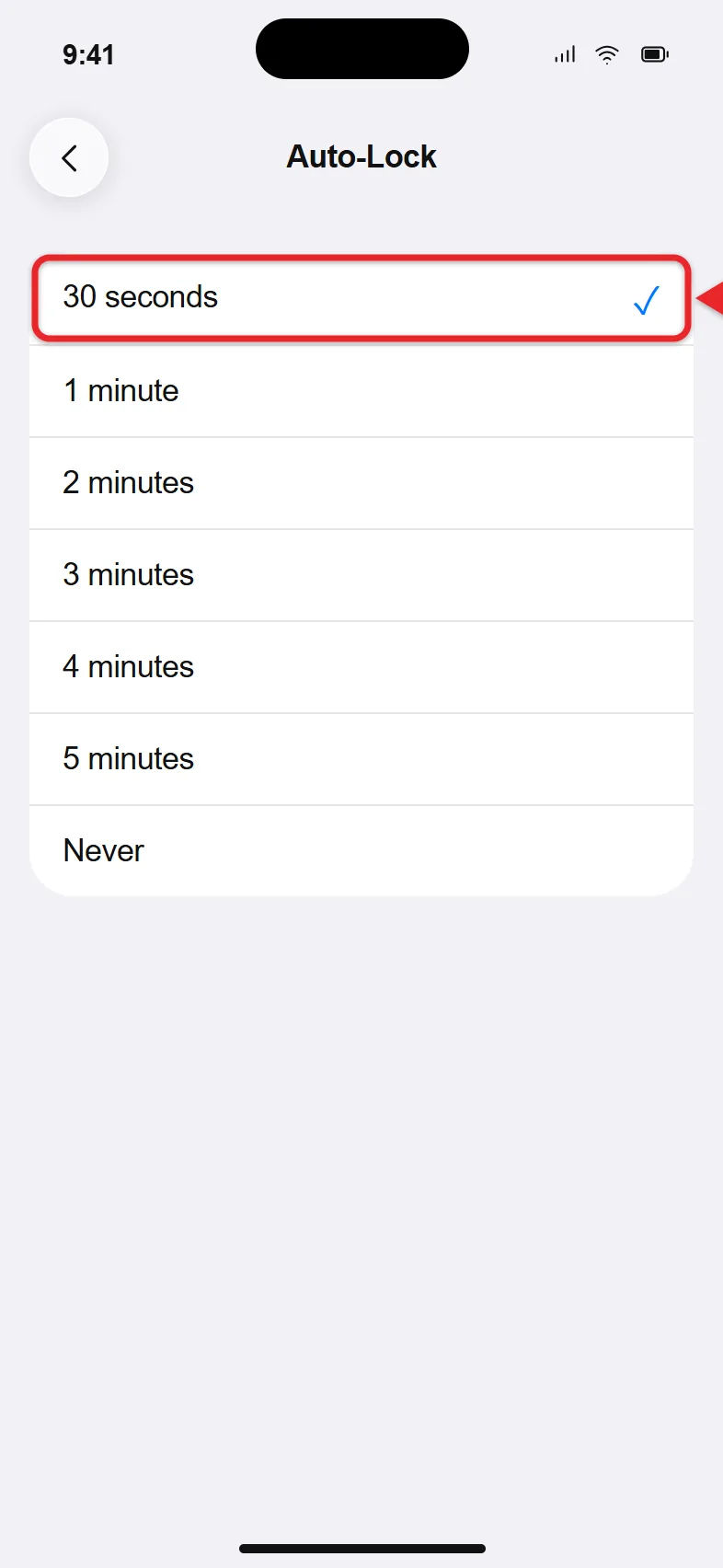
- Tap Back or swipe up to go to the Home Screen. There’s no Save button; the new time applies right away.
To check that it worked, set your iPhone down without touching it. The screen should dim a few seconds before your chosen time runs out, then turn off and lock. You can still lock the iPhone at any time by pressing the side button once, as Apple explains in its wake, unlock, and lock guide.
To undo the change, go back to Auto-Lock and pick your old time. The default on a new iPhone is 30 seconds.
Which Auto-Lock Time Should You Choose?
| Setting | Good for | Trade-off |
|---|---|---|
| 30 Seconds | Best battery life and privacy | You’ll unlock the phone more often |
| 1 or 2 Minutes | Reading messages and short articles | Small extra battery use |
| 3 to 5 Minutes | Recipes, sheet music, workout instructions | More battery use; phone stays open longer if you walk away |
| Never | Short hands-free tasks you’ll end yourself | Highest battery use; anyone can use the phone until you lock it |
The longest timed option is 5 minutes. There’s no 10-minute or 15-minute choice, even though some websites mention one.
If you choose Never, the screen stays on until you press the side button. Keeping the display on longer can use more power, and an unlocked phone left on a table gives anyone access to your messages, photos, and apps. Many people pick 3 or 5 minutes for kitchen or hobby use and save Never for the few minutes they really need it.
Why Auto-Lock Is Grayed Out or Your iPhone Locks Too Soon
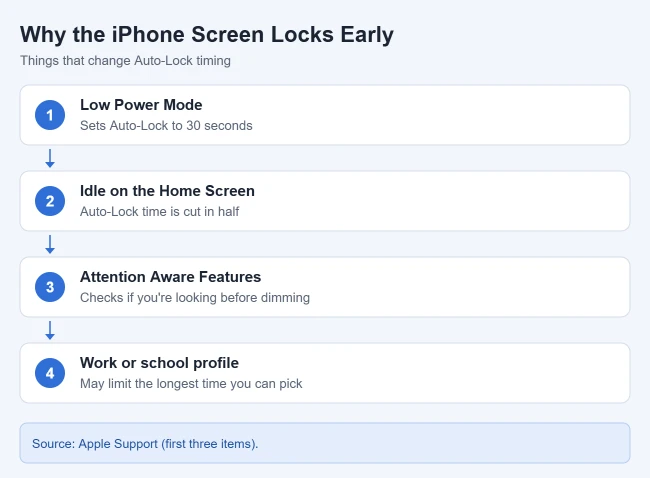
Low Power Mode Is On
Apple’s Low Power Mode article lists “Sets Auto-Lock to 30 seconds” among the changes Low Power Mode makes. While it’s on, the Auto-Lock row is grayed out and the battery icon in the status bar is yellow. To turn it off:
- Open Settings and tap Battery.
- On iPhone 15 or later, tap Power Mode. On iPhone 14 or earlier, skip this step.
- Turn off Low Power Mode.
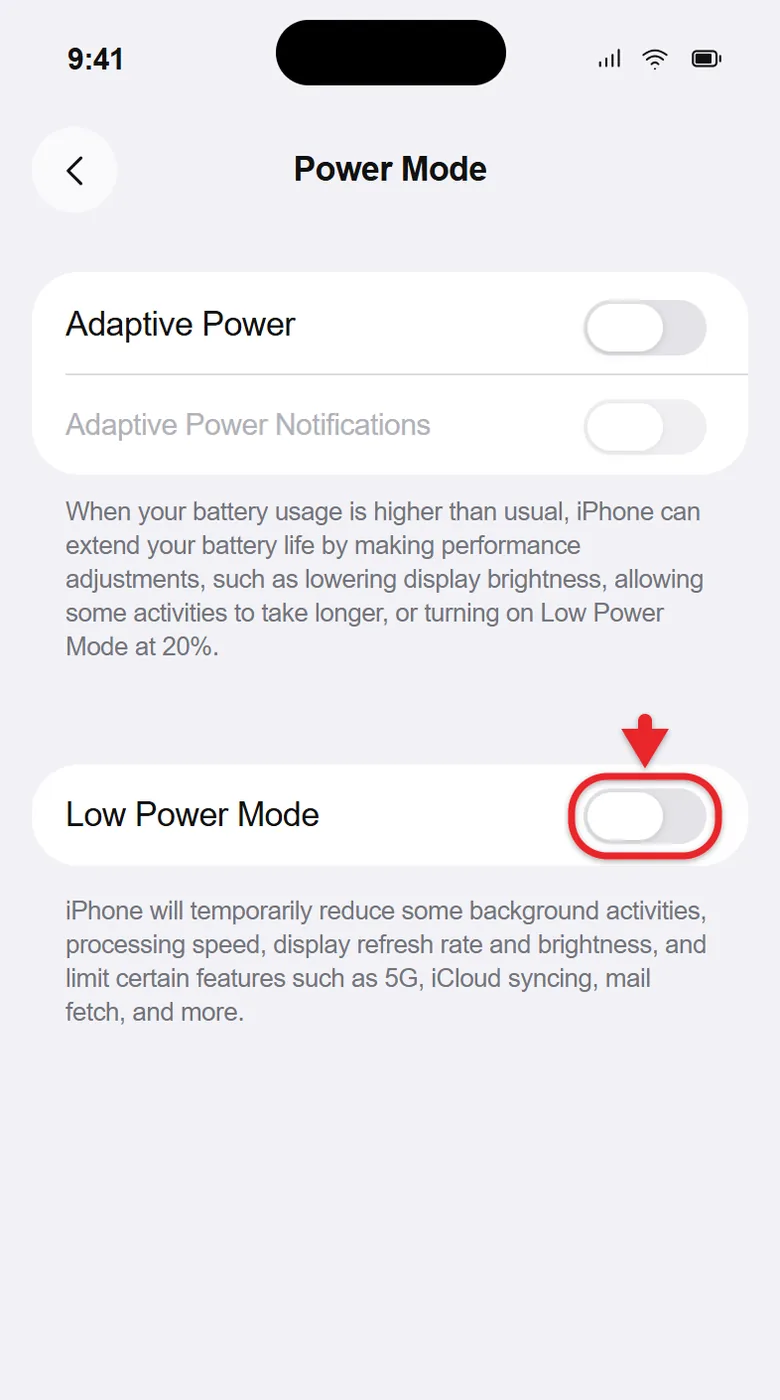
You can also tap the battery button in Control Center. Low Power Mode turns off by itself when the battery charges to 80% or higher. On iPhone models that support Adaptive Power, Low Power Mode can switch on automatically when the battery drops below 20%, which explains why Auto-Lock sometimes goes back to 30 seconds without you touching it. Turning Low Power Mode on or off also covers the Adaptive Power switch.
You’re on the Home Screen
If you leave your iPhone on the Home Screen and don’t do anything, the Auto-Lock time is cut in half. A 4-minute setting locks after about 2 minutes on the Home Screen, but waits the full 4 minutes inside an app.
A Work or School Profile Controls the Setting
If your iPhone is managed by an employer or school, a device management profile can limit which Auto-Lock times you can choose. To see whether one is installed, go to Settings > General > VPN & Device Management. Only the organization’s IT team can change those limits.
The Screen Dims While You’re Reading
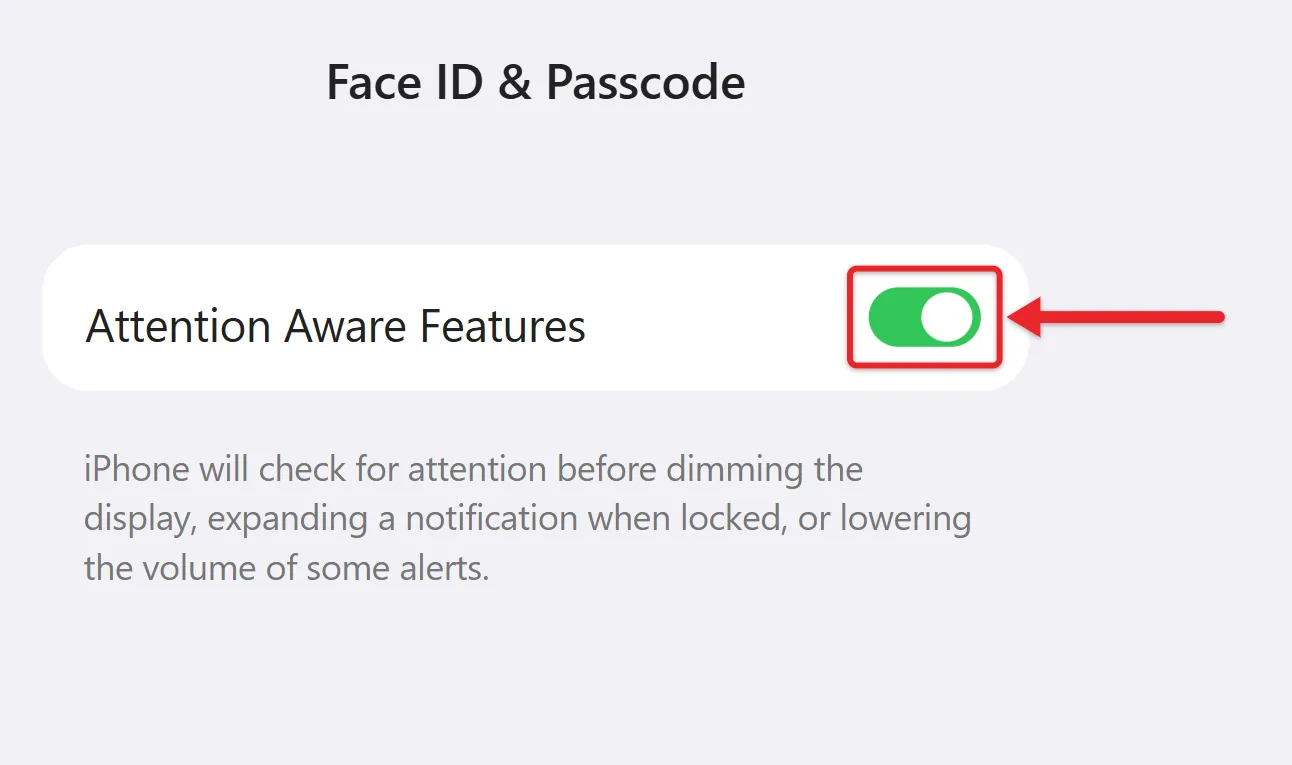
On iPhones with Face ID, Attention Aware Features checks whether you’re looking at the screen before it dims. Apple’s Face ID article puts the switch in Settings > Face ID & Passcode, and it also appears under Settings > Accessibility > Face ID & Attention. With it on, the screen stays bright while you look at it. If you look away, it can dim sooner. A case, sticker, or screen protector that covers the TrueDepth camera at the top of the screen can stop it from seeing you.
If the screen gets darker well before the Auto-Lock timer runs out, see why your iPhone keeps dimming.
It Still Won’t Change
- Restart the iPhone and check the setting again.
- Install any waiting update in Settings > General > Software Update.
- As a last resort, go to Settings > General > Transfer or Reset iPhone > Reset > Reset All Settings. This keeps your photos and apps but resets every setting, including saved Wi-Fi passwords, so you’ll need to set those up again.
Ways to Keep the Screen On Without Changing Auto-Lock
- Apps that stay awake on their own. Video players and navigation apps usually keep the screen on while they’re playing or guiding you, whatever your Auto-Lock time is.
- Guided Access. This accessibility feature locks the iPhone to one app and has its own Display Auto-Lock option, so you can keep a recipe app awake without changing the setting for the whole phone. Turn it on in Settings > Accessibility > Guided Access, then triple-click the side button inside the app, as described in Apple’s Guided Access article. For every session option, read locking an iPhone to one app with Guided Access.
- Always On Display. On iPhone models that support it, this setting in Settings > Display & Brightness shows a dimmed Lock Screen with the time, widgets, and notifications after the phone locks. The iPhone is still locked, so it’s for glancing, not using.
- StandBy. When the iPhone is charging on its side, StandBy can show a full-screen clock, photos, or widgets. Find it in Settings > StandBy.
Frequently Asked Questions
Is Auto-Lock the same as when my passcode is required?
No. Auto-Lock decides when the screen turns off and locks. After that, unlocking needs Face ID, Touch ID, or your passcode. Apple also always asks for the passcode in some cases, such as after a restart or when the iPhone hasn’t been unlocked for more than 48 hours.
Can I set a different timeout for one app?
Not in Auto-Lock itself, which applies to the whole iPhone. Guided Access is the built-in way to give one app its own screen timeout.
Does a longer Auto-Lock time drain the battery?
Yes. The display is one of the biggest power users, so every extra minute it stays lit uses more battery. A shorter time saves the most.
Can I change Auto-Lock on an iPad the same way?
Yes. The path is the same on iPad: Settings > Display & Brightness > Auto-Lock. Making an iPad wait longer before it locks lists the iPad options.
If you mostly want the screen to stay bright rather than stay on, check Auto-Brightness and True Tone next.

Matthew Burleigh is the founder, head writer, and editor of Solve Your Tech, which he launched in 2012. He has written technology tutorials since 2008 and worked in IT since 2003, including small-business support, IT management, and consulting. He holds Bachelor’s and Master’s degrees in Computer Science from Arizona State University.
Matthew writes practical guides for Windows, iPhone and iPad, Microsoft Office, Outlook, Google apps, and Android. Solve Your Tech’s guides are checked step by step against the device or app maker’s own documentation and tested on his own devices whenever he has the hardware or software, with clear steps, sources, and update dates.
Read more about Matthew and how Solve Your Tech writes and updates its guides, or report a correction.