To get updates for other Microsoft products when you update Windows 11, open Start > Settings > Windows Update > Advanced options and turn on Receive updates for other Microsoft products. Then go back to Windows Update and select Check for updates.
These steps cover Windows 11 (including version 25H2) and Windows 10 version 22H2. The switch adds eligible Microsoft software, such as MSI-based Office 2016, Visual Studio, SQL Server, and .NET, to Windows Update. It is not a master updater for every Microsoft app on your PC.
Before you start
- Use an administrator account. Update settings apply to the whole PC, so a standard account may not be able to change them.
- Connect to the internet. If the connection is set as metered, Windows may hold back some downloads until you allow updates over metered connections in Advanced options.
- Save your work. Some product updates finish only after a restart.
Turn on updates for other Microsoft products in Windows 11
- Select Start, then Settings. You can also press Windows key + I.
- Select Windows Update in the left pane. The page shows your update status and a Check for updates button.
- Select Advanced options. The first setting on this page is Receive updates for other Microsoft products.
- Turn on the Receive updates for other Microsoft products switch. It changes to On right away; there is no Save button and no restart is needed for the setting itself.
- Go back to Windows Update and select Check for updates. Windows now searches for Windows updates and for updates to eligible Microsoft software.
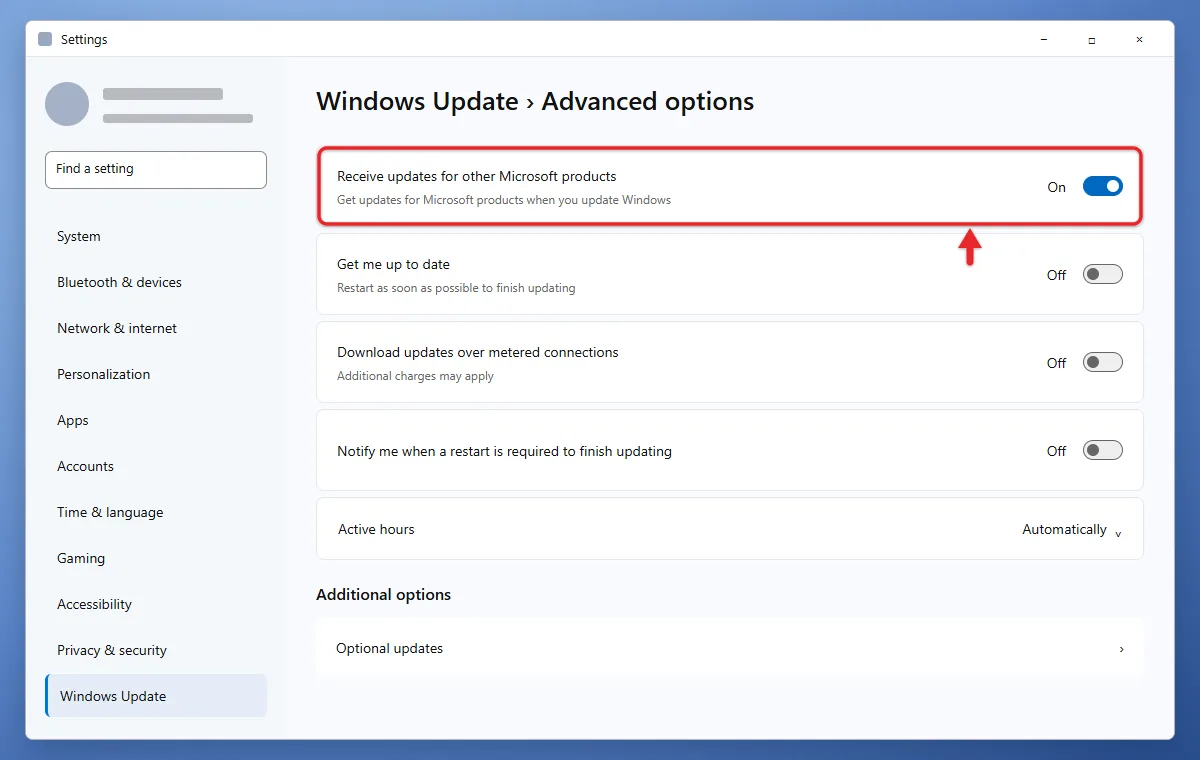
- Let the updates download and install. If Windows shows Restart now or Schedule the restart, save your work and pick the option that suits you.
If the switch is already on, nothing more is needed. Windows keeps checking for these updates on its normal schedule.
Don’t confuse this switch with Get the latest updates as soon as they’re available, which sits on the main Windows Update page. That one gets you early non-security Windows updates and features. It does not add Office or other Microsoft software.
Windows 10: the older path
Windows 10 has the same feature with a longer name.
- Select Start > Settings > Update & Security.
- Select Windows Update, then Advanced options.
- Turn on Receive updates for other Microsoft products when you update Windows.
- Go back to Windows Update and select Check for updates.
Microsoft ended support for Windows 10 on October 14, 2025. A Windows 10 version 22H2 PC enrolled in the consumer Extended Security Updates program gets security updates through October 12, 2027. If your PC can run Windows 11, see how to update to Windows 11 from Windows 10.
Confirm that it worked
- Check the switch. Reopen Settings > Windows Update > Advanced options and confirm Receive updates for other Microsoft products is still On.
- Check the history. Open Settings > Windows Update > Update history. Updates for other Microsoft products are listed by name and KB number, next to your Windows updates.
- Check the app. For Office, open Word or Excel, select File > Account, and look at the version under Product Information.
If Windows Update says You’re up to date, there may be nothing new for your installed products. That is normal.
PowerShell 7 is one example: an MSI install that opted into Microsoft Update can get new releases this way, as covered in our guide on how to update PowerShell on Windows 11.
What the switch covers, and what it doesn’t
Microsoft’s list of products updated through this option is mostly business and developer software. Microsoft also notes that the policy behind the switch includes drivers. Here is how common Microsoft software gets its updates on a home PC:
| Product | How it updates |
|---|---|
| Office 2016 (MSI) and volume license Office | Windows Update, with this switch on |
| Visual Studio, SQL Server, .NET | Windows Update, with this switch on |
| Microsoft Defender security intelligence | Windows Update |
| Microsoft 365 apps and Office 2019 or later (Click-to-Run) | Inside Office: File > Account > Update Options |
| Microsoft Store apps | The Microsoft Store |
| Microsoft Edge | Edge’s own updater |
| PowerShell 7 | Depends on how you installed it (MSI with Microsoft Update opt-in, WinGet, or the Store) |
Most home users have Microsoft 365 or a recent Office version, which updates itself. Turning on the switch is still worth doing because it costs nothing and catches products such as .NET runtimes that you may not know are installed.
Update Microsoft 365 or Office from inside the app
- Open Word, Excel, or another Office app.
- Select File > Account. In classic Outlook, select Office Account.
- Under Product Information, select Update Options > Update Now. If you see only Enable Updates, select it first, then Update Now.
- Wait for the You’re up to date! or Updates were installed message, then close it.
If you see only an About button and no Update Options, you probably have a volume license copy or your organization manages Office updates. In that case Windows Update with the switch on, or your IT department, delivers the updates. Microsoft’s Install Office updates page covers these cases.
Update Microsoft Store apps
Open the Microsoft Store, select Downloads (called Library in older versions of the Store), and select Get updates. Store apps such as Photos, Paint, and Clipchamp update here, not through Windows Update.
If the switch is grayed out or keeps turning off
- “Some of these settings are managed by your organization.” A work or school PC uses Group Policy, Intune, or WSUS to control updates. Ask your IT administrator; local changes are overwritten.
- Personal PC with a managed message. An old registry tweak or a third-party “privacy” or update-blocking tool may have set an update policy. Undo the change in that tool, restart, then check again.
- The switch turns itself off after a restart. A local policy is probably overriding it. On Windows 11 Pro, open the Local Group Policy Editor (
gpedit.msc) and check the Configure Automatic Updates policy described in the next section. - Updates fail to install. Open Update history, note the KB number and error code, and restart before trying again. Don’t download an updater from an unofficial site.
For administrators and power users
Microsoft documents two policy routes for managed PCs:
- Group Policy: Computer Configuration > Administrative Templates > Windows Components > Windows Update > Manage end user experience > Configure Automatic Updates, then select Install updates for other Microsoft products.
- MDM (Intune): the Update/AllowMUUpdateService policy.
To turn the option on from an administrator PowerShell window, Microsoft’s Windows Update Agent opt-in sample registers the Microsoft Update service with this command:
(New-Object -ComObject Microsoft.Update.ServiceManager).AddService2("7971f918-a847-4430-9279-4a52d1efe18d",7,"")
Microsoft says the sample script itself is unsupported, though the underlying API is supported. For a single home PC, the Settings switch is the simpler choice. To exclude drivers while keeping product updates, Microsoft points to the separate ExcludeWUDriversInQualityUpdate policy.
How to turn it off
Go to Settings > Windows Update > Advanced options and turn off Receive updates for other Microsoft products. Windows then offers only Windows updates. Products that have their own updaters, such as Microsoft 365 and Edge, keep updating themselves.
Frequently Asked Questions
Is it safe to turn this on?
Yes. The updates come from Microsoft’s own update service, the same one that delivers Windows updates. They include security fixes for software already on your PC.
Will this install a new copy of Office?
No. The switch only offers updates for Microsoft products that are already installed. It does not buy, install, or activate Office.
Do I have to restart?
Changing the switch doesn’t need a restart. Some of the updates it brings in do. Save your work, restart when asked, then open Windows Update again to confirm nothing is still pending.
Why don’t I see any Office updates in Windows Update?
Most current Office installations are Click-to-Run and update through File > Account > Update Options instead. Windows Update offers Office updates mainly for MSI and volume license installations.
Does this update my drivers too?
Windows Update already offers drivers. Microsoft notes that the policy behind this option includes drivers; optional drivers still wait under Advanced options > Optional updates until you choose them.
For the rest of the Windows Update settings, including pausing and restart options, see how to update Windows 11.

Matthew Burleigh is the founder, head writer, and editor of Solve Your Tech, which he launched in 2012. He has written technology tutorials since 2008 and worked in IT since 2003, including small-business support, IT management, and consulting. He holds Bachelor’s and Master’s degrees in Computer Science from Arizona State University.
Matthew writes practical guides for Windows, iPhone and iPad, Microsoft Office, Outlook, Google apps, and Android. Solve Your Tech’s guides are checked step by step against the device or app maker’s own documentation and tested on his own devices whenever he has the hardware or software, with clear steps, sources, and update dates.
Read more about Matthew and how Solve Your Tech writes and updates its guides, or report a correction.