To see hidden folders in Windows 11, press Windows key + E, then choose View > Show > Hidden items in File Explorer. To stop hiding a particular personal folder, open its Properties and clear Hidden. These are different actions: the first changes what Explorer displays; the second changes the folder itself.
Use this guide for the standard Windows 11 File Explorer. You do not need a download or a registry edit. Start with the display setting if you only want to open a hidden folder, such as AppData.
Choose the Result You Need
- See hidden folders while keeping their attributes: use Hidden items. Turn it off afterward if you want to hide them from the normal view again.
- Make your own folder visible without Hidden items: clear that folder’s Hidden attribute. Work on the specific folder, not your entire user profile or drive.
- Find something missing: confirm its location first. Showing hidden items cannot restore a deleted folder or reconnect an unavailable drive.
Show Hidden Folders in File Explorer
- Open Explorer. Press Windows key + E and navigate to the folder or drive where you expect the missing folder. Our Windows 11 File Explorer guide explains the address bar and navigation pane.
- Open the display menu. Select View on the command bar, then Show. In Windows 11 this is a menu rather than the old Windows 10 ribbon tab.
- Enable Hidden items. Select Hidden items so it is checked. Hidden folders should appear, commonly with a faded icon, if they are in this location and you can access them.
- Open the folder you need. Double-click it. To hide items from the ordinary display again, return to the same menu and clear Hidden items.
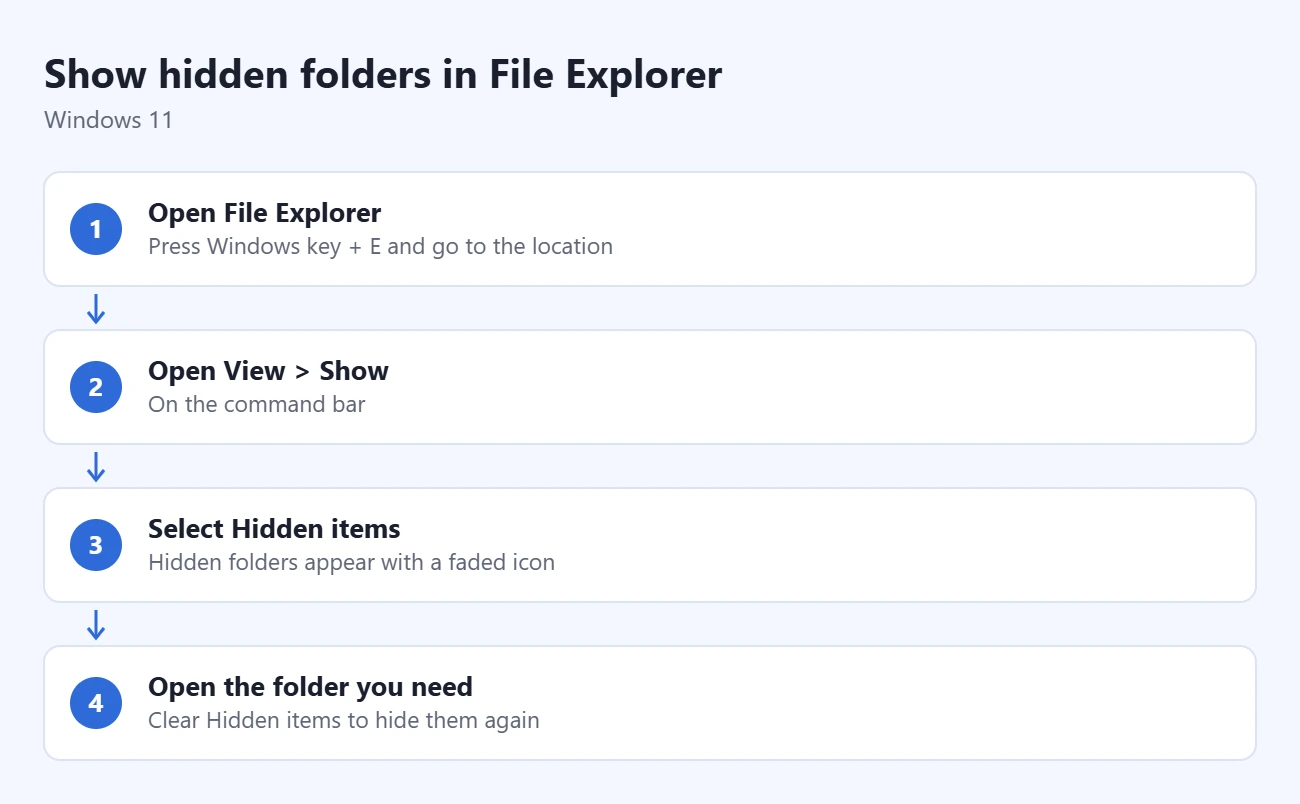 Show, select Hidden items, open the folder you need” class=”wp-image-162749″ style=”width:650px;height:auto”/>
Microsoft documents this route in its File Explorer help. Navigating to another folder does not normally require enabling it again. The setting does not give you new permissions and does not change a folder’s Hidden attribute.
Remove the Hidden Attribute from One Personal Folder
Use this only for a personal folder you recognize. Leave Windows-managed folders such as AppData hidden if you merely need to access their contents. Do not apply changes to a whole drive, Windows folder, or user profile as a shortcut.
- Make the folder visible first. Enable Hidden items as above, then select the exact personal folder. Confirm its name and location before changing it.
- Open Properties. Right-click the folder and choose Properties. If the shortened menu does not show it, choose Show more options and look there.
- Change only Hidden. On the General tab, clear the Hidden checkbox. Leave unrelated attributes and security settings alone, then select Apply.
- Choose the narrow scope. If Windows asks, select Apply changes to this folder only to leave the contents’ attributes unchanged. Use the subfolders-and-files option only when you intentionally want to change all those items too. Select OK to finish.
- Check the result. Turn Hidden items off and return to the parent folder. The personal folder should remain visible. To undo this change, return to Properties, check Hidden, and apply it to the same scope.
Microsoft defines the Hidden file attribute as metadata used to omit an item from an ordinary listing. A folder that you unhide can still contain independently hidden files; unhiding the parent alone does not change those files.
Use Command Prompt for a Known Folder
The command below targets one personal folder. Replace the example path with its actual full path and keep the quotation marks around paths containing spaces. Do not substitute the root of a drive or add wildcard/recursive options to troubleshoot a single folder.
- Open Start, type Command Prompt, and open it normally. Administrator access is not a routine prerequisite for a folder you own.
- Inspect the folder with
attrib "C:\Users\YourName\Documents\Private Notes". The output lists its attributes; H means Hidden. Check that the reported path is the intended folder. - Run
attrib -h "C:\Users\YourName\Documents\Private Notes". Successful completion normally returns to the prompt without a message. - Run the first command again. The H should be gone; refresh the parent folder in Explorer to check visibility. To undo it, use
attrib +hfollowed by the same quoted path.
Microsoft’s attrib reference documents -h, +h, and the difference between a specified path and recursive options. If the output has S, or changing it fails, do not blindly clear System or modify permissions. Confirm why the folder is protected before proceeding.
If the Folder Still Does Not Appear
- Check the location: open the parent folder directly using the address bar. Home, a search result, and the real parent folder can show different sets of items.
- Check the setting: reopen View > Show and confirm Hidden items is checked. If a folder was already hidden inside another hidden folder, navigate into the parent first.
- Check availability: reconnect the expected external drive or network location, or check the correct cloud account. A missing connection is different from the Hidden attribute.
- Respect access errors: Access denied or a disabled attribute control can indicate permissions, a protected location, or management rules. Ask the owner or administrator rather than taking ownership of a system folder.
- Consider deletion: check the Recycle Bin and your backups if the folder is no longer present. Do not run broad attribute commands hoping they will recover deleted data.
Frequently Asked Questions
Why is the folder icon faded?
Explorer often draws hidden items with faded icons when it is showing them. Check Properties or attrib before assuming the folder is damaged. A visibility change alone is not a repair for corrupted files.
Should I show protected operating system files?
Keep that separate protection enabled for this task. Hidden items is enough for ordinary hidden personal folders. If a vendor’s specific repair instructions require protected files, follow that procedure’s scope rather than exposing or changing everything.
Does hiding a folder protect private information?
The Hidden attribute is not a password or encryption. Someone who can access the folder can enable Hidden items or use its path. Use appropriate account permissions or encryption for privacy.
Can I show several hidden folders at once?
Yes. Hidden items changes Explorer’s display of hidden items, so you can browse them without changing each folder. Removing attributes from many folders is a different, broader change; use the single-folder method unless you have a specific reason to expand it.
Start by showing Hidden items. If your own folder needs to stay visible afterward, change only that folder’s Hidden attribute and verify the result with Hidden items turned off.

Matthew Burleigh has been writing tech tutorials since 2008. His writing has appeared on dozens of different websites and been read hundreds of millions of times.
After receiving his Bachelor’s and Master’s degrees in Computer Science he spent several years working in IT management for small businesses. However, he now works full time writing content online and creating websites.
His main writing topics include iPhones, Microsoft Office, Google Apps, Android, and Photoshop, but he has also written about many other tech topics as well.