“SOS” on an iPhone means two different things. To stop accidental emergency calls, open Settings > Emergency SOS and turn off Call with Hold and Release and Call with 5 Button Presses. If “SOS” shows in the top corner of your screen, your iPhone has lost its connection to your carrier, and you fix it by reconnecting, not by changing a setting.
These steps cover iPhones running iOS 16 or later, including iOS 27, plus a section for Apple Watch. Labels match Apple’s current iPhone User Guide.
Which SOS Are You Seeing?
| What you see | What it means | What to do |
|---|---|---|
| A countdown and siren after you hold or press the side button | Emergency SOS started from a button shortcut | Turn off the shortcuts below |
| “SOS” or “SOS only” next to the battery or signal icon | No connection to your carrier; emergency calls only | Reconnect using the status bar steps below |
| A loud alarm after a hard stop in a car | Crash Detection (iPhone 14 or later) | Turn off Call After Severe Crash, if you choose |
| A government alert banner with a loud tone | Emergency or public safety alert | Change Government Alerts in Notifications |
How to Turn Off the Emergency SOS Shortcuts
Emergency SOS is the feature that calls emergency services when you hold or press the side button. It’s on by default. These steps follow Apple’s Emergency SOS guide.
- Open the Settings app.
- Scroll down and tap Emergency SOS. If you don’t see it, swipe down on the Settings screen and type “SOS” in the search field.
- Turn off Call with Hold and Release. The switch turns gray. Holding the side button and a volume button no longer starts a countdown to call.
- Turn off Call with 5 Button Presses. The switch turns gray. Pressing the side button five times quickly no longer starts a countdown.
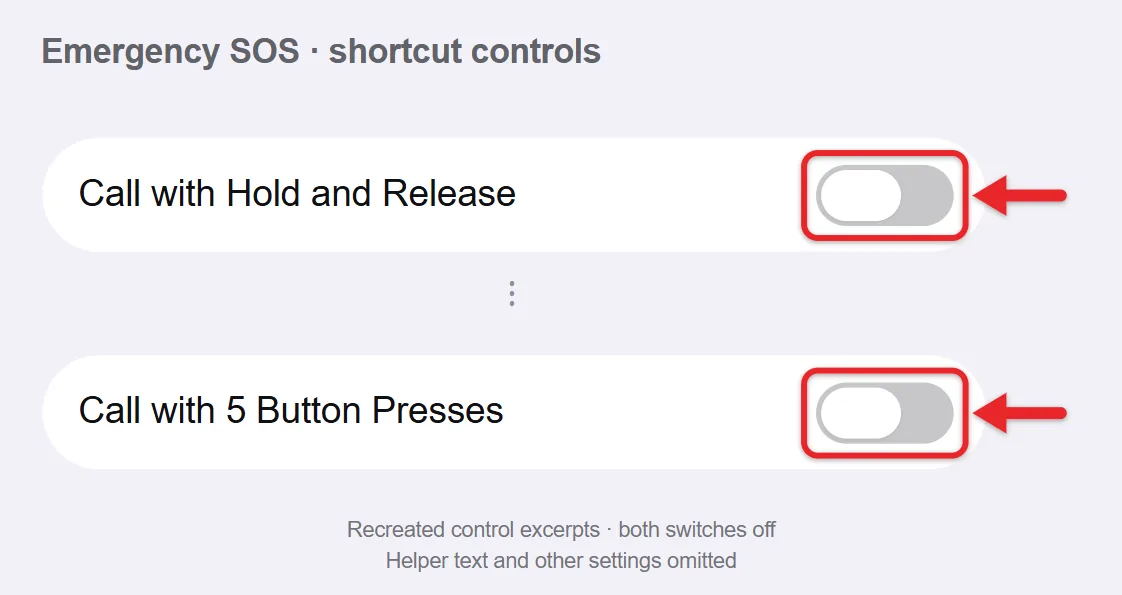
- Leave the Settings app. There’s no Save button; the change applies right away.
When both switches are off, you can still call for help on purpose:
- Hold the side button and either volume button until the sliders appear, then drag the Emergency Call slider.
- On the Passcode screen, tap Emergency and dial the number, such as 911 in the U.S.
- Open the Phone app and dial 911, or ask Siri to call 911.
What Each Emergency SOS Setting Does
| Setting | What it controls | Good reason to turn it off |
|---|---|---|
| Call with Hold and Release | Holding the side button and a volume button starts a countdown, then calls when you let go | Calls start when you shut down the phone or squeeze it in a pocket |
| Call with 5 Button Presses | Five fast presses of the side button start a countdown | A child or a tight case keeps pressing the button |
| Call After Severe Crash | Crash Detection on iPhone 14 or later | Frequent false alerts during rides or rough sports |
| Emergency Contacts | Who gets a text after an emergency call | Not a shortcut; edit it in the Health app |
If you only get accidental calls when you shut down your iPhone, turning off Call with Hold and Release is usually enough. You can leave Call with 5 Button Presses on as a deliberate backup.
In India the shortcut works differently: pressing the side button three times quickly starts Emergency SOS. If Accessibility Shortcut is turned on there, you hold the side button and a volume button instead.
How to Turn Off Crash Detection
Apple’s Crash Detection page says the feature is on by default on every iPhone 14 or later with iOS 16 or later. After a severe crash, your iPhone sounds an alarm and shows an alert for 10 seconds. If you don’t respond, a 30-second countdown runs, and then the phone calls emergency services.
- Open Settings.
- Tap Emergency SOS.
- Turn off Call After Severe Crash.
- Tap Turn Off if your iPhone asks you to confirm.
Turning Crash Detection off on one device turns it off on your paired Apple Watch too. Leave it on if you drive often; it can call for help when you can’t.
How to Stop Accidental SOS Calls on Apple Watch
An Apple Watch has its own Emergency SOS setting, and calls from the watch can go through your iPhone. Turning off the iPhone shortcuts doesn’t change the watch.
- Open the Watch app on your iPhone.
- Tap the My Watch tab.
- Tap Emergency SOS.
- Turn off Hold Side Button to Dial.
You can also do this on the watch itself in Settings > SOS > Hold Side Button. Per Apple’s emergency call guide, the Emergency Call slider still works after you turn it off. The same Emergency SOS screen in the Watch app also has Fall Detection and Call After Severe Crash.
If You Start an Emergency Call by Accident
- During the countdown: let go of the buttons before the countdown ends. With Call with Hold and Release, the call starts only after the countdown finishes and you release.
- If the call connects: don’t hang up. Wait for the dispatcher, say it was an accident, and confirm you don’t need help. A hang-up can lead to a callback or a check on your location.
- After the call: your iPhone offers to text your emergency contacts. You can cancel that message if no one needs to know.
What Happens After an Emergency SOS Call
After an emergency call ends, your iPhone texts your emergency contacts unless you cancel. It shares your current location if available, and for a while after you enter SOS mode, your contacts get updates when your location changes.
To change who gets that text, open the Health app, tap your profile picture, tap Medical ID, tap Edit, and scroll to Emergency Contacts. You can’t add emergency services as a contact. In the U.S., if you choose to share your Medical ID, your iPhone can also send your medical details to emergency services during a 911 call.
How to Get Rid of “SOS” in the Status Bar
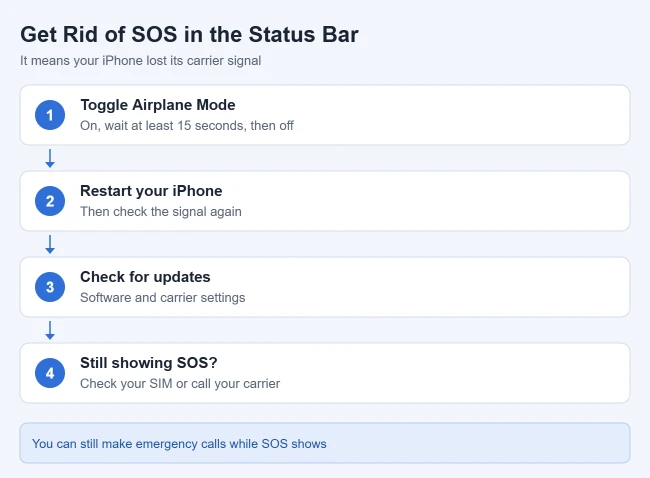
“SOS” or “SOS only” means your iPhone isn’t connected to your carrier, but it can still make emergency calls through other networks. That label appears in Australia, Canada, and the United States; elsewhere you’ll see “No Service” or “Searching.” No setting hides it. It goes away when your phone reconnects. Try these in order:
- Open Settings, turn on Airplane Mode, wait at least 15 seconds, and turn it off. Bars and your carrier name should return.
- Restart your iPhone. Button combinations differ by model, so check how to turn off or force restart your iPhone if you’re not sure.
- Install updates: go to Settings > General > Software Update.
- Check for a carrier settings update: connect to Wi-Fi, then go to Settings > General > About. If an update is ready, you’ll see a prompt to install it.
- If you have more than one line, go to Settings > Cellular, tap the line, and make sure it’s on. If it’s off, tap Turn On This Line.
- If you’re traveling abroad, go to Settings > Cellular > Cellular Data Options and turn on Data Roaming. Check your carrier’s roaming rates first.
- If you use a physical SIM card, remove it and put it back. Ask your carrier for a new one if it’s damaged.
- Contact your carrier. Ask them to confirm your account is active, there’s no outage in your area, and your phone isn’t blocked from the network.
If none of that works, resetting network settings is the next step, but it erases saved Wi-Fi passwords, VPN settings, and Bluetooth pairings. For what it removes and how to do it, read about resetting network settings on iPhone. On iOS 18 or later, the Apple Support app can also run extra checks on your connection.
Manage Government Emergency Alerts Separately
Government alerts are separate from Emergency SOS and the SOS status message. Open Settings > Notifications, scroll to the bottom, and under Government Alerts turn off Emergency Alerts or any other alert type you don’t want. Apple’s government alert guide says alerts are on by default, the choices depend on your region and carrier, and some national alerts can’t be turned off. Keep safety alerts on when you can, since they warn you about nearby danger.
Troubleshooting
Emergency SOS isn’t in Settings
Use the search field at the top of Settings and type “Emergency SOS.” Make sure you’re in the main Settings app, not the Watch app, which has its own Emergency SOS screen for Apple Watch.
Call After Severe Crash doesn’t appear
Crash Detection only exists on iPhone 14 and later models. On older iPhones, the Emergency SOS screen shows only the button shortcuts and emergency contacts.
The sliders still appear when I hold the buttons
That’s expected. Holding the side button and a volume button always shows the power off, Medical ID, and Emergency Call sliders. With Call with Hold and Release off, no countdown starts. Release the buttons as soon as the sliders appear, then drag Power Off or tap Cancel.
Accidental calls keep happening
Check your Apple Watch setting too, since the watch can start a call on its own. A stiff or tight case can also press the side button in a pocket. Try a case with softer button covers.
How to Check It Worked or Turn It Back On
Open Settings > Emergency SOS and look at the switches. Gray means off; green means on. Don’t test the shortcut by pressing the buttons, since that can reach real dispatchers. To turn a shortcut back on, tap the same switch so it turns green.
Frequently Asked Questions
Will turning off the SOS shortcuts stop me from calling 911?
No. You can still dial 911 in the Phone app, tap Emergency on the Passcode screen, use the Emergency Call slider, or ask Siri.
Does turning off the shortcuts also turn off Crash Detection?
No. Crash Detection has its own switch, Call After Severe Crash, on the same Emergency SOS screen. Turn it off separately if you want to.
Why does my iPhone say SOS when my friend’s phone has signal?
The status bar label depends on your own carrier. Your carrier may have weak coverage or an outage where you are, or your line may need attention on their end.
Is SOS in the status bar the same as Emergency SOS via satellite?
No. Emergency SOS via satellite lets an iPhone 14 or later text emergency services when there’s no cellular or Wi-Fi coverage. The SOS label only means you’re off your carrier’s network.
How do I turn off emergency alerts?
Go to Settings > Notifications, scroll to Government Alerts, and turn Emergency Alerts off. Your region and carrier decide which alert types you can change.
If “SOS” in the status bar keeps coming back, work through how to get an iPhone out of SOS mode for SIM, eSIM, and travel fixes.

Matthew Burleigh is the founder, head writer, and editor of Solve Your Tech, which he launched in 2012. He has written technology tutorials since 2008 and worked in IT since 2003, including small-business support, IT management, and consulting. He holds Bachelor’s and Master’s degrees in Computer Science from Arizona State University.
Matthew writes practical guides for Windows, iPhone and iPad, Microsoft Office, Outlook, Google apps, and Android. Solve Your Tech’s guides are checked step by step against the device or app maker’s own documentation and tested on his own devices whenever he has the hardware or software, with clear steps, sources, and update dates.
Read more about Matthew and how Solve Your Tech writes and updates its guides, or report a correction.