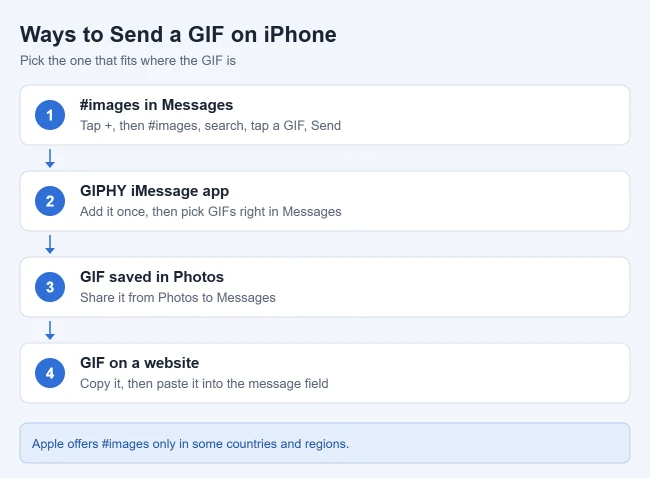
To send a GIF on an iPhone, open a conversation in Messages, tap the + button next to the text field, and choose #images. Search for a GIF, tap the one you want, add a comment if you like, and tap Send. If you don’t see #images right away, swipe up in the app list to see more.
This guide covers the built-in #images search, the GIPHY app, sending GIFs you’ve saved or found online, saving GIFs people send you, and what to do if #images is missing or a GIF arrives as a still picture.
How to Send a GIF in Messages
- Open Messages and open a conversation, or tap the compose button to start a new one.
- Tap the + button to the left of the text field. Expected result: a list of Messages apps appears, such as Camera, Photos, and Stickers.
- Swipe up if needed and tap #images. Expected result: a grid of trending GIFs opens.
- Browse, or tap Find images and type a word like “thank you” or “happy birthday.”
- Tap a GIF to add it to your message, type a comment if you want, then tap Send. Expected result: the GIF plays in the conversation.
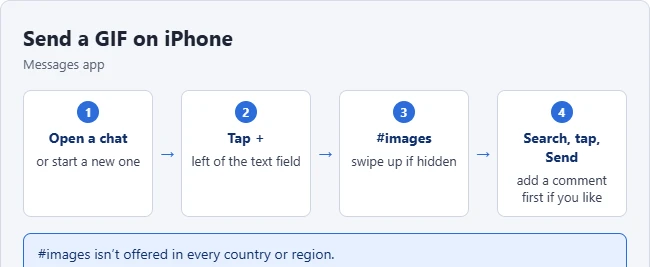
Apple describes #images as a built-in iMessage app for finding trending GIFs in its guide to iMessage apps. Its Send and save GIFs page says #images is available in the United States, United Kingdom, Canada, Australia, New Zealand, Ireland, France, Germany, Italy, India, Singapore, the Philippines, and Japan.
Specific search words work better than general ones: “dog high five” finds more useful results than “funny.”
Other Ways to Send a GIF
- GIPHY in Messages: GIPHY’s help page says to open the App Store inside Messages, get the GIPHY app, and then pick GIFs, stickers, or text right from the conversation. After the first time, GIPHY appears in the app list below the text field. See GIPHY’s iMessage guide.
- From the Photos app: GIFs you’ve saved appear in your library. Open one, tap the share button, and choose Messages.
- Copy and paste: copy a GIF from a website or app, then touch and hold in the Messages text field and tap Paste. If Paste doesn’t appear, see how to check your iPhone clipboard.
- Keyboard apps: keyboards such as Gboard include a GIF search you can use in any app after you add the keyboard in Settings.
- Other chat apps: WhatsApp, Instagram, and Messenger have their own GIF buttons inside each conversation.
How to Save a GIF Someone Sent You
- Open the conversation with the GIF.
- Touch and hold the GIF, then tap Save. Expected result: Apple says the GIF is saved to the Photos app, where you can send it again later.
If #images Is Missing or GIFs Don’t Work
- Swipe up in the app list after tapping +. #images may be further down, or under More.
- Check your language and region. Apple says to make sure your keyboard is set to a supported language and region in Settings > General > Language & Region, since #images is offered only in the countries listed above.
- Update your iPhone in Settings > General > Software Update, then close and reopen Messages or restart the iPhone.
- Use another method. If #images isn’t offered where you live, GIPHY, Photos, or copy and paste still work.
The GIF arrives as a still picture
GIFs animate most reliably between iPhones over iMessage (blue bubbles). When a message goes as SMS or MMS (green bubbles), the carrier or the other person’s app may show only a still frame, and very large GIFs may be compressed. Try a smaller GIF, or check that iMessage is turned on.
Frequently Asked Questions
Can I save a GIF someone sent me?
Yes. Touch and hold the GIF in the conversation and tap Save. Saved GIFs go to your Photos library.
Can I send GIFs to Android phones?
Yes, but they go as MMS, so whether they animate depends on the recipient’s phone, messaging app, and carrier.
What if I see an inappropriate GIF in #images?
Apple’s Send and save GIFs page explains how to report an image from #images.
To hide when you’ve read a message, see how to turn off read receipts. To clean up pictures and GIFs you no longer want in a chat, see how to delete pictures from text messages on iPhone.

Matthew Burleigh is the founder, head writer, and editor of Solve Your Tech, which he launched in 2012. He has written technology tutorials since 2008 and worked in IT since 2003, including small-business support, IT management, and consulting. He holds Bachelor’s and Master’s degrees in Computer Science from Arizona State University.
Matthew writes practical guides for Windows, iPhone and iPad, Microsoft Office, Outlook, Google apps, and Android. Solve Your Tech’s guides are tested on current devices or checked against official product documentation, with clear steps, sources, and update dates.
Read more about Matthew and how Solve Your Tech writes and updates its guides, or report a correction.