A Marketplace seller wants you to pay through a link outside Facebook, or a friend’s account suddenly messages you about a giveaway. To report it, open the Options menu (three dots) on the post, profile, Page, group, comment or ad and choose the Report option; Marketplace and Messenger have their own Report paths. Save screenshots first, and if you already sent money or a password, deal with that before reporting.
Reporting helps Facebook remove the scammer, but it will not stop a payment or protect an account by itself. If any of these happened, start here:
- You paid someone. Contact your bank, card issuer or payment app right away and tell them the payment was a scam. The sooner they hear about it, the more options they may have. Meta says it does not refund person-to-person transactions or payments made off Facebook.
- You bought through Marketplace checkout. Meta’s Purchase Protection applies to eligible items bought with checkout on Facebook. Local pickup and person-to-person payments are not covered.
- You typed your password into a link. Change your Facebook password immediately, plus any other account that uses the same password. Then turn on two-factor authentication (covered at the end).
- You lost access to your account. That is a hacked account, not just a scam. Use Meta’s hacked-account tools first (see the section on hacked accounts below).
- You are in the US. You can report the scam to the Federal Trade Commission at ReportFraud.ftc.gov; the FTC says reports help it build cases against scammers. Elsewhere, contact local police or your national fraud reporting service.
One more warning: be suspicious of anyone who contacts you afterward offering to recover your money for a fee. The FTC notes it will never threaten you or tell you to move money to “protect” it.
Save Evidence Before You Report
Once you report or block someone, the content can disappear from your view. Take a minute to capture:
- The link to the profile, Page, post, listing or ad. Copy it from the browser address bar or the share menu.
- Screenshots of the post or conversation, with the account name and date visible.
- Payment details, such as transaction IDs, amounts, dates and the account you paid.
- Listing details for Marketplace: the title, price and seller name.
Don’t reply to the scammer to “get more proof,” don’t send anything else, and don’t click further links in the conversation. Meta’s advice is simple: if you think something is a scam, don’t respond, and report it.
Report a Scam Post, Profile, Page, Group or Comment
Meta’s Help Center describes these steps on a computer. In the Facebook mobile app, look for a similar menu, usually shown as three dots on the item.
A post
- Go to the post and click Options (the three dots at the top right).
- Click Report post.
- Choose the option that best describes the problem. If a scam or fraud option is listed, pick it.
- Follow the prompts. If you see a summary screen, click Submit, then Done.
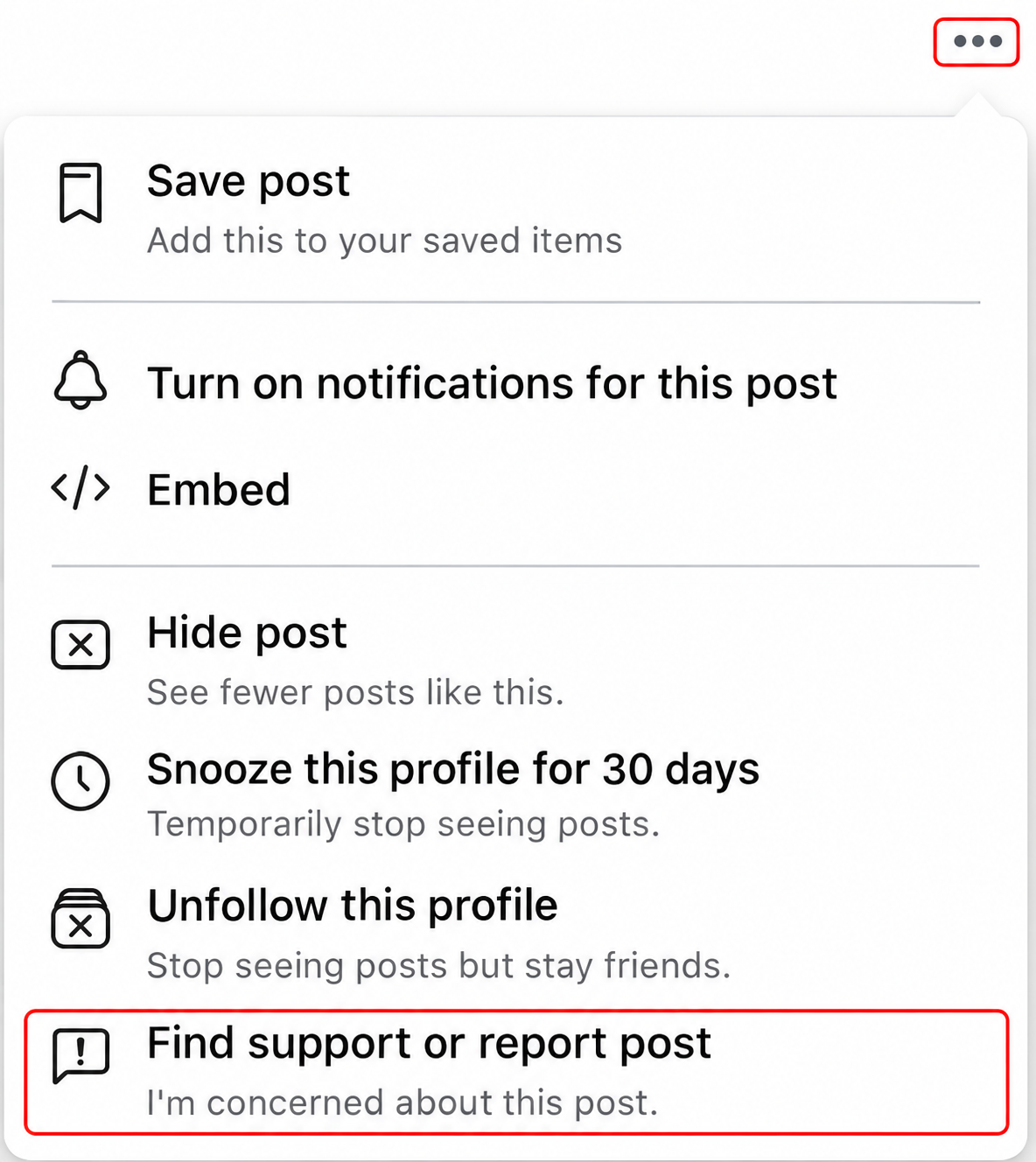
After a report, Facebook may also offer to unfollow, block or unfriend the account.
A profile
- Open the profile and click Options (to the right, below the cover photo).
- Click Report profile.
- Pick the option that best matches and follow the prompts.
Meta notes that, depending on your answers, you may be able to submit a report. For some types of content, Meta uses your feedback to help its systems learn instead of filing a formal report.
A Page
- Go to the Page and click Options below the cover photo.
- Click Report page and choose the option that fits.
A group
- Go to the group and click Options below the cover photo.
- Click Report Group and follow the prompts.
A comment
- Click Options (the three dots) next to the comment.
- Click Report comment.
You can’t report a comment on your own profile this way; you can hide or delete it instead. Meta’s guide to reporting content on Facebook has the full list, including photos and videos.
Report a Scam Message
Scam messages often come from hacked friend accounts: “Is this you in this video?”, a prize you supposedly won, or an urgent request for money. To report a conversation on Facebook in a computer browser:
- Click the Messenger icon at the top right.
- Open the conversation.
- Click the person’s name or the chat name at the top.
- Scroll down and click Report.
- Choose the category that fits and click Done.
Meta says it won’t let the person know who reported them. It also notes that some categories, like false information or technical problems, don’t create a report about the person.
In a single message, you can also use the message’s Options (in the pop-up chat) or Information (in the full message view) and choose Report; some versions put it under Privacy & support. The Messenger app has its own reporting options for conversations, messages and profiles, including end-to-end encrypted chats; Meta’s steps for reporting a conversation link to the app versions.
If the message came from a friend’s account, tell your friend another way (a phone call or text). Their account may be hacked.
Report a Marketplace Seller, Buyer or Listing
Marketplace has dedicated report paths, and Meta’s Help Center uses the label Scam in each one. Stop messaging the other person before you report.
Report a seller
- Open Marketplace and go to Buying.
- Open the listing and click the seller’s name.
- Click Options, then Report.
- Click Scam and follow the prompts.
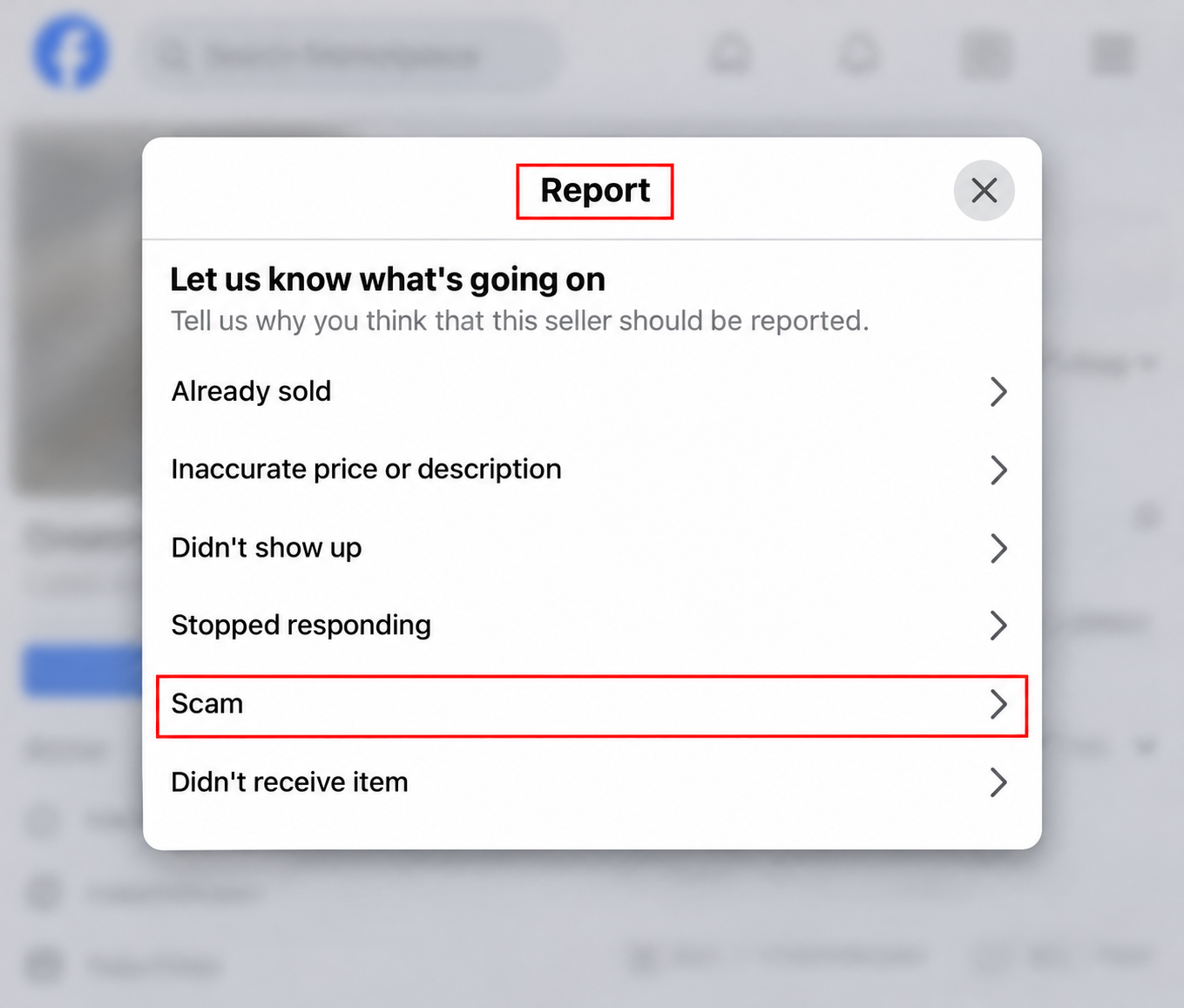
Report a buyer
- Open Marketplace and go to Selling, then your seller dashboard.
- Open the listing and the message from the buyer (click See More if needed).
- Click More options, then Report.
- Click Scam and follow the prompts.
Report a listing
- Open the listing in Marketplace.
- Click Options below the listing title.
- Click Report Listing, then Scam.
Typical Marketplace tricks reported by buyers and sellers include asking you to pay a deposit before seeing an item, moving the chat to another app, sending a fake payment confirmation, or “overpaying” and asking for the difference back. Meta’s Marketplace scam reporting page lists the exact steps for each role. If you sell on Marketplace, these tips on setting up Facebook Marketplace cover the basics.
Report a Scam Ad
- In your Feed, click Options (the three dots) next to the ad.
- Click Report ad and follow the prompts.
Fake ads often copy a real brand’s name and logo, offer prices far below normal, and lead to a site that is not the brand’s own. Meta also mentions the Ad Library and your recent ad activity as places to find an ad you scrolled past.
Report a Fake Account or Someone Pretending to Be You
Impersonation accounts copy a real person’s name and photos, then message their friends asking for money. You can report the fake profile with Options and Report profile. Meta’s Help Center also has a reporting form with options including Someone is pretending to be me, Someone is pretending to be someone I know and I want to report a fake account.
If the scammer is copying a friend, let the friend know so they can report it too. The form has a separate option for people reporting an account that pretends to be them.
If you don’t have an account or can’t see the content
If you’ve been blocked or don’t use Facebook, ask a friend who can see the content to report it. Meta says it can’t act until it can find the content, so give your friend the link and screenshots.
Hacked Account or Scam?
The two get mixed up, and the fix is different:
| What happened | What it is | Where to go |
|---|---|---|
| You can’t log in, or posts you didn’t write appear | Your account was hacked | Meta’s hacked-account help |
| A friend’s account sends strange links or money requests | Their account may be hacked | Tell the friend; report the messages |
| A new account uses your name and photos | Impersonation | Report the profile; use the impersonation form option |
| A stranger offers a deal, prize, job or romance and wants money | A scam | Report the content as described above |
Meta’s help with a hacked account page offers choices for “Someone else gained access to my account,” your friend’s account, or someone creating a new account with your information. For a walkthrough of recovery, see how to recover a hacked Facebook account, and if Facebook has locked you out, the steps to recover a locked Facebook account.
What Happens After You Report
Facebook keeps your reports in the Support Inbox. Meta says you can:
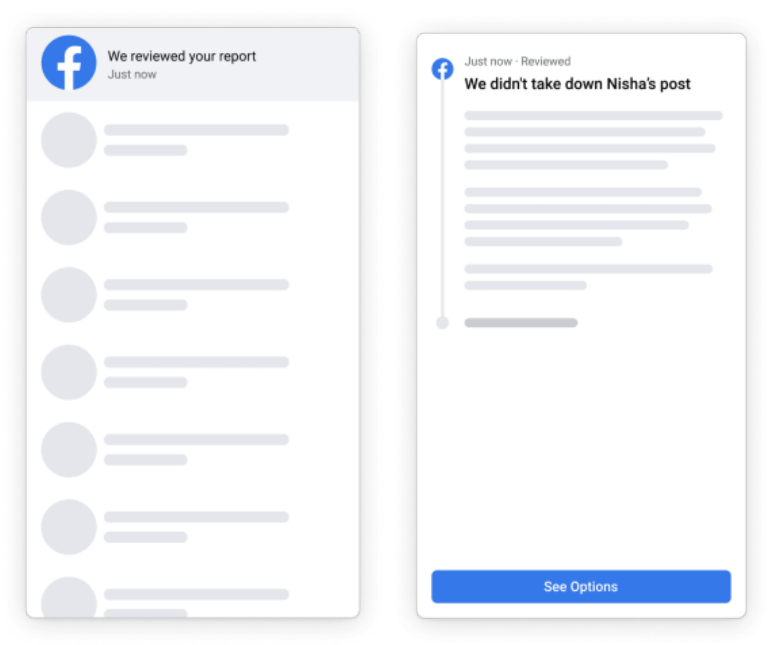
- Check the status of a report and click it to read the policy it relates to.
- Cancel a report with Delete Report, but only if it hasn’t been reviewed yet.
- See when action was taken and what the decision was.
- Use Request Review for some decisions you disagree with.
Meta doesn’t publish a set review time, and a report doesn’t guarantee removal. Content is taken down when Meta finds it goes against its Community Standards. You can find the same reports from Meta’s Scam Protection Center under View your reports, along with links to secure your account and spot scams. Details are on Meta’s page on checking a report’s status.
If you need help with something reporting can’t fix, these options for contacting Facebook directly lay out what actually exists.
Spot the Common Scams Before They Cost You
Meta’s scam guidance names these types; the signs in the second column are common patterns, not Meta’s wording. Recognizing them helps you choose the right report option.
| Scam type | Typical sign |
|---|---|
| Investment | Guaranteed returns, crypto “coaches,” pressure to invest fast |
| Romance | A new online partner who soon needs money for an emergency or travel |
| Job | A job offer that requires you to pay for training, equipment or a background check |
| Lottery or giveaway | You “won” something you never entered and must pay a fee to claim it |
| Loan | Approval regardless of credit, with an upfront fee |
| Donation | A charity appeal after a disaster with payment to a personal account |
| Inheritance | A stranger says you’re owed money from a relative or estate |
| Commerce | Prices far below normal, deposits, or payment outside Facebook |
| Paid subscription | Charges you didn’t expect after a free trial or “verification” |
Meta also lists red flags across these types: requests to move the conversation off Facebook, a sudden emergency from a “friend,” fees paid in advance, urgent messages about account problems, links asking you to log in, and accounts with no friends or profile photo. Its own rule of thumb is to slow down, check the details, and not send money or information. Messages that claim to be from Facebook about your account deserve extra care; Meta suggests checking recent emails from Facebook in your settings rather than trusting a link. More is on Meta’s page about avoiding scams.
Here is how it plays out. Elena lists a bike on Marketplace. A buyer offers full price, says a courier will collect it, and sends a link to “confirm the shipping payment.” Elena doesn’t click it. She screenshots the chat, reports the buyer from her seller dashboard with Scam, and blocks them.
Lock Down Your Account
Scammers love accounts they can take over, because friends trust them. Meta recommends:
- Two-factor authentication, so a stolen password isn’t enough to log in. If you’re tempted to switch it off, read whether you can turn off Facebook 2FA without logging in first.
- Login alerts, so you hear about logins you don’t recognize.
- Security Checkup in Accounts Center, which walks through passwords, alerts and logged-in devices.
- A password you don’t use anywhere else.
Questions About Reporting Facebook Scams
Will the scammer know I reported them?
For conversations, Meta states it won’t let the person know who reported them. Meta’s reporting pages don’t promise the same in every situation, so avoid mentioning a report to the scammer.
How long does Facebook take to act on a report?
Meta doesn’t publish a timeline. Check the Support Inbox for the status and decision.
Can Facebook get my money back?
Not for person-to-person payments or payments made off Facebook, according to Meta. Eligible purchases made with Facebook checkout may be covered by Purchase Protection. For anything else, your bank or payment provider is the place to start.
The scammer blocked me. Can I still report them?
You can report anything you can still see, such as messages already in your inbox. For content you can no longer see, ask a friend to report it with the link and your screenshots.
What if Facebook didn’t remove it?
Open the report in your Support Inbox. For some decisions, Meta offers Request Review. Keep your evidence in case you need to report to your bank or the authorities.
One Last Step
After reporting, check your Support Inbox in a day or two, and turn on two-factor authentication if it isn’t on yet.

Matthew Burleigh is the founder, head writer, and editor of Solve Your Tech, which he launched in 2012. He has written technology tutorials since 2008 and worked in IT since 2003, including small-business support, IT management, and consulting. He holds Bachelor’s and Master’s degrees in Computer Science from Arizona State University.
Matthew writes practical guides for Windows, iPhone and iPad, Microsoft Office, Outlook, Google apps, and Android. Solve Your Tech’s guides are checked step by step against the device or app maker’s own documentation and tested on his own devices whenever he has the hardware or software, with clear steps, sources, and update dates.
Read more about Matthew and how Solve Your Tech writes and updates its guides, or report a correction.