Your child just got their own iPad, or you are handing over yours for a road trip, and you want to decide which apps, websites, purchases and hours are off limits before they start tapping. The built-in answer is Screen Time. On iPadOS 27 and later, give your child their own Apple Account in Family Sharing, then open Settings > Family > [child’s name] to set purchase approval, website filters, allowed contacts, time limits and age ratings, and lock it all with a Screen Time passcode.
How Family Sharing Fits In
Apple’s parental controls are built around Family Sharing, so a few pieces need to be in place first. Skipping them is the most common reason a setting seems to be missing.
- Family Sharing. One adult is the family organizer, and that person (or another adult marked as a parent or guardian) manages the child’s settings. Family Sharing is set up from Settings > Family.
- A Child Account. Your child needs their own Apple Account that is in your family group and not shared with anyone else. For children under 13 (the age varies by country or region), a parent creates it: Settings > Family > Add Member > Create Child Account > Continue. Enter the correct birthday, because Apple uses age to pick default restrictions. Apple’s Child Account instructions cover the details.
- The right software. The newer parental controls described here arrived with iPadOS 27 (and iOS 27 and macOS 27 on other family devices). If your iPad cannot update, see the section on older iPadOS versions further down. To check, open Settings > General > Software Update, or follow the walkthrough on finding and installing an iPad software update.
- You in your child’s contacts. Apple asks that the organizer or another parent or guardian be saved in the child’s Contacts so purchase and website requests can reach you.
Two terms come up again and again. Screen Time is the Settings area that holds every limit and report. The Screen Time passcode is a separate four-digit code that protects those settings; it is not the passcode your child uses to open the iPad.
Choose Where to Set the Controls
There are two ways to set things up, and the choice affects how much control you keep.
- From your own device, through Family Sharing (recommended). You open Settings > Family > [child’s name] on your iPhone or iPad and change their limits remotely. Requests from your child (to buy an app or open a blocked website) arrive on your device, and you can change a rule without picking up their iPad.
- On the child’s iPad itself. Useful when a younger child uses a family iPad without their own Apple Account, or when you simply want limits on a shared device. You open Settings > Screen Time on that iPad and lock it with a Screen Time passcode. You lose remote approval and remote reports, and any change means getting the iPad back in hand.
If the iPad is your child’s own device and they are old enough for an Apple Account, the Family Sharing route is worth the extra five minutes. A shared family iPad that several kids pass around is the main case for the on-device route.
Example: One Family, Two Setups
Say Maya, age 9, gets a new iPad for school. Her parent creates a Child Account for her, signs her iPad into it, and manages everything from their own iPhone. The older family iPad stays on the kitchen counter for the younger sibling, so the parent sets a Screen Time passcode directly on that iPad and blocks app installs there. Same family, two different routes, each matching how the device is used.
Upgrade Every Family Device First
Apple’s new controls need every device in the family to be on version 27. According to Apple, that includes any device used in the last 90 days by a parent, guardian or managed child. You can see the list under Settings > Family > View Family Devices.
- Update each iPad and iPhone in Settings > General > Software Update.
- Open Settings > Family and tap Get Started when Apple prompts you to move to the new parental controls.
- Check the device list. Devices that cannot run version 27 appear under Legacy Devices. Apple notes that a parent can still manage such a device locally with the Screen Time passcode.
Set Up Screen Time for Your Child on iPadOS 27
With Family Sharing and the upgrade done, every control lives under one screen. These steps assume you are on your own iPhone or iPad.
- Open Settings and tap Family.
- Tap your child’s name.
- Work through the sections you see there: Apps & Websites, Allowed Contacts, Communication Safety, Time Allowances, Screen Time Schedule, Content & Privacy Restrictions and Passcode & Management.
- Enter your Screen Time passcode if a section asks for it.
Apple sets some protections automatically by age, so you may find several rules already on. Per Apple’s Screen Time and parental controls overview, Ask to Browse is on by default for children under 13 and Limit Adult Websites is on by default for children under 18, with thresholds that vary by region. Review them rather than assuming the screen is blank.
The sections below follow the order most parents tackle things: lock the settings, then purchases, websites, contacts, time and ratings.
Lock the Settings With a Screen Time Passcode
Do this early. Without a Screen Time passcode, a child who knows their way around Settings can simply change the limits back.
For a Child’s Device Managed Through Family Sharing
- Open Settings, tap Family, then tap your child’s name.
- Tap Passcode & Management. If you do not see it, set up the child’s usage and parental controls first.
- Tap Lock Screen Time Settings.
- Enter a four-digit passcode and confirm it.
On the iPad Itself
- Open Settings, scroll down and tap Screen Time.
- Tap Passcode & Management, then Lock Screen Time Settings.
- Enter a four-digit passcode and confirm it.
- When asked, add Screen Time Passcode Recovery by entering your Apple Account email or phone number and password.
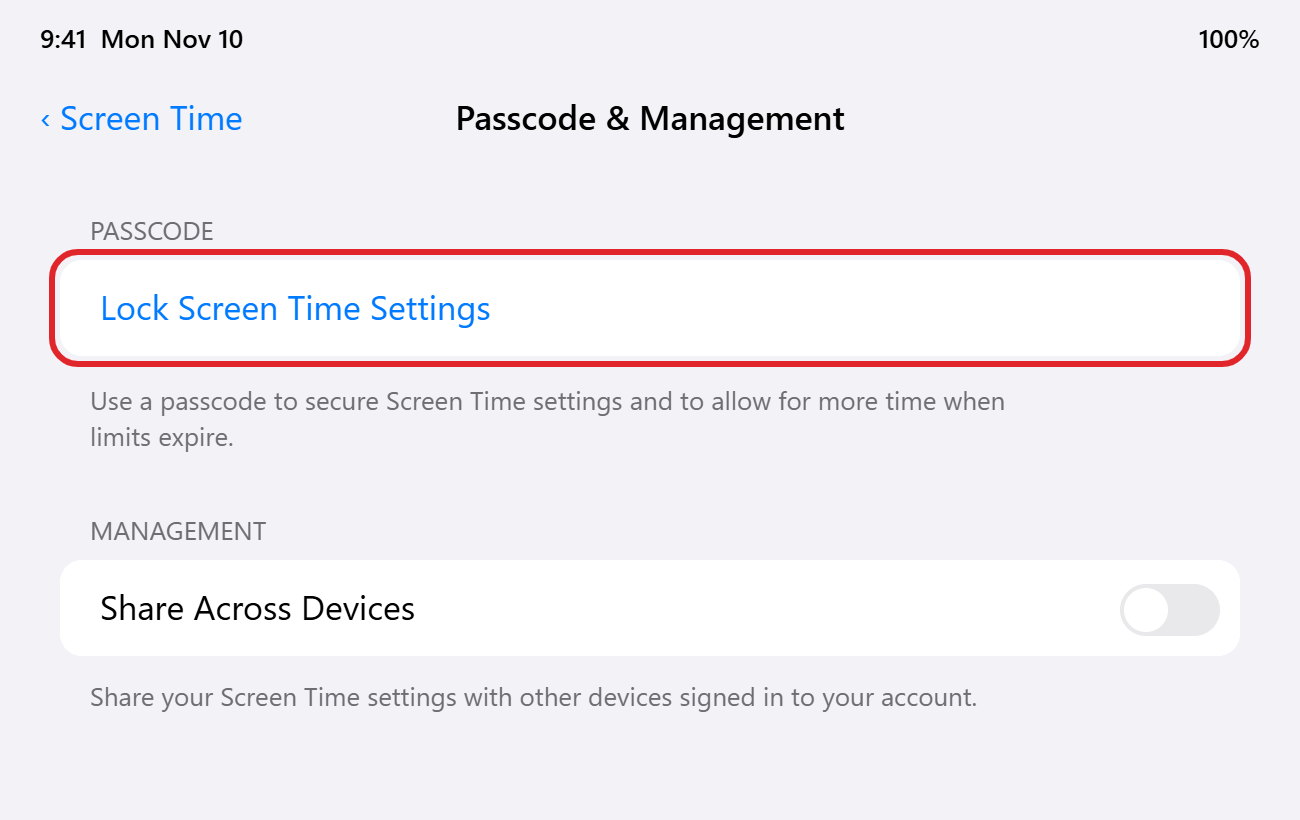
Warning before you skip step 4: Apple says that without the recovery account, you won’t be able to remove or reset the Screen Time passcode, and it recommends not skipping recovery. Pick a code your child has not seen you type, and do not reuse the code that opens the iPad. If you are not sure which Apple Account you are signed into, here is how to find your Apple Account email on an iPhone. Apple’s Screen Time passcode page also notes that you are notified when your child uses the passcode.
Control App Downloads, Purchases and Specific Apps
Turn On Ask to Buy
Ask to Buy sends you a request each time your child tries to download or buy something.
- Go to Settings > Family > [child’s name] > Apps & Websites.
- Tap Restrictions, then Ask to Buy.
- Choose Require Purchase Approval.
What it covers, per Apple’s Ask to Buy page: App Store downloads (free apps included), in-app purchases and redownloads of apps shared through the family. It does not cover redownloading your child’s own past purchases, app updates or redeeming a gift code. Requests expire after 24 hours, so a request your child sent last night may need to be sent again. Depending on your state, country or region, Apple turns Ask to Buy on by default for children under 18, and it can’t be turned off.
Block Installing or Deleting Apps
- Go to Settings > Family > [child’s name] > Apps & Websites > App Store.
- Pick a setting such as Installing Apps or App Clips.
- Choose Allowed or Blocked.
Block One App or Website
- Go to Settings > Family > [child’s name] > Apps & Websites.
- Select the app or website.
- Tap Block App or Block Website, then tap again to confirm.
Blocked apps are not deleted. They stay on the Home Screen, dimmed, so your child can see the app is there but can’t open it. If they want it, they can send you a request, and Apple notes that in iPadOS 26 and later a child can ask for an exception to a limit you set.
Filter Websites and Content Ratings
Web Filtering
- Go to Settings > Family > [child’s name] > Apps & Websites > Restrictions.
- Tap Filtering under Websites.
- Choose Limit Adult Websites to let Apple screen out adult content, or choose Approved Websites Only to use Ask to Browse, where your child can only visit sites you approve and must request the rest.
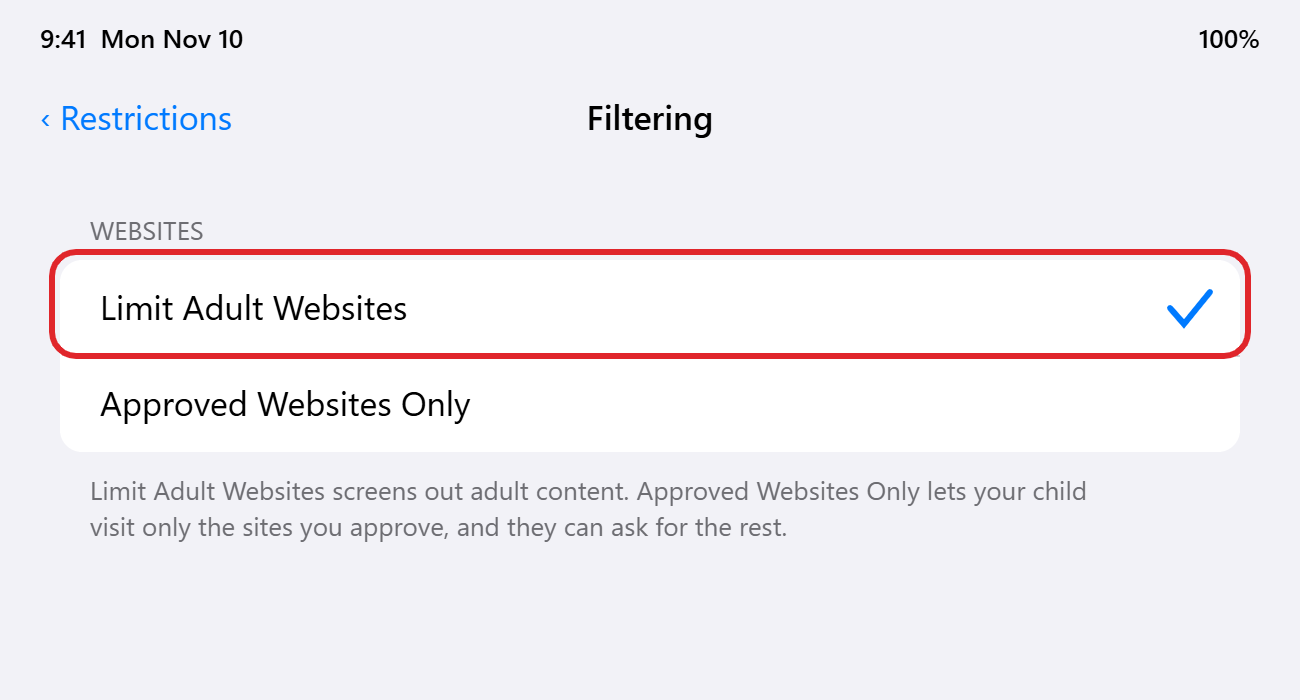
Which to pick: Approved Websites Only fits a young child who uses a handful of learning sites. Limit Adult Websites suits an older child who needs the open web for homework. Apple says Ask to Browse works in Safari and other supported browsers on iPadOS 27 after you upgrade Screen Time. No filter is perfect, so a quick look at what your child is browsing still matters.
Age Ratings for Apps, Movies, Music and Books
- Go to Settings > Family > [child’s name] > Content & Privacy Restrictions.
- Under Content Restrictions, pick a content type.
- Choose Don’t Allow, Unrated, Allow All or a specific age rating.
Ratings systems differ by country, so the exact labels you see depend on your region. For a deeper look at choosing the right ages, see how to change age restrictions on an iPad.
Decide Who Your Child Can Message and Call
Allowed Contacts
- Go to Settings > Family > [child’s name] > Allowed Contacts.
- Tap During Screen Time and choose Contacts Only, Contacts & Groups with at Least One Contact or Everyone.
- To control the contact list itself, turn on Manage Contacts. Leave Allow Contact Editing off if you want your child to send a request before adding someone new.
Apple’s child safety guide notes that your child has to approve your request to manage their contacts, and Contacts needs to be turned on in iCloud for it to work. The list also has a separate setting for when the device is paused or unavailable, which decides who can still reach your child during scheduled off time.
Communication Safety
Go to Settings > Family > [child’s name] > Communication Safety and turn it on. Apple says the feature blurs photos and videos that appear to contain nudity, and its overview lists gore and violence as well, including in FaceTime. Apple states that it does not get access to those images. It is a good default for any child old enough to message friends.
Set Time Allowances and a Screen Time Schedule
Time Allowances
Time Allowances are daily caps for apps or categories of apps.
- Go to Settings > Family > [child’s name] > Time Allowances.
- Tap the Add button.
- Pick a category or individual apps and set the amount of time.
Apple’s guide lists Entertainment, Games and Social Media as default categories, and an option to match the Screen Time Schedule. For example, you might give Maya 45 minutes of Games on school days and leave her reading and drawing apps without a cap.
Screen Time Schedule
A schedule decides when the iPad can be used at all.
- Go to Settings > Family > [child’s name] > Screen Time Schedule.
- Turn on Schedule.
- Scroll down, tap Add Schedule and select the days.
Apple’s guide describes built-in windows such as Before School, School and After School, which you can adjust. Apps and contacts you set as Always Allowed stay usable during off time, so keep anything your child must reach (a parent, a school app) on that list.
After a week, open the usage report to see whether your limits match reality. The report works the same way it does on iPhone; see how to check Screen Time reports.
Other Built-In Tools Worth Knowing
- Siri. Settings > Family > [child’s name] > Content & Privacy Restrictions > Siri. Choose a category such as Writing Assistance or Image Creation and set it to Allowed or Blocked.
- Game Center. Settings > Family > [child’s name] > Apps & Websites > Restrictions, then scroll to Game Center to set Connect with Friends or Private Messaging to Allowed or Blocked.
- Privacy Restrictions. Under Content & Privacy Restrictions, scroll to Privacy Restrictions and choose Allow or Don’t Allow for categories such as Accounts or Calendar. This stops changes to things like signed-in accounts.
- Screen Distance. Apple says this may be on by default for some child accounts depending on location, and covers how to use it on a separate support page.
- Guided Access. For a toddler or a single-app session (one game on a flight), Guided Access locks the iPad to one app until you end the session. It is in Settings > Accessibility > Guided Access, and it works the same way as locking an iPhone to one app with Guided Access.
People often ask for a “kid mode” on iPad. There isn’t a separate one: Screen Time for long-term limits plus Guided Access for short sessions is Apple’s built-in combination. Third-party parental control apps exist, but they add another account and subscription, and Screen Time covers what most families need.
If Your iPad Runs iPadOS 26 or Earlier
Older iPads that can’t install version 27 keep the earlier Screen Time layout, which you open from Settings > Screen Time (and, for a child in Family Sharing, by tapping the child’s name there). Apple’s current pages point to its iPadOS 26 guide for these devices, and that guide could not be checked for this update, so treat the labels below as what to look for rather than exact wording:
- Downtime for scheduled off hours (the older version of Screen Time Schedule).
- App Limits for daily caps by category (the older version of Time Allowances).
- Communication Limits for who your child can contact, and Always Allowed (a label iPadOS 27 keeps) for apps and contacts that work during Downtime.
- Content & Privacy Restrictions, which may hold iTunes & App Store Purchases (installing, deleting and in-app purchases), Allowed Apps, Content Restrictions and web content options.
The ideas are the same, and the passcode still protects the settings. The general approach on iPhone is described in what restrictions on an iPhone are and how to set them.
When Controls Do Not Work as Expected
- Requests never reach you. Check that you (or another parent or guardian) are saved in your child’s Contacts, and that Ask to Buy is set to Require Purchase Approval. Remember the 24-hour expiry on Ask to Buy requests.
- Sections such as Time Allowances are missing. One or more family devices may still be on an older version. Check Settings > Family > View Family Devices, update what you can, and look for anything listed under Legacy Devices.
- Your child’s iPad shows different settings from the ones you set. Confirm the iPad is signed in with the child’s own Apple Account, not yours or a shared one. Apple requires the child’s account to be theirs alone.
- You forgot the Screen Time passcode. On your own iPad, go to Settings > Screen Time > Passcode & Management > Change Screen Time Passcode, authenticate with Face ID or the device passcode, and enter the Apple Account you added for Screen Time Passcode Recovery when asked. Apple says you must use that same recovery account, which may belong to another family member. For a child managed through Family Sharing, the change is made on your device under Settings > Family > [child’s name] > Passcode & Management. Apple’s forgotten passcode steps cover both cases.
- A limit seems to have been changed. Change the passcode, and check Privacy Restrictions so accounts and passcodes can’t be altered.
Questions Parents Ask About iPad Limits
Can I manage my child’s iPad from my iPhone?
Yes, if your child has their own Apple Account in your Family Sharing group and both devices are on version 27. Open Settings > Family > [child’s name] on your iPhone and every control is there.
Do free apps need my approval with Ask to Buy?
Yes. Apple’s Ask to Buy covers free downloads as well as paid apps and in-app purchases. App updates and redownloads of the child’s own earlier purchases do not need approval.
Does Screen Time follow my child to other Apple devices?
The controls are tied to your child’s Apple Account in Family Sharing, which is one reason Apple wants every family device updated to version 27. A device that can’t update shows up under Legacy Devices and needs local management.
What happens when a time allowance runs out?
The app stops opening once the allowance is used up. Apple notes that a child can request an exception to a limit, and the request comes to you to approve or decline.
Is there a single switch to turn every control off?
Not one Apple documents. If you need a break from limits, loosen individual settings (a longer allowance, a wider web filter) with your Screen Time passcode, and tighten them again later.
Should I talk to my child about the limits?
Settings work better when kids know what they are and why. Agreeing on a schedule together, and reviewing it as they get older, tends to cause fewer arguments than surprise blocks.
Once the controls are in place, hand the iPad over, wait for the first request to arrive, and adjust from there.

Matthew Burleigh is the founder, head writer, and editor of Solve Your Tech, which he launched in 2012. He has written technology tutorials since 2008 and worked in IT since 2003, including small-business support, IT management, and consulting. He holds Bachelor’s and Master’s degrees in Computer Science from Arizona State University.
Matthew writes practical guides for Windows, iPhone and iPad, Microsoft Office, Outlook, Google apps, and Android. Solve Your Tech’s guides are checked step by step against the device or app maker’s own documentation and tested on his own devices whenever he has the hardware or software, with clear steps, sources, and update dates.
Read more about Matthew and how Solve Your Tech writes and updates its guides, or report a correction.