To install a Bluetooth driver in Windows 10, check Settings > Update & Security > Windows Update, including View optional updates when it appears. If no suitable driver is available, get the Windows 10 Bluetooth package for your exact PC or adapter model from its manufacturer. Run its installer, or use Device Manager to select the downloaded driver folder.
This guide uses Windows 10 menus (version 22H2, the final release). For Windows 11, follow the Windows 11 Bluetooth driver steps instead. Windows 10 support ended on October 14, 2025, but drivers still install the same way.
Before You Start
- Sign in as an administrator. A standard account can open Device Manager but can’t install or change drivers.
- Plug in a laptop and save your work. Most driver installs ask for a restart.
- Keep a wired mouse or keyboard handy if you use Bluetooth ones. They stop working while the driver is removed or replaced.
- Have an internet connection, or another computer and a USB drive to carry the download over.
- On a work or school PC, ask IT. Your organization may manage drivers for you.
A driver can’t add Bluetooth to a PC that has no Bluetooth radio. Many desktop PCs don’t have one. If yours doesn’t, a USB Bluetooth adapter adds it, and the adapter maker’s page tells you whether it needs its own driver.
Identify the Adapter Before Downloading
Knowing the exact adapter keeps you from downloading the wrong package.
- Right-click Start and select Device Manager.
- Expand Bluetooth and note the adapter name, such as Intel Wireless Bluetooth. Ignore paired devices like mice and headsets.
- If there’s no Bluetooth category, expand Other devices and look for an unknown device. A missing driver often shows up there with a yellow warning icon.
- To see the current driver, right-click the adapter, select Properties and open the Driver tab. Write down the Driver Version so you can compare it later.
- If the name is generic, open the Details tab and choose Hardware Ids from the list. A code like VID_8087 points to Intel, and VID_0BDA points to Realtek.

For more on reading this screen, read about checking drivers in Device Manager. Device Manager looks almost the same in Windows 10 and Windows 11.
Check Windows Update and Optional Drivers
Start here. Windows Update offers drivers that Microsoft and your PC maker have tested for your hardware.
- Open Start > Settings > Update & Security > Windows Update.
- Select Check for updates and let the check complete. Review any applicable updates and finish a requested restart.
- If View optional updates appears on the Windows Update page, open it and expand Driver updates.
- Check the Bluetooth driver for your adapter and select Download and install.
- Restart after installation and check the Bluetooth adapter in Device Manager.

Microsoft’s Windows Update driver instructions distinguish recommended drivers from optional ones, which are not installed automatically. If the optional-updates link or a Bluetooth package is absent, use the model-specific download method below.
Why Device Manager May Not Find a New Driver
You can right-click the adapter in Device Manager and select Update driver > Search automatically for drivers. Older Windows 10 versions may use the longer label Search automatically for updated driver software.
Device Manager’s automatic search isn’t a full check of the manufacturer’s downloads. Microsoft’s driver-distribution documentation says that, starting with Windows 10 version 2004, Device Manager only searches the drivers already on your PC. So a “best drivers are already installed” message doesn’t mean a newer driver isn’t available from Windows Update or your PC maker.
Download the Correct Manufacturer Package
- Open the official support site for the PC, motherboard or Bluetooth adapter manufacturer. Search for the exact model or service identifier shown on the device.
- Choose the model’s Windows 10 downloads and find its Bluetooth or wireless Bluetooth driver. Match any listed Windows architecture and hardware requirements.
- Read the package’s installation notes and supported-device list, then download it. A processor brand alone does not identify the Bluetooth radio.
- If the manufacturer supplies an .exe installer, run it and follow its prompts. Complete any restart it requests.
Microsoft’s Bluetooth driver guide recommends the PC maker’s support site when other update methods do not resolve the issue. If Windows 10 is absent from the model’s supported downloads, ask the manufacturer about compatibility instead of substituting a Windows 11 package or a generic driver-updater tool.
Getting the driver from the chip maker
The PC maker’s package is the safest choice because it may include changes for your model. If you have an Intel Bluetooth radio and the PC maker’s driver is old, Intel publishes its own package. The Intel Wireless Bluetooth driver page lists version 24.70.0, released September 8, 2026, for Windows 10 64-bit and Windows 11. It covers Intel Wi-Fi 7, Wi-Fi 6 and 6E, Wireless-AC 9560, 9462, 9461 and 9260 adapters, plus several Killer models. Intel itself suggests checking with your PC maker first.
Intel also warns that PCs with Wireless-AC 9560, 9462 or 9461 adapters running driver versions 23.10 through 23.50 must disconnect and unpair Bluetooth devices before upgrading. Pair them again afterward.
For Realtek, MediaTek or Qualcomm radios, get the driver from your PC maker’s support page or Windows Update. Those chip makers usually supply Bluetooth drivers through PC makers rather than as public downloads.
Install Downloaded Driver Files With Device Manager
Use this method when the download is a folder of driver files instead of an installer. Unzip it first and note where you saved it.
- Open Device Manager from Start search. Expand Bluetooth, or find the identified adapter under Other devices.
- Right-click the adapter and select Update driver.
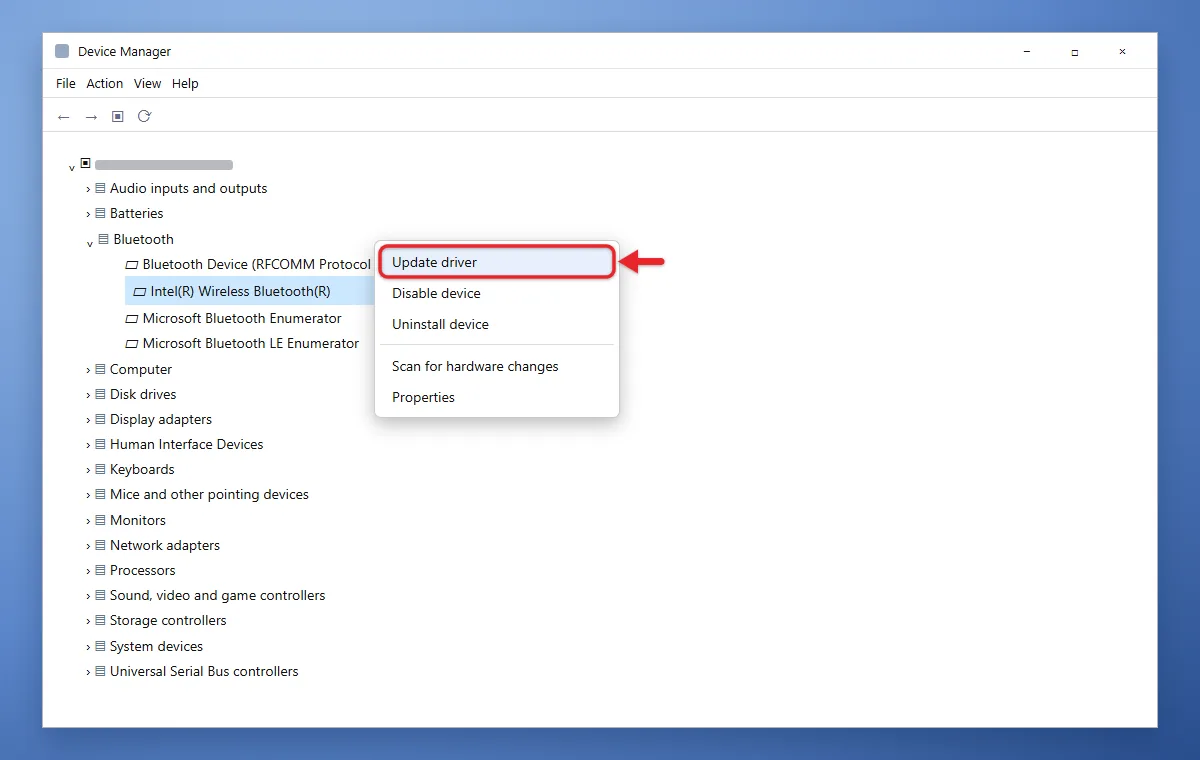
- Choose Browse my computer for drivers (older builds may say Browse my computer for driver software).
- Select Browse, choose the extracted driver folder and confirm OK. Leave Include subfolders checked, and check that the displayed path is correct.
- Select Next and read the installation result. Close the dialog and restart when instructed.
Microsoft documents this folder-based method in its Device Manager driver instructions. If Windows cannot find a suitable driver, recheck the folder, model, Windows version and architecture. Keep the exact error message for the manufacturer rather than forcing a package intended for different hardware.
Reinstall the Driver if the Adapter Is Listed but Broken
If the adapter shows a warning icon or Bluetooth stopped working, a clean reinstall often fixes it.
- In Device Manager, expand Bluetooth.
- Right-click the adapter and select Uninstall device, then confirm Uninstall. Leave the option to delete the driver software unchecked unless you have a replacement driver ready.
- Restart the PC. Windows detects the adapter and installs a driver for it during startup.
If the adapter doesn’t come back, open Device Manager and select Action > Scan for hardware changes. If you’re not sure how to reach Device Manager quickly, see ways to open Device Manager, which also work in Windows 10.
Verify the Result and Handle Remaining Problems
Open Device Manager and expand Bluetooth. The adapter should show no yellow warning icon, and its Driver tab should show the new version. Then open Settings > Devices > Bluetooth & other devices, turn on Bluetooth, and pair your accessory to test it.
If Bluetooth is still missing, check for a wireless switch or Fn key and confirm your PC has Bluetooth hardware. If the adapter looks fine but one accessory won’t connect, use Microsoft’s Bluetooth troubleshooting steps for airplane mode, battery, range, and pairing checks.
If Bluetooth stops working after a driver update, right-click the adapter, select Properties, open the Driver tab, and select Roll Back Driver. If that button is grayed out, download the previous version from the PC maker before you uninstall the adapter.
More fixes to try
- Run the Bluetooth troubleshooter. Open Settings > Update & Security > Troubleshoot > Additional troubleshooters, select Bluetooth and choose Run the troubleshooter. Windows 10 keeps its built-in troubleshooters, while Windows 11 moved them to the Get Help app.

- Turn off Airplane mode. Open the action center at the right end of the taskbar and make sure Airplane mode is off and the Bluetooth tile is on.
- Check the Bluetooth Support Service. Press Windows + R, type services.msc and press Enter. Double-click Bluetooth Support Service. If Startup type is Disabled, set it to Manual or Automatic, select Start, then OK.
- Read the error code. In the adapter’s Properties, the General tab shows a status. Code 28 means no driver is installed, so use one of the install methods above. Code 10 or Code 43 usually calls for a reinstall or the PC maker’s driver.
- Look for hidden devices. In Device Manager, select View > Show hidden devices to see an adapter that Windows has turned off or can’t currently reach.
- One accessory keeps failing. Remove it from Bluetooth & other devices and pair it again. Here’s how to remove a paired Bluetooth device in Windows 10.
Frequently Asked Questions
Can I install the driver without internet on this PC?
Yes. Use another connected computer to download the exact manufacturer package, copy it to a USB drive, then transfer it to the Windows 10 PC. Run its installer or select its extracted folder as described above. The destination PC still needs compatible Bluetooth hardware.
Should I update a working driver just because another version exists?
Only if the maker’s release notes list a fix you need, such as a pairing or audio problem you’re having. Note the current version in Device Manager (adapter Properties > Driver) before you update, so you can compare or roll back later.
Will installing the driver automatically pair my headphones?
No. Installing the driver makes the Bluetooth adapter work; pairing is a separate step. Put the headphones in pairing mode and add them in Settings > Devices > Bluetooth & other devices with Add Bluetooth or other device.
How do I know if my PC has Bluetooth at all?
Look for a Bluetooth category in Device Manager and a Bluetooth switch in Settings > Devices > Bluetooth & other devices. If neither appears even after a driver check, look up your model’s specifications on the PC maker’s site. No driver can create the hardware.
Can I use a Windows 11 Bluetooth driver on Windows 10?
Only when the package says it supports Windows 10. Intel’s package, for example, covers both systems. A driver made only for Windows 11 may not install or may not work properly on Windows 10.
Do I still get Bluetooth drivers now that Windows 10 support has ended?
Drivers already published for Windows 10 still install, and PC makers may keep their Windows 10 downloads online. Microsoft no longer provides security updates for Windows 10 without the Extended Security Updates program, so if your PC meets the requirements, upgrading to Windows 11 keeps drivers and security fixes coming.

Matthew Burleigh is the founder, head writer, and editor of Solve Your Tech, which he launched in 2012. He has written technology tutorials since 2008 and worked in IT since 2003, including small-business support, IT management, and consulting. He holds Bachelor’s and Master’s degrees in Computer Science from Arizona State University.
Matthew writes practical guides for Windows, iPhone and iPad, Microsoft Office, Outlook, Google apps, and Android. Solve Your Tech’s guides are checked step by step against the device or app maker’s own documentation and tested on his own devices whenever he has the hardware or software, with clear steps, sources, and update dates.
Read more about Matthew and how Solve Your Tech writes and updates its guides, or report a correction.