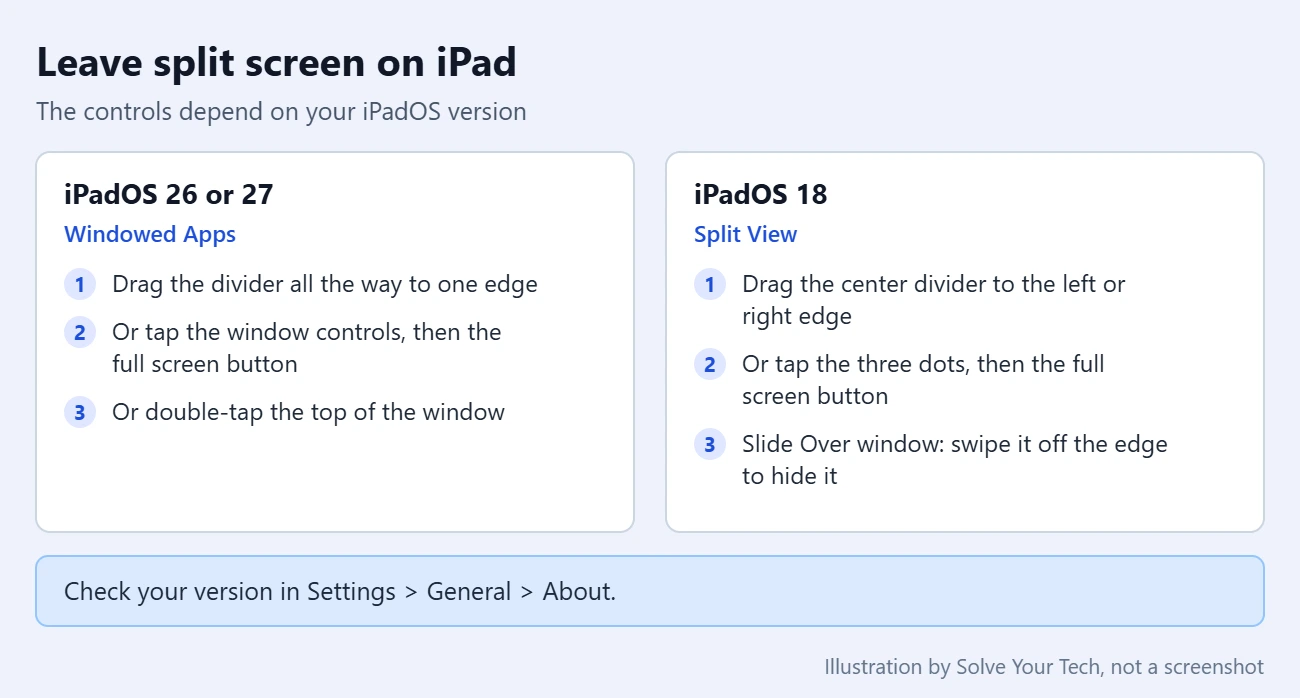
To get rid of split screen on an iPad, drag the divider between the two apps all the way to the left or right edge of the screen. The app you dragged over disappears from view and the other one fills the display. You can also make the app you want to keep full screen with its window controls.
The exact buttons depend on your software. iPadOS 26 and iPadOS 27 use resizable windows with controls at the top left, while iPadOS 18 and earlier use the older Split View with three dots at the top of each app. Pick the section below that matches what you see. Nothing here erases data, and you do not need to reset the iPad to change the layout.
Before You Start: Check Your iPadOS Version
Open Settings, tap General, then tap About and read the number next to iPadOS Version. That number tells you which set of steps applies.
- iPadOS 26 or 27: side-by-side apps are two tiled windows. The feature that allows them is called Windowed Apps, and a second mode called Stage Manager also shows several windows at once.
- iPadOS 18 or earlier: side-by-side apps are called Split View, and a narrow floating app is called Slide Over.
A quick visual check also works. If each window shows a small group of round controls at its top left after you resize it, you are on the newer design. If each app has three dots at the top center, you are on the older one.
Get Rid of Split Screen on iPadOS 26 or 27
When two app windows are tiled side by side, the divider is the fastest route.
- Find the divider, the bar that runs down the screen between the two windows.
- Touch it and drag it sideways. As you drag, both windows change size together.
- Keep dragging until the divider reaches the edge of the screen on the side of the app you want out of the way, then lift your finger.
- The remaining app expands to full screen. Drag toward the other edge instead if you want to keep the other app.
If the windows overlap or are not neatly tiled, there is no divider to drag. Use the window controls instead:
- Tap the window you want to keep so it comes to the front.
- Tap the window controls at the top left of that window.
- Tap the full screen button. Apple’s support article names it the Zoom button.
Two shortcuts do the same thing. You can double-tap the top of the window, or drag the window down from its top, hold it for a moment, and then swipe it quickly toward the top of the screen. Apple lists all three methods in its guide to working with multiple windows on iPad, and the divider method in its guide to changing the layout of windows.
Making one window full screen only changes what you see. The other app is still open behind it. If you want that second window gone, tap its window controls and choose the Close button, or use the Minimize button to tuck it away without closing it.
Turn Off Windowed Apps So Apps Always Open Full Screen
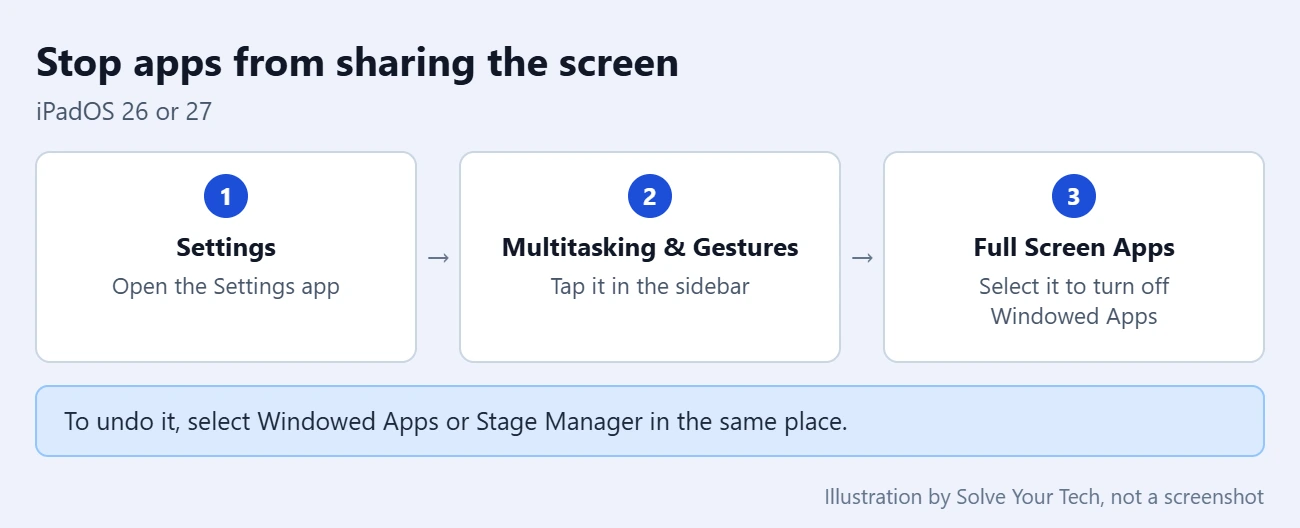
If apps keep ending up side by side and you never want that, change the multitasking mode. Be aware of what this does first: with Full Screen Apps selected, every app opens on its own and you can no longer resize windows or place two apps next to each other until you switch back.
- Open Settings.
- Tap Multitasking & Gestures in the sidebar.
- Select Full Screen Apps.
There is also a faster switch. Swipe down from the top-right corner of the screen to open Control Center, then tap the Windowed Apps button to turn the mode off or on. Touching and holding that button lets you switch between Windowed Apps and Stage Manager. Apple documents both routes in Turn Windowed Apps on or off on your iPad.
The same Settings screen controls Stage Manager. If Stage Manager is the mode that is selected, choosing Full Screen Apps turns it off as well. Apple’s Stage Manager instructions note that some software versions label this choice Off instead.
To undo the change, return to Settings > Multitasking & Gestures and select Windowed Apps or Stage Manager.
Exit Split View on iPadOS 18 or Earlier
On the older design, Apple’s iPadOS 18 Split View guide gives three ways to return to full screen.
- Drag the divider. Drag the center divider to the left or right edge of the screen. The app on that side is removed from the view and the other fills the screen.
- Use the three dots. Tap the three dots at the top of the app you want to keep, then tap the full screen button, which is the first icon in the small menu.
- Drag the app to the center. Touch and hold the three dots at the top of the app you want to keep, drag it to the middle of the screen while keeping its top edge at the top, and lift your finger when its name and icon appear.
To stop Split View from appearing at all on these versions, open Settings > Multitasking & Gestures. The options under Multitasking include Split View & Slide Over and Stage Manager; choosing Off leaves every app in full screen. This switch may not exist on some older releases, such as iPadOS 15 and 16. If you do not see it, you can still leave Split View with the divider or the three dots each time.
Remove a Small Floating Window (Slide Over)
A narrow window that sits on top of another app is Slide Over, not split screen, so there is no divider to drag.
On iPadOS 26.2 or later: touch and hold the window controls of the floating window and tap Exit Slide Over. You can also drag the window to the middle of the screen and pause. It becomes an ordinary window, which you can then close or make full screen. Dragging the top of the window past the left or right edge only hides it; an arrow at that edge shows where it went, and a swipe from that edge brings it back. Apple covers these controls in Multitask on iPad.
On iPadOS 18: swipe all the way up from the bottom of the Slide Over window, or drag the window off the side of the screen, to hide it. A small tab shows it is still available. To get rid of it for good, tap the three dots at the top of the Slide Over window and choose the full screen button, which turns it into a normal full-screen app.
How to Confirm It Worked
One app should fill the whole display with no divider, no second window, and no arrow or tab at the screen edge. Open a different app from the Home Screen. If it also opens full screen, your layout is back to normal. If you changed the setting to Full Screen Apps, the window controls and resize handle no longer appear on apps.
Troubleshooting
- The divider snaps back. You released it too early. Drag it completely to the edge before lifting your finger.
- You cannot find the window controls. On iPadOS 26 or 27, they appear at the top left after a window has been resized. If an app is in full screen, swipe down from the top of the screen to show them in the menu bar.
- You cannot find Full Screen Apps in Settings. Your iPad is probably on iPadOS 18 or earlier, where the choice is labeled Off, or the setting is not offered. Check the version under Settings > General > About.
- Split screen keeps coming back. Dragging an app icon from the Dock onto the left or right side of a full-screen app tiles the two apps. Tap Dock icons instead of dragging them, or select Full Screen Apps.
- The screen does not respond to dragging. Restarting the iPad is a reasonable next step. See our guide on how to turn off or restart an iPad, and use only the restart steps.
- Two Safari windows are side by side. They behave like any two apps. Drag the divider to an edge or make one window full screen.
- Only the keyboard is divided. That is a keyboard layout, not split screen. See our guide on how to fix an iPad keyboard that is split in two.
Frequently Asked Questions
Does dragging the divider close the other app?
It removes the app from the shared view so the other one can fill the screen. On iPadOS 26 and 27, Apple describes this as making one window full screen, and closing is a separate action done with the Close button. If you want to quit an app completely, see how to close apps on an iPad.
Can I turn off split screen permanently?
On iPadOS 26 or 27, select Full Screen Apps under Settings > Multitasking & Gestures. On iPadOS 18, choose Off on the same screen. The setting stays that way until you change it back.
Why did my iPad go into split screen by itself?
It is usually an accidental drag. On current software, dragging an app icon to the left or right side of a full-screen app tiles them side by side, and swiping a window quickly toward one side does the same. On iPadOS 18, the three dots at the top of an app open the Split View and Slide Over choices.
Which iPads have Windowed Apps?
Apple’s list includes iPad (8th generation and later), iPad Air (3rd generation and later), iPad mini (5th generation and later), iPad Pro 11-inch (all generations), and iPad Pro 12.9-inch (3rd generation and later), along with the newer models. The software version matters too, since Windowed Apps arrived with iPadOS 26.
Is full screen the same as hiding the Dock or status bar?
No. Here, full screen means one app uses the whole display instead of sharing it. For other meanings, such as full-screen video or websites, see our guide on how to get full screen on an iPad.
Next Step
Once you are back to a single app, you may still want two apps together now and then. Our guide to using two apps side by side on iPad shows how to set that up on purpose, so it only happens when you choose.

Matthew Burleigh has been writing tech tutorials since 2008. His writing has appeared on dozens of different websites and been read hundreds of millions of times.
After receiving his Bachelor’s and Master’s degrees in Computer Science he spent several years working in IT management for small businesses. However, he now works full time writing content online and creating websites.
His main writing topics include iPhones, Microsoft Office, Google Apps, Android, and Photoshop, but he has also written about many other tech topics as well.