If a charger tip breaks off inside your iPad, stop charging, unplug the cable from the power adapter, and shut the iPad down. Don’t put anything metal into the port, don’t use glue, and don’t force it. The safest fix is Apple: a Genius Bar or an Apple Authorized Service Provider can inspect the port and remove the piece.
The cable went limp mid-charge, and when you pulled it away the metal tip stayed inside the iPad’s port.
First Things to Do
The next few minutes matter more than any removal trick. A broken connector sits against the port’s electrical contacts, and the goal right now is to keep power away from it and avoid pushing it deeper.
- Pull the cable’s other end out of the power adapter or computer, and unplug the adapter from the wall. Nothing should be feeding power toward the port.
- Shut the iPad down. On most models you’ll find Shut Down at the bottom of Settings > General, or you can use the buttons to bring up the power off slider. Powering off lowers the risk of a short while you inspect the port, but it doesn’t make the contacts any less delicate.
- Leave the stub alone for now. Don’t shake the iPad, tap it on a table, or try to push another cable in to “seat” the broken piece.
- Don’t try to charge through the port while something is stuck inside, even with a different cable.
If the battery is already low, the iPad may not have much time left once you turn it back on. Turning on Low Power Mode stretches what’s left, and the steps for Low Power Mode on an iPhone or iPad show where the switch is.
Look Before You Touch Anything
A good look tells you which situation you’re in, and that decides everything else. Work in bright light with a flashlight or a phone light angled into the port. Hold the iPad with the port facing down, so anything loose has a chance to fall out rather than in.
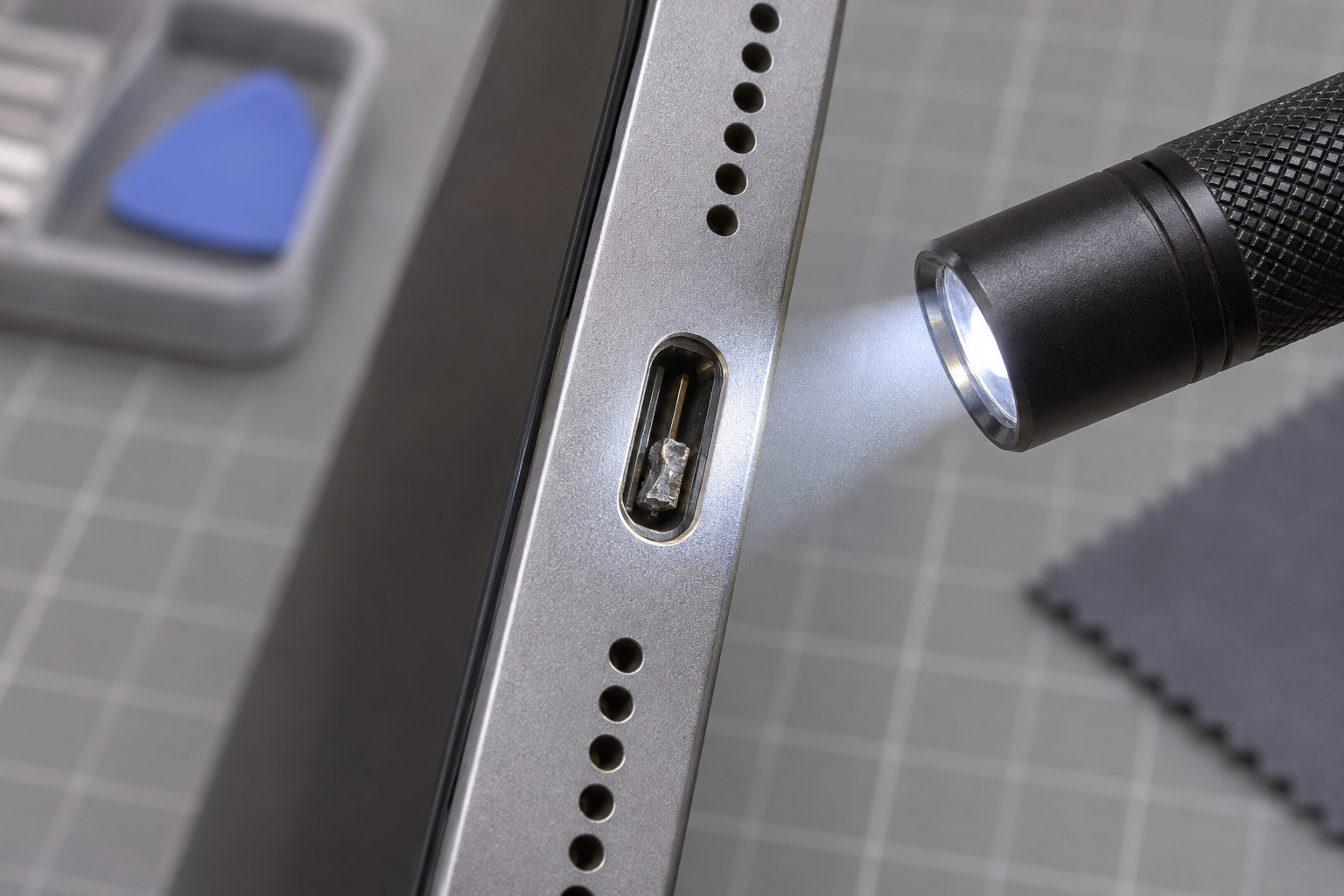
Check these three things:
- Which port you have. Recent iPads use USB-C, an oval port with a small tongue of contacts in the middle. Older models use Lightning, a slim slot with contacts along the inside walls. Knowing the shape helps you tell the broken piece from the port itself.
- What’s actually in there. A snapped tip looks like a flat metal or plastic surface sitting in the opening, often with the cable’s plastic shell or a jagged edge visible. Packed lint looks like a dark, fuzzy plug instead. Lint on its own doesn’t mean a piece broke off, but it can sit behind a fragment and make it harder to see.
- Whether anything sticks out. A piece that stands proud of the opening, even by a millimeter, is the only kind worth a careful try at home. A piece that’s flush with the opening or recessed below it is a job for a technician.
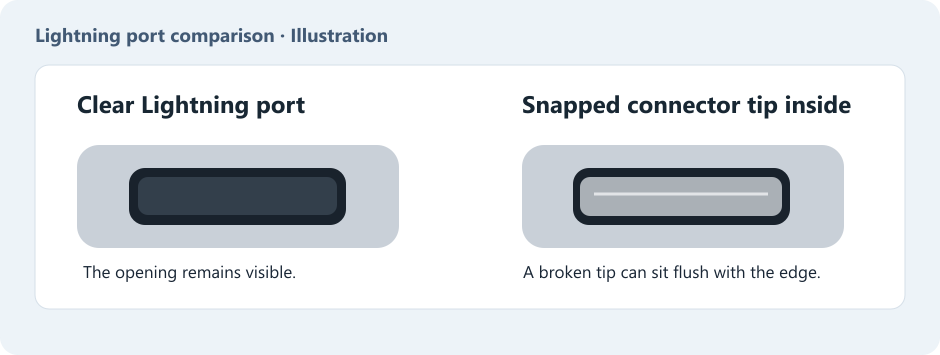
If you can’t tell what you’re looking at, treat it as a stuck fragment and skip to the service section. Guessing wrong here is how ports get damaged.
What Never to Do
Popular online fixes include several methods that can turn a removal into a port replacement or worse. Skip all of these:
- Metal objects: needles, safety pins, paper clips, SIM eject tools, metal tweezers or knife tips. Bare metal in a port full of contacts can short them and scratch or bend the parts that hold a cable in place. Powering off reduces the risk but doesn’t remove it.
- Glue of any kind: super glue, epoxy or hot glue on a toothpick or a stick. Glue can run into the port and set there, which turns a removable fragment into a permanently blocked port.
- Drilling or cutting into the broken plug to get a grip on it.
- Compressed air, liquids and sprays. Apple’s cleaning guidance for Apple products says not to use compressed air or aerosol sprays on an iPad and to avoid getting moisture in any openings. That rules out alcohol, contact cleaner and blowing hard into the port.
- Force. Prying, twisting or levering against the edges of the port can crack the port housing or the case around it.
- Another cable as a ram. Pushing a new connector in on top of the broken one drives the fragment deeper.
If liquid got into the port as well, deal with that first: the advice on how to dry an iPhone and its charging port covers safe drying steps that apply to a wet port too.
A Careful Try When a Piece Sticks Out
Apple doesn’t publish instructions for removing a broken connector, and any home attempt is at your own risk. It can still damage the port or the contacts, and that damage may cost more to fix than the original problem. Only consider this if a piece clearly sticks out of the opening and you can grip it without reaching into the port.
What to use: plastic-tipped or other non-conductive tweezers, nothing metal. If you only have metal tweezers, don’t use them; book service instead.
- Make sure the iPad is shut down and no cable is connected anywhere.
- Rest the iPad flat on a soft cloth with the port facing you, under bright light.
- Grip only the part of the fragment that sticks out. Don’t push the tweezer tips into the port to get a better hold.
- Pull straight out, in line with the port, with light, steady pressure. No wiggling, twisting or prying.
- If it doesn’t move with gentle pressure, stop. Don’t try again with more force.
The stop rule matters most. A tip that doesn’t come out easily is often caught on the port’s internal parts, and more force is how those parts get bent. One gentle attempt, and if it fails, the iPad goes to a technician.
When to Stop and Get Apple Service
For most broken tips, service is the right answer from the start. Get help if any of these are true:
- The piece is flush with the opening or below it.
- You can’t see clearly what’s inside.
- A gentle straight pull didn’t move it.
- The port looks bent, scorched or cracked, or the iPad got wet.
- The iPad is covered by AppleCare and you don’t want to risk anything that might complicate a claim.
Apple’s iPad repair and service page lists the options:
- In person at a Genius Bar in an Apple Store. You can book ahead by starting a service request on Apple’s support site.
- An Apple Authorized Service Provider, an independent repair shop Apple has authorized. Apple notes that these providers can set their own service fees and will give you their own estimate.
- Mail-in service, where Apple can send you a prepaid box so you don’t need an appointment.
Before you go, check your coverage. Apple’s page says the Apple Limited Warranty covers manufacturing issues for one year and doesn’t cover accidental damage. AppleCare plans can cover accidental damage for a service fee, according to Apple’s Express Replacement Service page, and you can check an iPad’s status by serial number on Apple’s coverage check site. A cable that snapped because it was bent or yanked usually counts as accidental, so expect the technician to tell you whether removal is simple or the port needs a repair, and what each will cost. Apple’s repair page has a cost estimator by iPad model, but it doesn’t list a price for removing a stuck tip; Apple inspects the iPad to set the final fee.
Back up the iPad if you can before handing it over. If the battery still has charge, an iCloud backup on the iPad runs over Wi-Fi and doesn’t need the port at all.
After the Piece Is Out
Once the port is clear, look in again with a light to make sure no small bits or plastic shell fragments are left behind. Then test charging the way Apple’s page on what to do if your iPad won’t charge describes:
- Use a different cable, ideally the one that came with the iPad, and a power adapter you know works. Don’t reuse the cable that broke.
- Plug it in and watch for the charging sign: a lightning bolt next to the battery in the status bar, or a large battery icon on the Lock Screen.
- If nothing happens, try another adapter or a different cable, and make sure the iPad isn’t too hot or too cold.
- Still nothing? Force restart the iPad. On an iPad without a Home button, press and quickly release the volume button nearest the top button, press and quickly release the other volume button, then press and hold the top button until the iPad restarts. On an iPad with a Home button, press and hold the top button and the Home button together until the Apple logo appears.
If the iPad still won’t charge or the cable only works at a certain angle, the port may have been damaged by the break or the removal. That’s a repair for Apple or an authorized provider, not something to keep testing. If the battery ran flat while the port was blocked, use these signs that a dead iPad is charging before you decide the port is damaged.
How to Keep It From Happening Again
Connectors usually snap because of stress at the plug end. A few habits make it much less likely:
- Pull the plug, not the cord. Grip the connector housing when you unplug.
- Keep the cable straight. Using the iPad propped on a pillow with the cable bent sharply at the port puts all the strain on the tip. A right-angle cable or a stand helps when you use the iPad while charging.
- Replace damaged cables early. A frayed, bent or loose connector is more likely to snap the next time it’s stressed.
- Use quality cables. Stick with the cable that came with your iPad, an Apple cable, or a third-party cable certified for Apple devices (for Lightning, look for MFi certification on the packaging). Very cheap cables are a common source of weak connectors.
- Keep the port clean and dry. Lint buildup can stop a cable from seating fully, which tempts you to push harder or hold it at an angle.
Broken Charger Tip Questions
Can I get a broken charger out of an iPad myself?
Only in one case: a piece clearly sticks out and comes free with a gentle, straight pull using non-conductive tweezers, at your own risk. Anything flush, recessed or stuck should go to Apple or an authorized provider.
Is it safe to use super glue to pull out the broken piece?
No. Glue can flow into the port and harden around the contacts, which leaves you with a port that has to be replaced instead of a fragment that could have been removed.
Does AppleCare cover a snapped cable tip?
The standard Apple Limited Warranty doesn’t cover accidental damage. An AppleCare plan with accidental damage coverage may (a service fee usually applies), so check your coverage by serial number before booking and ask Apple what your plan includes.
Will Apple remove it without replacing the iPad?
Apple doesn’t list a price for this specific job, and its repair page says Apple inspects the device to set the final fee. A technician who looks at the port can tell you whether the piece can be removed or the port needs repair, so ask for the estimate before agreeing to any work.
Can I keep using the iPad while I wait for a repair appointment?
Yes, on battery, as long as nothing is plugged into the port. Turn on Low Power Mode, lower the screen brightness and avoid heavy apps to make the charge last until your appointment.
If the piece is flush or didn’t move on the first gentle pull, start a service request with Apple now. The sooner a technician sees it, the fewer chances there are for the port to get worse.

Matthew Burleigh is the founder, head writer, and editor of Solve Your Tech, which he launched in 2012. He has written technology tutorials since 2008 and worked in IT since 2003, including small-business support, IT management, and consulting. He holds Bachelor’s and Master’s degrees in Computer Science from Arizona State University.
Matthew writes practical guides for Windows, iPhone and iPad, Microsoft Office, Outlook, Google apps, and Android. Solve Your Tech’s guides are checked step by step against the device or app maker’s own documentation and tested on his own devices whenever he has the hardware or software, with clear steps, sources, and update dates.
Read more about Matthew and how Solve Your Tech writes and updates its guides, or report a correction.