If a USB drive doesn’t show up in File Explorer, first plug it into a different USB port directly on the computer, ideally one on the back of a desktop PC, and try another cable if it uses one. If Windows still doesn’t show it, open Disk Management. A drive that appears there without a drive letter is the most common cause, and you can fix it in a minute.
This guide covers current Windows 11 releases (including version 26H2) and Windows 10, which reached the end of support on October 14, 2025. It follows Microsoft’s Disk Management guide, Disk Management troubleshooting page and Device Manager driver guide. Work through the sections in order. The early steps are quick and safe, and the last ones can erase data, so copy anything important off the drive as soon as Windows can read it.
Step 1: Quick Checks
- Try a different USB port. Front-panel ports and hubs sometimes do not supply enough power. Plug directly into a port on the computer, not a hub or dock.
- Try a different cable if it is an external hard drive or SSD, and connect its power adapter if it has one.
- Test the drive on another computer. If it does not work anywhere, the drive itself may have failed.
- Unplug other USB devices in case of a power or port conflict.
- Restart the PC with the drive unplugged, then plug it back in. For an external drive with its own power, turn the drive off and on too.
- Listen and look. A drive light or a Windows connection sound means the PC sees something, which points to a software fix.
Step 2: Find the Drive in Disk Management
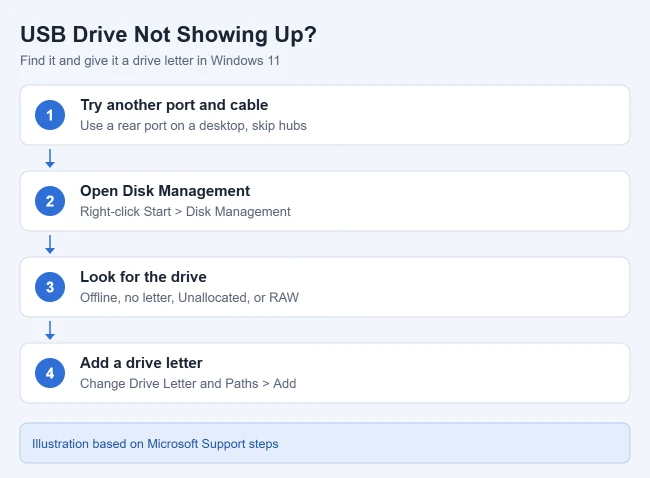
- Right-click the Start button and select Disk Management. You can also press Windows + R, type
diskmgmt.msc, and select OK. - Look in the lower half of the window for your USB drive. It is often labeled Removable, and its size should match the drive. If you plugged it in after opening Disk Management, select Action > Rescan Disks.
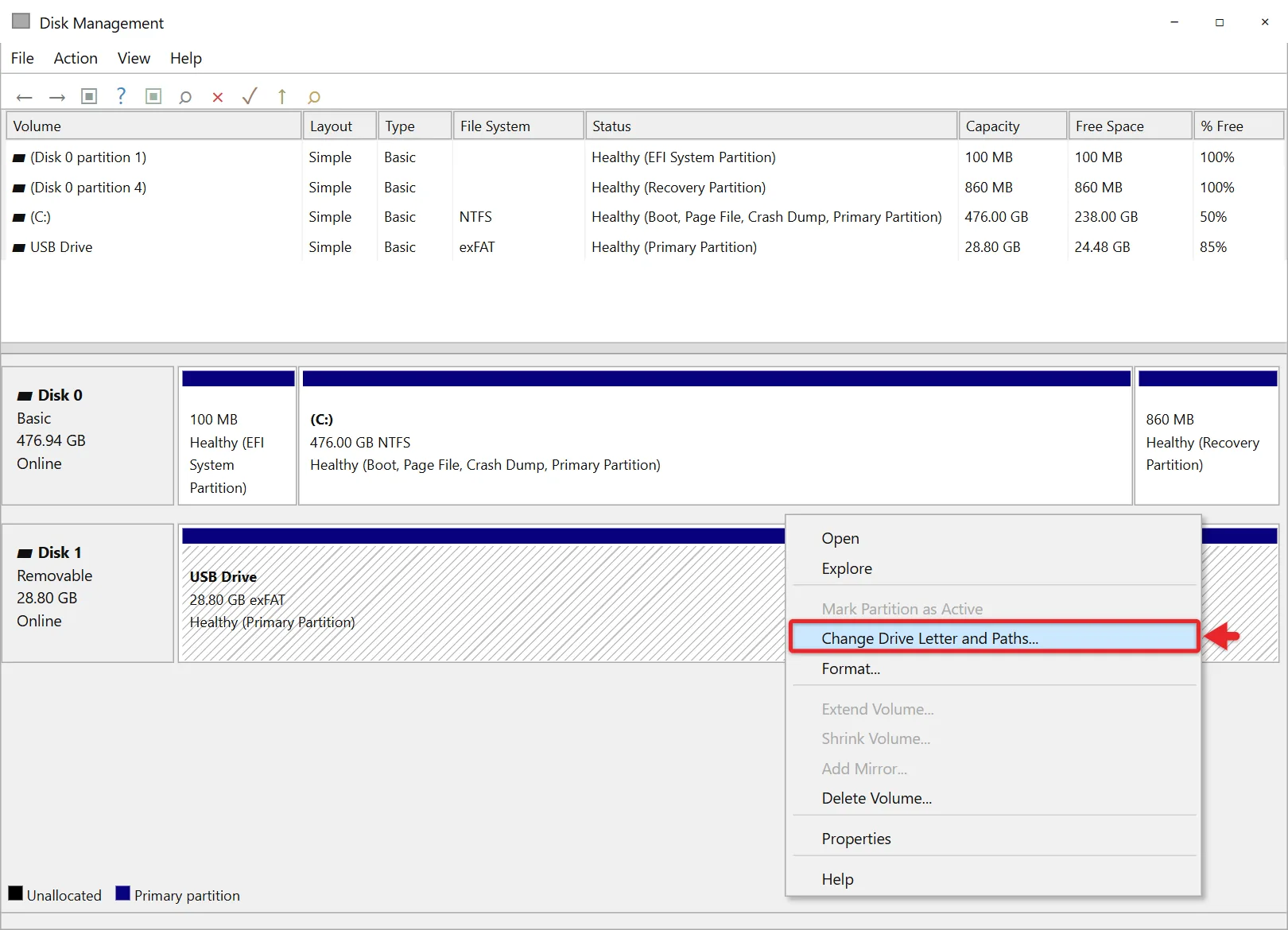
- Check how it is listed and use the matching fix below.
| What you see | What it means and what to do |
|---|---|
| A partition with no drive letter | Windows sees the drive but has not assigned a letter. Add one (next section). |
| Offline | Right-click the disk and select Online. |
| Not Initialized | May be a new disk, corrupted layout or hardware problem. Initialize only a confirmed empty disk; recover important old files first. Some USB devices do not support initialization. |
| Unallocated | Windows sees no volume here. Create a volume only on space you know is empty; do not do this when recovering old files. |
| RAW | The file system is damaged or unknown. Try to recover files before formatting. |
| No Media | Usually an empty card reader, or a drive that has failed. Insert the card or test the drive elsewhere. |
| Not listed at all | Windows does not detect the drive. Move on to Device Manager. |
Assign a drive letter
- Right-click the drive’s partition and select Change Drive Letter and Paths.
- Select Add (or Change if a letter exists but conflicts with a network drive), pick a letter, and select OK. The drive appears under This PC in File Explorer.
If Change Drive Letter and Paths is grayed out, the space is unallocated or you are not signed in as an administrator.
Create a new volume on unallocated space
Before creating a volume: make sure the disk is new and empty. If it held files you need, stop and plan recovery; initializing, creating a volume and formatting can erase data. For a new blank SSD or hard drive, follow the Windows 11 disk initialization and volume setup guide.
Right-click the unallocated area, select New Simple Volume, and follow the wizard: accept the maximum size, pick a drive letter, and choose a format. For a flash drive you will use on other devices, you can format it to FAT32.
Step 3: Reinstall the Drive in Device Manager
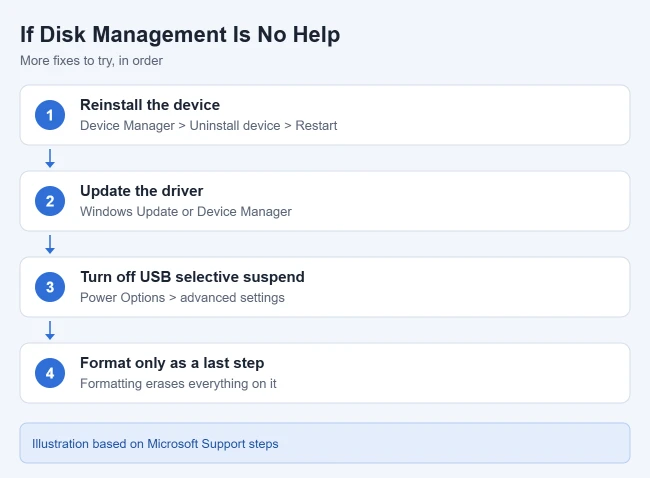
- Right-click Start and select Device Manager.
- Expand Disk drives or Universal Serial Bus controllers. A yellow warning icon marks a device with a problem.
- Save your work and identify the specific USB drive whose driver needs reinstallation. Right-click only that entry, select Uninstall device, and confirm with Uninstall. Do not uninstall unrelated entries or all USB controllers. Keep another input method available if the affected hardware supplies your keyboard or mouse.
- Restart the PC and reconnect the drive if needed. Windows attempts to reinstall its driver, but this does not always work. You can also select Action > Scan for hardware changes in Device Manager. Check whether the drive opens.
If the driver does not come back, right-click the device and select Update driver > Search automatically for drivers. Windows Update is the best way to get drivers, so also check Settings > Windows Update > Advanced options > Optional updates. If the problem started after an update, open the device’s Properties, select the Driver tab and choose Roll Back Driver if it is available. For USB controller drivers, your PC maker’s support site is another source.
Enable a Disabled USB Device in Windows 11
Error Code 22 means the device is disabled. To turn it back on:
- Right-click Start and select Device Manager.
- Expand Universal Serial Bus controllers, or Disk drives for the drive itself.
- Right-click the device, select Properties, and read the status on the General tab.
- If the status shows Code 22, close Properties, right-click the device, and select Enable device. If the menu shows Disable device instead, it is already enabled.
- Reconnect the drive and check File Explorer and Disk Management.
Enable only the device you are fixing. Changing every USB controller can disconnect your keyboard and mouse.
Step 4: Check Repeated USB Disconnections
For repeated disconnections, try a direct port, a known-good cable and adequate power before assuming a power-setting fault. Leave USB selective suspend enabled, which is Microsoft’s recommendation; disabling it globally is not a routine fix. If the manufacturer directs a temporary, device-specific diagnostic change, record the previous setting and restore it after testing.
Step 5: Repair or Format the Drive
If the drive shows a letter but will not open, or File Explorer says it needs to be formatted, try a repair first. In File Explorer, right-click the drive, select Properties > Tools, and under Error checking select Check. If that fails and the files do not matter, format it: right-click the volume in Disk Management and select Format.
For more repair options, including the command line, read about running CHKDSK in Windows 11.
Warning: formatting destroys the data on the drive. If the files are important, try recovery first or contact a recovery service. A quick format only creates a new file table, while a full format erases the data.
Other Things That Can Hide a Drive
- Encryption: a BitLocker-encrypted drive asks for its password or recovery key before it opens.
- Work or school PCs: your organization may block USB storage. Ask your IT department.
- Mac-formatted drives: drives formatted for a Mac (APFS or Mac OS Extended) can show up in Disk Management but not open in Windows. Back up the files on a Mac before reformatting.
- Empty card readers: File Explorer hides empty drives by default, so a card reader can vanish until a card is inserted. To show them, select See more (three dots) > Options > View in File Explorer and clear Hide empty drives.
- Write protection: some SD cards and adapters have a small lock switch. In the locked position the drive opens but rejects changes.
How to Confirm the Fix Worked
Open File Explorer, select This PC, and look under Devices and drives. Open a file you know is on the drive. When you are done, right-click the drive and select Eject before unplugging it.
Frequently Asked Questions
Where does a USB drive appear when it works?
Under This PC in File Explorer. For more detail, read about opening a USB drive on Windows 11.
Can I recover files from a RAW drive?
Sometimes. Do not format the drive or run repairs that write to it first if the files matter.
Why does the drive disconnect randomly?
A loose or faulty cable, insufficient power, a port fault or a driver problem can cause repeated disconnects. Test a direct port and a cable you know works, then follow Step 4.
Why does the drive show up on another PC but not mine?
That points to a port, driver, or drive letter problem on your PC rather than a failed drive. Work through Steps 2 to 4.
Once the drive shows up, you can put files on the flash drive. If it’s a camera or its memory card that won’t appear, follow the steps for transferring photos from a camera to a Windows 11 PC.

Matthew Burleigh is the founder, head writer, and editor of Solve Your Tech, which he launched in 2012. He has written technology tutorials since 2008 and worked in IT since 2003, including small-business support, IT management, and consulting. He holds Bachelor’s and Master’s degrees in Computer Science from Arizona State University.
Matthew writes practical guides for Windows, iPhone and iPad, Microsoft Office, Outlook, Google apps, and Android. Solve Your Tech’s guides are checked step by step against the device or app maker’s own documentation and tested on his own devices whenever he has the hardware or software, with clear steps, sources, and update dates.
Read more about Matthew and how Solve Your Tech writes and updates its guides, or report a correction.