Your iPhone’s warranty is about to run out, or you’re selling the phone, and you need to know exactly when it was bought. The fastest check is Apple’s Check Coverage page with your serial number, but Apple’s dates are estimates built from its own records. For the exact day, the receipt is your proof, and Apple will fix its record if you send one.
What Apple Shows and What It Doesn’t
People asking “when did I get my iPhone?” usually mean one of three dates, and they aren’t the same thing:
- Purchase date: the day the phone was sold. Apple’s coverage tools are built on this, using the date of purchase information Apple has for that serial number.
- The day you got it: when you unboxed it, received it as a gift or first set it up. Apple doesn’t display a setup or activation date anywhere in Settings.
- Manufacture date: when the phone (or its battery) was made. Only newer models show anything like this, and only for the battery.
Apple says plainly that the estimated purchase date it uses “may be incorrect,” depending on when or whether the product was registered and where it was bought. That matters if you’re arguing a warranty claim or writing a resale listing. Here is how the routes compare:
| Method | Where | What you get | How exact |
|---|---|---|---|
| Check Coverage | checkcoverage.apple.com | Coverage status and dates tied to Apple’s estimated purchase date | Estimate |
| AppleCare & Warranty | Settings > General on the iPhone | Coverage expiration date | Estimate |
| Receipt or order email | Apple, carrier or store | The actual sale date | Exact |
| Battery Health dates | Settings > Battery (iPhone 15 and later) | Battery manufacture date and date of first use | Close clue for age |
| Model number | Settings > General > About | The year the model came out | Rough |
Find Your iPhone’s Serial Number
Check Coverage and Apple Support both work from the serial number, so get that first. On the iPhone:
- Open Settings.
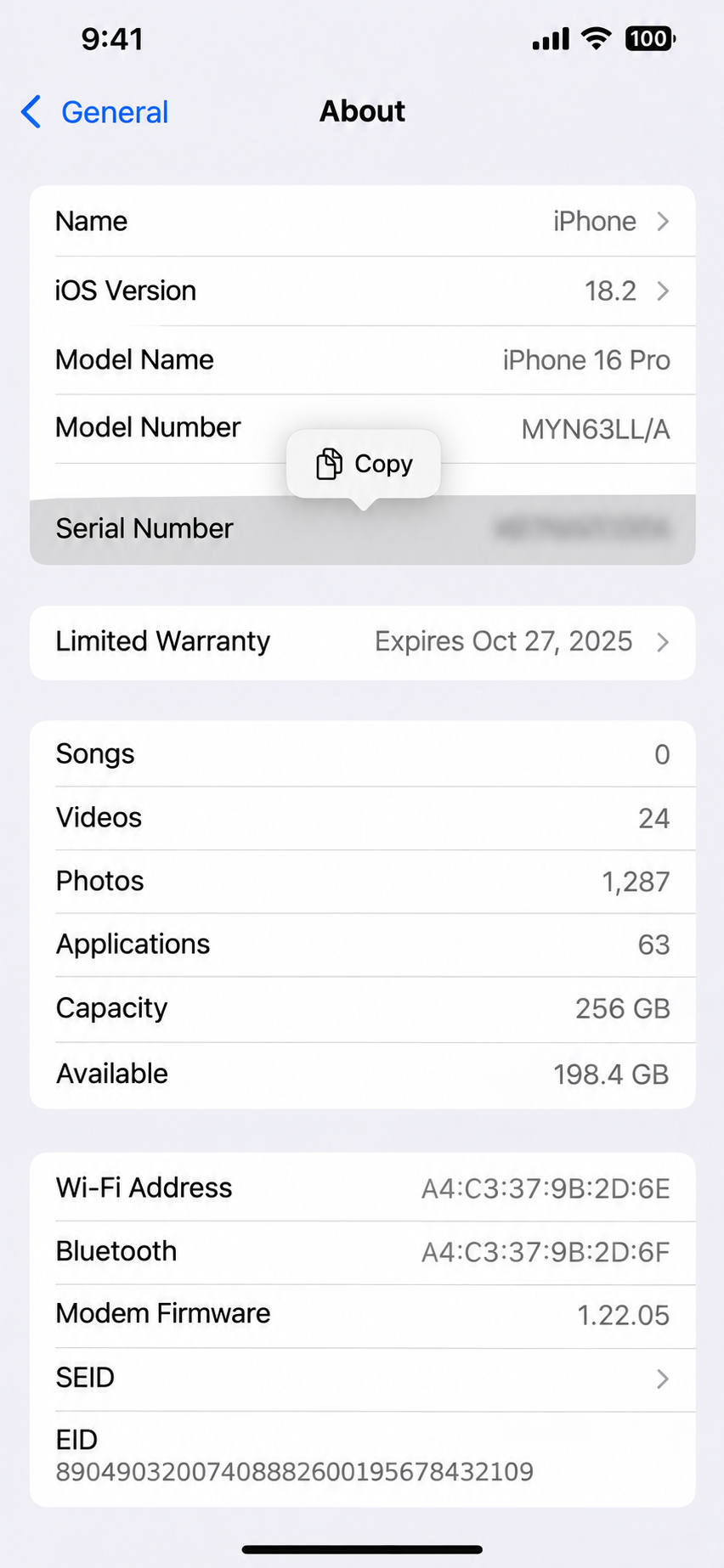
- Tap General, then About.
- Find Serial Number in the list. Touch and hold it, then tap Copy so you can paste it instead of typing it.
If the phone won’t turn on, is erased, or you don’t have it with you, Apple lists other places to find the serial number:
- On a computer: connect the iPhone, select it in Finder on a Mac (macOS Catalina or later) or in the Apple Devices app on a Windows PC, and on the General tab click the model name until the serial number appears.
- On the web: sign in at account.apple.com and open Devices, then select the iPhone. This list shows the device and its serial number, not a purchase date.
- On another Apple device: on an iPhone or iPad signed in to the same Apple Account, go to Settings, tap your name and pick the phone from the device list.
- On the box: the barcode label on the original packaging lists the serial number.
- Before setup: on the “Hello” screen, tap the Info button in the bottom right corner.
Don’t rely on the SIM tray. On some older models the tray is engraved with the IMEI, which is a different number, and iPhone 14 and later models have no engraving there at all. Apple’s page on finding the serial number, IMEI and EID walks through each location.
One caution: the serial number pulls up your coverage for anyone who has it, so avoid posting it publicly in a listing photo or a forum. Share it with a buyer privately when they ask.
Check the Date on Apple’s Check Coverage Page
This works from any browser, and you don’t need the iPhone in your hand once you have the serial number.
- In a browser, go to checkcoverage.apple.com.
- Paste or type the serial number in the serial number box.
- Type the characters from the verification image into the code box, then click Submit. You can also choose Sign In and use your Apple Account instead.
- Read the results for your iPhone: whether the Limited Warranty or an AppleCare plan is active, and the dates Apple has for that coverage.
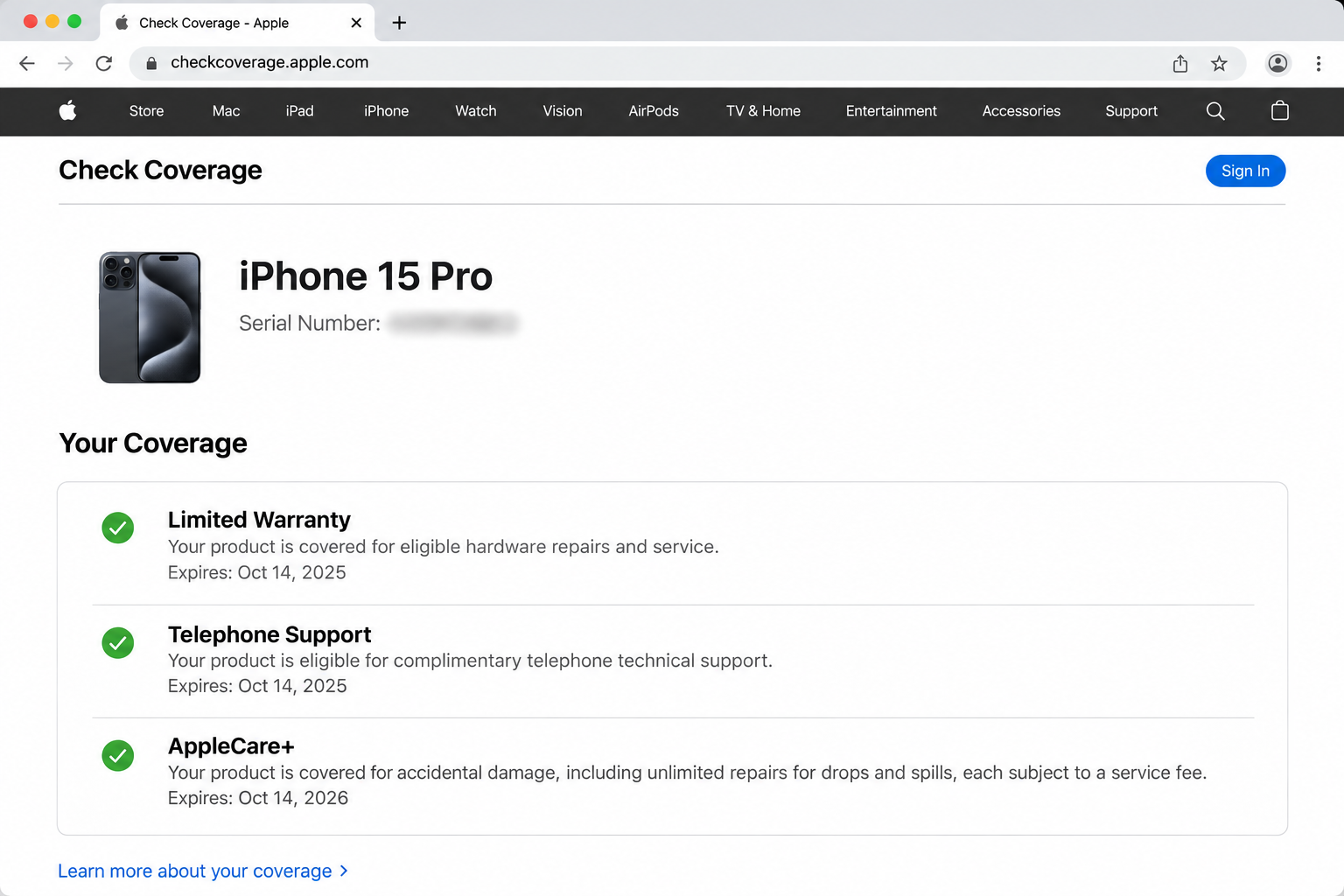
What the results page prints about the purchase date itself isn’t spelled out in Apple’s support documents. Depending on the device, you may see a purchase date, only coverage end dates, or a prompt to validate the purchase date. Whatever date appears, treat it as Apple’s estimate rather than a record of the day you paid.
If you only see a coverage end date, you can work backward. Apple’s standard Limited Warranty runs one year from purchase (two years in Turkiye). Say Jordan’s phone shows a Limited Warranty ending March 14, 2027, and no AppleCare plan was ever bought. That points to a purchase around March 14, 2026. The math breaks down when an AppleCare plan is on the phone, because the plan sets its own end date, and once coverage has lapsed the page may simply say it has expired, which tells you the phone is past its first year but not the day.
See Coverage on the iPhone Itself
You can check the same coverage information without a browser:
- Open Settings and tap General.
- Tap AppleCare & Warranty.
- Tap your iPhone in the list to see its coverage and the expiration date.
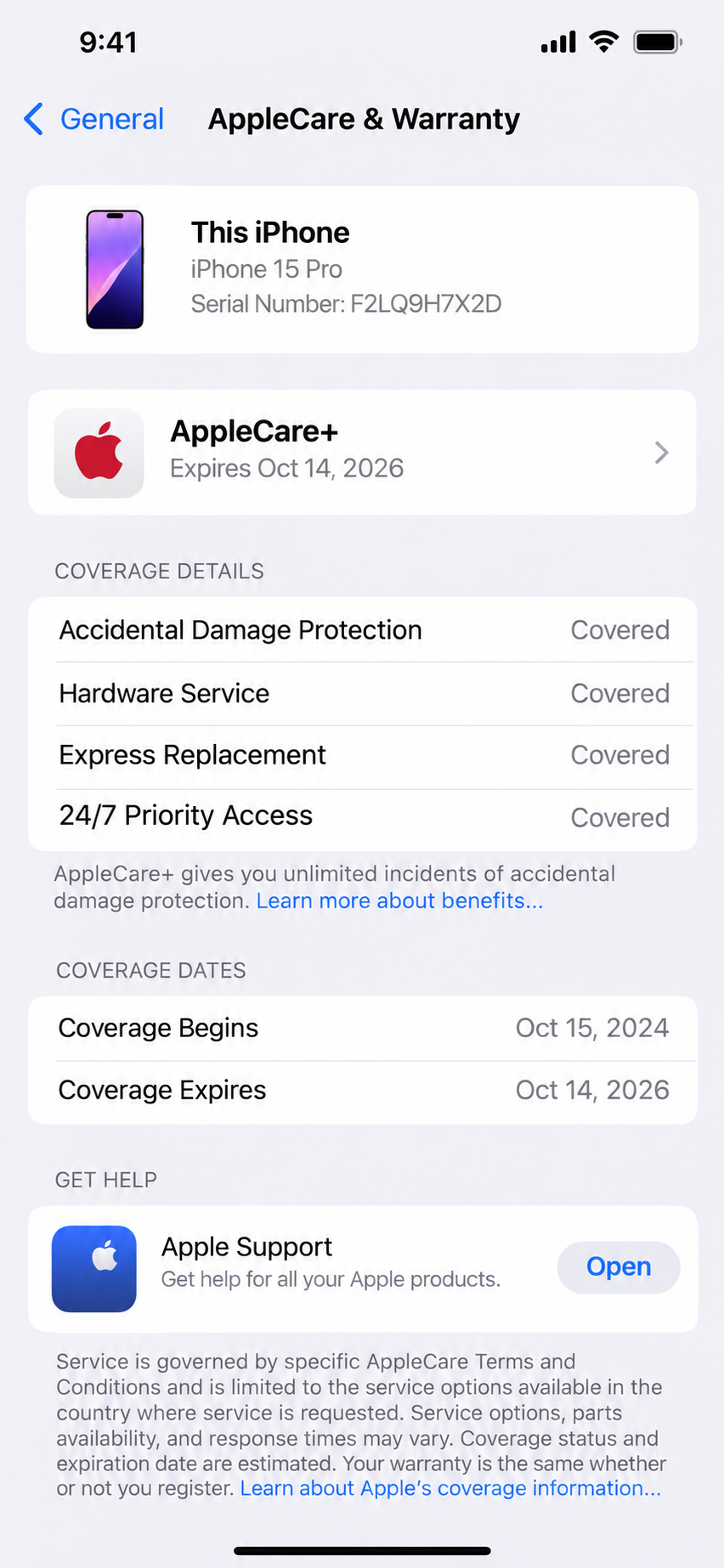
This is the path Apple documents for iPhone and iPad. Older iOS versions may label the screen differently, so if you don’t see AppleCare & Warranty, use Check Coverage instead. Apple’s warranty and AppleCare information page also covers the Mac version of the screen.
Need something to show a repair shop or an insurer? Sign in at mysupport.apple.com, choose the iPhone and select View Proof of Coverage. Apple notes that your Apple Account needs two-factor authentication turned on for proof of coverage to appear. If you can’t remember which account the phone uses, here’s how to find the Apple ID on an iPhone.
Get the Exact Date From a Receipt
The receipt gives you the actual date, and it’s also what Apple asks for if the estimate is wrong. Look in this order:
- Bought from Apple: search your email for the order confirmation or receipt from Apple, or sign in to your order history on Apple’s online store.
- Bought from a carrier: sign in to your carrier account and look at past orders, device upgrades or the start date of the installment plan for the phone. A carrier store may be able to reprint a receipt.
- Bought from a retailer: check the store’s online order history or the email receipt. Some stores can look up an in-store purchase from the card you paid with.
- No receipt at all: your bank or card statement will at least show the date and amount of the charge.
Your App Store purchase history won’t help here, since it covers apps and subscriptions rather than the phone. It’s still handy for other things, such as when you need to cancel subscriptions or review purchase history on an iPhone.
Estimate How Old the Phone Is
If you’re after “when did I get this?” rather than a sale date, two clues on the phone help.
Battery dates on iPhone 15 and later. On an iPhone 15 or later model running iOS 17.4 or later, open Settings > Battery > Battery Health. Apple lists the battery’s manufacture date and its date of first use there, along with maximum capacity and cycle count. On a phone you bought new, the date of first use is the closest thing to a “got it” date Apple shows. iPhone 14 and earlier models show Battery Health & Charging without those dates (see Apple’s iPhone battery and performance page). For older phones, checking iPhone battery health still tells you how worn the battery is, even without a date.
The model’s release year. In Settings > General > About, note the model name, then match it on Apple’s Identify your iPhone model page, which lists the year each model was introduced. Your phone can’t be older than that.
Your oldest photos or first backup can hint at timing, but photos synced from iCloud may come from an earlier phone, so use them only as a rough clue. Skip tricks that read the year from one character of the serial number; they don’t work on recent iPhones, and third-party serial lookup sites aren’t Apple records.
When the Date Is Wrong: Update It With Proof of Purchase
If Check Coverage shows a date that doesn’t match your receipt, you can ask Apple to correct it. Apple’s proof of purchase page has a link to start the request, and the receipt you upload needs to clearly show:
- a description of the device
- the date you bought it
- the invoice or receipt number
- the price
- the seller’s contact details
- the serial number
Some carrier and retailer receipts leave out the serial number, so ask the seller for an itemized copy that includes it before you upload. Apple also notes that recently submitted information can take some time to show on the coverage page, so give it some time and check again before you submit a second request.
Used, Refurbished, Gifted or Replacement iPhones
Apple’s record follows the serial number, not the person holding the phone. That changes what the date means:
- Gifted: the date reflects when the giver bought it, which may be weeks before you opened it.
- Bought used: you’ll see the first owner’s coverage dates, and the warranty may already be over. Ask the seller for the original receipt if warranty matters to you.
- Refurbished or replacement units: coverage on these can follow different dates from the original sale, so check the new serial number on Check Coverage rather than assuming.
Before you buy a used iPhone, ask the seller for the serial number and run it through Check Coverage, which doesn’t require signing in, and make sure they turn off Find My iPhone before handing it over. The same Check Coverage page works for other Apple gear, too; here’s where to find an Apple Watch serial number if you want to check a watch at the same time.
iPhone Purchase Date Questions
Does Apple show the date I first activated my iPhone?
No. Apple doesn’t document any activation or “first registered” date in Settings > General > About, despite older advice that says otherwise. On an iPhone 15 or later, the battery’s date of first use is the nearest substitute; on older models, rely on your receipt.
Does registering my iPhone extend the warranty?
No. Apple says registering a product doesn’t change its warranty coverage. Coverage depends on the purchase date, which is why a correct receipt matters more than registration.
Will erasing or restoring the iPhone change the date?
Apple doesn’t address this directly, but Check Coverage looks up the serial number in Apple’s records rather than reading anything stored in iOS, so erasing the phone shouldn’t change what it shows.
Does this work for an iPad or Mac?
Yes. The same Check Coverage page and AppleCare & Warranty screen cover iPad and Mac as well, and the same estimate rules apply. On a Mac, the screen is under System Settings > General > AppleCare & Warranty.
If the date Apple shows looks right, screenshot it or save the proof of coverage with your receipt. If it looks wrong, find the receipt now and send it to Apple before you need a repair.

Matthew Burleigh is the founder, head writer, and editor of Solve Your Tech, which he launched in 2012. He has written technology tutorials since 2008 and worked in IT since 2003, including small-business support, IT management, and consulting. He holds Bachelor’s and Master’s degrees in Computer Science from Arizona State University.
Matthew writes practical guides for Windows, iPhone and iPad, Microsoft Office, Outlook, Google apps, and Android. Solve Your Tech’s guides are checked step by step against the device or app maker’s own documentation and tested on his own devices whenever he has the hardware or software, with clear steps, sources, and update dates.
Read more about Matthew and how Solve Your Tech writes and updates its guides, or report a correction.