To change your PIN on Windows 11, open Settings > Accounts > Sign-in options, select PIN (Windows Hello), and select Change PIN. Type your current PIN, enter the new PIN twice, and select OK. The new PIN works the next time you sign in or unlock your PC. If you forgot your current PIN, use I forgot my PIN instead.
These steps apply to your own account on Windows 11 Home and Pro. Windows 10 uses the same path, but Microsoft ended support for Windows 10 on October 14, 2025, so it no longer gets security updates. Your PIN is part of Windows Hello, the sign-in system that also handles face and fingerprint sign-in.
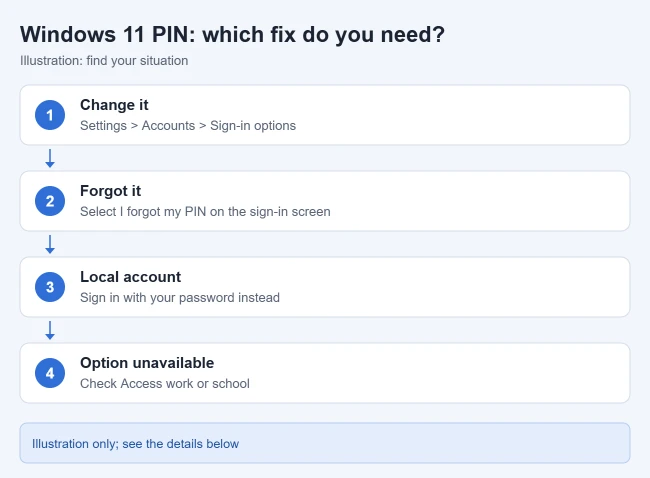
Know Your Account Type
- Know which kind of account you use. A Microsoft account signs in with an email address, and a local account exists only on this PC. The forgotten-PIN steps differ for each. Not sure which one you have? Open Settings > Accounts > Your info. A Microsoft account shows its email address there, and a local account shows Local account.
- Be signed in to your own account. Each Windows account has its own PIN, and you can only change the PIN for the account you are using.
- Have your password handy in case Windows asks you to confirm it. Your PIN and your Microsoft account password are separate, and changing one doesn’t change the other.
Change Your Windows 11 PIN
You need to know your current PIN for this method. The whole process takes less than a minute.
- Press Windows key + I to open Settings. You can also right-click the Start button and select Settings.
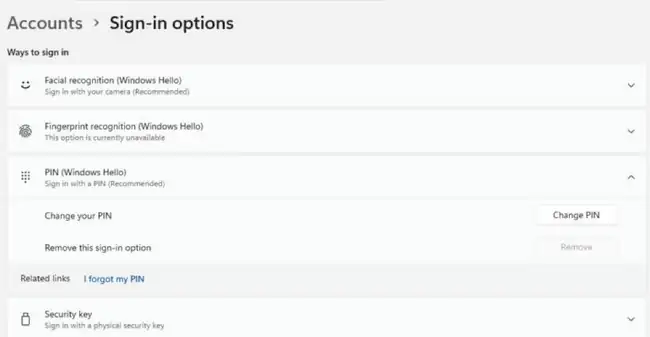
- Select Accounts in the left pane, then Sign-in options on the right.
- Under Ways to sign in, select PIN (Windows Hello) to expand it.
- Select Change PIN. A Windows Security box opens.
- Type your current PIN in the PIN box, then type your new PIN in both the New PIN and Confirm PIN boxes.
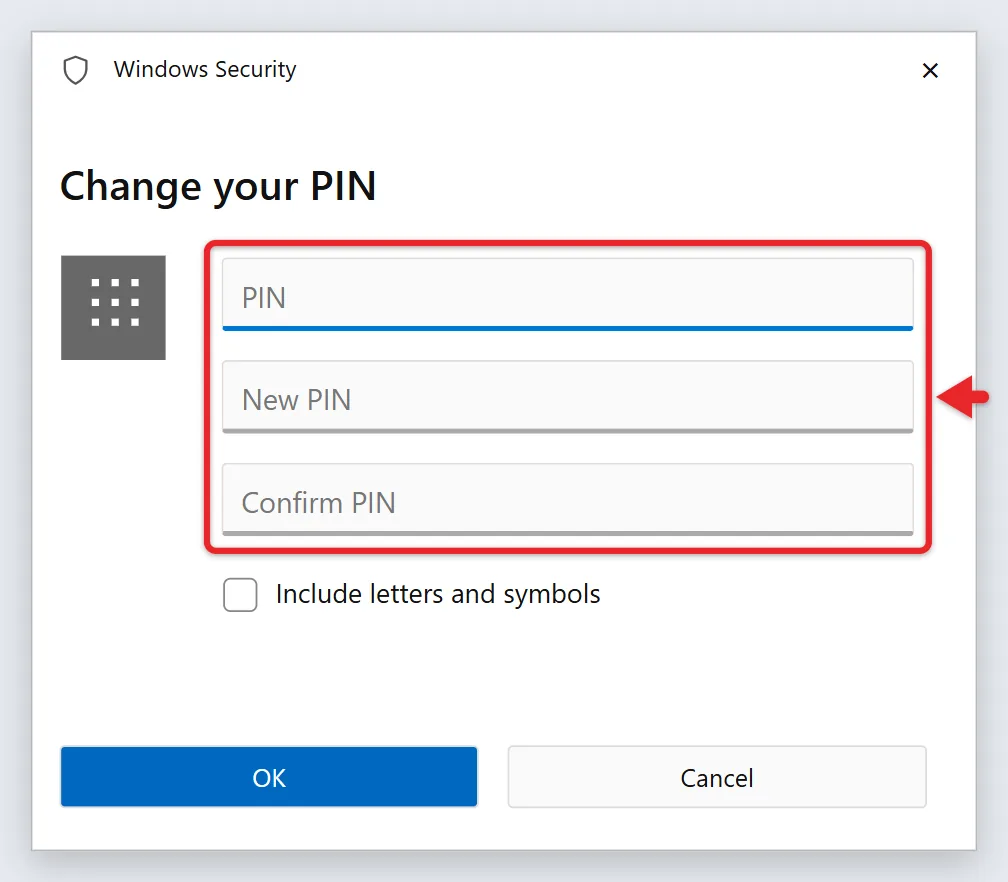
- Optional: check Include letters and symbols if you want a PIN that isn’t only numbers.
- Select OK. Windows saves the new PIN right away.
To check that it worked, press Windows key + L to lock your PC, then sign back in with the new PIN.
Shortcut: press Windows key + R, type ms-settings:signinoptions, and press Enter to jump straight to Sign-in options. Microsoft lists this shortcut on its PIN help page.
If you see Set up instead of Change PIN, your account doesn’t have a PIN yet. Select Set up, confirm your account password, and create a PIN.
Changing your PIN doesn’t touch your files, apps or settings.
Choose a Good PIN
- Length: a Windows Hello PIN must be at least four characters. Six or more digits are much harder to guess than four.
- Letters and symbols: checking Include letters and symbols turns the PIN into a short passphrase. It is stronger, but you’ll need to switch to the full keyboard on a touchscreen.
- Avoid patterns: skip 1234, repeated digits like 0000, and your birth year. If Windows says the PIN doesn’t meet the requirements, try a less predictable one.
- Work and school rules: your organization can require a longer PIN, letters, or regular changes. If a work PC rejects your new PIN, ask IT what the rules are.
If You Forgot Your PIN
On the sign-in screen (Microsoft account)
- On the sign-in screen, select I forgot my PIN under the PIN box. If several accounts use the PC, pick yours first.
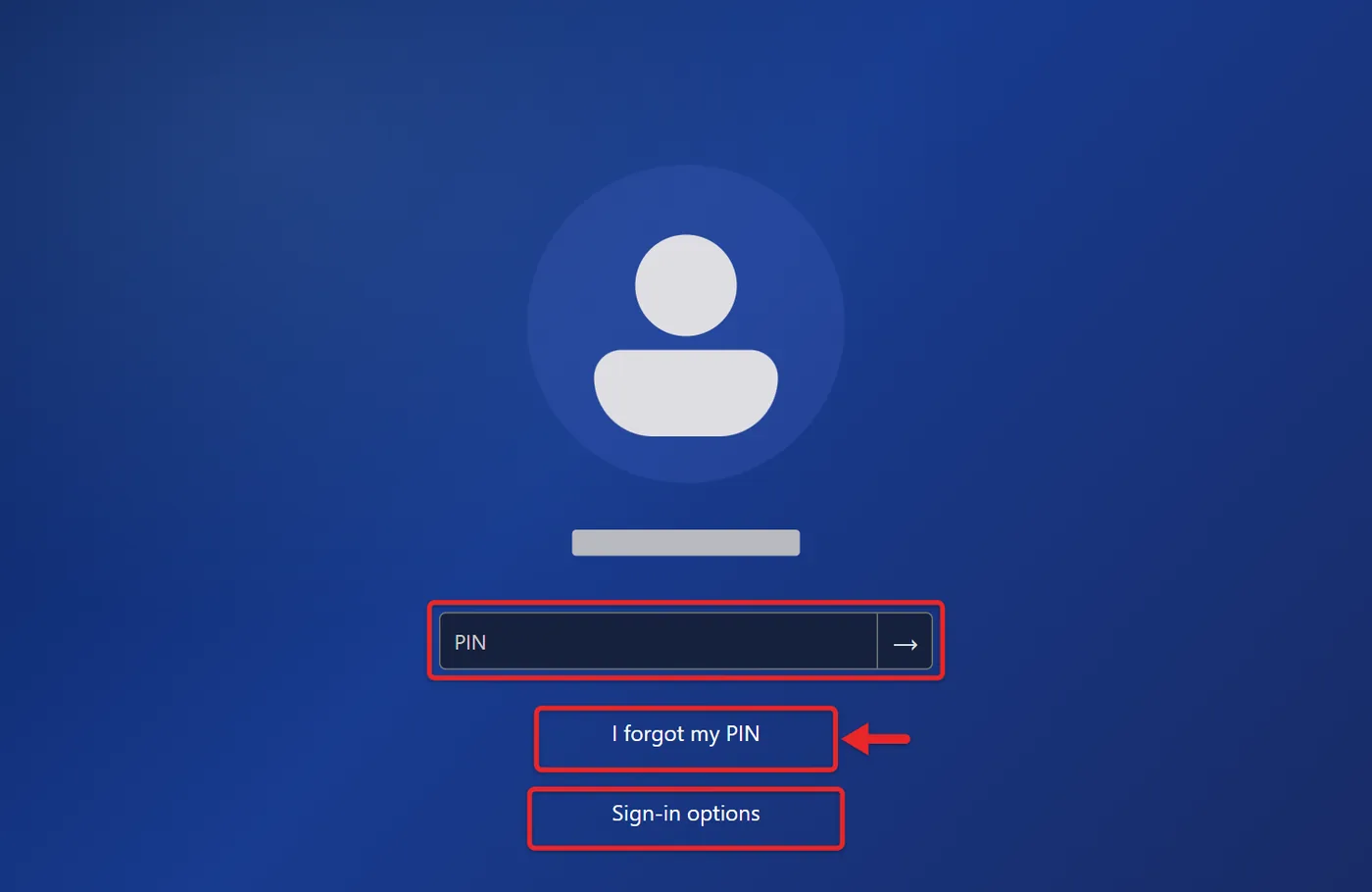
- Verify your Microsoft account with its password or a security code sent to your email or phone. This step needs an internet connection, so connect to Wi-Fi from the network icon on the sign-in screen if needed.
- Create a new PIN and confirm it.
The I forgot my PIN option on the sign-in screen only works for Microsoft accounts. The PIN help page has more detail.
With a local account, or if the link is missing
- On the sign-in screen, select Sign-in options, then the key icon to sign in with your password instead.
- Once you’re signed in, go to Settings > Accounts > Sign-in options > PIN (Windows Hello).
- Select I forgot my PIN, confirm your password, and create a new PIN.
If you forgot your password too
Reset the password first. For a Microsoft account, select I forgot my password on the sign-in screen, or use Microsoft’s account password reset page from any browser or phone. For a local account, type any password, select the arrow, then select OK and Reset password. Answer the security questions you set up when you created the account, or use a password reset disk if you made one. Then create a new PIN.
For more options, read how to change your password on Windows 11. If you’re not sure which account name you sign in with, here’s how to find your computer username in Windows 11.
Microsoft support agents can’t send password reset links or change account details for you, so use the official reset page instead of anyone who offers to do it.
- A work or school account is connected. Go to Settings > Accounts > Access work or school. If an organization account is listed on your personal PC and you no longer need it, select it, choose Disconnect, and restart. Don’t disconnect an account your employer or school requires, because you may lose access to email and files.
- Your organization manages the PC. PIN rules on work and school computers come from IT policy. Ask your IT department to reset or change it.
- You’re signed in to a different account. Each Windows account has its own PIN. Make sure you’re signed in to the account you want to change.
Example: Why Remove Was Grayed Out on One Laptop
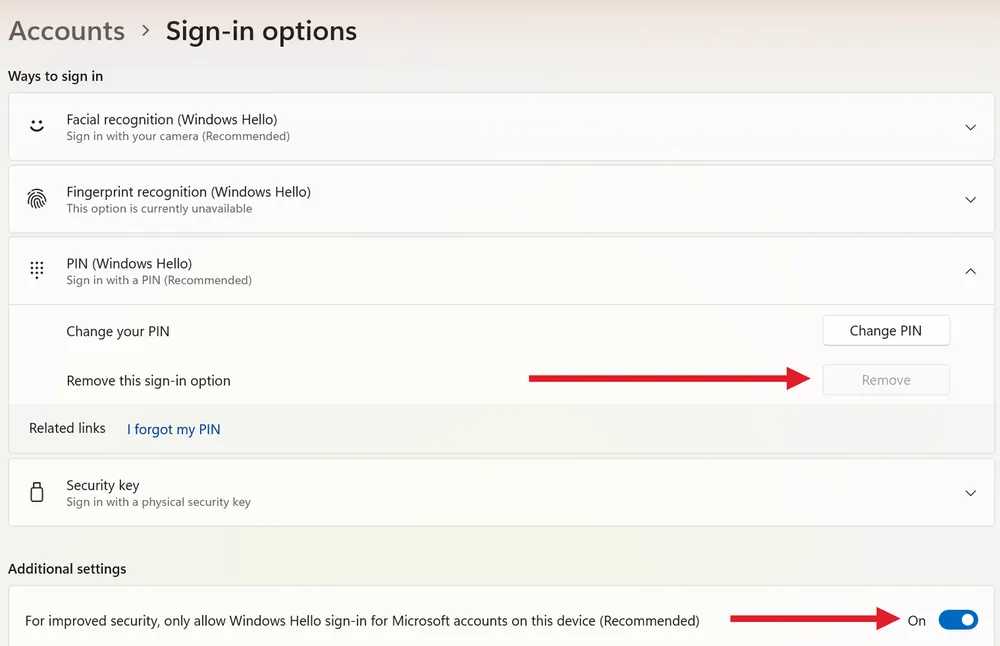
On an Alienware m16 R2 running Windows 11 Home 25H2 (OS build 26200.9711) signed in with a Microsoft account, Settings > Accounts > Sign-in options listed Facial recognition (Windows Hello), Fingerprint recognition (Windows Hello), PIN (Windows Hello) and Security key. Fingerprint showed “This option is currently unavailable,” because the laptop has no fingerprint reader.
Expanding PIN showed Change your PIN with an active Change PIN button, Remove this sign-in option with a grayed-out Remove button, and an I forgot my PIN link. Further down, For improved security, only allow Windows Hello sign-in for Microsoft accounts on this device (Recommended) was On. That setting is what kept Remove grayed out, as described in the Remove Your PIN Instead section below. It also grayed out If you’ve been away, when should Windows require you to sign in again?, with the note “Windows Hello is preventing some options from being shown.”
Changing the PIN doesn’t require turning that setting off. Only removing the PIN does.
If the New PIN Doesn’t Work
- Check Num Lock if you type numbers on a keypad. When it’s off, those keys won’t enter digits.
- Check the keyboard layout. The language icon on the sign-in screen shows the current layout. A different layout can change the characters you type, especially for PINs with letters and symbols.
- Use your password to get in. Select Sign-in options on the sign-in screen, sign in with your password, and set the PIN again.
- Windows asks you to type a phrase. After three wrong PIN attempts, Windows shows a message asking you to type A1B2C3 before you get one more try. Type it exactly, then enter the correct PIN. If you keep entering the wrong PIN, the PC makes you restart and then waits longer between tries, according to Microsoft’s Windows Hello FAQ. Stop guessing and use I forgot my PIN or your password instead.
Remove Your PIN Instead
- Go to Settings > Accounts > Sign-in options.
- Turn off For improved security, only allow Windows Hello sign-in for Microsoft accounts on this device. Leave Settings, then open Sign-in options again.
- Expand PIN (Windows Hello), select Remove, and confirm with your account password.
Removing the PIN also turns off face and fingerprint sign-in, so you’ll type your password each time. If the Remove button is grayed out, read about turning off the PIN on Windows 11.
PIN vs. Password: Why Windows Uses a PIN
Your PIN only works on the PC where you created it. Someone who learns it can’t use it to sign in to your Microsoft account online or on another device. The PIN is never sent over the internet and, on most PCs, is protected by the TPM security chip, which locks out repeated guessing. That’s why a short PIN can be safer than typing your full Microsoft account password on a laptop in public. Changing your PIN doesn’t change your Microsoft account password.
You don’t need to change your PIN on a schedule. Change it if you think someone has seen you type it, or if you shared it with someone who shouldn’t use the PC anymore.
Pressing Ctrl + Alt + Delete and choosing Change a password changes your account password, not your PIN. Use Sign-in options for the PIN.
Windows PIN Questions
How long can a Windows PIN be?
A Windows Hello PIN must be at least four characters. Longer PINs, or ones with letters and symbols, are harder to guess. Work and school PCs may require a longer PIN.
Can I use the same PIN on two PCs?
Yes, but you set it separately on each PC. A PIN is stored on one device and doesn’t sync between computers.
Do I need to restart after changing my PIN?
No. The new PIN works right away. Lock your PC with Windows key + L to test it. While you’re there, you can also change the Windows 11 lock screen.
Is my Windows PIN the same as a passkey PIN?
Your Windows Hello PIN can approve passkeys saved on this PC, so changing it changes what you type at those prompts too. A security key or a password manager may have its own separate PIN. The steps for using passkeys in Windows 11 explain the difference.
Can I remove the password and just use a PIN?
A Microsoft account always keeps its password, but you can sign in to Windows with only a PIN or face sign-in. To skip the password at startup, remove the password from Windows 11 sign-in.

Matthew Burleigh is the founder, head writer, and editor of Solve Your Tech, which he launched in 2012. He has written technology tutorials since 2008 and worked in IT since 2003, including small-business support, IT management, and consulting. He holds Bachelor’s and Master’s degrees in Computer Science from Arizona State University.
Matthew writes practical guides for Windows, iPhone and iPad, Microsoft Office, Outlook, Google apps, and Android. Solve Your Tech’s guides are checked step by step against the device or app maker’s own documentation and tested on his own devices whenever he has the hardware or software, with clear steps, sources, and update dates.
Read more about Matthew and how Solve Your Tech writes and updates its guides, or report a correction.