To forget a Wi-Fi network in Windows 11, open Settings > Network & internet > Wi-Fi > Manage known networks, find the network, and select Forget. Windows removes the saved network, including its password, and stops joining it automatically. To use it again, pick it from the Wi-Fi list and type the password.
These steps apply to current Windows 11 releases on a PC with a Wi-Fi adapter, and the Settings path is the same on Windows 10 (a short Windows 10 section is near the end). You do not need to be near the network to remove it in Settings.
Before you forget a network
Warning: forgetting a network deletes the password Windows saved for it. If you plan to rejoin later and do not know the password, look it up first.
- Open Settings and select Network & internet > Wi-Fi > Manage known networks.
- Select the network name to open its page.
- Next to Wi-Fi network password, select Show, then write the password down.
Microsoft describes this option in its guide to connecting to Wi-Fi in Windows. The label can differ on older Windows 11 versions, and some work or school networks do not use a simple password at all.
For the network you are connected to right now, the older Control Panel route also works: Network and Sharing Center, select the Wi-Fi connection, then Wireless Properties > Security > Show characters. The steps for finding saved passwords on Windows 11 cover the other places Windows keeps passwords.
Also note that if you forget the network you are using right now, your PC goes offline until you join a network again. If that network is a capped hotspot, it’s worth a look at your laptop’s data usage page before you forget it.
Forget a network in Settings
This is the method in Microsoft’s instructions, and it works for any saved network, whether it is in range or not.
- Press Windows key + I to open Settings. You can also select Start and then Settings, or see other ways to open Settings in Windows 11.
- Select Network & internet in the left pane.
- Select Wi-Fi. Select the row itself, not the on/off switch at its right edge.
- Select Manage known networks. A known network is one your PC has saved so it can rejoin without asking for the password. The list shows every saved network.
- Find the network. If the list is long, type part of the name in the search box above the list, or use the Sort by and Filter by menus to narrow it down.
- Select Forget on that network’s row. If you opened the network’s own page instead, it also has a Forget button.

The network drops out of the list right away, usually without a confirmation message. If Windows does ask you to confirm, select Forget again. The same path appears as a step in Microsoft’s Wi-Fi troubleshooting article.
Forget a nearby network from quick settings
Quick settings is the small panel that opens from the right end of the taskbar. It only lists networks that are in range, so use Settings for a network you are not near.
- Select the network, sound, or battery icons on the taskbar, or press Windows key + A.
- On the Wi-Fi button, select the arrow labeled Manage Wi-Fi connections. A list of nearby networks opens, with the one you are connected to at the top.
- Right-click the network you want to remove. On a touchscreen, press and hold it.
- Select Forget.

Forget appears only for networks your PC has saved. If you do not see it, use the Settings method above. If the Wi-Fi button itself is missing from quick settings, select the pencil icon at the bottom of the panel to edit it and add Wi-Fi back, or use Settings instead.
Forget a network with a command
The netsh wlan command manages saved Wi-Fi networks, which Windows calls profiles. It is useful when Settings will not remove a network or when you want to clear several at once.
- Right-click Start and select Terminal. Command Prompt and PowerShell work too.
- Type
netsh wlan show profilesand press Enter. Windows lists the saved profiles under User profiles. - Type
netsh wlan delete profile name="Network Name", replacing Network Name with the exact name from the list, and press Enter. Keep the quotation marks if the name has spaces. The name must match exactly, including capital letters and symbols. - Read the message that follows. It names the profile that was deleted and the interface (usually Wi-Fi) it was removed from.
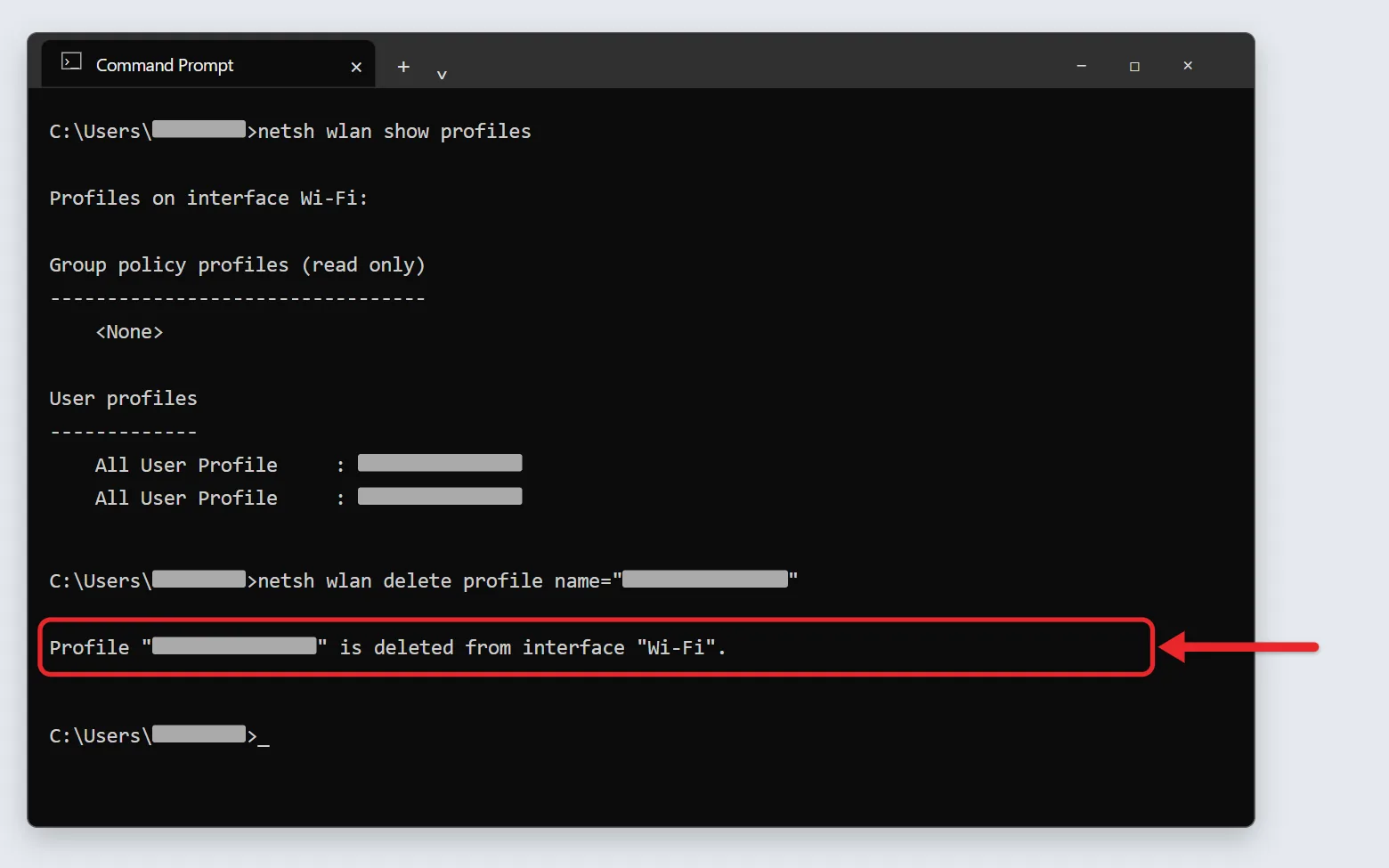
If the command is refused, close the window, right-click Start, select Terminal (Admin), and run it again.
Microsoft’s netsh wlan reference says the name can include wildcard characters. That is how you remove every saved network in one go.
Warning: the next command deletes all saved Wi-Fi networks and their passwords, including the one you are connected to. You will have to rejoin each network by hand.
Type netsh wlan delete profile name=* and press Enter. Windows lists each profile as it removes it. You may see this written with i=* at the end. That extra part is optional: when no interface is named, Windows removes the profile from all wireless adapters.
Which method should you use?
| Method | Works when the network is out of range | Best for |
|---|---|---|
| Settings | Yes | Most people; one network at a time |
| Quick settings | No | A network you can see right now |
| netsh command | Yes | Stubborn profiles or clearing every network |
Some older guides also suggest deleting network entries in Registry Editor. Microsoft’s own instructions use Settings and netsh for this job, and a mistake in the registry can cause other problems, so stick with the three methods above.
Check that it worked and reconnect
Open Settings > Network & internet > Wi-Fi > Manage known networks again. The network should no longer be in the list. In a terminal, netsh wlan show profiles should no longer show it either.
A forgotten network is not blocked. It still shows up in the list of available networks when you are in range, and Windows treats it as new. There is no undo button, so reversing the change means joining again:
- Select the network, sound, or battery icons on the taskbar.
- Select Manage Wi-Fi connections on the Wi-Fi button.
- Choose the network. Check Connect automatically if you want Windows to rejoin it on its own, then select Connect.
- Type the password and select Next.
Windows saves the network again once you connect. Open a website to confirm the connection works. If you have just changed a Spectrum WiFi password, each Windows PC has to forget the old network and rejoin with the new one; see how to change a Spectrum WiFi password first.
When forgetting a network helps
- The router’s password changed and Windows keeps failing with the old one.
- Your laptop joins a weak or unwanted network instead of the one you want. If you’d rather keep the network saved, changing the network connection priority in Windows 11 lets you move the network you want ahead of it in the order.
- You used a hotel, cafe, or other public network and do not want to join it again.
- You are lending the PC to someone and do not want it to join your other networks.
- You are troubleshooting. Forgetting and rejoining is an early troubleshooting step, after checking that Wi-Fi is on and airplane mode is off.
When the Network or Wi-Fi Option Is Missing
The network is not in Manage known networks
Windows only lists networks it has saved. If the name is missing, the network was never saved or was already forgotten, so there is nothing to remove. Check the spelling, since two nearby networks can have similar names, and clear any filter you set with Filter by.
There is no Wi-Fi option in Settings
If Wi-Fi is missing from Network & internet, Windows is not detecting a wireless adapter. A desktop PC may not have one. On a laptop, the adapter may be disabled or its driver may need attention. Here’s how to update your Wi-Fi driver in Windows 11.
Forget does nothing or the network stays in the list
Close Settings, open it again, and check the list. If the entry is still there, restart the PC and try once more, or remove it with the netsh wlan delete profile command above, which also confirms the name of the profile it deleted.
The network comes back after you forget it
On a work or school PC, your organization can push Wi-Fi networks to the device, and those can return after you delete them. Ask your IT department to remove it. On a home PC, run netsh wlan show profiles to look for a second saved profile with a similar name, and remember that joining the network again saves it again.
Wi-Fi still does not work after you forget and rejoin
Restart your modem and router, then try again. You can also run the network troubleshooter in the Get Help app on Windows 11; here’s how to get help in Windows 11. If that fails, Microsoft’s troubleshooting article moves on to driver steps and, last of all, network reset under Settings > Network & internet > Advanced network settings > Network reset. Network reset is a much bigger change than forgetting one network: it removes and reinstalls every network adapter, and you may need to reinstall VPN software afterward.

Here’s how to reset network settings in Windows 11.
Forget a Saved Wi-Fi Network in Windows 10
Open Settings > Network & Internet > Wi-Fi > Manage known networks, select the network and choose Forget. Make sure you know its password first; forgetting the network you’re on disconnects you. The network should disappear from the list. To reconnect, pick it from the taskbar Wi-Fi list, select Connect and enter the password again.
The netsh wlan commands above work the same way on Windows 10. Microsoft’s Wi-Fi troubleshooting guide covers forgetting and reconnecting on both Windows versions. This only removes the network from this PC; it doesn’t affect the router or other devices. Keep in mind that Windows 10 support ended on October 14, 2025, so a PC that still runs it no longer gets regular security updates.
After you forget a network, rejoin it with the current password and check that a website loads. If you cleared every saved network, reconnect to your home network first so your PC is back online.
Forgetting Wi-Fi Questions
What happens when you forget a Wi-Fi network in Windows 11?
Windows deletes the saved profile for that network, which includes its name, password, and connection settings. Your PC stops joining it automatically. Your files, apps, and other saved networks are not affected, and the router itself does not change.
Can I stop Windows from joining a network without forgetting it?
Yes, in most cases. Open Settings > Network & internet > Wi-Fi > Manage known networks, select the network, and turn off the option to connect automatically when in range. Windows keeps the password but waits for you to choose the network. The wording of this option can vary by Windows 11 version.
Does forgetting a network remove it from my other devices?
No. The steps here remove the saved network from the PC you are using. Phones, tablets, and other computers keep their own saved copies, so forget the network on each device separately.
Can I forget a network I have never connected to?
No. Only saved networks can be forgotten. Networks you have never joined still appear in the list of nearby networks, but Windows has nothing stored for them.
Is the Control Panel method still available?
Older Windows guides mention a Manage wireless networks page in Control Panel. Microsoft’s current Windows 11 instructions use the Settings app instead, so start there. Control Panel is still handy for viewing the password of the network you are connected to, as described near the top.

Matthew Burleigh is the founder, head writer, and editor of Solve Your Tech, which he launched in 2012. He has written technology tutorials since 2008 and worked in IT since 2003, including small-business support, IT management, and consulting. He holds Bachelor’s and Master’s degrees in Computer Science from Arizona State University.
Matthew writes practical guides for Windows, iPhone and iPad, Microsoft Office, Outlook, Google apps, and Android. Solve Your Tech’s guides are checked step by step against the device or app maker’s own documentation and tested on his own devices whenever he has the hardware or software, with clear steps, sources, and update dates.
Read more about Matthew and how Solve Your Tech writes and updates its guides, or report a correction.