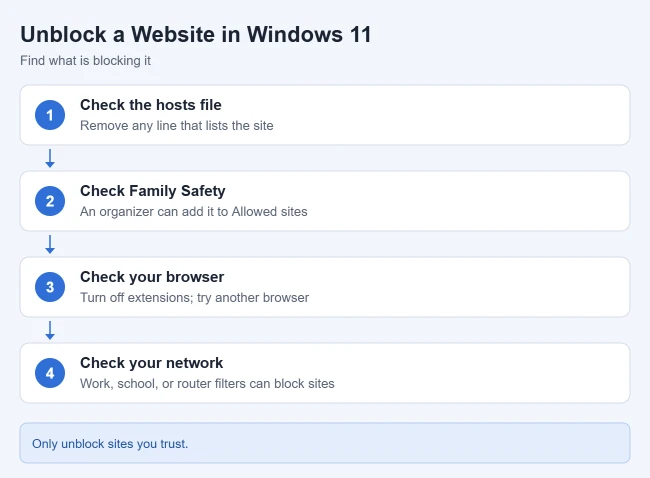
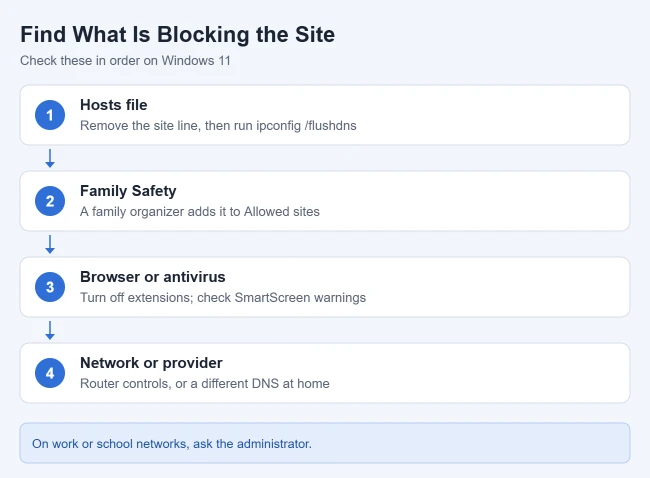
To unblock a website on Windows 11, first find out what’s blocking it. Common causes are an entry in the hosts file, Microsoft Family Safety content filters, a browser extension or setting, your antivirus, or a filter on your router, internet provider, or work network. Remove the block where it was set.
This guide shows how to tell which one you’re dealing with and how to remove each block on a PC you manage. It doesn’t cover getting around blocks on work, school, or other networks you don’t control; for those, ask the network’s administrator. If search results are being filtered rather than whole websites, see how to turn SafeSearch off.
Step 1: Figure Out Where the Block Is
- Try another browser. If the site opens there, the block is in the first browser (an extension, setting, or policy).
- Try another network. Turn on your phone’s hotspot or use mobile data. If the site works there, the block is on your router, internet provider, or workplace network.
- Read the message. Blocks often show up as ordinary errors like “This site can’t be reached,” while managed PCs may show ERR_BLOCKED_BY_ADMINISTRATOR. A red SmartScreen or antivirus warning means the site was flagged as unsafe.
- If it fails in every browser on this PC but works on other devices, check the hosts file and Family Safety next.
Step 2: Check the Hosts File
- Select Start, type Notepad, right-click it, and select Run as administrator.
- Select File > Open, go to
C:\Windows\System32\drivers\etc, change the file type to All files, and open hosts. - Look for any line that lists the site, such as
0.0.0.0 example.comor127.0.0.1 example.com, and delete it. - Save the file. If Notepad won’t let you save, you didn’t open it as administrator.
- Open Terminal, run
ipconfig /flushdns, and restart your browser. Expected result: the site loads.
For more detail, see how to edit the hosts file in Windows 11.
Step 3: Check Family Safety
If your account is part of a Microsoft family group, content filters may block sites. A family organizer can add it under Allowed sites in the Edge content filters at family.microsoft.com, as Microsoft explains. Filters only work in Edge, so Family Safety also blocks other browsers unless they’re allowed in app filters. If you’re the organizer and no longer need filters, see how to turn off Microsoft Family Safety.
Step 4: Check Your Browser
- Extensions: turn off extensions one at a time, especially ad blockers, site blockers, and parental-control add-ons, and reload the site each time. If you added the block yourself, our guide on how to block a website on Chrome lists where each kind of block is set.
- Site permissions: in Edge or Chrome, select the icon to the left of the address, open site settings, and check that nothing important, like JavaScript, is set to Block.
- Managed browser: if you see “Managed by your organization,” a policy may block the site. On a work PC, only IT can change that.
- Cached error: clear the browser’s cache or try a private window to rule out an old error page.
Step 5: Check Antivirus and SmartScreen
Microsoft Defender SmartScreen and third-party antivirus apps block sites they believe are dangerous. Read the warning carefully. Only allow a site you’re sure is safe, and never to get past a warning about a site asking for passwords or payment details. If you think a safe site was flagged by mistake, most antivirus apps let you report it or add an exception in their web protection settings.
Step 6: Check Your Router, Provider, or DNS
- Router parental controls: sign in to your router’s app or admin page and look for blocked sites, parental controls, or access schedules.
- Internet provider filters: some providers offer security or family filters on your account. Check your provider’s app or account settings.
- DNS-level blocking at home: Many home and provider filters work through DNS. On a network you control, you can switch to a public DNS service in Settings > Network & internet: select Wi-Fi or Ethernet, then Hardware properties, select Edit next to DNS server assignment, choose Manual, turn on IPv4, and enter a DNS server such as 1.1.1.1 (preferred) and 1.0.0.1 (alternate). For more on IP and DNS options, see how to change adapter settings in Windows 11.
Don’t change DNS settings on a work or school PC; the block there is intentional and managed by your organization.
Frequently Asked Questions
Should I use a VPN or proxy to get around a block?
Not on a work or school network, where it can break the rules you agreed to. Free web proxies can also log your browsing or show malicious ads. At home, fix the block at its source instead.
Why does the site say it’s unsafe?
SmartScreen or your antivirus flagged it. Don’t continue unless you trust the site. You can run a Microsoft Defender scan if you’re worried you already visited something harmful.
I changed the hosts file but the site is still blocked.
Run ipconfig /flushdns in Terminal and restart the browser. If it’s still blocked, check the other causes above.
Can Windows Firewall block a website?
Windows Firewall controls apps and network connections rather than individual website addresses, so it’s rarely the cause. Check the causes above first. A third-party firewall can still stop a whole browser from connecting, and our guide to allowing Google Chrome through the Norton 360 firewall shows where that setting lives.

Matthew Burleigh is the founder, head writer, and editor of Solve Your Tech, which he launched in 2012. He has written technology tutorials since 2008 and worked in IT since 2003, including small-business support, IT management, and consulting. He holds Bachelor’s and Master’s degrees in Computer Science from Arizona State University.
Matthew writes practical guides for Windows, iPhone and iPad, Microsoft Office, Outlook, Google apps, and Android. Solve Your Tech’s guides are tested on current devices or checked against official product documentation, with clear steps, sources, and update dates.
Read more about Matthew and how Solve Your Tech writes and updates its guides, or report a correction.