Windows 11 doesn’t have a Screen Time app like an iPhone. On a laptop, go to Settings > System > Power & battery > Battery usage to see how long the screen was on and which apps you used most. To see a child’s screen time on any Windows PC, desktop or laptop, use Microsoft Family Safety.
This covers Windows 11 Home and Pro as updated in October 2026, with a separate section for Windows 10. Pick the method that matches what you want to know:
| What you want | Best method | Works on |
|---|---|---|
| Your own screen-on time for the last day or week | Battery usage in Settings | Laptops and tablets with a battery |
| Which apps you used most | Battery usage, sorted by In use | Laptops and tablets with a battery |
| A longer history of active time | Battery report (powercfg) | Laptops and tablets with a battery |
| A child’s daily and weekly use, per app | Microsoft Family Safety | Any Windows 11 or 10 PC |
| How long the PC has been running | Task Manager Up time | Any PC |
How to Check Your Own Screen Time on a Laptop
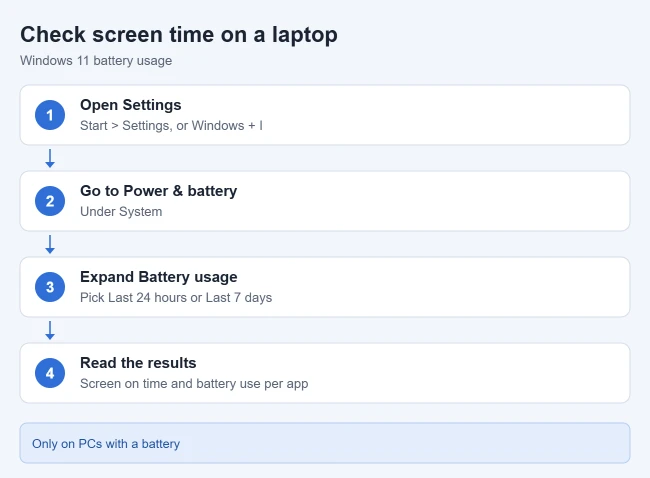
- Click Start > Settings, or press Windows + I. Settings opens.
- Click System, then Power & battery.
- Under Battery, click Battery usage to expand it. A chart of your battery level appears.
- Next to the chart, open the time menu and choose Last 24 hours or Last 7 days.
- Read the Screen on, Screen off, and Sleep totals below the chart. Screen on is your screen time for that period.
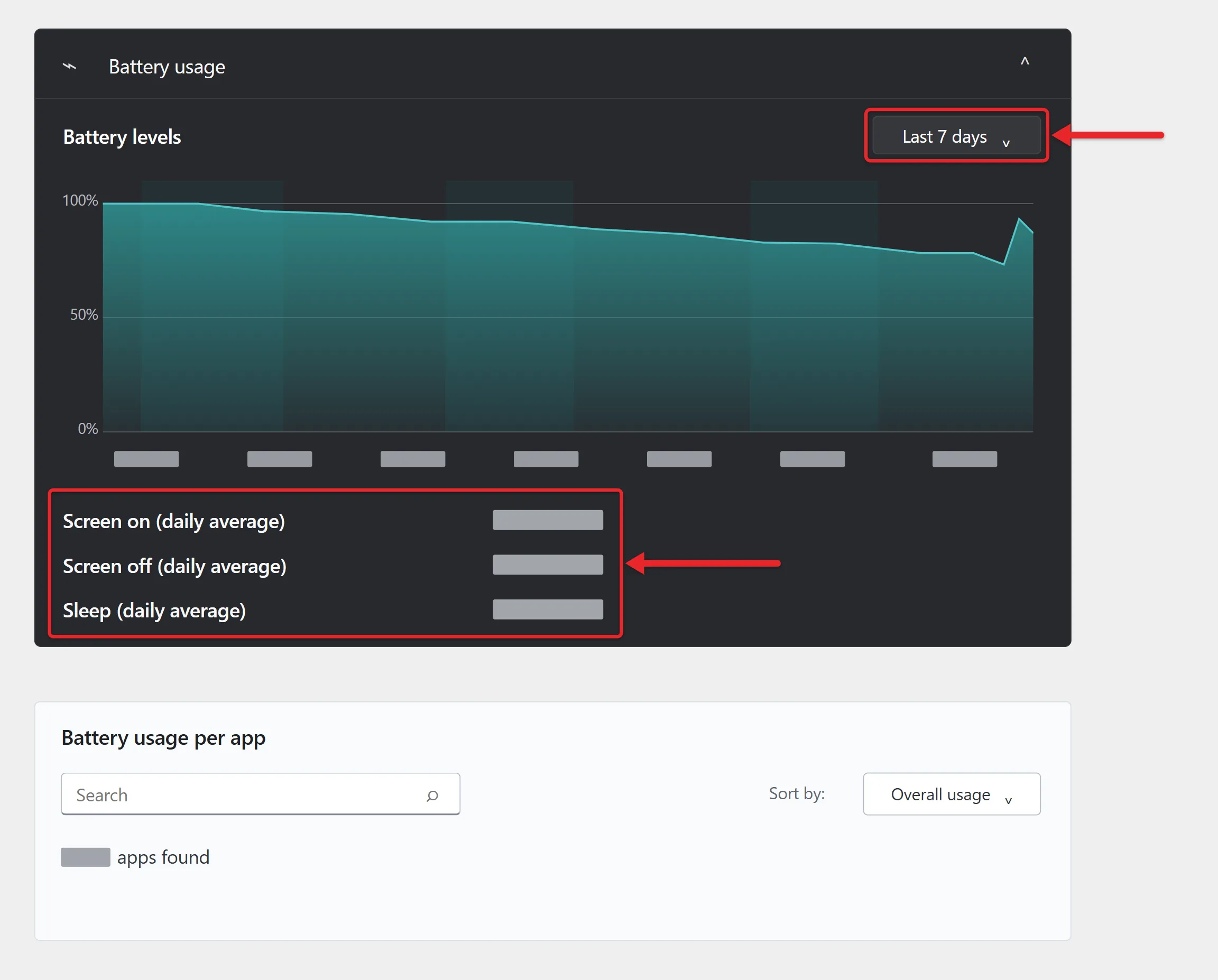
- Scroll to Battery usage per app. Open the Sort by menu and choose In use. Apps move into order by how long they were open in front of you, with the minutes next to each one.
You can hover over or tap a bar in the chart to see a single hour or day. The steps match Microsoft’s battery saving tips for Windows, which point to the same Battery usage per app list. Acer’s screen time guide for Windows 11 shows the same Screen on, Screen off, and Sleep totals.
What the Numbers Mean
- Screen on counts time the display was lit, not time you were looking at it. If you walk away, the count keeps going until your screen timeout turns the display off. A long timeout inflates the total. You can shorten the screen timeout in Windows 11.
- In use is time an app was on screen, and Background is time it ran without being in front of you. The Overall usage sort mixes both, so use In use for screen time.
- The page tracks battery use. Time spent plugged in can be missing or undercounted, so the numbers are most complete on days you work on battery.
- History stops at 7 days. Windows keeps no longer view on this page. For more, use the battery report below.
- Each PC is counted on its own. If you use two computers, check both.
Microsoft also uses this list to find apps that drain the battery when you aren’t using them. For an app that allows it, select More options (three dots) > Manage background activity and change Let this app run in the background.
How to See a Longer History With the Battery Report
The built-in battery report lists active time going back further than 7 days. It is a read-only file and does not change any settings.
- Right-click Start and select Terminal. A command window opens.
- Type powercfg /batteryreport and press Enter. Windows says where it saved battery-report.html, usually your user folder.
- Open that folder in File Explorer and double-click battery-report.html. It opens in your browser.
- Scroll to Recent usage to see each time the PC became active, went into standby, or was suspended over the last few days.
- Scroll to Usage history to see Active time per day or week, split between battery and plugged-in (AC) power.
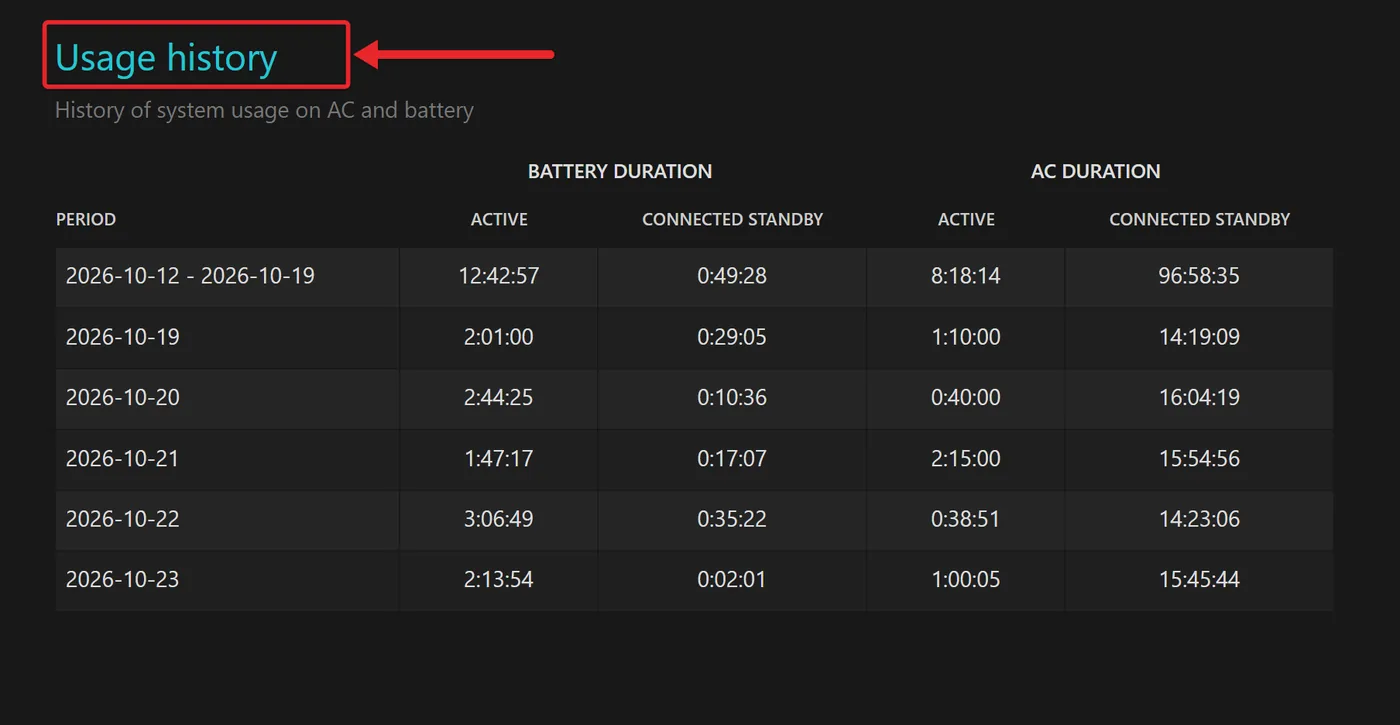
Active time is a good stand-in for screen-on time over weeks. To change how many days the report covers, add a number, such as powercfg /batteryreport /duration 14. Microsoft lists these options on its powercfg command-line options page. The same report also shows battery wear; here’s how to check battery health in Windows.
How to Check a Child’s Screen Time With Family Safety
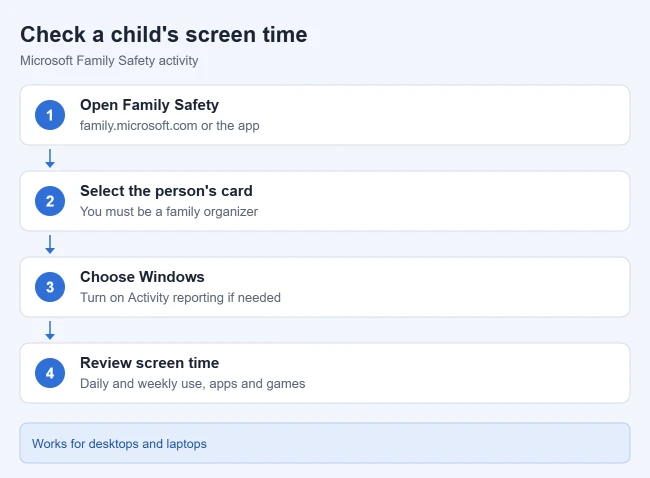
If you’re a family organizer in Microsoft Family Safety, you can see how long a family member used their Windows PC and which apps and games they used. Before you start:
- Your child needs their own Microsoft account in your family group, and they must sign in to Windows with it.
- Their Windows account should be a standard user, not an administrator. Family features may not work properly on an administrator account.
- The PC must be connected to your family. On the child’s PC, open Settings > Accounts > Family (called Family & other people on some versions), select your child under Your family, and select Allow if it appears. Microsoft’s connect devices in Family Safety page has the details.
Then check their screen time:
- Go to family.microsoft.com and sign in with your Microsoft account, or open the Microsoft Family Safety app on your phone.
- Select your family member’s card.
- Select Windows.
- Turn on Activity reporting if it isn’t on. Only organizers can turn activity reports on or off and view them.
- Review the screen time chart for daily and weekly totals, then open Apps, features and games to see time per app and game.
In the phone app, you can also tap Today, then Screen time > Devices. Microsoft’s activity reporting guide explains each report. Web activity, including Bing searches, only shows when your child uses a supported browser, Microsoft Edge, while signed in to their Microsoft account. Reports update when the PC is online, so a new device can take a while to show data.
How to Set Screen Time Limits
Family Safety can also limit how long a family member uses Windows. Microsoft’s screen time limits guide gives these steps:
- At family.microsoft.com or in the app, select the family member.
- Select Windows. If no limits show, select Turn limits on.
- Select a day, set the allowed time ranges and the total hours, and select Finished.
- To use the same schedule for other days, check those days or Every day.
To stop limits, select More options > Turn limits off. You can also limit single apps and games or block them, and here’s how to lock apps on a Windows 11 laptop. To remove Family Safety entirely, here’s how to turn off Microsoft Family Safety on Windows 11.
On an iPad, Screen Time handles content ratings as well as time limits; here’s how to change age restrictions on iPad.
Checking Screen Time on a Desktop PC
Desktops without a battery show a Power page instead of Power & battery, with no Battery usage and no battery report. Your built-in options there are:
- Family Safety: activity reporting works on desktops too, but it’s designed for checking a family member’s account rather than your own.
- Task Manager Up time: press Ctrl + Shift + Esc, open the Performance tab, and select CPU. Up time shows how long Windows has run since it last started, including time you weren’t using it. With Fast startup on, a normal shut down doesn’t reset it; a Restart does. To make a normal shut down reset it too, disable Fast startup in Windows 11.
- Task Manager App history: this tab shows CPU time and network use per app since a listed date. CPU time is processing work, not minutes on screen, so treat it only as a hint of which apps you use most.
Advanced: Log Lock and Unlock Times
On any PC you can have Windows record each time the screen is locked (event 4800) and unlocked (event 4801), then read the times in Event Viewer. It only records from the moment you turn it on.
- Right-click Start and select Terminal (Admin).
- Run auditpol /set /subcategory:”Other Logon/Logoff Events” /success:enable
- Later, open Event Viewer > Windows Logs > Security, select Filter Current Log, and enter 4800,4801.

The time between an unlock and the next lock is unlocked time, not proof someone was using the PC. The events are described under Audit Other Logon/Logoff Events. On a work or school PC, ask IT before changing audit settings.
Third-party time trackers can give a fuller dashboard. If you try one, download it only from the developer’s own site or the Microsoft Store.
What Windows 10 Can Report About Screen Time
Windows 10 laptops have a simpler per-app battery view. It doesn’t show a screen-on total, but it shows which apps you used most over a period:
- Open Settings and select System > Battery.
- Select See which apps are affecting your battery life. The Battery usage by app page opens.
- Choose 6 hours, 24 hours, or 1 week in the time period list.
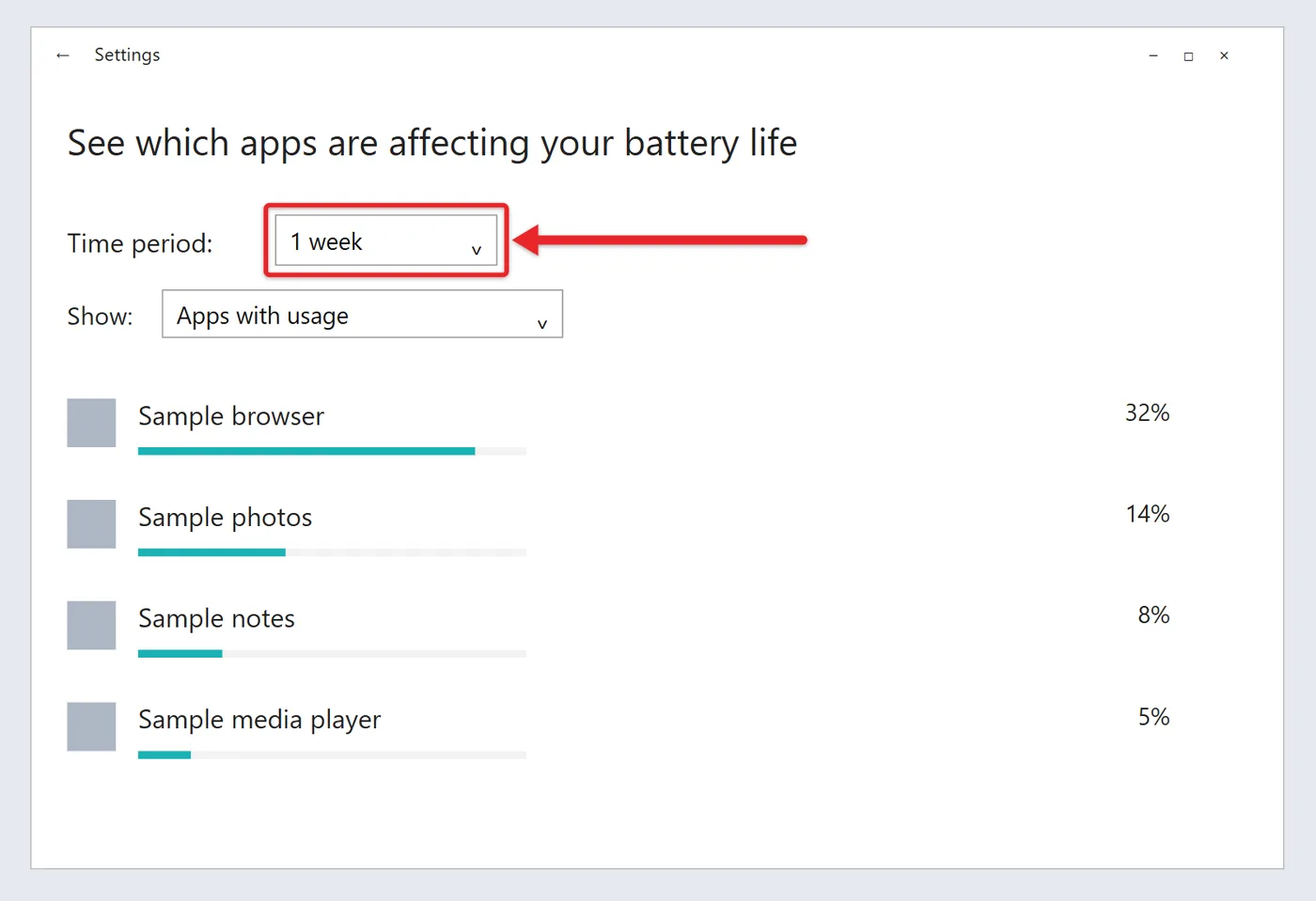
- Review the apps and the share of battery each one used.
The battery report, Task Manager, and Family Safety steps above work the same on Windows 10. Family Safety supports Windows 10 and 11. Windows 10 support ended in October 2025, so upgrade to Windows 11 if your PC supports it.
If the PC qualifies, you can upgrade to Windows 11 from Windows 10.
Troubleshooting
I don’t see Battery usage. Your PC has no battery, so Windows shows the Power page instead. Use Family Safety, Up time, or the lock log. Virtual machines also usually hide battery data.
Battery usage is empty or only shows a few hours. This is common after a reset or a new install. Use the laptop on battery for a day and check again.
An app I used is missing from the list. It may have had very little recorded use, or you used it while plugged in. Switch the period to Last 7 days.
Family Safety shows no activity. Check that Activity reporting is on for Windows, the child signed in with their own Microsoft account, the PC appears in their connected devices, and it has been online.
Limits don’t work. The child’s Windows account is probably an administrator. Change it to a standard user in Settings > Accounts.
I’m looking for Activity history or Timeline. Timeline, which showed past activity in Task View, was removed in Windows 11, so there is no built-in activity log to browse.
Frequently Asked Questions
Does Windows 11 have a Screen Time feature like iPhone?
No. The closest built-in tools are the Screen on total in Battery usage for your own laptop and Family Safety activity reporting for a child.
Can I set screen time limits for myself?
Family Safety limits are made for family members, not the organizer. For yourself, you can make the screen turn off sooner when idle by changing the power and sleep settings.
How accurate is the Screen on number?
It is accurate for how long the display was lit. It counts idle time before the screen timeout, so the real time you spent is usually lower.
How do I see which apps are installed?
Here’s how to find installed apps and programs in Windows 11. If battery use looks high, here’s how to extend battery life in Windows 11.
Want the same numbers for your phone? Here’s how to check Screen Time on iPhone.

Matthew Burleigh is the founder, head writer, and editor of Solve Your Tech, which he launched in 2012. He has written technology tutorials since 2008 and worked in IT since 2003, including small-business support, IT management, and consulting. He holds Bachelor’s and Master’s degrees in Computer Science from Arizona State University.
Matthew writes practical guides for Windows, iPhone and iPad, Microsoft Office, Outlook, Google apps, and Android. Solve Your Tech’s guides are checked step by step against the device or app maker’s own documentation and tested on his own devices whenever he has the hardware or software, with clear steps, sources, and update dates.
Read more about Matthew and how Solve Your Tech writes and updates its guides, or report a correction.